Highlights

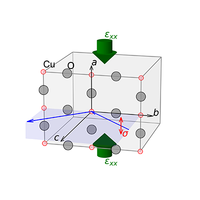
Resonant x-ray scattering study of charge density wave correlations in YBa2Cu3O6+x under uniaxial stress

S. Nakata, D. Betto, E. Schierle, S. Hameed, Y. Liu, H.-H. Kim, S. M. Souliou, T. Lacmann, K. Fürsich, T. Loew, E. Weschke, A. P. Mackenzie, C. W. Hicks, M. Le Tacon, B. Keimer, and M. Minola

Phys. Rev. B 111, 115152 (2025) - Published 24 March, 2025

The authors report a comprehensive study of the uniaxial stress response of charge density wave (CDW) correlations – leading competitors to high-temperature superconductivity – in YBa2Cu3O6+x by means of resonant x-ray scattering. The influence of uniaxial stress is found to be strongly doping dependent. Whereas the quasi-two-dimensional CDW is enhanced by uniaxial stress in a wide hole doping range, a stress-induced three-dimensionally long-range ordered CDW was observed only in a very limited doping regime. The findings call for a variety of further experiments on YBa2Cu3O6+x and other quantum materials under uniaxial stress.

Layer-dependent spin-resolved electronic structure of ferromagnetic triple-layered ruthenate Sr4Ru3O10

Prosper Ngabonziza, Jonathan D. Denlinger, Alexei V. Fedorov, Gang Cao, J. W. Allen, G. Gebreyesus, and Richard M. Martin

Phys. Rev. B 111, 115146 (2025) - Published 21 March, 2025

Electronic structure origins of anomalous magnetic character in the ferromagnetic trilayer Sr4Ru3O10 are investigated using angle- and spin-resolved photoemission. The authors highlight two momentum-separated narrow spectral peaks 30 meV below the Fermi-level with opposite-spin polarization as well as dramatic temperature-dependent coherence-incoherence crossover behavior. In addition, comparison to spin-polarized band theory reveals that they possess different antibonding versus nonbonding dxz/yz orbital character, and thus different spatial localization in the central versus outer layers, with implications for its in-plane metamagnetic behavior.

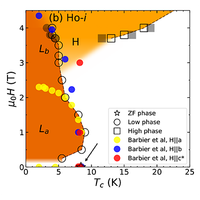
Hidden magnetic phases in i-MAX compounds

Dror Yahav, Ariel Maniv, Daniel Potashnikov, Asaf Pesach, El'ad N. Caspi, Arneil P. Reyes, Quanzheng Tao, Johanna Rosén, and Eran Maniv

Phys. Rev. B 111, 094427 (2025) - Published 20 March, 2025

The authors uncover a hidden high-field, high-temperature magnetic phase in i-MAX compounds, revealing new complexities in their magnetic behavior. By exploring the influence of rare-earth elements and external fields, they demonstrate an unexpected evolution of magnetic phases. The findings highlight the intricate interplay between composition, temperature, and field strength, providing fresh insights into the fundamental properties of these materials and their potential implications for future studies of magnetism in layered systems.

Electronic doping induced increase in coercive field of sliding ferroelectric 1T′-ReS2 multilayers

Mingyan Liu, Yi Wan, Pei Wang, Xiaodong Zhang, Yunwei Yang, Yibin Zhao, Hualing Zeng, Fang Wu, Chengxi Huang, Ting Hu, and Erjun Kan

Phys. Rev. B 111, 104110 (2025) - Published 20 March, 2025

The authors reveal here that sliding ferroelectrics display a distinct doping-dependent coercive field behavior, diverging from conventional displacement-type ferroelectrics. Employing 1T′-ReS2 multilayers, they demonstrate that sulfur vacancy density – controlled through annealing atmosphere – directly regulates charge doping, amplifying the coercive field by as much as 870 kV/cm with increased vacancy concentration. Combined experimental and theoretical analyses reveal that increased vacancy densities elevate the energy barrier for polarization switching. This study highlights the unique mechanistic framework of sliding ferroelectrics and proposes innovative strategies for their integration into next-generation electronic technologies.

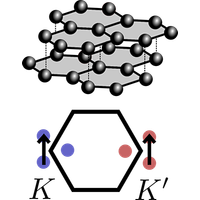
Switching between superconductivity and current density waves in Bernal bilayer graphene

Jun Ho Son, Yi-Ting Hsu, and Eun-Ah Kim

Phys. Rev. B 111, 115144 (2025) - Published 20 March, 2025

Recent experiments on Bernal-stacked bilayer graphene discovered superconductivity near the van Hove filling only when an in-plane magnetic field or proximate spin-orbit coupling lifts spin degeneracy. Inspired by the experiments, the authors theoretically study here competing ordering instabilities near the van Hove filling of the bilayer graphene with renormalization group methods. The study shows that breaking spin degeneracy would “switch” the balance between incommensurate current density wave that breaks translation, time-reversal, and C3 symmetry, and superconductivity to favor superconductivity.

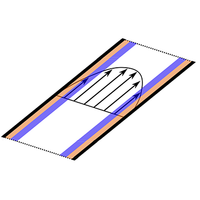
Hall field and odd viscosity in near-hydrodynamic electron flows

Nitay Ben-Shachar, Joseph T. Johnson, Mayhar Madadi, Douglas R. Brumley, Jason Nassios, and John E. Sader

Phys. Rev. B 111, L121107 (2025) - Published 20 March, 2025

The Hall or odd viscosity governs hydrodynamic electron flows in the presence of an applied magnetic field. Here, the authors report a rigorous asymptotic theory of near-hydrodynamic electron flows and demonstrate a rarefaction effect that competes with the Hall viscosity. This resolves the discrepancy of prior hydrodynamic theories in predicting the Hall resistivity in channel flow, providing insight into the flow physics and an alternative to numerical solutions of the Boltzmann equation.

Dynamic mass generation on two-dimensional electronic hyperbolic lattices

Noble Gluscevich, Abhisek Samanta, Sourav Manna, and Bitan Roy

Phys. Rev. B 111, L121108 (2025) - Published 20 March, 2025

The authors show here that two-dimensional hyperbolic lattices can be classified as Dirac liquids, Fermi liquids, and flat bands, respectively, featuring vanishing, constant, and diverging density of states near half-filling. On such curved quantum crystals, on-site Hubbard and nearest-neighbor Coulomb repulsion stabilize antiferromagnetic and charge density wave ground states, respectively. The requisite critical couplings for these orderings decrease with the increasing curvature in hyperbolic Dirac fluids, suggesting a curvature-induced weak-coupling quantum phase transitions therein. By contrast, these two orderings develop even for infinitesimal interactions in Fermi liquids and flat-band systems.

Chiral terahertz photocurrent in quantum point contact–split ring resonator coupled systems in the quantum Hall regime

Jing Huang, Jinkwan Kwoen, Yasuhiko Arakawa, Kazuhiko Hirakawa, and Kazuyuki Kuroyama

Phys. Rev. B 111, L121407 (2025) - Published 20 March, 2025

Light-matter interaction between cyclotron resonance and photons in a plasmonic resonator enables the formation of polaritons in the ultrastrong coupling regime. While optical studies are common, the authors demonstrate here electrical detection of ultrastrong coupling via terahertz-induced photocurrent through a quantum point contact and reveal the chiral behavior of the photocurrent with respect to magnetic field. Their theoretical model based on nonequilibrium electron distribution in edge channels agrees well with the experimental data, which offers new insights into light-matter interactions.

Observation of ultraflat bands in gapped moiré metamaterials

Xingjian Zhang, Tingzhi Liu, Qicheng Zhang, Xiying Fan, Fengcheng Wu, and Chunyin Qiu

Phys. Rev. B 111, 125143 (2025) - Published 19 March, 2025

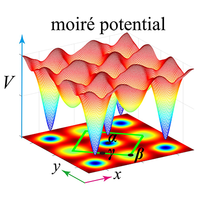
The authors propose here a universal mechanism for ultraflat bands in moiré structures and experimentally validate it in acoustic metamaterials. Unlike magic-angle twisted bilayer graphene, these bands form over a broad range of twist angles, advancing moiré physics across diverse systems.

Quantum communication and mixed-state order in decohered symmetry-protected topological states

Zhehao Zhang, Utkarsh Agrawal, and Sagar Vijay

Phys. Rev. B 111, 115141 (2025) - Published 18 March, 2025

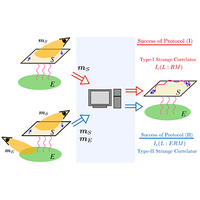
Long-range quantum entanglement can be distilled from certain symmetry-protected topological (STP) states of matter. Here, the authors investigate whether SPT states, subject to decoherence, can still be used for the transmission of coherent quantum information, and link this capability to quantum order in the resulting mixed quantum many-body states. This connection reveals new sources of decoherence which permit the use of SPT states as a resource for information transmission, offering new perspectives on entanglement distillation and on the resilience of mixed-state symmetry-protected order.

Mode-coupling formulation of heat transport in anharmonic materials

Aloïs Castellano, J. P. Alvarinhas Batista, Olle Hellman, and Matthieu J. Verstraete

Phys. Rev. B 111, 094306 (2025) - Published 17 March, 2025

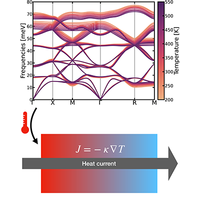
The authors apply here the recently introduced mode-coupling framework for anharmonic lattice dynamics to derive a general theory of phonon heat transport, which does not depend on the harmonic approximation or perturbation theory. They account for diagonal and off-diagonal contributions to the heat current, with and without collective effects, and describe an efficient implementation of the theory, including Monte Carlo integration of the scattering, which reduces the computational cost by an order of magnitude.

Muon spectroscopy investigation of anomalous dynamic magnetism in NiI2

T. L. Breeze, B. M. Huddart, A. Hernández-Melián, N. P. Bentley, D. A. Mayoh, G. D. A. Wood, G. Balakrishnan, J. Wilkinson, F. L. Pratt, T. J. Hicken, S. J. Clark, and T. Lancaster

Phys. Rev. B 111, 104420 (2025) - Published 17 March, 2025

NiI2 is a magnetic van der Waals material, noted for its multiferroic behaviour, which has recently been proposed to host a novel form of skyrmion phase in the 2D limit. The authors present here the results of muon spectroscopy (μ+SR) measurements with supporting density functional theory calculations that probe changes in dynamics around two magnetic phase transitions. The measurements reveal an unusual region of temperature-independent fluctuations in the intermediate phase, the onset of which is driven by a change in the material’s structural symmetry.

Competing ordinary and Hanle magnetoresistance in Pt and Ti thin films

Sebastian Sailler, Giacomo Sala, Denise Reustlen, Richard Schlitz, Min-Gu Kang, Pietro Gambardella, Sebastian T. B. Goennenwein, and Michaela Lammel

Phys. Rev. B 111, 104421 (2025) - Published 17 March, 2025

The Hanle magnetoresistance (MR) can be utilized to probe the spin and orbital Hall activity of materials, such as Pt and Ti. However, isolating the Hanle MR from the ordinary MR is challenging as they coexist. The authors find here that high-resistance, low-crystallinity samples show a MR dominated by the Hanle MR, while more crystalline, low-resistance samples exhibit the ordinary MR. The Hanle MR’s strong dependence on crystallinity exceeds established scaling relations and is universal for both spin and orbital effects.

Magnetoelectric imprint of skyrmions in van der Waals bilayers

Zhong Shen, Xiaoyan Yao, and Shuai Dong

Phys. Rev. B 111, 104422 (2025) - Published 17 March, 2025

To effectively track and manipulate topological solitons, e.g.., skyrmions, is a key challenge before their application. Here, the authors propose a general strategy to print magnetic skyrmions to electric skyrmions in van der Waals bilayers. Through proximate interactions, there is an isoperiodic bijection between local dipoles and spin moments. This magnetoelectric imprint effect not only extends the strategies to create electric skyrmions, but also provides an approach for all-electrical readout/manipulation of magnetic skyrmions.

Magnetic and quadrupole coupling emerging in NdB4 with geometrically frustrated orthogonal antiferromagnetic dimer

Naoto Metoki, Hiroki Yamauchi, Masato Hagihala, Ryuta Watanuki, Seiko Kawamura, Maiko Kofu, Kenji Nakajima, and Masaaki Matsuda

Phys. Rev. B 111, 104424 (2025) - Published 17 March, 2025

NdB4, under geometrical frustration with the Shastry-Sutherland lattice, shows unusual magnetic successive order with an induced magnetic c moment (mc). This induced mc is very small but increases very steeply with decreasing temperature. The f-electron states are clarified here from neutron scattering spectra, reproduced using a model Hamiltonian. The magnetic-quadrupole coupling is revealed to play an essential role. Usually, negligible interactions have a casting vote for the unusual ordered states under geometrical frustration, where strong Heisenberg interactions are canceled out.

Green's function approach to Josephson dot dynamics and application to quantum Mpemba effects

Kateryna Zatsarynna, Andrea Nava, Reinhold Egger, and Alex Zazunov

Phys. Rev. B 111, 104506 (2025) - Published 17 March, 2025

The authors present here a novel Green’s function approach to general quantum transport problems. This formalism is considerably simpler than a full-fledged Keldysh approach. The authors apply their approach to a study of the nonequilibrium dynamics of quantum dot Josephson junctions, exposed to an electromagnetic environment. Following a sudden quench of the average phase difference across the junction, two different types of quantum Mpemba effects are predicted to arise in these experimentally accessible open quantum systems over wide parameter regimes.

Ghost Josephson plasmon in bilayer superconductors

Niccolò Sellati and Lara Benfatto

Phys. Rev. B 111, 104509 (2025) - Published 17 March, 2025

This work provides a physical explanation for the existence of a “ghost” plasmon in bilayer superconductors. The authors show that one of the two Josephson plasmons is connected to counterflowing current fluctuations polarized perpendicularly to the planes. This effect makes it a transverse mode at small out-of-plane momenta, explaining why it is hidden in the density response. This work offers a new perspective on the understanding of collective excitations in systems with multiple intertwined degrees of freedom.

Quantum geometry probed by chiral excitonic optical response of Chern insulators

Wen-Xuan Qiu and Fengcheng Wu

Phys. Rev. B 111, L121104 (2025) - Published 17 March, 2025

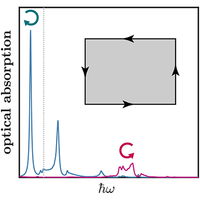
Quantum geometry describes phase and amplitude distances between quantum states, akin to Euclidean geometry in the classical world. The authors propose here probing the quantum geometry of Chern insulators via the excitonic optical response, using twisted bilayer MoTe2 as an example. In the terahertz frequency range, a single chiral exciton dominates the optical sum rule, enabling measurement of quantum geometry. This measurement could provide an assessment on the ideality of the quantum geometry, a key factor for realizing fractional Chern insulators.

Decoherence of electron spin qubit during transfer between two semiconductor quantum dots at low magnetic fields

Jan A. Krzywda and Łukasz Cywiński

Phys. Rev. B 111, 115305 (2025) - Published 14 March, 2025

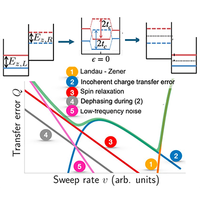
Building a scalable semiconductor-based quantum computer would greatly benefit from coherent spin transfer. The authors analyze here the decoherence of an electron spin qubit adiabatically transferred between two tunnel-coupled quantum dots in the presence of typical disorder and charge noise. They identify key error mechanisms: spin relaxation due to spin-orbit mixing and dephasing activated by differences in Zeeman splitting. These results suggest a minimum tunnel coupling required for coherent transfer across longer quantum dot arrays in Si and GaAs.

Kinetic control of high pressure phase transitions in anatase TiO2

XiaoHui Chen, Yi Zhang, Lei Liu, Shijia Ye, Shourui Li, Qiumin Jing, Junjie Gao, Jun Li, Qiang Wu, Hao Wang, and Chuanlong Lin

Phys. Rev. B 111, 104108 (2025) - Published 13 March, 2025

This work elucidates the kinetic control of high-pressure phase transitions in anatase TiO2 using a dynamic diamond anvil cell and time-resolved Raman spectroscopy. The authors demonstrate that phase boundaries shift linearly with the logarithm of compression rate, resolving discrepancies in previous studies. By revealing compression rate as a critical dimension in phase diagrams for sluggish reconstructive transitions, this work advances understanding of non-equilibrium high-pressure synthesis and metastable phase engineering, offering practical insights for material design.

Sign In to Your Journals Account

Filter

Section

Filter

Article Lookup

Enter a citation