Highlights

Atypical vortex lattice and the magnetic penetration depth in superconducting Sr2RuO4 deduced by μSR

M. Yakovlev, Z. Kartsonas, and J. E. Sonier

Phys. Rev. B 111, 094509 (2025) - Published 11 March, 2025

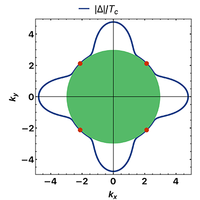
For three decades, the superconducting order parameter symmetry in Sr2RuO4 has remained elusive. In most superconductors this symmetry manifests in the structure of the magnetic vortex lattice induced by applying a magnetic field. The minimum field of the vortex lattice is typically located at the center of a triangular or square arrangement of vortices. The authors report here on an unusual situation for Sr2RuO4, where the minimum field appears to be between midway between nearest-neighbor vortices in a square lattice. This finding introduces another constraint on possible superconducting order parameters.

Average-exact mixed anomalies and compatible phases

Yichen Xu and Chao-Ming Jian

Phys. Rev. B 111, 125128 (2025) - Published 11 March, 2025

Quantum anomalies strongly constrain possible low-energy physics of condensed matter systems. In particular, it prohibits the existence of a trivially gapped phase. Here, the authors extend the notion of quantum anomalies to disordered systems, where symmetries can be preserved on average by disorder. Through physical arguments and solvable lattice models, the authors discover a series of phases intrinsic to disordered systems that are compatible with quantum anomalies involving average symmetries. These results serve as compelling evidence of the nontriviality of quantum anomalies, even with loosened requirements on symmetry and quantum coherence.

Nodal points, lines, and surfaces, and topological surface states in superconductor NiBi3

Jie Zhang, Kai-Yue Jiang, Shu-Xiang Qiao, Peng-Cheng Xiao, Na Jiao, Ping Zhang, Hong-Yan Lu, and Qi-Feng Liang

Phys. Rev. B 111, 094508 (2025) - Published 10 March, 2025

Despite the numerous reports on the time-honored superconductor NiBi3, theoretical investigations remain limited. By using first-principles calculations, the authors select here multiple pairs of bands to show its topological structure, including nodal points, lines, and surfaces and topological surface states. The authors also demonstrate that the superconductivity of NiBi3 originates from the p orbitals of Bi and d orbitals of Ni coupling with the Bi vibration. Thus, NiBi3 holds significant potential for realization of topological superconductivity and other exotic phenomena.

Corner charge fluctuations and many-body quantum geometry

Xiao-Chuan Wu, Kang-Le Cai, Meng Cheng, and Prashant Kumar

Phys. Rev. B 111, 115124 (2025) - Published 10 March, 2025

Charge fluctuations in a subregion provide key insights into entanglement and topological properties. We show how many-body quantum geometry manifests in the shape dependence of these fluctuations in 2D insulators, carefully disentangling the universal and nonuniversal aspects. Furthermore, we discuss bounds on many-body quantum geometry and the conditions under which they are saturated, highlighting the roles of spacetime symmetries and wavefunction holomorphicity.

Variational mapping of Chern bands to Landau levels: Application to fractional Chern insulators in twisted MoTe2

Bohao Li and Fengcheng Wu

Phys. Rev. B 111, 125122 (2025) - Published 10 March, 2025

Recent experimental breakthroughs have identified fractional Chern insulators (FCIs) in twisted bilayer MoTe2 (tMoTe2) at zero external magnetic field. The authors propose here a variational approach to map Bloch Chern bands in tMoTe2 to generalized Landau levels. This mapping sheds light on the formation mechanism and microscopic properties of FCIs in tMoTe2, offering a pathway to apply insights from fractional quantum Hall states to study FCIs in moiré materials.

Accurate and efficient localized basis sets for two-dimensional materials

Daniel Bennett, Michele Pizzochero, Javier Junquera, and Efthimios Kaxiras

Phys. Rev. B 111, 125123 (2025) - Published 10 March, 2025

First-principles codes that use a local basis are naturally suited to simulating two-dimensional (2D) materials, offering better scaling with system size and the ability to include large vacuum regions at no additional cost. Unlike plane-wave bases which can be systematically improved, local basis sets require manual optimization. The authors develop here optimized basis sets for graphene and hexagonal boron nitride, achieving excellent agreement with plane-wave calculations at a significantly reduced computational cost. These optimized basis sets will facilitate accurate and efficient large-scale simulations of 2D materials in future research.

Fractionalization signatures in the dynamics of quantum spin liquids

Kang Wang, Shi Feng, Penghao Zhu, Runze Chi, Hai-Jun Liao, Nandini Trivedi, and Tao Xiang

Phys. Rev. B 111, L100402 (2025) - Published 10 March, 2025

The authors investigate dynamical signatures of fractionalization in the Kitaev honeycomb model under an out-of-plane magnetic field using advanced tensor network methods. By analyzing spin-spin and dimer-dimer correlations through the infinite Projected Entangled Pair States (iPEPS) simulations, they demonstrate distinct spectral features separating Majorana fermions from Z₂ flux excitations in the chiral spin liquid phase. Crucially, they identify the controversial intermediate phase as a gapless Majorana metal driven by strong flux fluctuations, characterized by logarithmic divergence in the low-energy density of states. This resolves a longstanding debate about the regime in question.

Quantum spin liquid ground state in the rare-earth triangular antiferromagnet SmTa7O19

Dhanpal Bairwa, Abhisek Bandyopadhyay, Devashibhai Adroja, G. B. G. Stenning, Hubertus Luetkens, Thomas James Hicken, Jonas A. Krieger, G. Cibin, M. Rotter, S. Rayaprol, P. D. Babu, and Suja Elizabeth

Phys. Rev. B 111, 104413 (2025) - Published 7 March, 2025

A quantum spin liquid (QSL) is a novel state of matter that hosts long-range quantum entanglement, absence of magnetic ordering, and exotic fractionalized quasiparticle excitations. The geometrically frustrated magnets promote strong quantum fluctuations at low-T, which offer an excellent route to stabilize the QSL phase. Here, the authors demonstrate a gapless QSL ground state of the triangular lattice antiferromagnet Sm-heptatantalate SmTa7O19 through combined dc and ac magnetization, specific heat, universal scaling analysis, and muon spin relaxation/rotation (μSR) study down to 30 mK. The zero-field μSR discards magnetic ordering transition, while the longitudinal field muon-decoupling measurements show the emphasis of the dynamic nature of the magnetic ground state.

Unconventional superconductivity mediated by nematic fluctuations in a multiorbital system: Application to doped FeSe

Kazi Ranjibul Islam and Andrey Chubukov

Phys. Rev. B 111, 094503 (2025) - Published 6 March, 2025

In unconventional superconductors, pairing is believed to be of electronic origin, and linked to critical collective fluctuations. Here, the authors investigate how nematic fluctuations, responsible for orbital polarization, mediate pairing in doped FeSe. They show that nematic-mediated pairing is highly unconventional and leads to a highly anisotropic gap structure. This in turn gives rise to pronounced non-BCS behavior of observables. The authors compute thermodynamic, spectroscopic, and transport characteristics, find good agreement with the experimental data, and propose further experiments to test their predictions.

Phase-dependent supercurrent and microwave dissipation of HgTe quantum well Josephson junctions

Wei Liu, Stanislau U. Piatrusha, Lena Fürst, Lukas Lunczer, Tatiana Borzenko, Martin P. Stehno, and Laurens W. Molenkamp

Phys. Rev. B 111, 104503 (2025) - Published 6 March, 2025

Future applications of semiconductor-superconductor heterostructures in quantum information science rely on careful engineering of proximity-induced quantum states. The authors apply here microwave admittance measurements to extract the current-phase relation and phase-dependent microwave dissipation in gated HgTe quantum well Josephson junctions. The experimental results are in good agreement with modeling of the Andreev bound state spectrum based on tight-binding simulations of the Bogoliubov–de Gennes equations. This allows to disentangle the effects of interface transparency, disorder, and magnitude of the superconducting energy gap.

Entanglement scaling and charge fluctuations in a Fermi liquid of composite fermions

Cristian Voinea, Songyang Pu, Ajit C. Balram, and Zlatko Papić

Phys. Rev. B 111, 115119 (2025) - Published 6 March, 2025

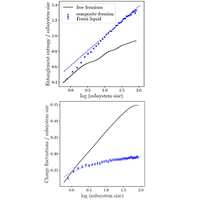
The composite fermion Fermi liquid (CFL) state at half-filling of a Landau level is a paradigmatic example of a non-Fermi liquid. Here, the authors study the entanglement entropy of many CFL states and find an enhanced scaling of it with subsystem size compared to the noninteracting Fermi liquid. They also show that the charge fluctuations in a CFL are strongly suppressed and obey an area-law scaling with a universal corner contribution. These results serve as fingerprints of the non-Fermi-liquid correlations encoded in the CFL states.

Physical properties of the ferromagnetic quantum critical system YbNi4(P1−xAsx)2

Kristin Kliemt, Jacintha Banda, Pavlo Khanenko, Ali Scherzad, Ulrike Stockert, Anna Efimenko, Kurt Kummer, Cornelius Krellner, and Manuel Brando

Phys. Rev. B 111, 125114 (2025) - Published 6 March, 2025

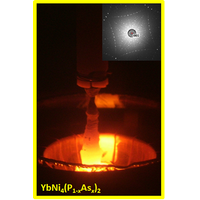
The heavy-fermion system YbNi4P2 is arguably the ferromagnetic (FM) metal with the lowest Curie temperature (Tc=0.17 K). It has been shown that replacing P with As tunes this system to a ferromagnetic quantum critical point (QCP) at x=0.1 As content. The authors here use the Czochralski method to grow high-quality single crystals of the series YbNi4(P1−xAsx)2 and studied their low-temperature properties. In particular, T-dependent measurements of the specific heat C(T) show that C(T)/T increases strongly towards lower T with similar power law for x= 0.1, 0.13, and 0.2. This suggests that in YbNi4(P1−xAsx)2 a FM quantum critical line rather than a FM QCP might exist.

Large magnetoresistance in a quantum dot between two reservoirs with spin accumulation

R. Jansen and S. Yuasa

Phys. Rev. B 111, 104407 (2025) - Published 5 March, 2025

Devices with ferromagnetic contacts exhibit magnetoresistance that is limited by the finite-contact spin polarization. Here, a quantum dot connected to source and drain reservoirs with spin accumulation is shown to exhibit a million-fold magnetoresistance. For parallel spin accumulations, the current vanishes due to Pauli spin blockade. Charge flows freely for antiparallel spin accumulations. The device, a spin qubit transistor, can operate as a spin transistor but also as a spin qubit by reconfiguring the source-drain bias and gate voltage.

Two types of colossal magnetoresistance with distinct mechanisms in Eu5In2As6

Sudhaman Balguri, Mira B. Mahendru, Enrique O. González Delgado, Kyle Fruhling, Xiaohan Yao, David E. Graf, Jose A. Rodriguez-Rivera, Adam A. Aczel, Thomas J. Hicken, Hubertus Luetkens, Michael J. Graf, Andreas Rydh, Jonathan Gaudet, and Fazel Tafti

Phys. Rev. B 111, 115114 (2025) - Published 5 March, 2025

This work investigates colossal magnetoresistance (CMR) in the Zintl semiconductor Eu5In2As6. The authors identify two distinct types of CMR occurring at different temperature regimes. The high-temperature CMR is attributed to the formation and percolation of magnetic polarons, while the low-temperature CMR is proposed to arise from charge ordering or other forms of electron localization. These results demonstrate the importance of interactions between the charge, spin, and lattice degrees of freedom in driving CMR in europium-based Zintl materials.

Statistical analysis of spurious dot formation in silicon metal-oxide-semiconductor single electron transistors

Kuan-Chu Chen, Clement Godfrin, George Simion, Imri Fattal, Julien Jussot, Stefan Kubicek, Sofie Beyne, Bart Raes, Arne Loenders, Kuo-Hsing Kao, Danny Wan, and Kristiaan De Greve

Phys. Rev. B 111, 125301 (2025) - Published 5 March, 2025

The presence of spurious quantum dots in silicon-based spin qubit devices is a challenge for quantum system scalability. The authors use here electrostatic triangulation to statistically analyse their spatial distribution in silicon metal-oxide-semiconductor (SiMOS) single-electron transistors (SETs), fabricated on an industrial 300-mm process. By combining experimental mapping with simulations, they reveal that spurious dots primarily arise from strain and gate bias effects. This insight informs device design strategies to mitigate spurious dots while preserving tunability, advancing scalable silicon-based quantum technologies.

Layer Nernst and thermal Hall effects in two-dimensional antiferromagnets

Xiangju Wang, Ling Bai, Wanxiang Feng, and Yugui Yao

Phys. Rev. B 111, 104405 (2025) - Published 4 March, 2025

In two-dimensional layered antiferromagnets, an out-of-plane electric field (ℰ) breaks the band spin degeneracy, inducing opposite spin polarizations in different layers due to spin-layer coupling. When an in-plane longitudinal temperature gradient (∇T) is applied, charge and heat currents in the top (Jt and JtQ) and bottom (Jb and JbQ) layers flow transversely in opposite directions with different magnitudes. This gives rise to net transverse charge and heat currents, referred to as the layer Nernst and layer thermal Hall effects, respectively.

Stripe magnetic order in semimetallic triangular-lattice CeLi3Bi2

M. M. Bordelon, R. Yamamoto, M. O. Ajeesh, C. Girod, J. Wampler, P. Sherpa, A. P. Dioguardi, J. D. Thompson, S. Calder, V. Zapf, F. Ronning, S. M. Thomas, E. D. Bauer, M. Hirata, and P. F. S. Rosa

Phys. Rev. B 111, 094401 (2025) - Published 3 March, 2025

Insulating triangular lattice materials have attracted much attention due to their potential quantum spin liquid ground state. Though metallic counterparts are predicted to host a breadth of exotic quantum states, experimentally recognizing pristine platforms that could be chemically and electronically tuned to generate unconventional states remains an outstanding challenge. This work presents a comprehensive experimental and theoretical investigation of triangular lattice CeLi3Bi2. The finding of stripe antiferromagnetic order in a semimetal places this compound as a promising platform for tuning the interplay between short-range geometric frustration and long-range magnetic interactions.

Nonmonotonic temperature dependence of electron viscosity and crossover to high-temperature universal viscous fluid in monolayer and bilayer graphene

Indra Yudhistira, Ramal Afrose, and Shaffique Adam

Phys. Rev. B 111, 085433 (2025) - Published 28 February, 2025

This paper studies the temperature dependence of viscosity and entropy density in the strong interaction regime for the electron fluid in monolayer and bilayer graphene. It demonstrates the nontrivial temperature dependence of the viscosity in the hydrodynamic regime, and calculates, via a combination of microscopic calculation of electron lifetime and the macroscopic Navier-Stokes equation, a high-temperature limit for the viscosity and entropy density. It represents a significant advancement in our understanding of the hydrodynamic electronic transport in monolayer and bilayer graphene.

Field-orientation-dependent magnetic phases in GdRu2Si2 probed with muon-spin spectroscopy

B. M. Huddart, A. Hernández-Melián, G. D. A. Wood, D. A. Mayoh, M. Gomilšek, Z. Guguchia, C. Wang, T. J. Hicken, S. J. Blundell, G. Balakrishnan, and T. Lancaster

Phys. Rev. B 111, 054440 (2025) - Published 27 February, 2025

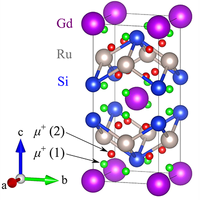
Centrosymmetric GdRu2Si2 exhibits a variety of multi-Q magnetic states as a function of temperature and applied magnetic field, including a square skyrmion lattice phase, with different phase diagrams resulting for fields applied parallel or perpendicular to the crystallographic c axis. These are revealed using muon spin relaxation (μ+SR) measurements on single crystals of this compound, aided by calculations of the dipolar field at the muon sites determined by density functional theory.

Harmonic Hall characterization of voltage-controlled magnetic anisotropy at ferromagnet/oxide interfaces

M. Fettizio and C. O. Avci

Phys. Rev. B 111, 054438 (2025) - Published 26 February, 2025

Voltage control of magnetic anisotropy (VCMA) has emerged as an effective solution to reduce power consumption in magnetic memories. This work presents an alternative method to detect and quantify VCMA at a ferromagnet/oxide interface using harmonic Hall voltage detection. An AC voltage is applied simultaneously across the Hall bar and oxide gate using the same source while measuring first and second harmonic Hall voltage responses. This approach also enables measurement of voltage-induced changes in anomalous Hall resistance, interpreted using a spin-dependent screening model.

Sign In to Your Journals Account

Filter

Section

Filter

Article Lookup

Enter a citation