Highlights

Flat plane based double-counting free and parameter free many-body DFT+U

Andrew C. Burgess and David D. O'Regan

Phys. Rev. B 110, 205150 (2024) - Published 26 November, 2024

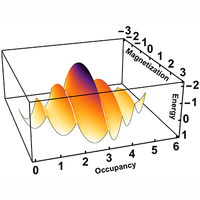
The authors construct here a DFT+U type corrective functional using exact quantum conditions instead of the Hubbard model. DFT+U is widely used in density functional theory, particularly for transition-metal and rare-earth bearing materials. In several small molecules, providing stringent, near-ideal test cases, traditional DFT+U worsens the total energy. The introduced mBLOR functional, with parameters calculated in situ, instead reduces errors significantly. It incorporates simplified interorbital error corrections, is free of double-counting approximations, and opens gaps without unphysical symmetry breaking.

Passivity constraints on the relations between transmission, reflection, and absorption eigenvalues

Cheng Guo and Shanhui Fan

Phys. Rev. B 110, 205431 (2024) - Published 26 November, 2024

Passivity is a fundamental property of many physical systems, characterizing their inability to generate energy. The authors investigate here passivity constraints on the relations between transmission, reflection, and absorption eigenvalues in linear time-invariant systems. The analysis shows that the set of allowable eigenvalue combinations forms a convex polyhedron. The theory reveals a surprising connection to Horn’s inequalities, a fundamental result in matrix theory. It has significant implications for the design and optimization of passive devices in optics, acoustics, and mesoscopic physics.

Optimization of ionic configurations in battery materials by quantum annealing

Tobias Binninger, Yin-Ying Ting, Piotr M. Kowalski, and Michael H. Eikerling

Phys. Rev. B 110, L180202 (2024) - Published 26 November, 2024

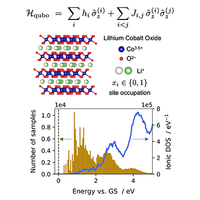
Configurational sampling is an exponentially scaling problem widely encountered in computational materials research. Quantum computing techniques can provide new solutions to such classically hard-to-solve problems. Here, the authors introduce a method that enables the use of quantum annealing to determine the ionic ground state configuration in a battery material. The method relies on a grand-canonical transformation of the energy cost function that strongly reduces the effective coupling strengths of the interaction graph, which is essential for effectiveness of quantum annealing.

Origin of nonlinear photocurrents in chiral multifold semimetal CoSi unveiled by terahertz emission spectroscopy

Yao-Jui Chan, Syed Mohammed Faizanuddin, Raju Kalaivanan, Sankar Raman, Hsin Lin, Uddipta Kar, Akhilesh Kr. Singh, Wei-Li Lee, Ranganayakulu K. Vankayala, Min-Nan Ou, and Yu-Chieh Wen

Phys. Rev. B 110, L201118 (2024) - Published 26 November, 2024

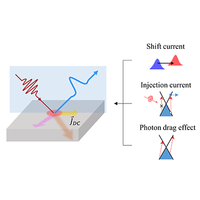
Nonlinear photocurrents in topological semimetals encode quantum geometric characters of Bloch wavefunctions and band topology, and offer a new opportunity for advanced photovoltaics. Here, the authors characterize the nonlinear photoconductivities of chiral multifold semimetal CoSi through a refined terahertz emission spectroscopy analysis. The results reveal a large linear shift conductivity and confirm a giant nonquantized circular injection conductivity in the mid-infrared range. Bulk transverse injection currents and relatively weak photon drag effect are also identified.

Bond disorder in extended Heisenberg-Kitaev models: Spin textures and in-gap states in the high-field regime

Georgia Fragkopoulou and Matthias Vojta

Phys. Rev. B 110, 174444 (2024) - Published 25 November, 2024

Motivated by experimental results obtained for the layered Kitaev magnet α-RuCl3, the authors investigate here the effect of quenched disorder in extended Heisenberg-Kitaev models. Defects are shown to introduce local spin textures and to induce magnetic states inside the excitation gap of the high-field phase, with both phenomena strongly depending on the direction of the applied magnetic field. The study highlights the nontrivial defect physics in strongly spin-orbit coupled magnets in general, and Kitaev materials in particular.

Effect of low-temperature compression on superconductivity and crystal structure in strontium metal

J. Lim, S. Sinha, D. E. Jackson, R. S. Kumar, C. Park, R. J. Hemley, D. VanGennep, Y. K. Vohra, R. G. Hennig, P. J. Hirschfeld, G. R. Stewart, and J. J. Hamlin

Phys. Rev. B 110, 174519 (2024) - Published 25 November, 2024

The superconducting and structural properties of strontium metal are examined under pressures up to 60 GPa at cryogenic temperatures. Low-temperature pressure application doubles the superconducting critical temperature between 35–42 GPa compared to previous results with cryogenic cooling after room-temperature compression. Low-temperature x-ray diffraction shows that the Sr-IV phase remains stable up to 60 GPa, suggesting that thermal energy aids in overcoming kinetic barriers to the Sr-V phase, which appears above 46 GPa under room-temperature compression.

Tunable magnetism in boron imidazolate based metal-organic frameworks

Jackson Davis, Pilar Beccar-Varela, Soumyodip Banerjee, Maxime A. Siegler, V. Sara Thoi, and Natalia Drichko

Phys. Rev. B 110, 184426 (2024) - Published 25 November, 2024

Magnetic metal organic frameworks (MMOFs) are a promising platform to host exotic magnetism. Studied here, MOFs with boron trisimidazolate linkers connecting nodes of Cu (S=½), Co (J=½), and Ni (S=1) demonstrate robust magnetism with magnetic interactions on the order of 1 K in Cu-BIF and Co-BIF. In the triangular lattice Ni-BIF, ferromagnetic interactions of 16 K and formation of a cluster spin-glass state are detected. An explanation by the presence of radicals on ligands highlights the tunability of magnetism in MOFs.

Microscopic theory of polariton-polariton interactions

E. R. Christensen, A. Camacho-Guardian, O. Cotlet, A. Imamoglu, M. Wouters, G. M. Bruun, and I. Carusotto

Phys. Rev. B 110, 195435 (2024) - Published 22 November, 2024

The authors develop here a microscopic theory of polariton-polariton interactions in microcavity systems, employing ab initio calculations for dipolar polaritons to build a generalized Born-Oppenheimer framework. Their theory predicts that strong light-matter coupling drastically enhances interaction strength, revealing unexpected scaling laws that can be experimentally validated. This model applies to both dipolar and non-dipolar polaritons, offering new insights and experimental strategies to explore strong polariton correlations and advance towards the realization of a polariton blockade regime.

Supercell Wannier functions and a faithful low-energy model for Bernal bilayer graphene

Ammon Fischer, Lennart Klebl, Dante M. Kennes, and Tim O. Wehling

Phys. Rev. B 110, L201113 (2024) - Published 22 November, 2024

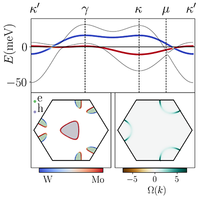
The authors derive here a minimal low-energy model for Bernal bilayer graphene and related rhombohedral graphene multilayers at low electronic densities. They construct valley-polarized Wannier orbitals defined in real-space supercells of the original primitive cell. By projecting realistic Coulomb interactions to the supercell Wannier basis, the authors demonstrate that Bernal bilayer graphene is in the weakly coupled regime. The resulting low-energy lattice models for rhombohedral graphene stacks pave the way for unbiased characterization of many-body phases in multilayer graphene.

Simulating electron-vibron energy transfer with quantum dots and resonators

C. Hermansen, M. Caltapanides, V. Meden, and J. Paaske

Phys. Rev. B 110, 205424 (2024) - Published 20 November, 2024

Quantum dot arrays offer a natural representation of the interacting π-electron system of small hydrocarbon molecules. This paper proposes an extension of quantum dot simulators to include also the molecular vibrational modes represented by single-mode microwave resonators coupled capacitively to the quantum dots. The authors calculate the gate-tunable energy transfer from a voltage-biased triple quantum dot system to a single damped resonator mode and find a pronounced maximum near an interference node in the electrical current.

Altermagnetism on the Shastry-Sutherland lattice

Francesco Ferrari and Roser Valentí

Phys. Rev. B 110, 205140 (2024) - Published 19 November, 2024

Altermagnetism is an unconventional form of magnetic order characterized by spin-split electronic bands and zero net magnetization. Here, the authors utilize a variational Monte Carlo approach to reveal the emergence of d-wave altermagnetism in the Hubbard model on the Shastry-Sutherland lattice and demonstrate how strong electronic correlations manifest in the metal-insulator transition. The calculation of photoemission spectral functions highlights the presence of altermagnetic Zeeman splitting, also in the Mott insulating phase (and upon doping).

Deconfined quantum criticality in Ising gauge theory entangled with single-component fermions

Umberto Borla, Snir Gazit, and Sergej Moroz

Phys. Rev. B 110, L201110 (2024) - Published 19 November, 2024

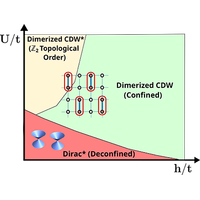
Investigating novel manifestations of quantum criticality is central to modern theoretical condensed matter physics. Here, the authors unveil the exotic quantum phase diagram of a two-dimensional system of single-component fermions, minimally coupled to dynamical Ising gauge fields. With state-of-the-art numerical methods, the authors detect a robust quantum critical line, where gauge confinement and translation symmetry breaking occur simultaneously. The authors conjecture a u(1) deconfined criticality scenario, and propose a corresponding low-energy effective field theory of the exotic quantum critical point.

High-fidelity dimer excitations using quantum hardware

Norhan M. Eassa, Joe Gibbs, Zoe Holmes, Andrew Sornborger, Lukasz Cincio, Gavin Hester, Paul Kairys, Mario Motta, Jeffrey Cohn, and Arnab Banerjee

Phys. Rev. B 110, 184414 (2024) - Published 18 November, 2024

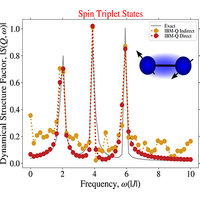
A spin dimer is the drosophila of an entangled system and the building block for more complex states such as valence bond solids. Trotterization on noisy quantum devices cannot yet cleanly yield the dynamics of quantum systems over large time scales. Here, the authors use a combination of a direct measurement scheme and variational fast forwarding to mitigate the need for large circuit depths from several trotter steps, thereby yielding a class-leading fidelity for the dimer dynamical structure factor on IBM quantum hardware.

Magnetic phase diagram of a two-orbital model for bilayer nickelates with varying doping

Ling-Fang Lin, Yang Zhang, Nitin Kaushal, Gonzalo Alvarez, Thomas A. Maier, Adriana Moreo, and Elbio Dagotto

Phys. Rev. B 110, 195135 (2024) - Published 18 November, 2024

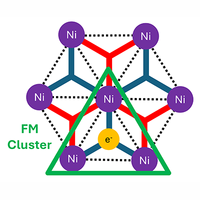
Motivated by the discovery of bilayer nickelate superconductor La3Ni2O7, the authors investigate here magnetic phase diagrams with varying electronic densities n in a bilayer 2×2×2 cluster. Rich magnetic states are observed, which can be understood by three main coupling mechanisms: (1) half-empty ferromagnetic (FM) coupling, (2) half-half antiferromagnetic (AFM) coupling, and (3) half-full FM coupling. At the half-filling case, the half-half mechanism leads to a robust (π, π, π) state. For the La3Ni2O7 (n=1.5) case, the AFM coupling is found to be strong along the z axis, while the xy plane shows strong competition between AFM and FM tendencies.

Quasinormal mode expansion in thin elastic plates

Benjamin Vial, Marc Martí Sabaté, Richard Wiltshaw, Sébastien Guenneau, and Richard V. Craster

Phys. Rev. B 110, 174305 (2024) - Published 15 November, 2024

The authors present here a quasinormal mode (QNM) framework to optimize wave control in thin elastic plates. This model simplifies complex wave interactions, enabling efficient simulations and precise manipulation of resonant modes. By integrating gradient-based optimization, the authors demonstrate control over resonator parameters, achieving quasibound states and tailored eigenfrequency placements. This approach offers a powerful tool for designing elastic metamaterials and sources with customized responses, advancing applications in wave manipulation and control.

Electron conductance and many-body marker of a cavity-embedded topological one-dimensional chain

Danh-Phuong Nguyen, Geva Arwas, and Cristiano Ciuti

Phys. Rev. B 110, 195416 (2024) - Published 15 November, 2024

The authors investigate here, using an exact diagonalization approach, how electron transport in the paradigmatic Su-Schrieffer-Heeger (SSH) model, a cornerstone of 1D topological systems, is influenced by cavity quantum fields. In addition to analyzing how the cavity modifies the linear electron conductance, they uncover an exact many-body topological marker that remains valid for any degree of cavity coupling and light-matter entanglement, providing a new framework for studying topological phases in cavity-coupled systems.

Quantum kinetic theory of quadratic responses

M. Mehraeen

Phys. Rev. B 110, 174423 (2024) - Published 14 November, 2024

A recurring research theme in linear response theory is the attempt to reconcile semiclassical and quantum transport. Starting from the quantum Liouville equation for the disorder-averaged density operator, this work presents a comprehensive theory of nonlinear responses in the presence of an electrostatic interaction and disorder. In addition to generalizing the equations of motion of carrier dynamics, several unexplored scattering and conductivity channels are uncovered, revealing the rich interplay between quantum geometry and disorder in the nonlinear response regime.

Stability of anomalous Hall crystals in multilayer rhombohedral graphene

Zhihuan Dong, Adarsh S. Patri, and T. Senthil

Phys. Rev. B 110, 205130 (2024) - Published 14 November, 2024

Amidst recent burning interest in quantum anomalous Hall phenomena in pentalayer graphene, the authors provide here an elegant understanding for existing numerical mean field results. Beyond mean field, the authors propose the picture of “moiré-enabled Hall crystals”, emphasizing the crucial role of a moiré potential even when weak. The authors provide a connection between electronic crystals and the superconducting Little-Parks effect to explicitly demonstrate the quantization of Chern number associated with spontaneous crystalline order, analogous to quantization of vorticity in a superconducting ring under a background magnetic field.

Correlated topological mixed-valence insulators in moiré heterobilayers

Juan Felipe Mendez-Valderrama, Sunghoon Kim, and Debanjan Chowdhury

Phys. Rev. B 110, L201105 (2024) - Published 14 November, 2024

Recent experiments in moiré transition metal dichalcogenide (TMD) materials have uncovered a number of remarkable correlation-induced phases with nontrivial band topology. Here, the authors investigate topological mixed-valence and Kondo insulators in this platform at a commensurate band filling. This study highlights the distinct roles of Mottness and topology in shaping the interaction-induced phase diagram, and proposes a possible route toward realizing exotic fractionalized insulators.

Twisted coupled wire model for a moiré sliding Luttinger liquid

Yichen Hu, Yuanfeng Xu, and Biao Lian

Phys. Rev. B 110, L201106 (2024) - Published 14 November, 2024
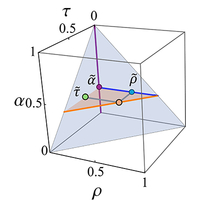
The authors propose here a twisted bilayer 2D array in a coupled-wire model to characterize the anisotropic Luttinger Liquid behavior observed in twisted bilayer WTe2. Solving this model using transfer matrix method gives quasi-1D moiré electron bands at small twist angles, which have a significantly reduced Luttinger parameter when interaction is taken into account. This indicates strong correlation effects and leads to the existence of a sliding Luttinger liquid (SLL) regime in twisted bilayer WTe2.

Sign In to Your Journals Account

Filter

Section

Filter

Article Lookup

Enter a citation