Highlights

Quantum geometry induced third-order nonlinear transport responses

Debottam Mandal, Sanjay Sarkar, Kamal Das, and Amit Agarwal

Phys. Rev. B 110, 195131 (2024) - Published 13 November, 2024

The authors develop here a comprehensive framework for third-order electronic transport, focusing on the impact of quantum geometry in materials where conventional responses are absent. By deriving new forms of reciprocal longitudinal and Hall currents in time-reversal symmetry-broken systems, they reveal how quantum geometric features – specifically, the quantum geometric connection and tensor – shape these nonlinear currents. This theoretical advancement provides a blueprint for identifying materials with intrinsic third-order responses, with potential applications in advanced quantum technologies.

Nearly quantized Born effective charges as probes for the topological phase transition in the Haldane and Kane-Mele models

Paolo Fachin, Francesco Macheda, Paolo Barone, and Francesco Mauri

Phys. Rev. B 110, L201405 (2024) - Published 13 November, 2024

The authors introduce here a novel method for examining transitions between distinct topological phases by analyzing vibrational resonances in infrared spectra. In the prototypical Haldane and Kane-Mele models, the Born effective charges, which measure the interaction between infrared light and phonons, are nearly quantized and exhibit a sharp change that coincides with the topological phase transition. In the Haldane model, which breaks time-reversal symmetry, a similar discontinuous shift is also observed in the chiral phonon splitting.

Nonferroelectric phase with loss of cycloidal magnetic structure in Tb0.515Gd0.485Mn2O5

Yuta Ishii, Terutoshi Sakakura, Yoshihisa Ishikawa, Ryoji Kiyanagi, Jana Lustikova, Takuya Aoyama, Kenya Ohgushi, Yusuke Wakabayashi, Hiroyuki Kimura, and Yukio Noda

Phys. Rev. B 110, 184404 (2024) - Published 12 November, 2024

The authors investigate here the magnetic structure of the multiferroic material RMn2O5 (R=Tb0.515Gd0.485) using neutron scattering experiments. They reveal the remarkable influence of the cycloidal magnetic structure on electric polarization, even in the commensurate magnetic phase, while the collinear structure has minimal effect on dielectric properties. This discovery contrasts with previous findings in other RMn2O5 materials, offering new insights into the magnetoelectric coupling in this system.

Superconductivity in a topological lattice model with strong repulsion

Rahul Sahay, Stefan Divic, Daniel E. Parker, Tomohiro Soejima, Sajant Anand, Johannes Hauschild, Monika Aidelsburger, Ashvin Vishwanath, Shubhayu Chatterjee, Norman Y. Yao, and Michael P. Zaletel

Phys. Rev. B 110, 195126 (2024) - Published 12 November, 2024

Can superconductivity arise from strong repulsive interactions between electrons in a lattice model with topological bands? Here, the authors answer this question in the affirmative via DMRG numerical simulations of an interacting spinful bilayer Hofstadter model featuring low-lying bands of opposite Chern number. Furthermore, by developing a new technique to probe the pairing symmetry in number-conserving DMRG, the authors demonstrate that superconductivity is p-wave, tantalizingly reminiscent of nodal pairing recently observed in twisted bilayer graphene, which shares many structural similarities with their model. This work thus showcases the possibility of an all-electronic pairing mechanism in the strong coupling limit in two dimensions, which can be tested directly with cold fermions in an optical lattice.

Quantum state transfer in interacting multiple-excitation systems

Alexander Yue, Rubem Mondaini, Qiujiang Guo, and Richard T. Scalettar

Phys. Rev. B 110, 195410 (2024) - Published 12 November, 2024

Coherent passage of quantum information across nodes on a network can be accomplished via quantum state transfer protocols. The authors employ here an optimized Monte Carlo annealing procedure to demonstrate that experiments emulating the physics of typical condensed matter Hamiltonians, such as localized orbitals coupled to conduction bands, could be tuned to exhibit highly efficient quantum state transfer.

Bonding states underpinning structural transitions in IrTe2 observed with micro-ARPES

C. W. Nicholson, M. D. Watson, A. Pulkkinen, M. Rumo, G. Kremer, K. Y. Ma, F. O. von Rohr, C. Cacho, and C. Monney

Phys. Rev. B 110, 205123 (2024) - Published 12 November, 2024

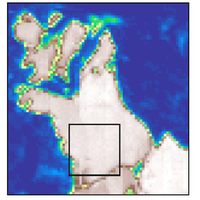
Structural phase transitions of debated origin occur at low temperature in IrTe2. This results in the formation of stripes of atomic dimers that drastically lowers the symmetry of the system. As a consequence, many domains with different orientations and periodicity coexist, making studies complicated. Here, the authors take advantage of micro-spot photoemission spectroscopy to isolate the electronic structure of each phase, thereby revealing the electronic orbitals that stabilize the phase transitions.

Anomalous Hall crystals in rhombohedral multilayer graphene. II. General mechanism and a minimal model

Tomohiro Soejima (副島智大), Junkai Dong (董焌锴), Taige Wang, Tianle Wang, Michael P. Zaletel, Ashvin Vishwanath, and Daniel E. Parker

Phys. Rev. B 110, 205124 (2024) - Published 12 November, 2024

Anomalous Hall crystals (AHCs) form a new phase of matter with spontaneous crystallization and quantized Hall response. It has been invoked to explain a recent experiment on rhombohedral pentalayer graphene, but a simple conceptual understanding of its existence has been lacking. Here, the authors propose a simple three-patch model that captures how quantum mechanical exchange interactions can stabilize the AHC phase, and apply it to analyze the phenomenology of rhombohedral pentalayer graphene.

Limitations of Caldeira-Leggett model for description of phase transitions in superconducting circuits

O. Kashuba and R.-P. Riwar

Phys. Rev. B 110, 184505 (2024) - Published 7 November, 2024

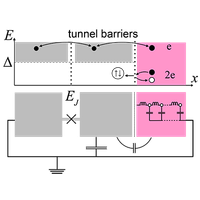
Accurate modeling of system-bath interactions in quantum systems is a challenge of intrinsic complexity. Here, the authors show that seemingly minute changes in the model approximations heavily impact the renormalization group flow and phase diagram of resistive superconducting circuits. A modified Caldeira-Leggett model is presented with four instead of two control parameters. While the Schmid-Bulgadaev phase transition persists in the transmon regime, it is driven exclusively by capacitive coupling. The Cooper pair box limit maps to the anisotropic Kondo model with a forbidden ferromagnetic phase.

Spin orbital lattice entanglement in the ideal j=12 compound K2IrCl6

P. Warzanowski, M. Magnaterra, Ch. J. Sahle, M. Moretti Sala, P. Becker, L. Bohatý, I. Císařová, G. Monaco, T. Lorenz, P. H. M. van Loosdrecht, J. van den Brink, and M. Grüninger

Phys. Rev. B 110, 195120 (2024) - Published 7 November, 2024

Materials with spin-orbit entangled j=½ moments provide a rich playground for frustrated quantum magnetism. Combining resonant inelastic x-ray scattering, optical spectroscopy, and x-ray diffraction, the authors show here that cubic K2IrCl6 hosts ideal spin-orbit entangled j=½ moments. Importantly, they also show that the j=³⁄₂ excited states hybridize with vibrational states leading to spin orbital lattice entanglement in K2IrCl6, thereby substantially enriching the field of spin-orbit entangled materials physics.

Ferromagnetic ferroelectricity due to the Kugel-Khomskii mechanism of orbital ordering assisted by atomic Hund's second rule effects

I. V. Solovyev, R. Ono, and S. A. Nikolaev

Phys. Rev. B 110, 205116 (2024) - Published 7 November, 2024

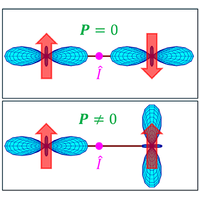
Ferromagnetic ferroelectricity is a fundamentally interesting and technologically important phenomenon. Nevertheless, the coexistence of ferroelectricity and ferromagnetism is extremely rare in nature. Here, the authors propose how the ferromagnetic ferroelectricity can be induced by the orbital degrees of freedom: if two magnetic sites are connected by the spatial inversion and the system can freely choose which orbitals to occupy, the occupation of unlike orbitals across the inversion center will not only stabilize the ferromagnetic coupling, but also break the inversion symmetry, thus resulting in the ferroelectric-ferromagnetic ground state. The phenomenon is expected in the layered van der Waals ferromagnet VI3, where atomic Hund’s second rule effects provide a sufficient flexibility for the orbital degrees of freedom to form the ordered pattern with broken inversion symmetry.

Poor man's Majorana edge mode enabled by specular Andreev reflection

C. W. J. Beenakker

Phys. Rev. B 110, L180402 (2024) - Published 7 November, 2024

The surface of a three-dimensional topological insulator supports a chiral Majorana edge mode at the interface between a superconductor and a magnetic insulator. The complexity of the materials combination is such that this state has not yet been observed. Remarkably enough, a similar state without topological protection appears in proximitized graphene, if the Fermi level of the massless electrons is at the Dirac point. The simplified geometry may favor experimental observation of this “poor-man’s” Majorana mode.

Circular dichroism experiments at the L edge of magnetic transition metals enabled by elliptically polarized pulses from a seeded free-electron laser

C. Spezzani et al.

Phys. Rev. B 110, 174409 (2024) - Published 6 November, 2024

The authors demonstrate the generation of elliptically polarized femtosecond pulses from a seeded free electron laser (FEL) in the 700–800 eV range. Using a variable-polarization undulator, they achieved on-axis elliptical polarization at the third harmonic of FEL’s fundamental wavelength, enabling studies based on magnetic circular dichroism at the Fe L2,3 edge. These results pave the way for investigations of transition metals, covering both the M and L edges at the FERMI FEL at Elettra Sincrotrone Trieste.

Inducing topological flat bands in bilayer graphene with electric and magnetic superlattices

Daniel Seleznev, Jennifer Cano, and David Vanderbilt

Phys. Rev. B 110, 205115 (2024) - Published 6 November, 2024

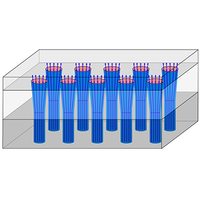
Topological flat bands offer a unique opportunity to study the interplay between electronic correlations and band topology, giving rise to correlation-induced topological phases, such as fractional quantum Hall states. Here, the authors explore the generation of topological flat bands in Bernal-stacked bilayer graphene via application of commensurate electric and magnetic superlattices. Tuning these superlattices reveals their versatility in producing topological flat bands, including those with high Chern numbers. The authors additionally propose a novel, tunable setup involving magnetoelectrics and type-II superconductors to generate such superlattices.

(La,Sr)2NiO3: An antiferromagnetic Mott insulator capable of doping

Xiaochao Wang, Paul Worm, Ying Gao, Wenfeng Wu, Nan Liu, Yongqiang Wang, Karsten Held, and Liang Si

Phys. Rev. B 110, 205110 (2024) - Published 5 November, 2024

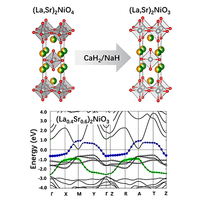
The synthesis and study of superconducting nickelate oxides represents an exciting frontier in condensed matter physics. Here, the authors investigate the structural, electronic, and magnetic properties of the nickelates (La,Sr)2NiO4 and their reduced form, (La,Sr)2NiO3. Using density functional theory (DFT) and dynamical mean-field theory (DMFT) calculations, they demonstrate that chemical reduction with CaH2 or NaH leads to a 3d9 electronic configuration, resulting in (La0.5Sr0.5)2NiO3 as a single-band antiferromagnetic Mott insulator. Hole doping disrupts this antiferromagnetic order, driving the material metallic, suggesting the intriguing potential for p-wave superconductivity in these nickelate systems.

Theory of phonon spectroscopy with the quantum twisting microscope

Jiewen Xiao, Erez Berg, Leonid I. Glazman, Francisco Guinea, Shahal Ilani, and Felix von Oppen

Phys. Rev. B 110, 205407 (2024) - Published 5 November, 2024

The quantum twisting microscope, or QTM, is a powerful new scanning probe based on momentum-conserving tunneling across a twistable finite-area interface between van der Waals layers placed on a tip with a flat top and on a substrate. The authors develop here a theory of QTM measurements probing phonon dispersions and electron-phonon couplings of van der Waals materials. The results inform the quest to understand superconductivity in twisted bilayer graphene and provide a case study for QTM investigations of collective modes.

Efficient electron spin relaxation by chiral phonons in WSe2 monolayers

D. Lagarde, M. Glazov, V. Jindal, K. Mourzidis, Iann Gerber, A. Balocchi, L. Lombez, P. Renucci, T. Taniguchi, K. Watanabe, C. Robert, and X. Marie

Phys. Rev. B 110, 195403 (2024) - Published 4 November, 2024

In transition metal dichalcogenide semiconductor monolayers, the spin dynamics of electrons is usually controlled by the spin-valley locking effect: a carrier spin flip occurs only if there is a simultaneous change in the valley. However, very little is known about the intravalley spin relaxation processes. Here, the authors demonstrate that the spin relaxation of an electron in WSe2 monolayers can occur efficiently without a change in valley thanks to chiral phonons. The consequence is an efficient relaxation from bright to dark excitons.

Charge density waves with nontrivial orbital textures in rare earth tritellurides

Sergey Alekseev, Sayed Ali Akbar Ghorashi, Rafael M. Fernandes, and Jennifer Cano

Phys. Rev. B 110, 205103 (2024) - Published 4 November, 2024

Recent experiments on the rare-earth tritellurides RTe3 reveal unconventional collective modes in the charge density wave (CDW) state, suggesting symmetry breaking beyond that imposed by the CDW wave vector. Here, the authors develop a CDW Ginzburg-Landau theory that incorporates nontrivial orbital order, allowing for solutions in which two CDWs with distinct orbital characters coexist. The resulting CDW pattern exhibits an orbital texture that can break mirror and/or inversion symmetry.

Interplay of superexchange and vibronic effects in the hidden order of Ba2MgReO6 from first principles

Dario Fiore Mosca, Cesare Franchini, and Leonid V. Pourovskii

Phys. Rev. B 110, L201101 (2024) - Published 4 November, 2024

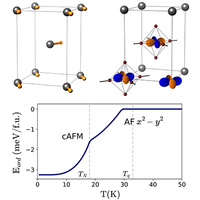
In heavy transition metal oxides, electronic correlation and strong spin-orbit coupling can give rise to “hidden order”, with multipolar order parameters. Here, the authors investigate the origin of the unusual quadrupolar and magnetic phases in the double perovskite Ba2MgReO6. They derive its low-energy Hamiltonian from first principles and show that its antiferroic order of x2-y2 quadrupoles and a low-temperature canted antiferromagnetic phase emerge from the interplay between electron-lattice coupling and multipolar superexchange interactions.

Field-induced superconductivity mediated by odd-parity multipole fluctuation

Kosuke Nogaki and Youichi Yanase

Phys. Rev. B 110, 184501 (2024) - Published 1 November, 2024

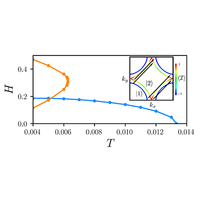
Magnetic field induced superconductivity is a counterintuitive phenomenon and has long been a challenge in the realm of condensed matter physics. The authors present here a novel mechanism to realize magnetic field induced superconductivity, in which the interplay between sublattice degrees of freedom and the Coulomb interaction plays a crucial role. This study significantly advances our understanding of the untapped phenomena in strongly correlated electron systems endowed with sublattice degrees of freedom, which are ubiquitous in superconductors attracting recent interest.

Rydberg series of intralayer K-excitons in WSe2 multilayers

Piotr Kapuściński, Artur O. Slobodeniuk, Alex Delhomme, Clément Faugeras, Magdalena Grzeszczyk, Karol Nogajewski, Kenji Watanabe, Takashi Taniguchi, and Marek Potemski

Phys. Rev. B 110, 155439 (2024) - Published 30 October, 2024

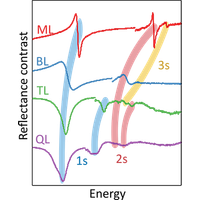
Here, the authors combine magnetoreflectance experiments with theoretical modeling based on the k⋅p approach to explore the origin and properties of intravalley excitons in WSe2 bi-, tri-, and quadlayers. The reflectance spectra display rich excitonic series across all thicknesses. By comparing magnetoreflectance data with theoretical predictions, the authors reveal that excitonic resonances in trilayers arise from two distinct Rydberg series, quadlayers exhibit four such series, and bilayers feature a single Rydberg series akin to that of monolayers.

Sign In to Your Journals Account

Filter

Section

Filter

Article Lookup

Enter a citation