Highlights

Non-Abelian fractional quantum anomalous Hall states and first Landau level physics of the second moiré band of twisted bilayer MoTe2

Cheong-Eung Ahn, Wonjun Lee, Kunihiro Yananose, Youngwook Kim, and Gil Young Cho

Phys. Rev. B 110, L161109 (2024) - Published 17 October, 2024

The authors report here the discovery of a realistic platform for emerging non-Abelian fractional quantum anomalous Hall states. This is the second moiré band in 2-degree twisted bilayer MoTe2. They elucidate the theoretical foundation behind this by demonstrating the resemblance of the second moiré band to the first Landau level, using Haldane pseudopotentials and Fubini-Study metric. A surprising similarity is revealed between the sequence of moiré bands in the twisted bilayer MoTe2 and Landau levels beyond a particular moiré band.

Topological hidden phase transition in honeycomb bilayers with a high Chern number

Ji-Huan Guan, Wen-Kai Lou, and Kai Chang

Phys. Rev. B 110, 165303 (2024) - Published 16 October, 2024

Topological phases have garnered considerable attention due to their robust quantum transport properties. However, observing the topological phase transition within valence bands seems to be elusive from the perspective of quantum transport. Here, the authors uncover this “topological hidden phase transition” in a composite honeycomb bilayer. They demonstrate that the emergence of robust “half-antichiral” edge states with the bi-conductance plateau is a fingerprint of the phenomenon in which the Chern number of the valence bands undergoes a transition from C=±(1+1) to C=±(2+0).

Chiral edge mode for single-cone Dirac fermions

C. W. J. Beenakker

Phys. Rev. B 110, 165421 (2024) - Published 16 October, 2024

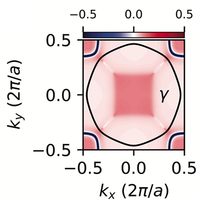
Confinement of 2D massless Dirac fermions by a mass boundary does not produce an edge mode. This applies to the surface of a 3D topological insulator at an interface to a magnetic insulator with a perpendicular magnetization. Surprisingly enough, an edge mode does appear if the magnetization is tilted away from the normal. The edge mode is an “arc state”, ranging over a finite momentum interval, as a 2D analogue of the surface Fermi arc familiar from 3D Weyl semimetals.

Detection of geometric phases in spin waves using nitrogen vacancy centers

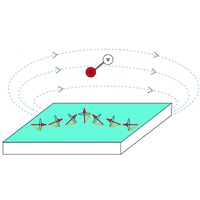
Tomas T. Osterholt, Pieter M. Gunnink, and Rembert A. Duine

Phys. Rev. B 110, 134424 (2024) - Published 15 October, 2024

Spin wave geometric phases are well-known to play a fundamental role in magnon Hall effects and may ultimately be used to control spin waves in the field of magnonics. Here, the authors demonstrate theoretically how nitrogen-vacancy (NV) centers can be used to directly measure spin wave geometric phases in a variety of physical systems, including magnetic domain walls and magnetic rings with directional anisotropies.

Magnetic and viscous dynamics of spheroidal nanoparticles

Frederik L. Durhuus, Marco Beleggia, and Cathrine Frandsen

Phys. Rev. B 110, 144425 (2024) - Published 15 October, 2024

Magnetic nanoparticles can be synthesised in a wide range of shapes, which greatly impacts their utility as heating agents. Here, the authors use Langevin dynamics simulations of spheroidal particles to study how their shape affects both the net energy absorption and whether the energy is dissipated by viscous friction or magnetic losses. This study establishes a procedure for maximising the absorption rate in a given applied field via particle shape.

Pairing interaction from three-dimensional acoustic plasmon demon modes in Sr2RuO4

Young Woo Choi, Jisoon Ihm, and Marvin L. Cohen

Phys. Rev. B 110, 155127 (2024) - Published 15 October, 2024

Sixty seven years after Pines’ prediction, the “demon” mode – a three-dimensional acoustic plasmon – has been experimentally observed in the unconventional superconductor Sr2RuO4. This low-energy, charge-neutral excitation could play an important role in the superconducting pairing interaction. The authors calculate here how the demon mode affects the dynamical screened Coulomb interaction and the Coulomb kernel in Sr2RuO4. Their findings reveal that the demon mode reduces Coulomb repulsion between electrons, favorable for anisotropic superconductivity. This also suggests that other materials exhibiting demon modes might experience reduced Coulomb repulsion, potentially leading to enhanced superconductivity.

Deep learning lattice gauge theories

Anuj Apte, Clay Córdova, Tzu-Chen Huang, and Anthony Ashmore

Phys. Rev. B 110, 165133 (2024) - Published 15 October, 2024

Here, the authors use gauge-invariant neural network quantum states (NNQS) to study ℤN lattice gauge theories. They compute ground states and map out phase transitions, identifying a continuous transition in ℤ2 with Ising critical exponents and a weakly first-order transition in ℤ3. Their work demonstrates how deep learning can overcome challenges in traditional lattice simulations, providing a novel approach for exploring complex quantum phases and topological order in condensed matter systems.

Gallery of soft modes: Theory and experiment at a ferromagnetic quantum phase transition

P. C. E. Stamp, D. M. Silevitch, M. Libersky, Ryan McKenzie, A. A. Geim, and T. F. Rosenbaum

Phys. Rev. B 110, 134420 (2024) - Published 11 October, 2024

Spectral divergences have long been important in physics, from the 19th century UV catastrophe to IR divergences in modern quantum field theory. In all these, “feedback” mechanisms quell the divergences. But what if multiple IR divergences – soft photons, phonons, and electronuclear magnons – conspire to produce finite decoherence at a quantum phase transition? The authors develop here the theory for these cancelling divergences and experimentally observe the resulting mode softening in a quantum Ising magnet, with implications from condensed matter to quantum gravity.

Signatures of fractionalization in the optical phonons of the hyperhoneycomb Kitaev magnet β−Li2IrO3

Swetlana Swarup, Susmita Singh, and Natalia B. Perkins

Phys. Rev. B 110, 134421 (2024) - Published 11 October, 2024

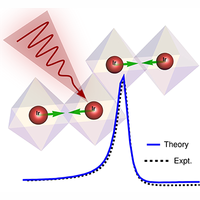
The three-dimensional hyperhoneycomb Kitaev material β-Li2IrO3 has been proposed to host spin fractionalization. While its direct detection is challenging, the Fano shape of the Ag phonon observed in Raman spectra offers a promising clue. This study explains the Fano resonance as being consistent with the fractionalization of spins into Majorana fermions and ℤ2 fluxes, providing an indirect signature of the quantum spin liquid phase in β-Li2IrO3.

Fluctuation-induced piezomagnetism in local moment altermagnets

Kostiantyn V. Yershov, Volodymyr P. Kravchuk, Maria Daghofer, and Jeroen van den Brink

Phys. Rev. B 110, 144421 (2024) - Published 11 October, 2024

Here, the authors introduce two Heisenberg models for d-wave altermagnets, namely the checkerboard model and model adapted to rutiles. Both models capture the altermagnetic properties of the magnon spectra and allow one to analyze transport and thermodynamic phenomena in d-wave altermagnets. The main prediction is a piezomagnetism driven by the thermal fluctuations, i.e., the appearance of the perpendicular magnetization in response to in-plane stress that only arises once temperatures reach a sizable fraction of the magnetic transition temperature. The authors further predict a thermal spin conductivity, i.e., generation of a spin current in response to an applied temperature gradient.

Intrinsic process for upconversion photoluminescence via K-momentum–phonon coupling in carbon nanotubes

Daichi Kozawa, Shun Fujii, and Yuichiro K. Kato

Phys. Rev. B 110, 155418 (2024) - Published 10 October, 2024

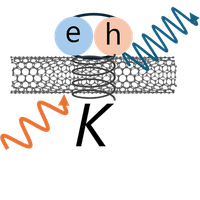
Carbon nanotubes exhibit efficient upconversion photoluminescence, which has been thought to arise from extrinsic effects such as defects. By using single nanotube spectroscopy on defect-free, air-suspended carbon nanotubes, the authors demonstrate here that upconversion readily occurs through an intrinsic process. Sidebands in the upconversion photoluminescence excitation spectra are assigned to K-momentum phonon modes, explaining the mechanism of upconversion. With efficient upconversion, large energy gain, and near-unity radiative quantum efficiency, these pristine nanotubes offer a promising platform for exploring optothermal effects.

Topological Kondo semimetal and insulator in AB-stacked heterobilayer transition metal dichalcogenides

Daniele Guerci, Kevin P. Lucht, Valentin Crépel, Jennifer Cano, J. H. Pixley, and Andrew Millis

Phys. Rev. B 110, 165128 (2024) - Published 10 October, 2024

The “Topological Kondo Insulator” is a long-sought phase of matter, in which two physically distinct systems, localized magnetic moments and mobile (conducting) electrons, combine via the many body process known as the Kondo effect to form a nonmagnetic insulator with gapless topological surface states and a quantized spin Hall conductance. Guerci and collaborators predict here that this state can be realized in the currently intensively studied transition metal dichalcogenide bilayer systems, opening the door to extensive studies of Kondo insulator physics.

Controlling orbital magnetism of band electron systems via bath engineering

Subrata Chakraborty and So Takei

Phys. Rev. B 110, L140405 (2024) - Published 10 October, 2024

A complete theory of the orbital magnetic susceptibility of an isolated multiband electron system was developed in 2015. Here, the authors study whether one can control this orbital susceptibility by opening the electron system to a fermionic bath. They show that, as the system-bath coupling is increased, a properly engineered bath can enhance the diamagnetic susceptibility of the system and even change its orbital paramagnetic response into a diamagnetic one. The work also discusses how a Van Hove singularity in the bath density of states can be exploited to generate a giant enhancement of the orbital magnetic response. These results are counterintuitive, relative to the common belief, that bath-induced decoherence merely leads to the quenching of the orbital magnetic susceptibility.

Evidence of skyrmionic phase in a GdNi0.4Si1.6 single crystal

Gourav Dwari, Shovan Dan, Bishal Baran Maity, Ruta Kulkarni, and A. Thamizhavel

Phys. Rev. B 110, 134413 (2024) - Published 9 October, 2024

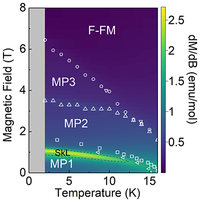
The topological Hall effect is often observed in materials that host the skyrmion lattice. Here, the authors present a comprehensive study of the magnetic phases observed in a GdNi0.4Si1.6 single crystal, which crystallizes in the centrosymmetric hexagonal crystal structure with the space group P6/mmm. The Hall data reveals the signature of topological Hall effect. A phase diagram constructed from the magnetic and transport studies highlights several magnetic phases, where a skyrmionic phase is sandwiched between these magnetic phases in a narrow field range.

Field-free switching of Tm3Fe5O12 on miscut garnet substrates with entangled spin Hall magnetoresistance and anomalous Hall resistance

Lin-Zhu Bi, Jintao Ke, Dalin Zhang, Guansong Li, Pengju Wang, Chaoqun Hu, Zhaozhao Zhu, Y. W. Liu, Ying Zhang, and J. W. Cai

Phys. Rev. B 110, 134415 (2024) - Published 9 October, 2024

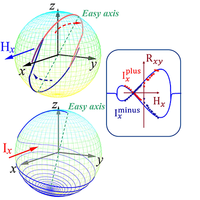
The authors study here the structural, magnetic, and unique magnetotransport properties of Tm3Fe5O12/Pt heterostructures epitaxially grown on miscut Y3(Sc2Ga3)O12 substrates. The resulting deviation of magnetic easy axis from the film normal enables field-free current-induced switching. Remarkably, it also makes the anomalous Hall resistance entangled with the transverse effect of the spin Hall magnetoresistance under in-plane fields. The Hall resistance magnitude and polarity in monitoring the current-induced magnetization switching are thereby significantly modified when applying in-plane fields. The results are verified theoretically.

Time-reversal symmetry breaking in the s-wave superconductor CaPd2As2 probed by μSR

Aarti, K. Panda, D. T. Adroja, A. Bhattacharyya, P. K. Biswas, A. D. Hillier, B. Lake, Samar Layek, and V. K. Anand

Phys. Rev. B 110, 144506 (2024) - Published 9 October, 2024

Time-reversal symmetry breaking in the superconducting state is pondered to occur in superconductors having anisotropic or multi-band energy gap, or p- and d-wave pairing superconductivity of unconventional character. Using the muon spin relaxation and rotation technique, here the authors detect the spontaneously generated internal magnetic field that evidence the occurrence of time-reversal symmetry breaking in the superconducting state of a conventional single-band s-wave superconductor CaPd2As2. They also demonstrate that the energy gap structure of CaPd2As2 is isotropic.

Absence of a bulk thermodynamic phase transition to a density wave phase in UTe2

Florian Theuss, Avi Shragai, Gael Grissonnanche, Luciano Peralta, Gregorio de la Fuente Simarro, Ian M Hayes, Shanta R Saha, Yun Suk Eo, Alonso Suarez, Andrea Capa Salinas, Ganesh Pokharel, Stephen D. Wilson, Nicholas P Butch, Johnpierre Paglione, and B. J. Ramshaw

Phys. Rev. B 110, 144507 (2024) - Published 9 October, 2024

Superconductors often host multiple competing and intertwined orders, such as spin and charge density waves. Recent scanning tunneling microscopy measurements suggest that the heavy-fermion superconductor UTe2 has both Cooper pair and charge density waves (PDWs and CDWs, respectively). Using high-resolution resonant ultrasound spectroscopy, the authors find here no evidence for a thermodynamic phase transition to a bulk CDW state, also ruling out a bulk PDW. These measurements highlight the need to distinguish between bulk and surface physics in UTe2.

Absence of a bulk signature of a charge density wave in hard x-ray measurements of UTe2

Caitlin S. Kengle, Dipanjan Chaudhuri, Xuefei Guo, Thomas A. Johnson, Simon Bettler, Wolfgang Simeth, Matthew J. Krogstad, Zahir Islam, Sheng Ran, Shanta R. Saha, Johnpierre Paglione, Nicholas P. Butch, Eduardo Fradkin, Vidya Madhavan, and Peter Abbamonte

Phys. Rev. B 110, 145101 (2024) - Published 9 October, 2024

The pair density wave (PDW), arising from an interplay between coexistent superconductivity and charge density wave (CDW) order, is a phase of matter in which the superconducting order parameter is modulated in real space. Recently, signatures of PDWs were reported in the unconventional superconductor UTe2 through surface-sensitive probes. This paper investigates the question of whether CDW order exists in the bulk of UTe2 using low-temperature synchrotron x-ray diffraction. The authors find no direct evidence of CDW ordering in the diffraction pattern and place an upper bound on the charge density amplitude. The results indicate that the CDW and, by extension, the PDW, observed in previous studies of UTe2 are likely confined to its surface.

Composite helical edges from Abelian fractional topological insulators

Yang-Zhi Chou and Sankar Das Sarma

Phys. Rev. B 110, 155117 (2024) - Published 9 October, 2024

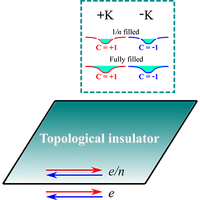
The authors investigate here composite (1+1/n) Abelian helical edge states with the n=2 case, pertinent to recent twisted MoTe2 experiments. The authors construct low-temperature phase diagrams with weak Rashba spin-orbit coupling and calculate edge-state conductance for each phase. The authors further explore the response to an in-plane magnetic field and predict a field-driven phase with 1ne2h edge-state conductance, offering concrete, testable predictions.

Minimal models for altermagnetism

Mercè Roig, Andreas Kreisel, Yue Yu, Brian M. Andersen, and Daniel F. Agterberg

Phys. Rev. B 110, 144412 (2024) - Published 8 October, 2024

Altermagnets feature vanishing net magnetization, similar to antiferromagnets, but exhibit time-reversal symmetry breaking and spin-split band structures. This work constructs minimal models for altermagnetism based on symmetry arguments considering two magnetic atoms in the unit cell and demonstrates that these can capture key properties of the band structure and altermagnetic spin splitting for the material candidate RuO2. Notably, the models have altermagnetic ground states and give rise to a Berry curvature and a conductivity linear in the spin-orbit coupling.

Sign In to Your Journals Account

Filter

Section

Filter

Article Lookup

Enter a citation