Highlights

Inchworm quasi Monte Carlo for quantum impurities

Hugo U. R. Strand, Joseph Kleinhenz, and Igor Krivenko

Phys. Rev. B 110, L121120 (2024) - Published 24 September, 2024

Quantum impurity models are key for describing many-body effects in both open quantum systems and correlated quantum materials through embedding methods. Continuous time quantum Monte Carlo provides numerically exact solutions with 1/N convergence, where N is the number of samples. Here, the authors show how the imaginary time integration can be performed using quasi Monte Carlo yielding parametrically better 1/N convergence. Benchmarks of the open source implementation accompanying the paper are shown to enable calculations with unprecedented accuracy.

Longitudinal optical phonons in photonic time crystals containing a stationary charge

Sihao Zhang, Junhua Dong, Huanan Li, Jingjun Xu, and Boris Shapiro

Phys. Rev. B 110, L100306 (2024) - Published 23 September, 2024

Photonic time crystals (PTCs) enable exotic light-matter interactions but typically require significant modulation strength to open a wide momentum band gap, limiting their practical realization. Here, the authors demonstrate that a Lorentzian medium-based PTC with a stationary charge cannot only excite but also amplify longitudinal optical phonons, with a band gap spanning the entire momentum space. This infinite momentum band gap can be achieved with a minimal modulation depth, enriching time-varying photonics by incorporating the distinct wave characteristics of longitudinal excitations.

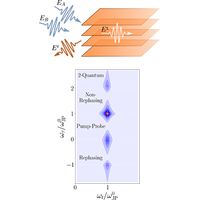
Principles of two-dimensional terahertz spectroscopy of collective excitations: The case of Josephson plasmons in layered superconductors

Alex Gómez Salvador, Pavel E. Dolgirev, Marios H. Michael, Albert Liu, Danica Pavicevic, Michael Fechner, Andrea Cavalleri, and Eugene Demler

Phys. Rev. B 110, 094514 (2024) - Published 20 September, 2024

This paper presents a theoretical framework for two-dimensional terahertz spectroscopy (2DTS) of collective excitations in condensed matter systems. Focusing on the Josephson plasma resonance in layered superconductors as a model collective excitation, the authors show how 2DTS reveals physics beyond what is accessible in the linear response. They also demonstrate that 2DTS spectra of collective modes can exhibit unique signatures that defy intuition from nuclear magnetic resonance, which may indicate, for example, the presence of dynamics beyond the mean-field approximation.

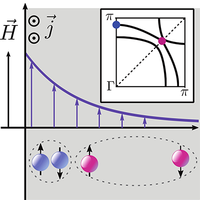
Unconventional superconductivity from electronic dipole fluctuations

Grgur Palle and Jörg Schmalian

Phys. Rev. B 110, 104516 (2024) - Published 20 September, 2024

The authors show that electric dipole fluctuations of Fermi-surface states are a possible source of unconventional superconductivity, especially in the presence of parity-mixing and spin-orbit coupling as is the case for Dirac metals. For the latter, they find a leading state analogous to the 3He-B phase and a competitive subleading p-wave state. They also show that the proposed pairing glue is directly measurable in the optical conductivity.

Topological quantum phase transitions driven by a displacement field in twisted MoTe2 bilayers

Prakash Sharma, Yang Peng, and D. N. Sheng

Phys. Rev. B 110, 125142 (2024) - Published 20 September, 2024

The Chern bands in twisted MoTe2 semiconductor bilayers host fascinating quantum effects, including the fractional quantum anomalous Hall (FQAH) state at a zero magnetic field. This study explores the stability of 1/3 and 2/3 FQAH states under intermediate values of an externally applied out-of-plane electric displacement field, where the single-particle band topology remains unchanged. By demonstrating the nontrivial effects of electric fields on partially filled topological bands, the authors map a rich topological quantum phase diagram as a function of twist angles and displacement fields.

Piezomagnetism in the Ising ferromagnet URhGe

Mikiya Tomikawa, Ryo Araki, Atsutoshi Ikeda, Ai Nakamura, Dai Aoki, Kenji Ishida, and Shingo Yonezawa

Phys. Rev. B 110, L100408 (2024) - Published 20 September, 2024

Piezomagnetism, deformation linear in magnetic fields, is an interesting response that is allowed only in materials, which break time-reversal symmetry. However, the most classical example of time-reversal-symmetry breaking, the ferromagnet, has never been known to exhibit piezomagnetism for more than half a century after the first prediction. Here, the authors found the overlooked piezomagnetism in the ferromagnet URhGe. They observed unconventional V-shaped field-induced deformation using optical-fiber-based strain-gauge technique. Unique monodomain switching of Ising-like magnetization in URhGe is key to this ferromagnetic piezomagnetism.

Scanning tunneling spectroscopy study of proximity superconductivity in finite-size quantized surface states

Lucas Schneider, Christian von Bredow, Howon Kim, Khai That Ton, Torben Hänke, Jens Wiebe, and Roland Wiesendanger

Phys. Rev. B 110, L100505 (2024) - Published 20 September, 2024

Normal metals can inherit superconducting pairing when they are proximity-coupled to a superconducting host material. Creating two-dimensional surface states with this pairing can lead to exotic phases of matter. However, their localized nature weakens direct coupling to the host material. This study explores how, despite weak intrinsic coupling – as evident by the observation of several Machida-Shibata-States in high-resolution tunneling spectroscopy – the surface states in Ag(111) and Cu(111) still achieve superconductivity through scattering from step edges and defects.

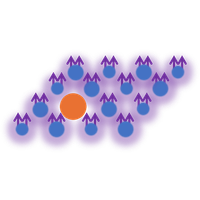
Weak-coupling theory of magic-angle twisted bilayer graphene

Jihang Zhu, Iacopo Torre, Marco Polini, and A. H. MacDonald

Phys. Rev. B 110, L121117 (2024) - Published 20 September, 2024

The discovery of exotic properties in magic-angle twisted bilayer graphene (MATBG) established two-dimensional moiré structures as an exciting new platform for strongly correlated physics. The distinct features of MATBG include a fourfold spin-valley flavor degeneracy and two extraordinarily flat topologically fragile low-energy bands. Here, the authors seek to gain new insights into MATBG physics by applying RPA theory, which accounts for dynamic screening of long-range Coulomb interactions and establishes the crucial influence of correlations in compressible metallic states in expanding unbroken symmetry regions in the MATBG phase diagram.

Electronic excitations in the bulk of fractional quantum Hall states

Xinlei Yue and Ady Stern

Phys. Rev. B 110, 115428 (2024) - Published 19 September, 2024

Tunneling electrons into fractional quantum Hall states is a potential probe for the fractionalization process. Here, the authors explore this process using composite fermion theory. They demonstrate how the long-range interaction dresses and shapes the electron spectral function to evolve from gapped sharp peaks to a possibly gapped continuum as the filling factor approaches compressible values.

Bipartite Sachdev-Ye models with Read-Saleur symmetries

J. Classen-Howes, P. Fendley, A. Pandey, and S. A. Parameswaran

Phys. Rev. B 110, 125140 (2024) - Published 19 September, 2024

The authors introduce and analyze a novel example of a nonlocal model that violates the eigenstate thermalization hypothesis via Hilbert space fragmentation. This fragmentation manifests itself through the presence of a highly degenerate null space. The commutant algebra responsible for the fragmentation is a subalgebra of the Read-Saleur commutant of Temperley-Lieb models. The model studied resembles the Sachdev-Ye model, and its low-energy correlators are analyzed using similar techniques. Perturbations leading to quantum many-body scarring in the model are also considered.

Nonlocal electrodynamics and the penetration depth of superconducting Sr2RuO4

Henrik S. Røising, Andreas Kreisel, and Brian M. Andersen

Phys. Rev. B 110, 094511 (2024) - Published 17 September, 2024

The low-temperature behavior of the penetration depth of a superconductor can be used to infer properties of low-energy quasiparticles. Due to the large size of the Cooper pair at the nodal region, nonlocal corrections need to be taken into account even in type-II superconductors. The authors calculate the penetration depth for a multiband superconductor with multiple nodes and compare it to penetration-depth measurements on Sr2RuO4 to evaluate what can be learned about the superconducting state in this material.

Revealing hidden medium-range order in silicate glass formers using many-body correlation functions

Zhen Zhang and Walter Kob

Phys. Rev. B 110, 104203 (2024) - Published 17 September, 2024

The medium-range order in amorphous systems is believed to be related to quantities like dynamic heterogeneity, glass-formation ability, or the elastic properties of the glass. So far, however, there has been no simple way to characterize this order. Here, the authors use a novel many-body correlation function that allows to characterize this order. Applying this approach to sodium silicate glasses reveals that in these systems the temperature and compositional dependence of the medium-range order is surprisingly complex.

Sliding-dependent electronic structures of alternating-twist tetralayer graphene

Kyungjin Shin, Jiseon Shin, Yoonsung Lee, Hongki Min, and Jeil Jung

Phys. Rev. B 110, 115136 (2024) - Published 17 September, 2024

Unlike twisted bilayer graphene (TBG), the electronic structures of alternating-twist tetralayer graphene (ATTG) vary with sliding between layers. Here, the authors model the system as two vertically stacked equal twist angle TBG layers. They specifically explore how three sliding geometries (AA, AB, and SP) affect its electronic and optical properties, including valley Chern numbers. The results of optical conductivity and self-consistent Hartree band structures provide deeper insights into ATTG with various sliding configurations and offer potential experimental fingerprints.

Superconducting penetration depth through a Van Hove singularity: Sr2RuO4 under uniaxial stress

Eli Mueller, Yusuke Iguchi, Fabian Jerzembeck, Jorge O. Rodriguez, Marisa Romanelli, Edgar Abarca-Morales, Anastasios Markou, Naoki Kikugawa, Dmitry A. Sokolov, Gwansuk Oh, Clifford W. Hicks, Andrew P. Mackenzie, Yoshiteru Maeno, Vidya Madhavan, and Kathryn A. Moler

Phys. Rev. B 110, L100502 (2024) - Published 17 September, 2024

Determining the symmetry of the superconducting gap in Sr2RuO4​ is a critical challenge in the field of unconventional superconductivity. To probe the gap’s structure in k space, this study uses strain to tune the material’s band structure through a Van Hove singularity (VHS), while imaging the superconductivity with scanning SQUID microscopy. The authors observe a peak in the superfluid density at the VHS and demonstrate a T2-dependent temperature behavior of the penetration depth across the entire strain range. These results are consistent with the presence of vertical line nodes in the superconducting gap, and confirm that nonlocal effects in the Meissner screening can lead to T2 behavior in the penetration depth, rather than the T-linear behavior typically expected for vertical line nodes.

Evidence for vertical line nodes in Sr2RuO4 from nonlocal electrodynamics

J. F. Landaeta, K. Semeniuk, J. Aretz, K. R. Shirer, D. A. Sokolov, N. Kikugawa, Y. Maeno, I. Bonalde, J. Schmalian, A. P. Mackenzie, and E. Hassinger

Phys. Rev. B 110, L100503 (2024) - Published 17 September, 2024

Sr2RuO4 is a well-characterized unconventional superconductor, but its gap structure remains unresolved. Here, the authors determine the magnetic penetration depth from precise measurements of the upper and lower critical fields via ac susceptibility on a spherical sample with a very low impurity concentration. Instead of impurities, nonlocal electrodynamics causes the observed T2 temperature dependence in the low-temperature limit. Furthermore, the data agree with a superconducting gap having purely vertical line nodes but not with one having purely horizontal line nodes.

Linear magnetoelectric electro-optical effect

D. J. P. de Sousa, C. O. Ascencio, and Tony Low

Phys. Rev. B 110, 115421 (2024) - Published 16 September, 2024

Berry curvature and the magnetic moment of Bloch electrons in quantum materials yield unexpected electro-optical effects. Here, the authors derive a generalized constitutive relation for current response in electrically biased systems using semiclassical Boltzmann theory. They uncover a magnetoelectric electro-optical effect requiring broken time-reversal or inversion symmetry. This work reveals how Berry curvature and magnetic moment textures in Bloch bands can lead to unique electromagnetic signatures, potentially enabling new ways to manipulate light in quantum materials.

Chiral Stoner magnetism in Dirac bands

Zhiyu Dong and Leonid Levitov

Phys. Rev. B 110, 104420 (2024) - Published 13 September, 2024

Stoner magnetism in bands with Berry curvature features a coupling between spin chirality density and Berry’s orbital magnetism, arising without microscopic spin-orbital interactions. Carriers moving in a spin texture perceive it as a geometric magnetic field coupled to their orbital motion through a spin-dependent gauge field. This emergent spin-orbital interaction, previously predicted to enable chiral magnons at system boundaries, also favors chiral spin textures such as skyrmions – topologically protected, particle-like objects stabilized in the ground state.

Terahertz and gigahertz magnetoratchets in graphene-based two-dimensional metamaterials

M. Hild, E. Mönch, L. E. Golub, I. A. Dmitriev, I. Yahniuk, K. Amann, J. Amann, J. Eroms, J. Wunderlich, D. Weiss, C. Consejo, C. Bray, K. Maussang, F. Teppe, J. Gumenjuk-Sichevska, K. Watanabe, T. Taniguchi, and S. D. Ganichev

Phys. Rev. B 110, 125303 (2024) - Published 13 September, 2024

Here, the authors study the ratchet effect – the conversion of alternating fields in the terahertz and gigahertz range into direct current – using a 2D metamaterial formed by monolayer graphene and a nearby gate with an array of triangular holes. A combined experimental and theoretical study shows that application of magnetic field leads to giant enhancement of the ratchet current and emergence of quantum magneto-oscillations, also featuring a complex Fano shape of the cyclotron resonance and well-pronounced electron spin resonance.

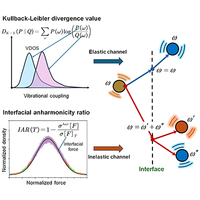
Metric for quantifying elastic and inelastic thermal transport at interfaces

Yixin Xu and Yanguang Zhou

Phys. Rev. B 110, 115305 (2024) - Published 12 September, 2024

Quantifying elastic and inelastic phonon scattering at interfaces is critical for designing corresponding devices with desired thermal properties. However, a general metric for quickly characterizing the contributions to interfacial thermal conductance from elastic and inelastic phonon scattering processes is lacking. Here, the authors introduce a general metric based on the Kullback-Leibler divergence and interfacial anharmonic ratio to quickly assess the contributions to interfacial thermal conductance from elastic and inelastic phonon scattering.

Unified model for probing solar cell dynamics via cyclic voltammetry and impedance spectroscopy

Victor Lopez-Richard, Luiz A. Meneghetti, Jr., Gabriel L. Nogueira, Fabian Hartmann, and Carlos F. O. Graeff

Phys. Rev. B 110, 115306 (2024) - Published 12 September, 2024

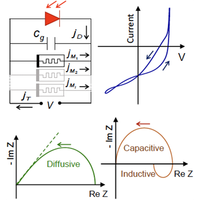
This paper presents a unified framework for analyzing cyclic voltammetry and impedance spectroscopy in solar cells. By integrating diffusive transport and nonequilibrium carrier dynamics, the authors explain complex capacitive and inductive responses, offering analytical expressions for current-voltage behavior. The model predicts how external factors like bias and illumination impact impedance, extending beyond perovskites and memristors. This approach provides insights into the microscopic mechanisms of device performance, highlighting how external stimuli modulate charge transport in a wide range of photovoltaic technologies.

Sign In to Your Journals Account

Filter

Section

Filter

Article Lookup

Enter a citation