Highlights

Interplay between many-body correlations, strain, and lattice relaxation in twisted bilayer graphene

Lorenzo Crippa, Gautam Rai, Dumitru Călugăru, Haoyu Hu, Jonah Herzog-Arbeitman, B. Andrei Bernevig, Roser Valentí, Giorgio Sangiovanni, and Tim Wehling

Phys. Rev. B 113, L241112 (2026) - Published 17 June, 2026

Here, the authors explain a set of experimental features that, while ubiquitously observed in twisted bilayer graphene samples, have so far eluded a unified theoretical description. A broad range of spectral, response, and thermodynamic properties in twisted bilayer graphene is accurately described microscopically and traced to the interplay of electronic correlations, lattice strain, and structural relaxation. The results are in excellent agreement with multiple recent experiments including scanning tunneling and quantum twisting microscopy experiments.

Search for magnetoacoustic quantum oscillations in the insulating phase of YbB12

Ryosuke Kurihara, Atsuhiko Miyata, Koji Araki, Shusaku Imajo, Ruo Hibino, Atsushi Miyake, Sergei Zherlitsyn, Joachim Wosnitza, Hiroshi Yaguchi, Fumitoshi Iga, Masashi Tokunaga, and Yasuhiro H. Matsuda

Phys. Rev. B 113, 235129 (2026) - Published 16 June, 2026

Quantum oscillations in the Kondo insulator YbB12 challenge the conventional understanding that insulators lack Fermi surfaces. Here, the authors perform ultrasonic measurements in high magnetic fields to search for magnetoacoustic quantum oscillations within the insulating phase. While oscillations are clearly observed in transport and magnetocaloric measurements, no corresponding signal is detected in the elastic constant. This contrast highlights a key inconsistency in the current understanding of quantum oscillations in insulators and provides new insight into the exotic electronic state of YbB12.

Beyond trotterization: Variational product formulas for quantum simulation

Ibsal Assi, Michael Vogl, Meenu Kumari, and J. P. F. LeBlanc

Phys. Rev. B 113, 214314 (2026) - Published 15 June, 2026

The authors introduce here a variational splitting scheme for the time-evolution operator that surpasses standard Trotter-Suzuki decompositions. Unlike typical variational methods, this framework works directly in operator space, providing globally valid results irrespective of the targeted initial state. The method generalizes naturally to a wide range of applications in condensed matter physics and beyond. In particular, it enables quantum circuits with lower gate counts and higher accuracy than Trotter-based formulas, making it useful for near-term quantum computing.

Tuning terahertz optomechanics of MoS2 bilayers with homogeneous in-plane strain

S. Patel, Jose D. Mella, S. Puri, Salvador Barraza-Lopez, and H. Nakamura

Phys. Rev. B 113, L220104 (2026) - Published 15 June, 2026

Strain engineering in van der Waals bilayers offers a route to nonlinear mechanical control at the THz regime. Here, the authors use ultralow-frequency Raman spectroscopy and first-principles calculations on 2H and 2R MoS2 bilayers to demonstrate that biaxial tensile strain contracts the interlayer van der Waals gap via a Poisson effect. This contraction hardens the interlayer breathing modes, driving the structure into a highly repulsive intermolecular regime characterized by a large Grüneisen parameter.

Boosted magnetic fluctuations at the onset of superconductivity in UTe2 beyond 40 T

T. Thebault, K. Somesh, G. Lapertot, M. Nardone, A. Zitouni, M. Barragan, J. Béard, J. Billette, F. Lecouturier-Dupouy, S. Tardieu, D. Aoki, G. Knebel, D. Braithwaite, and W. Knafo

Phys. Rev. B 113, L220503 (2026) - Published 15 June, 2026

Multiple triplet-candidate unconventional superconducting phases have been reported in the heavy-fermion compound UTe2. Here, the authors find an enhancement of the electrical resistivity Fermi liquid coefficient A at a metamagnetic transition preceding the onset of superconductivity in magnetic fields higher than 40 T. The enhancement of A is attributed to a magnetic fluctuation mode probably in play for the mechanism of this superconducting phase.

Hund's coupling governed orbital-selective superconductivity in Ba1−xKxFe2As2

Elena Corbae, Rong Zhang, Cong Li, Kunihiro Kihou, Chul-Ho Lee, Makoto Hashimoto, Thomas Devereaux, Oscar Tjernberg, Egor Babaev, Dung-Hai Lee, Vadim Grinenko, Donghui Lu, and Zhi-Xun Shen

Phys. Rev. B 113, 224517 (2026) - Published 12 June, 2026

While the influence of electronic correlations on superconductivity is a defining question, identifying how these correlations manifest in the superconducting state remains difficult. Furthermore, in multiorbital systems, correlations driven by Hund’s coupling can differentiate the behavior of individual orbitals, and how such orbital selectivity governs superconducting pairing has remained largely unexplored experimentally. Here, the authors use angle-resolved photoemission spectroscopy to experimentally determine the superconducting gap of a representative iron-based superconductor as the Hund’s coupling influence increases. They find increased correlation diminishes the superconducting gap in an orbital-selective way, suggesting that Hund’s coupling plays a central role in shaping pairing in multiorbital superconductors.

Three-dimensional spin-orbital liquids

Anna Sandberg, Lukas Rødland, and Maria Hermanns

Phys. Rev. B 113, 235120 (2026) - Published 12 June, 2026

Here, the authors introduce exactly solvable three-dimensional spin–orbital liquids that generalize Kitaev models using multiple Majorana flavors. They show that these systems realize a unifying landscape of Majorana metals with topological Fermi surfaces, nodal lines, and Weyl points, and show how symmetry and flavor mixing control their splitting, stability, and topological transitions. This provides an organizing framework for gapless fractionalized quantum spin liquid phases in three dimensions.

Lieb-Robinson causality and non-Fermi liquids

Subham Dutta Chowdhury, Aditya Hebbar, and Sean A. Hartnoll

Phys. Rev. B 113, 245125 (2026) - Published 12 June, 2026

Here, the authors show that the Lieb-Robinson causality bound, a fundamental result in quantum lattice physics, implies a first-principles and model-independent bound on certain non-Fermi liquid coupling constants. The work demonstrates that methods from the modern S-matrix bootstrap in high-energy physics — in particular, analyticity constraints in both the complex energy and momentum planes — can be adapted to condensed matter lattice models.

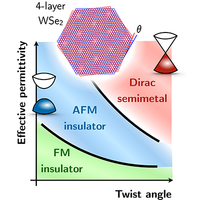
Dirac quantum criticality in twisted double bilayer transition metal dichalcogenides

Jan Biedermann and Lukas Janssen

Phys. Rev. B 113, 245123 (2026) - Published 11 June, 2026

Quantum criticality involving Dirac fermions has long been studied theoretically but has remained difficult to access experimentally. Here, the authors predict that twisted double bilayer transition metal dichalcogenides, such as WSe2, host a Dirac quantum critical point accessible by tuning the twist angle or applying uniaxial pressure. The semimetal-to-insulator transition is continuous and governed by Gross-Neveu-Heisenberg criticality with emergent Lorentz symmetry.

Edge spin galvanic effect in altermagnets

L. E. Golub

Phys. Rev. B 113, L220404 (2026) - Published 11 June, 2026

The authors predict here an edge spin galvanic effect in d-wave altermagnets, where nonequilibrium spin polarization generates an electric current flowing along the sample edge. The effect originates from the interplay of altermagnetic spin splitting and edge scattering, is sensitive to edge orientation, and reverses upon reversal of the Néel vector. The work also proposes a pure spin edge photocurrent induced by polarized radiation, analyzes its frequency dependence, and demonstrates its conversion into an electric current by an external magnetic field.

Theory for lattice relaxation in marginally twisted bilayers

Christophe De Beule, Gayani N. Pallewela, Mohammed M. Al Ezzi, Liangtao Peng, E. J. Mele, and Shaffique Adam

Phys. Rev. B 113, L241402 (2026) - Published 10 June, 2026

At small twist angles, two-dimensional moiré materials behave more like elastic membranes than rigid crystals, and structural reconstruction becomes increasingly dramatic as the twist angle decreases. Existing treatments rely on numerical simulations that fail due to the enormous atom count in the moiré cell. Here, the authors establish an analytical theory for relaxation in the regime of marginal twists, characterized by a single parameter and enabling accurate predictions in agreement with experiments on twisted bilayer graphene and transition metal dichalcogenides.

Dichotomy theorem separating complete integrability and nonintegrability of isotropic spin chains

Naoto Shiraishi and Mizuki Sanatani

Phys. Rev. B 113, L241111 (2026) - Published 9 June, 2026

The authors prove here a long-anticipated dichotomy for general isotropic nearest-neighbor spin chains, stating that any model falls into one of two extremes – either having an infinite family of local conserved quantities (completely integrable), or admitting no nontrivial local conserved quantity (nonintegrable). This rules out intermediate models with only finitely many local conserved quantities. The authors also provide a simple criterion for deciding which case holds, greatly reducing the work needed to diagnose integrability.

Affine transformations for purely anisotropic cloaking in flexural elastic thin plates

Léo Pradier, Baptiste Chomette, Manuel Collet, Grégoire Pizon, Morvan Ouisse, Valentin Rapine, and Arnaud Hubert

Phys. Rev. B 113, 214307 (2026) - Published 8 June, 2026

The problem of bending wave cloaking in thin elastic plates is a longstanding theoretical and engineering challenge due to the dispersive nature of guided bending waves. The approach proposed here establishes a theoretical framework and a design methodology allowing manufacturability of a unidirectional cloaking proof of concept using composite materials. The authors present numerical and experimental evidence of the broadband performances associated with the proposed cloaking implementation.

Theory of relaxation and its effects on the electronic structure in twisted systems

Junxi Yu, Bingbing Wang, and Cheng-Cheng Liu

Phys. Rev. B 113, 245118 (2026) - Published 8 June, 2026

Here, the authors present an analytical and physically transparent theory of lattice relaxation in twisted systems. They show how the balance between intralayer elasticity and interlayer adhesion determines the relaxation pattern, and how this pattern can be analytically embedded into moiré electronic Hamiltonians. The work reveals how relaxation reshapes flat bands and shifts topological transitions toward experimentally relevant twist angles.

Polar and quadratic magneto-optical Kerr effects in nonmagnetic/ferromagnet bilayers for spin-orbit torque measurements

Yukihiro Marui, Masashi Kawaguchi, Kohji Nakamura, and Masamitsu Hayashi

Phys. Rev. B 113, 214419 (2026) - Published 5 June, 2026

Spin orbit torque is one of the key technologies in developing next-generation spintronic devices. Various approaches have been developed to characterize the efficiency of spin orbit torque. Recent studies suggest that the optical approach provides a better means to study the efficiency compared to the conventional electrical approach. Here, the authors clarify the reason behind this. It is the small quadratic component of the magneto-optical Kerr effect compared to its polar counterpart that defines the high accuracy.

Engineering magnetic anisotropy and ferromagnetism in the topological kagome metal GdV6Sn6 via Nd substitution

Santosh Karki Chhetri, M. M. Sharma, Jian Wang, Dinesh Upreti, Gokul Acharya, Md Rafique Un Nabi, and Jin Hu

Phys. Rev. B 113, 224417 (2026) - Published 4 June, 2026

Rare-earth engineering offers a route to tune the coupling between magnetism and transport in kagome metals. Here, the authors show that replacing Gd with Nd in GdV6Sn6 preserves the V-based kagome framework while switching the magnetic anisotropy from easy plane to easy axis. Magnetotransport crosses over from spin-scattering-driven negative magnetoresistance at low fields to positive orbital magnetoresistance at high fields, accompanied by a twofold-to-fourfold angular evolution that disentangles magnetic and electronic anisotropy.

Regularized universal topological markers for Dirac systems

Yulin Qin, Chang-An Li, and Jian Li

Phys. Rev. B 113, 214201 (2026) - Published 3 June, 2026

Topological markers provide a powerful real-space characterization of topological systems, but they typically suffer from irregular behavior at boundaries. Here, using position operators compatible with periodic boundary conditions, the authors develop a regularized universal topological marker that eliminates the spurious boundary irregularities and connects rigorously to the global topological invariants in different symmetry classes. This new local marker further serves to effectively detect disorder-driven topological phase transitions.

Influence of controlled disorder on the dipolar spin-ice state of Ho-based pyrochlores

Adam A. Aczel, Brenden R. Ortiz, Yi Luo, Ganesh Pokharel, Paul M. Sarte, Clarina dela Cruz, Jue Liu, Gabriele Sala, Stephen D. Wilson, Benjamin A. Frandsen, and Joseph A. M. Paddison

Phys. Rev. B 113, 214415 (2026) - Published 3 June, 2026

The dipolar spin ice ground state is an exotic magnetic phase with degenerate spin configurations analogous to proton ordering in water ice. Here, the authors show that the dipolar spin ice state persists in holmium-based pyrochlores with different types of nonmagnetic site mixing, even when significant disorder-induced modifications to the crystal structure are observed at both the global and local level.

Superconductivity from the Slater mode: Application to KTaO3 heterostructures

M. R. Norman

Phys. Rev. B 113, 224506 (2026) - Published 3 June, 2026

Coupling of electrons to transverse-polarized phonons is usually weak in the long wavelength limit but becomes stronger when coupling orbitals with different symmetries. There have been claims in the literature that this is the driving force for superconductivity in nearly ferroelectric materials like SrTiO3. Here, the author applies these ideas to KTaO3, finding that coupling to these soft phonons can cause significant anisotropy of the superconducting order parameter due to the forward scattering nature of this interaction.

Linear static and dynamic glassy magnetoelectric response without long-range magnetic order in cluster-glass CuMn2O4

A. Hati, J. K. Dey, S. Nandy, A. Kumar, S. D. Kaushik, N. Mondal, O. Ivashko, S. Majumdar, and S. Giri

Phys. Rev. B 113, 214402 (2026) - Published 1 June, 2026

Despite the conventional requirement of simultaneous spatial inversion and time-reversal symmetry breaking for magnetoelectric (ME) coupling, the authors demonstrate here a linear ME effect without long-range magnetic order, evidenced by the lack of magnetic Bragg peaks in neutron diffraction. Remarkably, a novel glassy ME response is also uncovered, closely linked to the cluster-glass state. The coexistence of static linear and glassy ME responses in the cluster-glass regime raises fundamental questions about the nature of symmetry-driven ME coupling in disordered magnetic systems.

Sign In to Your Journals Account

Filter

Section

Filter

Article Lookup

Enter a citation