Browse by Subject

From Hi-C Contact Map to Three-Dimensional Organization of Interphase Human Chromosomes

Guang Shi and D. Thirumalai

Phys. Rev. X 11, 011051 (2021) - Published 15 March, 2021

A new computational method solves a major problem in biology—how to obtain 3D coordinates of positions on chromosomes from 2D “contact maps” that encode distances between the positions.

Competition, Collaboration, and Optimization in Multiple Interacting Spreading Processes

Hanlin Sun, David Saad, and Andrey Y. Lokhov

Phys. Rev. X 11, 011048 (2021) - Published 10 March, 2021

To predict and control the spread of collaborative epidemics or competing marketing campaigns, new computationally efficient algorithms offer crucial insights in scenarios where multiple processes interact.

Emergence of Polarized Ideological Opinions in Multidimensional Topic Spaces

Fabian Baumann, Philipp Lorenz-Spreen, Igor M. Sokolov, and Michele Starnini

Phys. Rev. X 11, 011012 (2021) - Published 20 January, 2021

By embedding opinions in a nonorthogonal topic space, a new model shows that a reinforcement mechanism driven by homophilic social interactions reproduces extreme and correlated opinion states found in surveys.

Magnetic Moments of Short-Lived Nuclei with Part-per-Million Accuracy: Toward Novel Applications of β-Detected NMR in Physics, Chemistry, and Biology

R. D. Harding et al.

Phys. Rev. X 10, 041061 (2020) - Published 28 December, 2020

Experiments determine the magnetic moment of a short-lived nucleus with parts-per-million accuracy, an improvement by several orders of magnitude thanks to a β-NMR setup at CERN.

Modeling the Spatiotemporal Epidemic Spreading of COVID-19 and the Impact of Mobility and Social Distancing Interventions

Alex Arenas, Wesley Cota, Jesús Gómez-Gardeñes, Sergio Gómez, Clara Granell, Joan T. Matamalas, David Soriano-Paños, and Benjamin Steinegger

Phys. Rev. X 10, 041055 (2020) - Published 18 December, 2020

A new model tailored to describe the spread of COVID-19 provides an analytic expression for the effective reproduction number R in terms of various containment attempts, a key parameter in slowing the spread of the virus.

Public Discourse and Social Network Echo Chambers Driven by Socio-Cognitive Biases

Xin Wang, Antonio D. Sirianni, Shaoting Tang, Zhiming Zheng, and Feng Fu

Phys. Rev. X 10, 041042 (2020) - Published 1 December, 2020

Social media interactions with friends and political campaigns can lead to the emergence of polarized echo chambers of thought.

Modeling COVID-19 Dynamics in Illinois under Nonpharmaceutical Interventions

George N. Wong, Zachary J. Weiner, Alexei V. Tkachenko, Ahmed Elbanna, Sergei Maslov, and Nigel Goldenfeld

Phys. Rev. X 10, 041033 (2020) - Published 16 November, 2020

A new model helps clarify the limits of pandemic predictions, which are notoriously difficult for the near future and impossible for longer timescales.

Effective Potential Description of the Interaction between Single Stem Cells and Localized Ligands

Ignacio Bordeu, Clare Garcin, Shukry J. Habib, and Gunnar Pruessner

Phys. Rev. X 10, 041022 (2020) - Published 30 October, 2020

An analysis of cell-ligand interactions from a statistical mechanics perspective shows cells act as effective force-field generators, actively organizing their environment.

Two-Dimensional Partial-Covariance Mass Spectrometry of Large Molecules Based on Fragment Correlations

Taran Driver, Bridgette Cooper, Ruth Ayers, Rüdiger Pipkorn, Serguei Patchkovskii, Vitali Averbukh, David R. Klug, Jon P. Marangos, Leszek J. Frasinski, and Marina Edelson-Averbukh

Phys. Rev. X 10, 041004 (2020) - Published 6 October, 2020

Analysis of fluctuations in molecular fragmentation patterns reveals the structure and decomposition pathways of large, complex biomolecules.

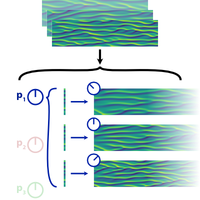
Extracting Interpretable Physical Parameters from Spatiotemporal Systems Using Unsupervised Learning

Peter Y. Lu, Samuel Kim, and Marin Soljačić

Phys. Rev. X 10, 031056 (2020) - Published 11 September, 2020

A new approach to analyzing systems with complex dynamics uses machine learning to extract physical parameters and predict their behavior all without knowledge of the underlying system.

Algorithmic Complexity of Multiplex Networks

Andrea Santoro and Vincenzo Nicosia

Phys. Rev. X 10, 021069 (2020) - Published 26 June, 2020

A new measure of complexity of multilayer networks shows that these systems can encode an optimal amount of additional information compared to their single-layer counterparts and provides a powerful tool for their analysis.

3D Spatial Exploration by E. coli Echoes Motor Temporal Variability

Nuris Figueroa-Morales, Rodrigo Soto, Gaspard Junot, Thierry Darnige, Carine Douarche, Vincent A. Martinez, Anke Lindner, and Éric Clément

Phys. Rev. X 10, 021004 (2020) - Published 6 April, 2020

Experiments show that bacteria constantly alter their exploration states—frequent directional changes and persistent swimming—which could provide insight into the onset of infections and the dynamics of microbial communities.

Complex Distributions Emerging in Filtering and Compression

G. J. Baxter, R. A. da Costa, S. N. Dorogovtsev, and J. F. F. Mendes

Phys. Rev. X 10, 011074 (2020) - Published 30 March, 2020

A simple filter for marking patterns in a binary sequence produces an output with similar statistics to cooperative systems such as spin glasses and neural networks, providing a potential tool for understanding the statistics in those systems as well.

Variational Method for Image-Based Inference of Internal Stress in Epithelial Tissues

Nicholas Noll, Sebastian J. Streichan, and Boris I. Shraiman

Phys. Rev. X 10, 011072 (2020) - Published 26 March, 2020

A new approach to inferring mechanical stress in living tissue provides a practical and noninvasive tool to experimentalists studying tissue and organ development.

Cumulative Merging Percolation and the Epidemic Transition of the Susceptible-Infected-Susceptible Model in Networks

Claudio Castellano and Romualdo Pastor-Satorras

Phys. Rev. X 10, 011070 (2020) - Published 24 March, 2020

During the spread of an epidemic, highly connected individuals can maintain infection throughout the population by reinfecting each other even when not in direct contact.

Spatial Patterns Emerging from a Stochastic Process Near Criticality

Fabio Peruzzo, Mauro Mobilia, and Sandro Azaele

Phys. Rev. X 10, 011032 (2020) - Published 12 February, 2020

Living systems operate near a critical point in their parameter space, which can allow researchers to predict spatial patterns that arise in a population of dynamic individuals.

Direct Measurement of the Impact of Teaching Experimentation in Physics Labs

Emily M. Smith, Martin M. Stein, Cole Walsh, and N. G. Holmes

Phys. Rev. X 10, 011029 (2020) - Published 10 February, 2020

Traditional physics labs can have a negative impact on student learning, whereas nontraditional inquiry-based labs improve performance and engagement while maintaining exam scores.

Conformal Quasicrystals and Holography

Latham Boyle, Madeline Dickens, and Felix Flicker

Phys. Rev. X 10, 011009 (2020) - Published 14 January, 2020

The boundary of a discrete spacetime is itself a discrete structure now dubbed a conformal quasicrystal, a fundamental new insight into ideas from holography that attempt to reconcile the conflict between general relativity and quantum physics.

Structural Invertibility and Optimal Sensor Node Placement for Error and Input Reconstruction in Dynamic Systems

Dominik Kahl, Philipp Wendland, Matthias Neidhardt, Andreas Weber, and Maik Kschischo

Phys. Rev. X 9, 041046 (2019) - Published 3 December, 2019

The state of complex systems such as power grids often masks external influences, a new analysis shows, but optimal sensor placement can reveal those inputs, leading to more robust system design.

Universal Rank-Order Transform to Extract Signals from Noisy Data

Glenn Ierley and Alex Kostinski

Phys. Rev. X 9, 031039 (2019) - Published 3 September, 2019

Based solely on ranking the data, a new symmetry-based perspective on white noise offers a robust and universal approach to statistical signal processing.

Sign In to Your Journals Account

Filter

Subject

Filter

Article Lookup

Enter a citation