Browse by Subject

Containing Epidemic Outbreaks by Message-Passing Techniques

F. Altarelli, A. Braunstein, L. Dall’Asta, J. R. Wakeling, and R. Zecchina

Phys. Rev. X 4, 021024 (2014) - Published 8 May, 2014

Computational epidemiology uses algorithms to identify and eradicate viruses. Researchers investigate targeted immunization as an optimization problem for a given choice of parameters and costs.

Driving Interconnected Networks to Supercriticality

Filippo Radicchi

Phys. Rev. X 4, 021014 (2014) - Published 22 April, 2014

“Going viral” is a familiar phrase in the world of social media, but fundamental scientific understanding of the mechanism(s) of “viral” spreading in interconnected multilayer networks is very limited. A new statistical-physics study reveals when and how fast spreading results from correlation between lateral (intralayer) and vertical (interlayer) spreading.

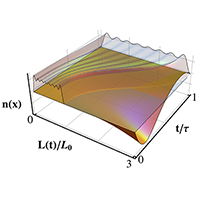
Classical and Quantum Shortcuts to Adiabaticity for Scale-Invariant Driving

Sebastian Deffner, Christopher Jarzynski, and Adolfo del Campo

Phys. Rev. X 4, 021013 (2014) - Published 22 April, 2014

A natural nonequilibrium process that takes a system from one equilibrium state to another in a short time always involves dissipation. But, it’s actually possible in quantum control to design and implement dissipationless “shortcuts” for quantum systems. Scientists add a few concrete practical tools for achieving this goal.

Sensing Viruses by Mechanical Tension of DNA in Responsive Hydrogels

Jaeoh Shin, Andrey G. Cherstvy, and Ralf Metzler

Phys. Rev. X 4, 021002 (2014) - Published 3 April, 2014

Could blowing your nose into a “smart tissue” help detect a viral infection? Theorists say “yes” with a proposal for such a smart tissue: a hydrogel film with embedded prestretched DNA molecules.

Hierarchical Block Structures and High-Resolution Model Selection in Large Networks

Tiago P. Peixoto

Phys. Rev. X 4, 011047 (2014) - Published 24 March, 2014

Social, technological, and biological networks are known to organize into modules or “communities.” Characterizing and identifying modules is highly nontrivial and still an outstanding problem in networks research. A new approach uses both the concept of modular hierarchy for network construction and the methods of statistical inference to address this problem, succeeding where the existing approaches see difficulties.

Common Physical Framework Explains Phase Behavior and Dynamics of Atomic, Molecular, and Polymeric Network Formers

Stephen Whitelam, Isaac Tamblyn, Thomas K. Haxton, Maria B. Wieland, Neil R. Champness, Juan P. Garrahan, and Peter H. Beton

Phys. Rev. X 4, 011044 (2014) - Published 21 March, 2014

Atoms, organic molecules, and polymerized DNA can all form polygon networks, despite enormous differences in their sizes and interactions. Scientists find the geometry, and strength of interactions, of building blocks to be the unifying factors for network assembly and codify them in the concept of an effective, material-dependent “patchy particle.”

Self-Consistent Approach to Global Charge Neutrality in Electrokinetics: A Surface Potential Trap Model

Li Wan, Shixin Xu, Maijia Liao, Chun Liu, and Ping Sheng

Phys. Rev. X 4, 011042 (2014) - Published 18 March, 2014

How to describe the “electric double layer” that is at the root of all electrokinetic phenomena such as electrophoresis and electro-osmosis? A new theoretical approach, introducing the concept of a surface potential trap and applying the constraint of global charge neutrality rigorously, answers this century-old question in the context of contemporary electrokinetics involving nanoscale systems and time-dependent electric fields.

Demonstration of Long-Lived High-Power Optical Waveguides in Air

N. Jhajj, E. W. Rosenthal, R. Birnbaum, J. K. Wahlstrand, and H. M. Milchberg

Phys. Rev. X 4, 011027 (2014) - Published 26 February, 2014

Laser filaments are a promising means of transporting light energy over long distances, but they can only carry an average power of a few watts, thus limiting certain applications. Experiments now overcome this limitation by demonstrating that the thermal wake of a bundle of filaments provides a long-lived air waveguide that can channel laser beams with an extremely high average power.

Subdiffraction-Limited Quantum Imaging within a Living Cell

Michael A. Taylor, Jiri Janousek, Vincent Daria, Joachim Knittel, Boris Hage, Hans-A. Bachor, and Warwick P. Bowen

Phys. Rev. X 4, 011017 (2014) - Published 4 February, 2014

Quantum effects may help devise new imaging schemes that can overcome classical constraints posed by noise and diffraction. By using squeezed states of light in photonic force microscopy (PFM), scientists have demonstrated a 14% quantum enhancement of PFM’s spatial resolution, imaging details of living yeast cells with a resolution of 10 nm.

Orientation-Dependent Handedness and Chiral Design

Efi Efrati and William T. M. Irvine

Phys. Rev. X 4, 011003 (2014) - Published 16 January, 2014

The handedness of an object has always been a binary concept: either left handed or right handed. Scientists now show that quantifying handedness as direction-dependent properties actually makes fundamental physical sense and can guide both our understanding of known handedness phenomena and design of materials with novel handed-response properties.

Collision of Akhmediev Breathers in Nonlinear Fiber Optics

B. Frisquet, B. Kibler, and G. Millot

Phys. Rev. X 3, 041032 (2013) - Published 19 December, 2013

Recently nonlinear fiber optics has revealed the existence of “breathers,” a new form of solitons with periodic oscillations on a finite background. But, how do such breathers, when they appear at the same time, interact with each other? A new experiment demonstrates that two such breathers, when their initial shapes and propagations are properly controlled, can collide to make a new giant “rogue” wave.

Mathematical Formulation of Multilayer Networks

Manlio De Domenico, Albert Solé-Ribalta, Emanuele Cozzo, Mikko Kivelä, Yamir Moreno, Mason A. Porter, Sergio Gómez, and Alex Arenas

Phys. Rev. X 3, 041022 (2013) - Published 4 December, 2013

A “monoplex” network, like a Facebook-based social network, can be represented by a set of nodes (people) linked by their Facebook connections (interactions). But real-world networks can be “multiplex,” with multiple types of interactions and where one type of interaction can influence another. A unifying framework for describing “multiplex” networks has been missing so far. Deftly employing the concept of tensors, theorists now present such a framework that will power studies of “multiplex” networks across many scientific disciplines.

Correlation of Positive and Negative Reciprocity Fails to Confer an Evolutionary Advantage: Phase Transitions to Elementary Strategies

Attila Szolnoki and Matjaž Perc

Phys. Rev. X 3, 041021 (2013) - Published 27 November, 2013

Why do humans cooperate with other unrelated humans? Correlated use of both a “reward” and a “punishment” strategy has been thought to be an evolutionary force underlying our predisposition for cooperation: if others are kind to us, we are kind to them; if they are exploitive, we may stop cooperating or tend to punish them. Recent human experiments show, however, that individuals mostly use one strategy or the other, rarely both. Now, statistical physical simulations of an evolutionary game model lend significant support to these findings.

Time-Shift Invariance Determines the Functional Shape of the Current in Dissipative Rocking Ratchets

José A. Cuesta, Niurka R. Quintero, and Renato Alvarez-Nodarse

Phys. Rev. X 3, 041014 (2013) - Published 18 November, 2013

Rocking ratchets are utilized in many different systems to create a directed current of energy or material and much of their behavior is universal across the systems. Scientists discover the time-shift invariance of the ratchet current to be the origin of the universality and based on this insight build a unified theory for rocking ratchets that can guide and interpret future research and applications.

Biofilm Growth and Fossil Form

A. P. Petroff, N. J. Beukes, D. H. Rothman, and T. Bosak

Phys. Rev. X 3, 041012 (2013) - Published 13 November, 2013

Stromatolites are fossilized remains of microbial mats that stopped growing billions of years ago. A large class of them have similar conical shapes. Understanding their growth dynamics would seem like a daunting task. However, positing diffusion of calcium ions and inorganic carbon-based molecules in microbial mats and their diffusion-limited precipitation as the primary growth mechanisms, a mathematical model not only successfully predicts the conical shape but also concludes that the thickness of the ancient microbial mats was similar to that of modern-day mats.

Microfluidic Microdialysis: Spatiotemporal Control over Solution Microenvironments Using Integrated Hydrogel Membrane Microwindows

Joel S. Paustian, Rodrigo Nery Azevedo, Sean-Thomas B. Lundin, Matthew J. Gilkey, and Todd M. Squires

Phys. Rev. X 3, 041010 (2013) - Published 4 November, 2013

Inspired by the two-step circulation-diffusion distribution strategy of human circulatory system, scientists have developed “hydrogel membrane microwindows” in microfludic devices as a powerful and versatile means to establish and manipulate chemical and electric-field gradients with speed.

Information Processing and the Second Law of Thermodynamics: An Inclusive, Hamiltonian Approach

Sebastian Deffner and Christopher Jarzynski

Phys. Rev. X 3, 041003 (2013) - Published 17 October, 2013

Coupling thermodynamics together with information processing is highly nontrivial conceptually, as demonstrated by the notion of Maxwell’s demon. Theorists present a fundamental framework that generalizes the second law of thermodynamics to include the physical effects of information processing.

Stochastic Model for the Vocabulary Growth in Natural Languages

Martin Gerlach and Eduardo G. Altmann

Phys. Rev. X 3, 021006 (2013) - Published 14 May, 2013

What cultural and social processes determine the size and growth of the vocabulary of a natural language? Does such a vocabulary grow forever? From large text databases, such as the Google Ngram, that have become available only recently, researchers tease out new and systematic insights into these fundamental questions and develop a mathematical model with predictive power that describes vocabulary growth as a simple stochastic process.

Nonlinearity of a Voltage-Gated Potassium Channel Revealed by the Mechanical Susceptibility

Amila Ariyaratne and Giovanni Zocchi

Phys. Rev. X 3, 011010 (2013) - Published 11 February, 2013

Voltage-gated ion channels regulate the flows of sodium or potassium ions across nerve cell membranes. A new study of a model potassium channel reveals that behind the channel’s regulation of the ion flow lies a viscoelastic molecular structural behavior similar to that of Silly Putty.

Probing Ordered Lipid Assemblies with Polarized Third-Harmonic-Generation Microscopy

Maxwell Zimmerley, Pierre Mahou, Delphine Débarre, Marie-Claire Schanne-Klein, and Emmanuel Beaurepaire

Phys. Rev. X 3, 011002 (2013) - Published 14 January, 2013

A proof-of-principle experiment based on multi-scale theoretical modeling demonstrates the promise of polarization-sensitive third-harmonic-generation microscopy for imaging molecular order in biological tissues in situ.

Sign In to Your Journals Account

Filter

Subject

Filter

Article Lookup

Enter a citation