Browse by Subject

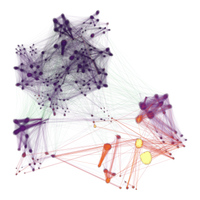
Network Reconstruction via the Minimum Description Length Principle

Tiago P. Peixoto

Phys. Rev. X 15, 011065 (2025) - Published 20 March, 2025

A new information-theoretic approach to analyzing complex systems uncovers hidden networks by minimizing data complexity, a method that improves accuracy and efficiency.

High Capacity and Dynamic Accessibility in Associative Memory Networks with Context-Dependent Neuronal and Synaptic Gating

William F. Podlaski, Everton J. Agnes, and Tim P. Vogels

Phys. Rev. X 15, 011057 (2025) - Published 13 March, 2025

A new associative memory model brings dynamic memory recall to the fore, offering a framework that is amenable to analysis while being much closer than existing models to how biological memory works.

Mechanical Tuning of Residual Stress, Memory, and Aging in Soft Glassy Materials

Paolo Edera, Minaspi Bantawa, Stefano Aime, Roger T. Bonnecaze, and Michel Cloitre

Phys. Rev. X 15, 011043 (2025) - Published 25 February, 2025

Pasty materials store mechanical memory through local stress distributions. By periodically shearing them, their memory can be controlled or erased, offering insights for optimizing materials in coatings, composites, and consumer products.

Chaperone-Driven Entropic Separation of Amyloid Nanofilament Bundles

Jose M. G. Vilar, J. Miguel Rubi, and Leonor Saiz

Phys. Rev. X 15, 011041 (2025) - Published 24 February, 2025

New insight into how molecular chaperones break apart toxic protein deposits that form amyloid fibrils sheds light on strategies to target these deposits in diseases like Alzheimer’s and Parkinson’s.

Interfacial Morphodynamics of Proliferating Microbial Communities

Alejandro Martínez-Calvo, Carolina Trenado-Yuste, Hyunseok Lee, Jeff Gore, Ned S. Wingreen, and Sujit S. Datta

Phys. Rev. X 15, 011016 (2025) - Published 29 January, 2025

The shape of interfaces between domains of differing cell types arises from differences in cell proliferation rates and substrate friction, an insight that offers a biophysical basis for understanding such interfaces in microbial communities.

Recurrences Reveal Shared Causal Drivers of Complex Time Series

William Gilpin

Phys. Rev. X 15, 011005 (2025) - Published 13 January, 2025

Many complex systems are driven by unobserved causal forces. A new physics-based algorithm can reconstruct such hidden causes from downstream signals.

Furutsu-Novikov–like Cross-Correlation–Response Relations for Systems Driven by Shot Noise

Jakob Stubenrauch and Benjamin Lindner

Phys. Rev. X 14, 041047 (2024) - Published 18 November, 2024

Model-independent relations between fluctuation and response statistics for systems driven by random pulses, derived for the first time, could have applications for collective neural dynamics and single photon detection.

Robust Edge Flows in Swarming Bacterial Colonies

He Li, Hugues Chaté, Masaki Sano, Xia-qing Shi, and H. P. Zhang

Phys. Rev. X 14, 041006 (2024) - Published 7 October, 2024

A study of the multiscale colony dynamics of Paenibacillus vortex bacteria reveals robust edge flows originating from an asymmetry in the motion of individual bacteria, demonstrating how biological chirality transfers across scales.

Decomposing Thermodynamic Dissipation of Linear Langevin Systems via Oscillatory Modes and Its Application to Neural Dynamics

Daiki Sekizawa, Sosuke Ito, and Masafumi Oizumi

Phys. Rev. X 14, 041003 (2024) - Published 4 October, 2024

A novel theoretical relation, linking oscillatory phenomena to entropy production rate, offers new insights into how brain waves cause the irreversibility of neural dynamics.

How to Measure the Controllability of an Infectious Disease?

Kris V. Parag

Phys. Rev. X 14, 031041 (2024) - Published 4 September, 2024

A new model of epidemics describes infections as part of a feedback loop—an approach that might one day help optimize interventions such as social distancing and lockdowns.

Higher-Order Null Models as a Lens for Social Systems

Giulia Preti, Adriano Fazzone, Giovanni Petri, and Gianmarco De Francisci Morales

Phys. Rev. X 14, 031032 (2024) - Published 20 August, 2024

New models of social systems as directed hypergraphs reveal how group dynamics play a crucial role in shaping social systems across various domains like politics, epidemiology, and economics.

Noisy Circumnutations Facilitate Self-Organized Shade Avoidance in Sunflowers

Chantal Nguyen, Imri Dromi, Ahron Kempinski, Gabriella E. C. Gall, Orit Peleg, and Yasmine Meroz

Phys. Rev. X 14, 031027 (2024) - Published 15 August, 2024

Broadly distributed plant movements serve as “functional noise.” This new insight provides a framework for studying plant navigation based on task oriented processes, optimization, and active sensing.

Nonequilibrium Antigen Recognition during Infections and Vaccinations

Roberto Morán-Tovar and Michael Lässig

Phys. Rev. X 14, 031026 (2024) - Published 14 August, 2024

A new analysis identifies a specific molecular recognition process that allows B cells in the human immune system to produce a potent, specific, and fast response during acute infections.

Tracking the Distance to Criticality in Systems with Unknown Noise

Brendan Harris, Leonardo L. Gollo, and Ben D. Fulcher

Phys. Rev. X 14, 031021 (2024) - Published 8 August, 2024

A new method of detecting criticality from time-series data outperforms conventional metrics in the presence of variable noise levels for both simulated systems and real neural recordings.

How Deep Neural Networks Learn Compositional Data: The Random Hierarchy Model

Francesco Cagnetta, Leonardo Petrini, Umberto M. Tomasini, Alessandro Favero, and Matthieu Wyart

Phys. Rev. X 14, 031001 (2024) - Published 1 July, 2024

A hierarchical model of high-dimensional data reveals how deep neural networks leverage their multiple layers to reduce the data dimensionality and learn from a finite set of examples.

In Situ Magnetometry of Iron in Human Dopaminergic Neurons Using Superresolution MRI and Ion-Beam Microscopy

Malte Brammerloh, Renat Sibgatulin, Karl-Heinz Herrmann, Markus Morawski, Tilo Reinert, Carsten Jäger, Roland Müller, Gerald Falkenberg, Dennis Brückner, Kerrin J. Pine, Andreas Deistung, Valerij G. Kiselev, Jürgen R. Reichenbach, Nikolaus Weiskopf, and Evgeniya Kirilina

Phys. Rev. X 14, 021041 (2024) - Published 10 June, 2024

A new technique for measuring the magnetic properties of metals within cells provides a powerful tool for studying how metal accumulation in cells leads to certain diseases.

Unlearnable Games and “Satisficing” Decisions: A Simple Model for a Complex World

Jérôme Garnier-Brun, Michael Benzaquen, and Jean-Philippe Bouchaud

Phys. Rev. X 14, 021039 (2024) - Published 6 June, 2024

Applying the physics of spin glasses to a multiplayer economic game shows that agents never reach collectively optimal strategies even when they learn from past outcomes.

Information Propagation in Multilayer Systems with Higher-Order Interactions across Timescales

Giorgio Nicoletti and Daniel Maria Busiello

Phys. Rev. X 14, 021007 (2024) - Published 8 April, 2024

A novel theoretical framework unravels how processes in complex systems that occur at different timescales are coupled together at the functional level by sharing information.

Revealing Higher-Order Interactions in High-Dimensional Complex Systems: A Data-Driven Approach

M. Reza Rahimi Tabar, Farnik Nikakhtar, Laya Parkavousi, Amin Akhshi, Ulrike Feudel, and Klaus Lehnertz

Phys. Rev. X 14, 011050 (2024) - Published 18 March, 2024

An innovative approach for analyzing complex systems sets the stage for a detailed understanding of the directions and strengths of pairwise and higher-order interactions in many fields ranging from neuroscience to finance to ecology.

Spatiotemporal Torquing of Light

S. W. Hancock, S. Zahedpour, A. Goffin, and H. M. Milchberg

Phys. Rev. X 14, 011031 (2024) - Published 28 February, 2024

Researchers have determined the amount of transverse orbital angular momentum that a type of optical vortex carries per photon, an important step for future applications.

Sign In to Your Journals Account

Filter

Subject

Filter

Article Lookup

Enter a citation