Browse by Subject

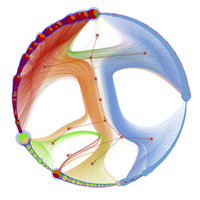
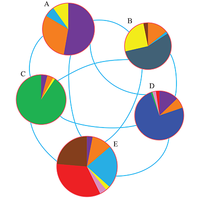
Community Detection for Correlation Matrices

Mel MacMahon and Diego Garlaschelli

Phys. Rev. X 5, 021006 (2015) - Published 14 April, 2015

Identifying groups of highly correlated units in a complex system is a notoriously challenging task. A new technique that adapts tools from network theory solves this problem and is used to map the mesoscopic structure of various stock markets.

Analytical Computation of the Epidemic Threshold on Temporal Networks

Eugenio Valdano, Luca Ferreri, Chiara Poletto, and Vittoria Colizza

Phys. Rev. X 5, 021005 (2015) - Published 8 April, 2015

A new model can compute when a spreading disease triggers an epidemic within a network that varies with time.

Model Selection and Hypothesis Testing for Large-Scale Network Models with Overlapping Groups

Tiago P. Peixoto

Phys. Rev. X 5, 011033 (2015) - Published 25 March, 2015

Modeling a network with too many parameters is likely to lead to overfitting. The minimum description length principle is used to reliably model networks and robustly differentiate models on the basis of confidence levels.

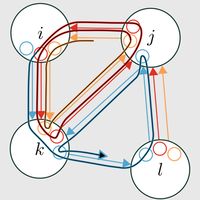
Identifying Modular Flows on Multilayer Networks Reveals Highly Overlapping Organization in Interconnected Systems

Manlio De Domenico, Andrea Lancichinetti, Alex Arenas, and Martin Rosvall

Phys. Rev. X 5, 011027 (2015) - Published 6 March, 2015

Ensembles of people, research ideas, and cells all represent complex interacting networks. Scientists use a community-detection method to trace the interconnectedness of networks.

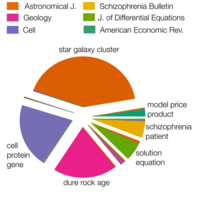
High-Reproducibility and High-Accuracy Method for Automated Topic Classification

Andrea Lancichinetti, M. Irmak Sirer, Jane X. Wang, Daniel Acuna, Konrad Körding, and Luís A. Nunes Amaral

Phys. Rev. X 5, 011007 (2015) - Published 29 January, 2015

Digital, text-based data are being created at a high rate in today’s electronic society. A new algorithm accurately and efficiently assigns topic tags to unstructured text.

Control of the Polarization of a Vacuum-Ultraviolet, High-Gain, Free-Electron Laser

Enrico Allaria et al.

Phys. Rev. X 4, 041040 (2014) - Published 2 December, 2014

The FERMI facility in Trieste, Italy, is ideal for generating and measuring light characterized by tunable polarization states in the vacuum ultraviolet spectral range. New results reveal a high degree of polarization (>0.9) over 26–55 nanometers.

Inheritance Patterns in Citation Networks Reveal Scientific Memes

Tobias Kuhn, Matjaž Perc, and Dirk Helbing

Phys. Rev. X 4, 041036 (2014) - Published 21 November, 2014

An automated analysis of the words in 117 years worth of the Physical Review selects scientific memes—significant ideas that emerge and spread through the literature.

Subgraph Covers: An Information-Theoretic Approach to Motif Analysis in Networks

Anatol E. Wegner

Phys. Rev. X 4, 041026 (2014) - Published 10 November, 2014

Many complex systems can be represented as networks of interacting elements. A new theoretical method identifies characteristics of the connectivity patterns of networks.

Matchmaker, Matchmaker, Make Me a Match: Migration of Populations via Marriages in the Past

Sang Hoon Lee (이상훈), Robyn Ffrancon, Daniel M. Abrams, Beom Jun Kim (김범준), and Mason A. Porter

Phys. Rev. X 4, 041009 (2014) - Published 16 October, 2014

Few quantitative studies of historic human migration exist because of a dearth of data. Now, using geographical information from Korean family books, scientists develop a physics-based analyses of clan migration.

Dynamics of Interacting Diseases

Joaquín Sanz, Cheng-Yi Xia, Sandro Meloni, and Yamir Moreno

Phys. Rev. X 4, 041005 (2014) - Published 8 October, 2014

Forecasting epidemic outbreaks has long been the goal of health researchers. By modeling the interactions of two diseases occurring simultaneously, scientists show that specific parameters control the thresholds of epidemics.

Evolution of the Digital Society Reveals Balance between Viral and Mass Media Influence

Kaj-Kolja Kleineberg and Marián Boguñá

Phys. Rev. X 4, 031046 (2014) - Published 9 September, 2014

Online social networks offer a data-driven way to study patterns of human behavior on small and large scales. Researchers show that individuals are significantly more likely to enroll in social networks based on the influence of one active friend than the influence of mass-media campaigns.

Focal Molography: Coherent Microscopic Detection of Biomolecular Interaction

Christof Fattinger

Phys. Rev. X 4, 031024 (2014) - Published 11 August, 2014

Noncovalent biospecific interactions between macromolecules play a crucial role in biology. The ability to detect them in real time is key for the understanding of biology at the molecular level and also for the development of diagnostic tests.

Exploration for Two-Dimensional Electrides via Database Screening and Ab Initio Calculation

Takeshi Inoshita, Sehoon Jeong, Noriaki Hamada, and Hideo Hosono

Phys. Rev. X 4, 031023 (2014) - Published 4 August, 2014

Electrides have valence electrons that occupy the space between ions. Researchers discover six new two-dimensional electrides that may play important roles in condensed matter magnetism.

Thermodynamics with Continuous Information Flow

Jordan M. Horowitz and Massimiliano Esposito

Phys. Rev. X 4, 031015 (2014) - Published 28 July, 2014

Information manipulation such as copying and erasing has associated thermodynamic implications. Scientists develop a unified framework describing the thermodynamics of information processing, suggesting that their analyses might be useful for biological sensing.

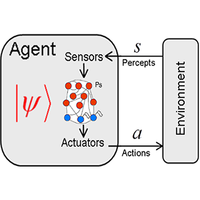
Quantum Speedup for Active Learning Agents

Giuseppe Davide Paparo, Vedran Dunjko, Adi Makmal, Miguel Angel Martin-Delgado, and Hans J. Briegel

Phys. Rev. X 4, 031002 (2014) - Published 8 July, 2014

Artificial intelligence will only become more ubiquitous with time. Scientists reveal that using quantum physics in autonomous learning agents yields a quadratic increase in speed in active learning.

Mapping between the Heisenberg XX Spin Chain and Low-Energy QCD

David Pérez-García and Miguel Tierz

Phys. Rev. X 4, 021050 (2014) - Published 16 June, 2014

Quantum chromodynamics and quantum magnetism, while appearing at first to be disparate fields, can be linked. Using a random matrix description, theorists show how the two paradigms map to one another.

Dicke Phase Transition with Multiple Superradiant States in Quantum Chaotic Resonators

C. Liu, A. Di Falco, and A. Fratalocchi

Phys. Rev. X 4, 021048 (2014) - Published 12 June, 2014

Superradiance, originally proposed by Dicke in 1954, has been recorded in both quantum and classical systems. Now, researchers use photonics crystals to experimentally verify the presence of superradiant states and the nonlinear dynamics of the Dicke transition.

Entropy of Leukemia on Multidimensional Morphological and Molecular Landscapes

Jose M. G. Vilar

Phys. Rev. X 4, 021038 (2014) - Published 28 May, 2014

Data-intensive medical tests require scientists to distill relevant information from massive datasets. Researchers now show that entropy—a concept traditionally used in statistical physics—can characterize both leukemic and normal cell populations, enabling correct diagnoses of leukemia.

Independent Manipulation of Heat and Electrical Current via Bifunctional Metamaterials

Massimo Moccia, Giuseppe Castaldi, Salvatore Savo, Yuki Sato, and Vincenzo Galdi

Phys. Rev. X 4, 021025 (2014) - Published 12 May, 2014

Artificially engineered materials—metamaterials—typically alter only one heat or electromagnetic parameter at once. Researchers test a metamaterial that behaves simultaneously like a thermal concentrator and an electrical invisibility cloak.

Sign In to Your Journals Account

Filter

Subject

Filter

Article Lookup

Enter a citation