Recent Articles

Anatomy of long-range Dzyaloshinskii-Moriya interaction

E. Demiroglu, B. E. Kivircik, C. O. Avci, and C. Deger

Phys. Rev. Materials 10, 084409 (2026) - Published 28 August, 2026

Role of defects in the paramagnetism of Fe-doped Cs2AgBiBr6 double perovskite

Volodymyr Vasylkovskyi, Olga Trukhina, Patrick Dörflinger, Mykola Slipchenko, Wolf Gero Schmidt, Timur Biktagirov, Andreas Sperlich, Anastasiia Kultaeva, Yakov Kopelevich, and Vladimir Dyakonov

Phys. Rev. Materials 10, 084410 (2026) - Published 28 August, 2026

Revisiting the thermal conductivity of β-Ga2O3: High-precision benchmarking and the role of interface in time-domain thermoreflectance

Mengchuan Guo, Yiyuan Liu, Wenxiang Mu, and Bo Sun

Phys. Rev. Materials 10, 084603 (2026) - Published 28 August, 2026

Pressure-enhanced superconductivity and pressure-induced uniaxial negative thermal expansion in CuAl2-type NiZr2

Ryunosuke Shimada, Cuiying Pei, Yuto Watanabe, Kota Muroi, Hidetomo Usui, Aichi Yamashita, Yanpeng Qi, and Yoshikazu Mizuguchi

Phys. Rev. Materials 10, 084802 (2026) - Published 28 August, 2026

Thermodynamic and kinetic stability of Cl and F donors in ZnO

Supparat Charoenphon, Audomsak Sripothongnack, Sukit Limpijumnong, and Pakpoom Reunchan

Phys. Rev. Materials 10, 084602 (2026) - Published 27 August, 2026

Ultrasound-induced shift of the shear thickening transition in dense adhesive suspensions

Aoxuan Wang, Fabrice Toussaint, and Thomas Gibaud

Phys. Rev. Materials 10, 085603 (2026) - Published 27 August, 2026

Electronic transport properties of single-crystal pyrite FeS2

Chris Leighton and Yeon Lee

Phys. Rev. Materials 10, 080301 (2026) - Published 26 August, 2026

Pyrite iron disulfide, in addition to being an important mineral, is also an earth-abundant, low-cost, non-toxic semiconductor with substantial unrealized application potential, particularly in photovoltaics. Subsequent to the first studies incorporating pyrite in solar cells, which yielded only disappointing power conversion efficiencies, a second wave of interest over the last 15 years or so focused on using single-crystal pyrite to better understand fundamental electronic properties and the origins of photovoltaic underperformance. This Research Update comprehensively summarizes this wave of effort with pyrite single crystals, focusing on electronic (particularly transport) properties, the most significant recent advances in knowledge and understanding, and potential implications for improved future devices.

Efficient and accurate interatomic potential for atomistic study of diffusion and precipitation in Cu-Ag-Co alloys

Sergei Starikov, Petr Grigorev, and Daria Smirnova

Phys. Rev. Materials 10, 083403 (2026) - Published 26 August, 2026

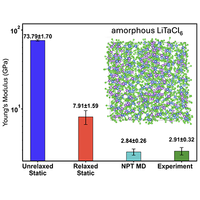
Elastic properties of amorphous LiTaCl6 solid-state electrolyte

Xiaolin Liu and De-en Jiang

Phys. Rev. Materials 10, 085402 (2026) - Published 26 August, 2026

Amorphous halide solid‑state electrolytes have recently emerged as promising candidates for safe, high-energy‑density all‑solid‑state lithium batteries because of their high ionic conductivity and absence of grain boundaries. However, little is known about their mechanical properties, which are critical for suppressing lithium dendrite growth and ensuring manufacturability. Here we simulate for the first time the elastic behavior of the amorphous superionic conductor LiTaCl₆ (a prototypical amorphous halide) and show that molecular dynamics with machine‑learning force fields in the isothermal–isobaric ensemble (NPT MD) using a 2,000‑atom supercell yield a Young’s modulus in quantitative agreement with the experimental value.

Mechanistic study of mixed lithium halides solid-state electrolytes

Davide Tisi, Sergey Pozdnyakov, and Michele Ceriotti

Phys. Rev. Materials 10, 085403 (2026) - Published 26 August, 2026

Halide solid electrolytes such as Li₃YCl₆ and Li₃YBr₆ are promising candidates for safer, denser all-solid-state batteries, but their vast alloying space is hard to explore experimentally. Using the universal machine-learning potential PET-MAD, validated against a fine-tuned model, we map how halogen and metal substitution shape structure, phase stability and Li⁺ conductivity in Li₃MX₆ compounds. Halide mixing turns out to act through two competing levers: lattice contraction hinders Li motion, while shorter metal–halide bonds free up diffusion pathways, largely canceling out. Metal-site alloying, in contrast, tunes phase stability and cost with little penalty on conductivity: a practical design principle for optimizing these materials.

E-coherent crystalline interfaces: Coherency enhanced by discohesion arrays

Ryan B. Sills, Alejandro Hinojos, Trevor J. Murray, Shane H. Cooley, David B. Robinson, Xiaowang W. Zhou, and Douglas L. Medlin

Phys. Rev. Materials 10, 083603 (2026) - Published 25 August, 2026

Pseudo Jahn-Teller effect driven displacive ferroelectric transition in GeTe

Changrui Wang, Kaiqi Li, Jian Zhou, and Zhimei Sun

Phys. Rev. Materials 10, 084408 (2026) - Published 25 August, 2026

In this study, the authors investigate the real-time atomic dynamics and local structural fluctuations in GeTe by coupling density functional theory with large-scale molecular dynamics simulations driven by neuroevolution potentials. Their findings demonstrate a displacive ferroelectric phase transition near the tricritical point. Crucially, the computed longitudinal current correlation function lacks a quasielastic peak, effectively ruling out thermally activated discrete jumps. Furthermore, time-resolved orbital analyses reveal a femtosecond ‘seesaw’ charge transfer driven by the pseudo-Jahn-Teller effect. These results support a ‘macro-ordered yet micro-disordered’ displacive paradigm.

Hierarchical inference separates superconducting feasibility from critical-temperature optimization

G. P. Hettiarachchi, N. Hettiarachchi, P. A. H. Nawoda, and M. Geshi

Phys. Rev. Materials 10, 084801 (2026) - Published 25 August, 2026

Mixed-anion-induced tetrahedral vacancy networks for fast Na+ transport in electrolyte Na3GdCl4Br2

Syed Jawad Hussain, Qiang Sun, Ram B. Gupta, and Puru Jena

Phys. Rev. Materials 10, 085401 (2026) - Published 25 August, 2026

Quantitative nondiagonal phase field modeling of pearlite growth involving multi-diffusion paths

Kai Wang, Guillaume Boussinot, Efim A. Brener, and Robert Spatschek

Phys. Rev. Materials 10, 083402 (2026) - Published 24 August, 2026

Effect of calcium deposition on the surfaces of WSe2 and WS2

N. Ghasemi, L. Karbivska, T. Klaproth, M. Knupfer, B. Büchner, and A. Koitzsch

Phys. Rev. Materials 10, 084004 (2026) - Published 24 August, 2026

Geometric frustration and strain-engineered magnetic phase transitions in the pentagonal FeS2 monolayer

Yuan Feng, Wei Fu, Sha-Sha Ke, and Hai-Feng Lü

Phys. Rev. Materials 10, 084406 (2026) - Published 24 August, 2026

Antiferromagnetic order and crystalline electric field in noncentrosymmetric hexagonal RERu6As4 (RE=Sm and Yb)

Yusuke Hirose, Hiroki Tsukui, Yuta Kato, Rina Shono, Fuminori Honda, Dai Aoki, and Rikio Settai

Phys. Rev. Materials 10, 084407 (2026) - Published 24 August, 2026

Interplay between anharmonic lattice dynamics and bipolar-transport-driven anomalous transport in Zintl phase KXSb (X=Ge, Sn, Pb)

Wenzhe Xue, Yinchang Zhao, Xichang Wang, Jun Ni, and Zhenhong Dai

Phys. Rev. Materials 10, 084601 (2026) - Published 24 August, 2026

Internal friction measurements of ion beam sputtered amorphous silica

Thomas H. Metcalf, Xiao Liu, Matthew Abernathy, Raymond Robie, Massimo Granata, Lorenzo Mereni, Christophe Michel, Julien Teillon, and Gianpietro Gagnoli

Phys. Rev. Materials 10, 085602 (2026) - Published 24 August, 2026

Sign In to Your Journals Account

Filter

Recent Issues

Vol. 10, Iss. 10
October 2026
Vol. 10, Iss. 9
September 2026
Vol. 10, Iss. 8
August 2026
Vol. 10, Iss. 7
July 2026
Category
Article Type
Section

Filter

Article Lookup

Enter a citation