

Elastic properties of amorphous solid-state electrolyte
Phys. Rev. Materials 10, 085402 – Published 26 August, 2026
DOI: https://doi.org/10.1103/sxyd-qjxf
Abstract
Amorphous solid-state electrolytes are attractive candidates for safe, high-energy-density all-solid-state batteries, yet their mechanical properties remain poorly understood from a computational perspective. Here, we investigate the elastic behavior of the recently discovered amorphous superionic Li-ion conductor using density-functional-theory (DFT)-based methods, including unrelaxed static, relaxed static, and strain fluctuations from molecular dynamics (MD) simulations in the isobaric–isothermal (NPT) ensemble with DFT-trained machine-learning force fields (MLFFs). While the unrelaxed static method predicts a Young's modulus an order of magnitude higher than the experiment, the relaxed static method—commonly applied to crystalline electrolytes—still overestimates the modulus by more than 170%. In contrast, the MD approach using MLFFs yields a Young's modulus of , which quantitatively agrees with the experimental value of GPa. Using the MLFF-MD approach, we further predict bulk modulus (4.44 GPa), shear modulus (1.02 GPa), and Poisson's ratio (0.39) for amorphous and conclude that elastically it behaves like a soft polymer or gel. These results demonstrate that amorphous superionic materials possess some unique elastic properties and that, among the methods examined, only the MLFF–MD approach yields quantitative agreement with experiment, highlighting the necessity of a dynamical treatment to simulate their elastic response, consistent with recent findings for crystalline superionic conductors.
Physics Subject Headings (PhySH)
Collections
This article appears in the following collection:
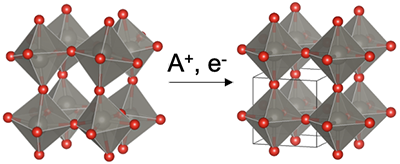
Functional Materials Through Electrochemical Ion Insertion
The Editors of Physical Review Materials are pleased to present the Collection on Functional Materials Through Electrochemical Ion Insertion, highlighting cutting-edge advances in the theory, synthesis, and structural and physical characterization of dynamic property modulation (e.g. optical, electrical, mechanical, chemical) using electrochemical ion insertion into solid state hosts. The Collection is being guest-edited by Veronica Augustyn and Nina Balke of North Carolina State University (USA). Every article published in this collection underwent a rigorous peer review process, adhering to the same high standards applied to all papers. The Physical Review Materials editorial team managed the peer review and made all editorial decisions.
