Electrochemical ion insertion can lead to dramatic changes in the structure and properties of the host material. The charge storage aspects of electrochemical ion insertion into oxides and graphite have been successfully leveraged on a massive scale for battery applications. However, scores of other applications are possible since electrochemical ion insertion can modulate the optical, electronic, magnetic, thermal, and mechanical properties of many unique classes of host materials. The purpose of this Collection is to highlight cutting-edge research into such fundamental properties of materials during electrochemical ion insertion.

The use of electrochemical ion insertion for dynamic property modulation of materials provides a vast frontier for exploration. This includes theoretical and experimental studies into the thermodynamics and kinetics of ion-insertion coupled electron transfer; design of new classes of insertion host materials; understanding the role of electrolyte composition; understanding the impact of host material microstructure, topography, and defects; in situ and operando electrochemical characterization using bulk and surface probes; and development of new electrodes and device architectures.

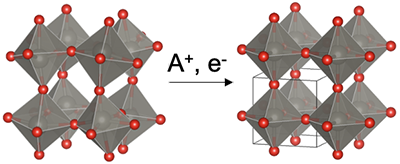
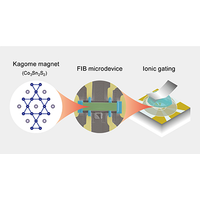
Gate-induced carrier control methods are powerful techniques for tuning quantum materials, but their applicability has been confined to thin-film systems. In this study, the authors present the concept of bulk-gating, where the gating technique is applied to a microdevice fabricated from a bulk single crystal of the magnetic Weyl semimetal Co4Sn2S2 using focused ion beam techniques. Through ionic gating, the authors achieve substantial electron doping exceeding 5×1021 cm−3 and a rigid-band-like Fermi level shift, while preserving the magnetic order and structural integrity. This work positions bulk-gating as a versatile platform for exploring carrier-controlled phases and topological phenomena beyond the traditional 2D landscape.

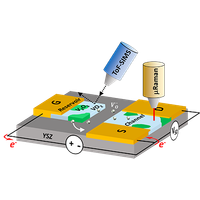
Electrochemical random-access memory (ECRAM) works by electrochemical insertion of mobile ions into a functional material to change its redox state and its electronic conductivity. Here, the authors investigate ECRAM with thin film vanadium oxide channel and reservoir electrodes, arranged on single-crystal oxygen vacancy electrolyte substrates. Using various optical, electron, and elemental analysis methods, they uncover the phase transformation reactions that enable the vanadium oxide ECRAM to exhibit tunable synaptic, spiking neuronal and oscillatory characteristics. They also show that long-term retention in the vanadium oxide ECRAM is enabled by phase separation and interphase reactions.

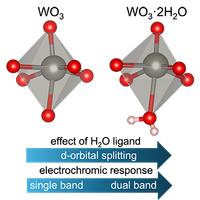
The divergent optical response of WO3⋅2H2O compared to anhydrous WO3 represents a critical gap in understanding electrochromic materials. Through combined electronic structure modeling and experimental analysis, the authors demonstrate that structural water molecules fundamentally alter the electronic structure by introducing asymmetries in the tungsten coordination environment. The investigation reveals how these coordination asymmetries, more pronounced in the dihydrate material, create distinct absorption conditions for visible and near-infrared wavelengths that enable independent spectral control. The authors also report on the low-temperature electrochromic response of these materials. By establishing direct correlations between minute structural distortions and macroscopic electrochromic behavior, this work provides mechanistic insight into dual-band electrochromism. These findings advance the fundamental understanding of structure-property relationships in electrochromic oxides and will inform the future of electrochromic materials design.

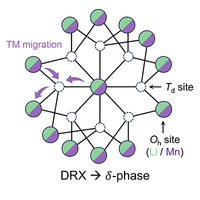
Mn-rich disordered rocksalt (DRX) cathodes promise high energy density, but their performance depends on a structural evolution during electrochemical cycling. Using a fine-tuned machine learning interatomic potential, the authors performed large-scale molecular dynamics simulations to reveal this transformation. The simulations map the atomic-level transition from a disordered structure to a partially disordered, spinel-like phase. This transformed phase features enhanced Li-ion transport pathways, and the analysis further clarifies the role of Mn valence states and correlates cation ordering with intercalation voltage profiles.

Magneto-ionics, as the electrochemical modulation of magnetic properties, holds great promise for energy-efficient data storage and computing. In this work, the authors introduce metallic nickel as a material system for magneto-ionics. They demonstrate a reversible dual ionic control of magnetic moment and coercivity for nickel in alkaline electrolytes, based on electrochemical reactions with hydrogen and hydroxide species. Using thiourea as an electrolyte additive, the magneto-ionic moment changes are enhanced by a factor of 2, which is attributed to a promotion of hydrogen absorption. The use of additives might become a general strategy to enhance the performance of magneto-ionic devices.

Conversion cathodes are attractive for next-generation ion batteries, owing to their large specific capacities. However, candidate materials suffer from limited electrochemical reversibility. The authors propose that cathode reversibility is directly related to the structural transformations of active materials during charge and discharge. Through a selection of case studies, we demonstrate that these transformations depend on the material composition and structure type. Transformations that favor simplicity, e.g. few intermediates and the preservation of structural motifs, correlate to increased reversibility. This work indicates that reaction pathways are essential in understanding the performance of conversion materials.

Cathode materials for Na-ion batteries often degrade in air and suffer from large lattice mismatch during ion intercalation. This work focuses on the pillaring effect to address these challenges. The authors have used an ion exchange method to introduce Ca ions as structural pillars in the P2-type Na0.67Fe0.5Mn0.5O2 layered oxide Na-ion cathode material. The pillared materials show improved stability in moist and acidic environments and reduced lattice mismatch between phases developed during Na ion (de)intercalation. The ion exchange reaction provides a general method to exploit the pillaring effect in layered metal oxides for electrochemical energy storage.

Every time a battery is cycled between charged and discharged states, ions and electrons are shuttled between electrodes. In this process, beyond storing charge, the addition and removal of ions in electrodes provides a reversible and tunable handle over the electronic structure and magnetic order. This Research Update paper connects the chemistry of battery electrode materials with the physics of emergent phenomena, including insulator–metal transitions, geometric magnetic frustration, charge and vacancy ordering, and cooperative Jahn–Teller effects. Ion insertion is suggested as being a potentially overlooked handle for the design of functional materials, and open experimental and theoretical challenges are highlighted.

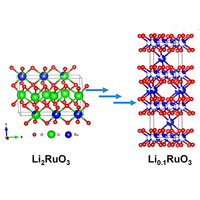
Here, the authors interrogate the sequential structural and electronic evolution of Li2RuO3 during Li cycling. The material transforms from a well-ordered monoclinic phase, dominated by classical Ru-centered redox activity, to a complex trigonal phase characterized by predominant involvement of O 2p hybridized states. The analysis highlights the strong coupling between lattice distortions, Ru-O bond rearrangements, and the transitions in redox behavior. These transformations, tracked by diffraction and X-ray absorption spectroscopy, elucidate the origins of voltage hysteresis and emphasize the importance of structural fidelity in modeling oxygen redox mechanisms in layered oxide battery cathodes.

Electrochemical lithium intercalation in the van der Waals gaps of MoS2 can be used to control its crystal phase and physical properties. Applications include electronic contacts, batteries, neuromorphic computing, and thermal switches. In this work, the authors study the dynamics of the phase transformations upon the removal of lithium from 1T-LiMoS2. By combining single-flake electrochemistry with correlative Raman spectroscopy, they demonstrate that MoS2 remains in a metastable 1T phase even when lithium is electrochemically removed. However, it slowly relaxes back to the thermodynamically stable 2H phase over several days without additional chemical or electrochemical reactions. This delayed transition enables the design of metastable mixed phases in MoS2 through electrochemical intercalation.

La1−xSrxCoO3−δ (LSCO) is known to undergo an electrochemically driven perovskite-to-brownmillerite transition with wide modulation of electronic, magnetic, thermal, and optical properties. However, the extended reversibility of this transition remains unproven, with repeated cycling leading to performance degradation via acid-etching, particularly in humid environments. Here, combining density functional theory with an out-of-the-box universal machine learning interatomic potential, the authors demonstrate that hydrogen insertion in LSCO is thermodynamically favorable over a wide range of conditions, but ultimately destabilizes the host structure towards decomposition. Metastable protonated phases are expected to exhibit significant structural expansion and band gap widening, mirroring the effect of oxygen vacancies and highlighting the need for caution when interpreting experimental results for electrochemically-gated LSCO and related materials.

Understanding polaron mobility in transition metal oxides is essential for advancing materials in proton-based electrochemical random access memory (ECRAM) neuromorphic devices. Using first-principles calculations, the authors quantify how protons affect polaron migration barriers in promising ECRAM channel materials WO3, V2O5, and MoO3. Beyond electrostatic attraction, which promotes proton-polaron pairing and increases migration barriers, protons also influence polaron transport directionality. By forming hydrogen bonds that distort metal-oxygen-metal linkages, they affect orbital overlap between metal sites and modulate migration barriers along these pathways. These results highlight a nontrivial role of protons in polaron transport and provide guidance for designing energy-efficient electrochemical devices.

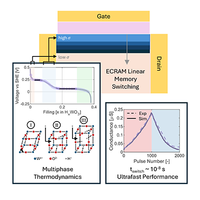
Recent advances in protonic electrochemical random-access memory (ECRAM) have demonstrated ultrafast, nanosecond switching dynamics, seemingly faster than diffusion. We develop a theory to explain how these devices outperform some counterparts by up to five orders of magnitude by leveraging multiphase polarization in tungsten oxide, which can be tuned during annealing of the material. Supported by simulations, the theory shows that high-concentration metallic phases formed electrochemically along the gate enable the conductance to be modulated linearly and symmetrically throughout the ultrafast switching protocols.

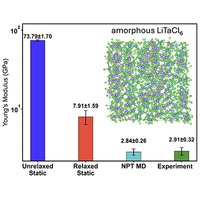
Amorphous halide solid‑state electrolytes have recently emerged as promising candidates for safe, high-energy‑density all‑solid‑state lithium batteries because of their high ionic conductivity and absence of grain boundaries. However, little is known about their mechanical properties, which are critical for suppressing lithium dendrite growth and ensuring manufacturability. Here we simulate for the first time the elastic behavior of the amorphous superionic conductor LiTaCl₆ (a prototypical amorphous halide) and show that molecular dynamics with machine‑learning force fields in the isothermal–isobaric ensemble (NPT MD) using a 2,000‑atom supercell yield a Young’s modulus in quantitative agreement with the experimental value.

Sign In to Your Journals Account

Filter

Filter

Article Lookup

Enter a citation