Recent Articles

Prediction of the lightest three-dimensional diamond-like fullerene phase with orbital-coupling-tunable pseudo-Dirac states and flat band states

Yandi Zhu, Xiaoyan Ren, Lili Zhang, Panshuo Wang, Hao He, Lin Dong, Xigui Yang, Chongxin Shan, Xingju Zhao, and Shunfang Li

Phys. Rev. Materials 10, 086001 (2026) - Published 24 August, 2026

Elucidating anisotropic seed-mediated nanorod growth in solution

Junjie Hao, Eugenie Pariente, Marie-Helene Delville, and Jean-Pierre Delville

Phys. Rev. Materials 10, 083401 (2026) - Published 21 August, 2026

Achieving uniaxial magnetic anisotropy in Ce2Fe17N3 through Co- and Sm-substitution

Nabaraj Pokhrel, Akila Raja, Brian C. Sales, German D. Samolyuk, Deborah Schlagel, Olena Palasyuk, Andriy Palasyuk, and David S. Parker

Phys. Rev. Materials 10, 084405 (2026) - Published 21 August, 2026

Exploring magnetic and topological complexity in MgMn6Sn6: From frustrated ground states to nontrivial Hall conductivity

Jyotirmoy Sau, Hrishit Banerjee, Sourabh Saha, Nitesh Kumar, and Manoranjan Kumar

Phys. Rev. Materials 10, 086203 (2026) - Published 21 August, 2026

DFT-based grand canonical study of the stability of crystalline battery materials under operating conditions

Johannes Döhn and Axel Groß

Phys. Rev. Materials 10, 075402 (2026) - Published 20 August, 2026

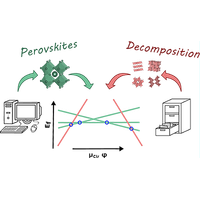
The stability of functional materials under operating conditions is of great importance in the search for materials with improved properties. This is in particular true for battery materials which have to operate robustly and safely under strongly varying electrochemical conditions. In this study, the authors demonstrate how a grand-canonical approach coupled to first-principles electronic structure calculations can predict the stability of chloride perovskites for Cl-ion batteries under operating conditions. This approach allows to determine whether the studied materials can be used as potential electrodes or solid-electrolytes or whether they are not appropriate for battery applications, thus contributing to an accelerated materials design.

Exploring magnetoelectric effects in 1T−FeCl2/bilayer−GaSe multiferroic heterostructures

Fahmida Fakhera, Oliver J. Conquest, Carla Verdi, and Catherine Stampfl

Phys. Rev. Materials 10, 074420 (2026) - Published 19 August, 2026

Epitaxial stabilization of magnetic GdAuSb/LaAuSb superlattices

Patrick J. Strohbeen, Soohyun Im, Tamalika Samanta, Zachary LaDuca, Dongxue Du, Estiaque H. Shourov, Jessica L. McChesney, Fanny Rodolakis, Paul M. Voyles, and Jason K. Kawasaki

Phys. Rev. Materials 10, 074421 (2026) - Published 19 August, 2026

Superconductivity in the transition metal silicide Zr2Ru3Si4 single crystals

D. Y. Yan, H. X. Liu, X. Han, C. W. Zhang, and Y. G. Shi

Phys. Rev. Materials 10, 074804 (2026) - Published 19 August, 2026

Theory of ultrafast conductance modulation in electrochemical protonic synapses by multiphase polarization

Michael L. Li, Dingyu Shen, Jesus A. del Alamo, and Martin Z. Bazant

Phys. Rev. Materials 10, 075802 (2026) - Published 19 August, 2026

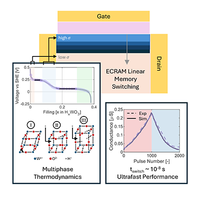
Recent advances in protonic electrochemical random-access memory (ECRAM) have demonstrated ultrafast, nanosecond switching dynamics, seemingly faster than diffusion. We develop a theory to explain how these devices outperform some counterparts by up to five orders of magnitude by leveraging multiphase polarization in tungsten oxide, which can be tuned during annealing of the material. Supported by simulations, the theory shows that high-concentration metallic phases formed electrochemically along the gate enable the conductance to be modulated linearly and symmetrically throughout the ultrafast switching protocols.

First-principles analysis of the effect of magnetic states on the oxygen vacancy formation energy in doped La0.5Sr0.5CoO3 perovskite

Wei Wei, Florian Fuchs, Andreas Zienert, Xiao Hu, and Jörg Schuster

Phys. Rev. Materials 10, 075401 (2026) - Published 18 August, 2026

Synthesis and defect control of Sr2IrO4 films by reactive sputtering

Ksenia S. Rabinovich, Olfat Omareya, Tim Priessnitz, Maisam Abdallah, Kathrin Küster, Iyad Saadeddin, Zafer Hawash, Muayad Abu Saa, Bernhard Keimer, and Gideok Kim

Phys. Rev. Materials 10, 073402 (2026) - Published 17 August, 2026

Ab initio study of magnetism in pristine and defective MnBi2Te4

Ana Beatriz Pedro Fontes, Jiaqi Zhou, Simon M.-M. Dubois, and Jean-Christophe Charlier

Phys. Rev. Materials 10, 074419 (2026) - Published 17 August, 2026

Spin-pumping in Pt/Py heterostructures: The role of Al spacer layers

Verena Ney, Kilian Lenz, Fabrice Wilhelm, René Hübner, Fabian Ganss, Robert Freynschlag, Jürgen Lindner, Andrei Rogalev, and Andreas Ney

Phys. Rev. Materials 10, 075202 (2026) - Published 17 August, 2026

Temperature-dependent elastic properties of U3Si2 from DFT+U calculations: Reconciling anisotropy with experimental measurements

Edoardo Brando, Aloïs Castellano, Xiaofeng Guo, Marjorie Bertolus, and Johann Bouchet

Phys. Rev. Materials 10, 073606 (2026) - Published 14 August, 2026

Structural distortions and ferroelectricity in antiperovskite oxides with tetrel elements

He Zhu and Turan Birol

Phys. Rev. Materials 10, 074418 (2026) - Published 14 August, 2026

Pinning of antiferromagnetic domain walls and domain structure in ultrathin La0.45Sr0.55MnO3 films

G. Panchal, F. Stramaglia, M. Krummenacher, A. Kleibert, C. W. Schneider, D. Backes, F. Kronast, and C. A. F. Vaz

Phys. Rev. Materials 10, 084404 (2026) - Published 14 August, 2026

Surface photovoltage and open-circuit voltage spectroscopies of oxide heterostructures by atomic force microscopy under variable illumination

X. Henning, L. Schlur, D. Stoeffler, M. Vomir, S. Colis, A. Dinia, and M. V. Rastei

Phys. Rev. Materials 10, 083802 (2026) - Published 11 August, 2026

Bond-order anisotropy induced nematicity in the charge density wave phase of RbV3Sb5

Shichang Yao, Chongze Wang, Shuyuan Liu, Bing Wang, Liangliang Liu, Yu Jia, and Jun-Hyung Cho

Phys. Rev. Materials 10, 084001 (2026) - Published 11 August, 2026

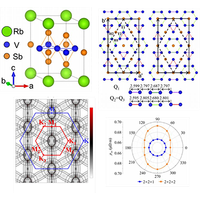
Nematicity in kagome metals AV3Sb5 (A = K, Rb, Cs) has been widely regarded as an electronically driven phenomenon. Here, the authors uncover a structural origin of nematic behavior in the CDW phase of RbV3Sb5 through firstprinciples calculations. They show that an interlayer π phase shift induces anisotropic V–V bond reconstruction, forming a bond-order wave that breaks C6 rotational symmetry and gives rise to intrinsic C2 anisotropy. This bond-order mechanism manifests in distinctive signatures across the electronic structure, Fermi surface, phonon spectrum, and transport properties, establishing a unified microscopic framework for lattice-driven nematicity in kagome quantum materials.

Influence of atomic vacancies on the electronic and mechanical properties of two-dimensional AsBiSe3 monolayers

Naoures Kedidi, Tarek Ayadi, Mourad Debbichi, and Rémi Arras

Phys. Rev. Materials 10, 084002 (2026) - Published 11 August, 2026

Continuous tuning of gas adsorption in two-dimensional transition metal disulfides enabled by vacancy engineering and high-entropy design

Minglei Jia, Wenjiang Gao, Shujuan Jiang, and Huabing Yin

Phys. Rev. Materials 10, 084003 (2026) - Published 11 August, 2026

Sign In to Your Journals Account

Filter

Recent Issues

Vol. 10, Iss. 10
October 2026
Vol. 10, Iss. 9
September 2026
Vol. 10, Iss. 8
August 2026
Vol. 10, Iss. 7
July 2026
Category
Article Type
Section

Filter

Article Lookup

Enter a citation