

Theory of ultrafast conductance modulation in electrochemical protonic synapses by multiphase polarization
Phys. Rev. Materials 10, 075802 – Published 19 August, 2026
DOI: https://doi.org/10.1103/m4jb-v7vd
Abstract
Three-terminal electrochemical ionic synapses (EIoS) have recently attracted interest for in-memory computing applications. These devices utilize electrochemical ion intercalation to modulate the ion concentration in the channel material. The electrical conductance, which is concentration dependent, can be read separately and mapped to a nonvolatile memory state. To compete with alternative random access memory technologies, linear and symmetric conductance modulation is often sought after, properties typically thought to be limited by the slow ion diffusion timescale. A recent study by Onen et al. [Science 377, 539 (2022)] examining protonic EIoS with a tungsten oxide () channel reveals that this limiting timescale appears irrelevant, with linear conductance modulation achieved over nanosecond timescales, much faster than the bulk ion diffusion timescale. This contrasts with previous studies that have shown similar conductance modulation with pulse timescales of milliseconds to seconds. Understanding the phenomena behind these conductance modulation properties in EIoS systems remains a crucial question gating technological improvements to these devices. Here, we provide a theoretical explanation that demonstrates how linearity and symmetry arise from consistent control over the electrolyte- interface. Comparing these past works, the changes in the channel crystallinity are mapped to effects on the material thermodynamics, identifying a link between phase separation on nanosecond pulse timescales. We demonstrate that the electric field applied across the phase-separating polycrystalline channel polarizes the system and induces spontaneous phase separation, even when the bulk concentration remains in a stable single-phase region. By coupling this with increased electron conductivity in the high-concentration filaments formed, the reaction environment at the gate electrode is effectively controlled, resulting in ideal conductance modulation within the diffusion-limited regime. This work highlights the potential for phase-separating systems to overcome the traditional diffusion barriers that limit EIoS performance.
Physics Subject Headings (PhySH)
Collections
This article appears in the following collection:
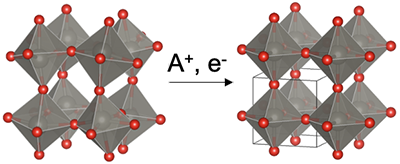
Functional Materials Through Electrochemical Ion Insertion
The Editors of Physical Review Materials are pleased to present the Collection on Functional Materials Through Electrochemical Ion Insertion, highlighting cutting-edge advances in the theory, synthesis, and structural and physical characterization of dynamic property modulation (e.g. optical, electrical, mechanical, chemical) using electrochemical ion insertion into solid state hosts. The Collection is being guest-edited by Veronica Augustyn and Nina Balke of North Carolina State University (USA). Every article published in this collection underwent a rigorous peer review process, adhering to the same high standards applied to all papers. The Physical Review Materials editorial team managed the peer review and made all editorial decisions.
