Highlights

Faceting transition in aluminum as a grain boundary phase transition

Yoonji Choi (최윤지) and Tobias Brink

Phys. Rev. Materials 9, 083607 (2025) - Published 25 August, 2025

Certain faceted grain boundaries have been observed to become flat above a critical temperature. In this work, the authors use atomistic computer simulations to show that the flat and faceted boundaries have different atomic structures. This means that the two states are in fact two distinct defect phases with different thermodynamic stability ranges and there is a first order transition between them. The change of the mesoscopic topography of the grain boundary with temperature is thus a result of the microscopic structural transition.

Isolated spin ladders in Ln2Ti9Sb11 (Ln:La–Nd) metals

Brenden R. Ortiz, Heda Zhang, Karolina Górnicka, Matthew S. Cook, Suchismita Sarker, Satoshi Okamoto, and Jiaqiang Yan

Phys. Rev. Materials 9, 086203 (2025) - Published 18 August, 2025

The authors have synthesized a family of rare-earth intermetallics, Ln2Ti9Sb11 (Ln=La-Nd), featuring isolated square ladders decorated with rare-earth ions. These materials offer a unique platform to explore spin-ladder physics, with tunable spin anisotropy and magnetic interactions. The ladders are well-separated, with interactions mediated by the metallic nature of this family. Notably, the lower energy scale of the rare-earth elements makes these systems highly responsive to perturbations like external magnetic fields. This tunability, combined with the diverse magnetic behaviors of the rare-earth ions, positions these materials as promising candidates for future studies in quantum magnetism.

Magnetic order and physical properties of the kagome metal UNb6Sn6

Z. W. Riedel, W. Simeth, C. S. Kengle, S. M. Thomas, J. D. Thompson, A. O. Scheie, F. Ronning, C. Lane, Jian-Xin Zhu, P. F. S. Rosa, and E. D. Bauer

Phys. Rev. Materials 9, 084401 (2025) - Published 5 August, 2025

Kagome lattices provide a unique platform for probing geometrical effects, such as flatband enhancement of the density of states, frustrated magnetism, and reduced dimensionality. The chemically tunable “166” materials typically contain Kagome lattices of transition metal atoms intercalated with f-electron elements, which may lead to a strong interplay between the two sublattices. Yet, uranium 5f-based 166 compounds are rare compared to 4f systems. Here the authors report the newly synthesized compound UNb6Sn6, which exhibits a remarkably complex field-temperature phase diagram with six distinct uranium-driven magnetic phases. Though zero-field neutron diffraction shows a simple A-type antiferromagnetic ground state, five additional magnetic phases are observed through electrical transport and magnetic property measurements.

Slip-dominated structural transitions

Kanka Ghosh, Oğuz Umut Salman, Sylvain Queyreau, and Lev Truskinovsky

Phys. Rev. Materials 9, 073604 (2025) - Published 7 July, 2025

By introducing a novel method of tracking the history of atomic-scale metric tensors in molecular dynamics, the authors uncover hidden micro-slips during pressure-induced square to hexagonal transition. The purely geometrical tessellation of the configurational space of metric tensors creates a possibility to distinguish between elastic and plastic deformations and reveals previously hidden “micro-slips” under “shuffle”, portraying a central role of lattice invariant shears in this class of phase transformation. The discovered slip-dominated mechanism during the square to hexagonal transition contains some generic elements and is expected to be common for most reconstructive transitions including the iconic BCC-HCP and FCC-HCP transitions.

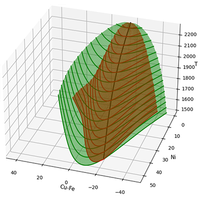
Computing ternary liquid phase diagrams: Fe-Cu-Ni

Dallas R. Trinkle

Phys. Rev. Materials 9, 073801 (2025) - Published 7 July, 2025

Liquid immiscible systems, like Fe-Cu, offer exciting possibilities for additive manufacturing, but determining the phase diagram is difficult. Here, the phase diagram for the ternary liquid alloy Fe-Cu-Ni is mapped out by calculating the Gibbs free energy across composition and temperature. A virtual semigrand canonical Widom approach allows for efficient computation of free energy differences. The approach can be used as a post-processing step with regular molecular dynamics or Monte Carlo simulations and can be applied to solids or liquids. The phase diagram, miscibility gap, and spinodal decompositions are accurately determined, with a computational cost similar to the trajectory calculation itself.

Orthogonality point and intersublattice exchange in Dy2Fe17 determined in strong magnetic fields

Y. Skourski, M. D. Kuz'min, K. P. Skokov, N. Shayanfar, A. V. Andreev, S. Zherlitsyn, S. Yasin, L. Zvyagina, O. Drachenko, O. Portugall, and J. Wosnitza

Phys. Rev. Materials 9, 064404 (2025) - Published 10 June, 2025

The authors investigated the magnetization of single-crystalline Dy₂Fe₁₇ in pulsed magnetic fields up to about 130 T. They observed step-like transitions and identified the orthogonality point of the rare-earth and iron sublattices. Ultrasound-velocity measurements, performed up to 85 T, confirmed one of the transitions. Based on these results, the authors determined the intersublattice exchange field, establishing Dy₂Fe₁₇ as a model system for extreme-field magnetism.

Scaling behavior and giant field enhancement of the thermal conductivity in the honeycomb antiferromagnet BaCo2(AsO4)2

Jiayi Hu, Ruidan Zhong, Peter Czajka, Tong Gao, R. J. Cava, and N. P. Ong

Phys. Rev. Materials 9, L061401 (2025) - Published 10 June, 2025

In this Letter, the authors have completed a detailed investigation of the thermal conductivity of the magnetic insulator BaCo2(AsO4)2 (BCAO) and uncovered two striking features. First, below 10 K, the thermal conductivity exhibits an unusual one-parameter scaling behavior throughout the magnetically disordered regime, corresponding to the range where the zigzag state is suppressed. The authors demonstrate that the intricate behavior of the thermal conductivity in the field-temperature (H-T) plane collapses to a simple scaling function. Secondly, just above the Neel temperature, they observe a giant magnetic-field enhancement of the thermal conductivity, which is closely related to the scaling behavior. From the data, the authors infer that phonons and spins constitute a strongly coupled system in zero field. An in-plane magnetic field steadily weakens this coupling to yield the one-parameter scaling.

Epitaxial growth of gold films on the elemental superconductors V(100), Nb(100), and Nb(110)

Dongfei Wang, Katerina Vaxevani, Danilo Longo, Samuel Kerschbaumer, Jon Ortuzar, Stefano Trivini, Jingcheng Li, Maxim Ilyn, Celia Rogero, and Jose Ignacio Pascual

Phys. Rev. Materials 9, 066201 (2025) - Published 6 June, 2025

Gold films deposited on superconducting materials such as vanadium and niobium can acquire superconducting properties through the proximity effect. Upon annealing, these films grow flat and free of oxygen contamination. Moreover, they can host molecules without suppressing their magnetic states, allowing for a novel approach to explore the interplay between molecular magnetism and superconductivity. This makes them a highly promising and versatile platform for integrating superconductivity and magnetism in future quantum devices, particularly in systems that benefit from strong spin-orbit coupling and molecular-level control.

Single-crystalline CrSb(0001) thin films grown by dc magnetron co-sputtering

S. P. Bommanaboyena, C. Müller, M. Jarošová, K. Wolk, S. Telkamp, P. Zeng, F. Krizek, T. Uchimura, A. Badura, K. Olejník, D. Scheffler, K. Beranová, S. Banerjee, M. Ledinský, H. Reichlová, T. Jungwirth, L. Horák, and D. Kriegner

Phys. Rev. Materials 9, 064402 (2025) - Published 3 June, 2025

The study of altermagnets has spurred interest in synthesizing epitaxial films of hexagonal CrSb, a prominent example of this class. However, growing this compound along its high-symmetry c-axis is particularly challenging. Here, the authors report the magnetron co-sputtering-based fabrication and characterization of high-quality single crystalline CrSb(0001) thin film seeded by an isostructural, nonmagnetic PtSb underlayer. PtSb promotes the desired orientation and preserves the intrinsic properties of CrSb, providing a clean platform for studying its magnetic structure, transport properties, and band topology. These results mark a significant step toward unlocking the potential of CrSb in spintronic applications.

Correlated dynamic disorder, octahedral tilts, and acoustic phonon softening in CsSnBr3 and CsPbBr3

Chengjie Mao, Xing He, Hung-Min Lin, Mayanak K. Gupta, Patrick Postec, Tyson Lanigan-Atkins, Matthew Krogstad, Daniel M. Pajerowski, Tao Hong, Travis J. Williams, J. Ross Stewart, Duck Young Chung, Mercouri G. Kanatzidis, Stephan Rosenkranz, Raymond Osborn, and Olivier Delaire

Phys. Rev. Materials 9, 065401 (2025) - Published 3 June, 2025

This work reports a systematic comparative study of structural fluctuations and atomic dynamics in CsSnBr3 and CsPbBr3. The study combines inelastic neutron scattering on single crystals as a function of temperature with extensive atomistic simulations based on first-principles methods and machine-learned interatomic potentials. The results reveal the existence of two-dimensional nanodomains of correlated tilts of Br octahedra in CsSnBr3, akin to monolayers of the tetragonal phase, similar to those previously reported in CsPbBr3. The correlated disorder results in diffuse rods in reciprocal space, particularly prominent in the cubic phase. The correlations are dynamic with a characteristic lifetime of a few picoseconds, and result from an overdamped phonon branch along the edge of the Brillouin zone. The Sn2+ or Pb2+ ions do not exhibit displacements from the center of the Br octahedron beyond those expected from phonon oscillations.

Quantifying the creation of negatively charged boron vacancies in He-ion irradiated hexagonal boron nitride

Amedeo Carbone, Ilia D. Breev, Johannes Figueiredo, Silvan Kretschmer, Leonard Geilen, Amine Ben Mhenni, Johannes Arceri, Arkady V. Krasheninnikov, Martijn Wubs, Alexander W. Holleitner, Alexander Huck, Christoph Kastl, and Nicolas Stenger

Phys. Rev. Materials 9, 056203 (2025) - Published 27 May, 2025

Hexagonal boron nitride (hBN) can host a plethora of luminescent defects with various quantum properties, also at room temperature. Charged boron vacancies (VB-), in particular, possess spin qualities compatible with quantum sensing protocols. In this work, the authors exploit a focused beam of helium ions to systematically generate optically active vacancy defects in hBN flakes at varying density. By comparing optical magnetic resonance measurements with calculations based on a microscopic charge model, in which a correction term due to a constant background charge was introduced, they are able to quantify the number of defects generated by the ion irradiation. With the help of molecular dynamics simulations, a lower bound for the fraction (0.2%) of all vacancies in the optically active, negatively charged state is reported.

Fully thermal meta-GGA exchange correlation free-energy density functional

Katerina P. Hilleke, Valentin V. Karasiev, S. B. Trickey, R. M. N. Goshadze, and S. X. Hu

Phys. Rev. Materials 9, L050801 (2025) - Published 27 May, 2025

Warm dense matter (WDM) is the materials regime that bridges condensed matter and plasmas that occurs in giant-planet centers and the state trajectory of inertial confinement fusion experiments. Predictive density functional theory simulations of WDM must use an explicitly temperature-dependent free-energy exchange-correlation functional. Incorporating thermal effects at the meta-GGA level of refinement, the newly developed fully thermal fTSCAN functional provides high accuracy across the entire temperature and pressure range from ambient to extreme conditions. Tests on model systems highlight the contributions of thermal and density inhomogeneity effects, while molecular dynamics simulations demonstrate accuracy for materials ranging from water under ambient conditions to dense hydrogen at a wide range of temperatures.

Dynamical phase transition in the growth of programmable polymorphic materials

Fan Chen and William M. Jacobs

Phys. Rev. Materials 9, 053403 (2025) - Published 22 May, 2025

In conventional materials design problems, the possibility of assembling alternative crystal structures from a single set of subunits is disadvantageous. By contrast, multicomponent systems with programmable interactions can in principle be designed to assemble into multiple distinct crystal structures on purpose, opening up the possibility of selecting a specific encoded polymorph on demand by growing the crystal from an initial seed. Here the authors describe the conditions under which seeded polymorphic self-assembly is dynamically stable, and they identify a nonequilibrium phase transition that fundamentally limits the number of unique polymorphs that can be encoded in this way.

Adaptation of Wallace's approach to the specific heat of elemental solids with significant intrinsic anharmonicity, particularly the light actinide metals

Christopher A. Mizzi, W. Adam Phelan, Matthew S. Cook, Greta L. Chappell, Paul H. Tobash, David C. Arellano, Derek V. Prada, Boris Maiorov, and Neil Harrison

Phys. Rev. Materials 9, 053801 (2025) - Published 9 May, 2025

Intrinsic anharmonicity refers to changes in phonon frequencies with temperature at constant volume. This phenomenon can be significant, but is often not captured in traditional thermodynamic models. The authors introduce the “elastic softening approximation” to model intrinsic anharmonic effects by tracking entropy changes resulting from the continuous change of phonons as a function of temperature deduced from elastic moduli measurements. The new framework is successfully applied to elemental solids with different crystal and electronic structures, including the light actinide metals. This approach reveals large anharmonicity at elevated temperatures across the actinides and a connection between phonon softening and Poisson’s ratio.

Acoustic response of molecular adsorption and sound propagation in nanoporous materials

Loriane Didier, Alan Sam, Rodolfo Venegas, and Benoit Coasne

Phys. Rev. Materials 9, 056001 (2025) - Published 7 May, 2025

Molecular simulation and statistical mechanics are used to unravel the microscopic mechanisms through which fluid adsorption impacts sound propagation and attenuation in nanoporous materials. By considering different fluids, temperatures, and fluid-solid interaction strengths, the authors first derive a simple model that predicts the decay in the sound velocity upon increasing the fluid mass density. They also show that sound attenuation increases with the amount of fluid adsorbed and with the solid-fluid interaction strength due to phonon scattering at the fluid-solid interface. The authors establish that all data can be quantitatively rationalized by considering the change in the phonon lifetime through an additional relaxation time arising from the interaction between fluid molecules and the atoms of the nanoporous solid.

Experimental confirmation of Ruderman-Kittel-Kasuya-Yosida-type interlayer Dzyaloshinskii-Moriya interaction across Ru spacers

Yu-Hao Huang, Xi-Wei Lu, Jui-Hsu Han, Chih-Chen Peng, and Chi-Feng Pai

Phys. Rev. Materials 9, L051401 (2025) - Published 5 May, 2025

The Ruderman–Kittel–Kasuya–Yosida (RKKY) interaction, a cornerstone of magnetism for over half a century, is now linked to a new frontier: interlayer Dzyaloshinskii–Moriya interaction (IL-DMI). In this study, the authors experimentally demonstrate that IL-DMI mediated by a Ru spacer exhibits a damped oscillatory behavior mirroring the classic RKKY signature. This discovery not only confirms the link between RKKY and IL-DMI but also unveils a new pathway for engineering chiral spin textures through spacer thickness control.

Identifying insulating to metallic complexion transitions in NbFeSb

Duncan Zavanelli, Ruben Bueno Villoro, Raana Hatami Naderloo, Nicolas Perez Rodriguez, Siyuan Zhang, Ran He, Christina Scheu, and G. Jeffrey Snyder

Phys. Rev. Materials 9, 045402 (2025) - Published 25 April, 2025

Electrical resistance from grain boundary phases (complexions) is detrimental to thermoelectric performance. A promising strategy for mitigating this resistance is altering the composition at a grain boundary through complexion transitions. In NbFeSb, increasing the Ti content has been shown to result in Ti-rich boundaries that effectively eliminate boundary resistance and make Ti-doped NbFeSb a high performing thermoelectric. In this study, a model based on the average band offset between the grain boundaries and grain is used to identify a resistive to nonresistive complexion transition in NbFeSb. This method can be applied to any material with thermoelectric transport data and grain size measurements.

Strain-enabled control of the vanadium qudit in silicon carbide

Philipp Koller, Thomas Astner, Benedikt Tissot, Guido Burkard, and Michael Trupke

Phys. Rev. Materials 9, L043201 (2025) - Published 24 April, 2025

Nuclear spins in crystals are strong candidates for the storage of quantum information in quantum communication and computing. Addressing their energy states is, however, challenging due to their small gyromagnetic moment. The authors show that the presence of strain enables fast state control in the hyperfine manifold of the spin 7/2 nuclear qudit of vanadium in silicon carbide. This high-dimensional system offers a hardware-efficient route to fault-tolerant quantum operations. The qudit also features a telecom-band optical transition, paving the way for scalable light-matter interfaces. These results mark a significant step toward integrating high-dimensional quantum memories with optical quantum networks.

Observation of multiple surface states in naturally cleavable chiral crystal PdSbSe

Zhicheng Jiang, Zhengtai Liu, Chenqiang Hua, Xiangqi Liu, Yichen Yang, Jianyang Ding, Jiayu Liu, Jishan Liu, Mao Ye, Ji Dai, Massimo Tallarida, Yanfeng Guo, Yunhao Lu, and Dawei Shen

Phys. Rev. Materials 9, L031201 (2025) - Published 25 March, 2025

Chiral multifold fermions in topological semimetals host exotic quantum states, but their intuitive spectroscopic studies are often constrained by challenges in achieving high-quality surfaces. In this study, the authors employ high-resolution angle-resolved photoemission spectroscopy (ARPES) in combination with first-principles calculations to uncover multiple chiral Fermi arc surface states in the naturally cleavable topological semimetal PdSbSe. They provide direct spectroscopic evidence of multifold fermions and spin-split bulk bands, firmly establishing PdSbSe as a promising material platform for exploring topological chirality. Furthermore, the identification of high-order Chern numbers and robust surface states provides new insights into chiral electronic structures and paves the way for potential applications in topological quantum devices.

Large Seebeck coefficient driven by “pudding mold” flat band in hole-doped CuRhO2

Amitayush Jha Thakur, Maximilian Thees, Franck Fortuna, Emmanouil Frantzeskakis, Daisuke Shiga, Hiromichi Kuriyama, Minoru Nohara, Hidenori Takagi, Hiroshi Kumigashira, and Andrés F. Santander-Syro

Phys. Rev. Materials 9, L032401 (2025) - Published 24 March, 2025

Efficient thermoelectric materials convert heat into electricity, enabling solid-state cooling and waste-heat conversion to usable energy. Among such materials, oxides stand out for high-temperature stability, nontoxicity, and oxidation resistance. However, good thermoelectricity requires good electrical but low thermal conductivity— often conflicting properties. This study experimentally demonstrates that in the conducting oxide Cu(Rh, Mg)O2, flat electronic bands near the Fermi level EF, which become highly dispersive below EF, are key to its good thermoelectric figure of merit. Such a pudding-mold band-structural effect offers an alternative promising approach to enhancing thermoelectric efficiency in oxides.

Sign In to Your Journals Account

Filter

Section

Filter

Article Lookup

Enter a citation