Highlights

Tailoring ultrathin magnetic multilayers at terraced topologically insulating interfaces for perpendicularly magnetized domains

Benjamin A. Brereton, Soumyarup Hait, Ahmet Yagmur, Christy J. Kinane, Francesco Maccherozzi, Michele Conroy, Satoshi Sasaki, Thomas A. Moore, Sarnjeet S. Dhesi, Sean Langridge, and Christopher H. Marrows

Phys. Rev. Materials 10, 064413 (2026) - Published 24 June, 2026

Topological insulators are known for their highly efficient spin-to-charge conversion, capable of exerting spin-orbit torques in adjacent magnetic multilayers, yet their usefulness in the manipulation of spin textures remains largely unexplored. This work describes the optimization process of a combined topological insulator-magnetic multilayer heterostructure where, through the minimization of the density of characteristic Bi2Se3 surface terraces and the insertion of a refractory metal buffer layer, conventional magnetic multilayers with full perpendicular magnetic anisotropy can be grown. Labyrinthine, zero-field domains de-pinned from the TI topography are observed, raising the possibility of future, highly efficient electrical control of hosted spin textures.

Interfacial control of orbital occupancy and spin state in LaCoO3

Ellen M. Kiens, Nicolas Gauquelin, Arno Annys, Emma van der Minne, Iris C. G. van den Bosch, Matthijs A. van Spronsen, Zezhong Zhang, Annick De Backer, Sandra Van Aert, Jo Verbeeck, Gertjan Koster, Bastian Mei, Frank M. F. de Groot, and Christoph Baeumer

Phys. Rev. Materials 10, 066003 (2026) - Published 22 June, 2026

Interfacial engineering offers a powerful route to control electronic states in correlated oxides. Here, the authors demonstrate tunable Co 3d orbital occupancy in LaCoO3 heterostructures, spanning partial d5 to d7 configurations via tailored interfaces with LaTiO₃, LaMnO₃, LaNiO₃, and LaAlO₃. Combining X-ray absorption spectroscopy with multiplet calculations reveals interface-dependent charge transfer and spin-state modulation, while atomic-scale microscopy links these effects to strain and structural distortions. Notably, inserting a LaAlO₃ spacer suppresses charge transfer, stabilizing an unexpected low-spin d6 state. These findings highlight how interfacial design governs orbital occupation and spin, providing a versatile platform for tuning functionality in oxide electronics and catalysis.

Deformation regimes in soft materials under large amplitude oscillatory shear

Rishav Agrawal, Patrick T. Spicer, and Esther García-Tuñón

Phys. Rev. Materials 10, 065604 (2026) - Published 11 June, 2026

The deformation and flow of complex soft materials are ubiquitous both in nature and across many industrial applications, such as landslides, extrusion flows, and additive manufacturing. This paper reconciles bulk rheological measurements with microscopic dynamics to elucidate complex deformation pathways and fracture events in concentrated suspensions embedded in a hard gel matrix. The results demonstrate that the deformation of such composites is complex, where heterogeneous yielding and fracture coexist and negatively impact shape fidelity in direct ink writing. Rheo-microscopy enables the establishment of a phase diagram to map concentration-dependent deformation regimes and define the boundaries between affine deformation, banding, and fracture.

Competing phases and domain structures of ferroelectric perovskites: The benefit of epitaxial (110) growth

Lan-Tien Hsu, Takeshi Nishimatsu, and Anna Grünebohm

Phys. Rev. Materials 10, 064405 (2026) - Published 8 June, 2026

Epitaxial strain is a powerful route for engineering ferroelectric phases, yet the role of film orientation remains largely underexplored. Using first-principles-based molecular dynamics, we show that biaxial (110) strain can stabilize a rich variety of nanoscale states, including unusual domains, heterophases, superdomains, and antiferroelectric-like ordering, in the chemically simple perovskites BaTiO3, KNbO3, and PbTiO3. These metastable configurations, persisting across broad strain–temperature ranges, not only point to promising opportunities for large and adaptive functional responses, but also highlight the importance of symmetry breaking by film orientation in ferroelectric materials design.

Fracture initiation in silicate glasses via a universal shear localization mechanism

Matthieu Bourguignon, Gustavo Alberto Rosales-Sosa, Yoshinari Kato, Bruno Bresson, Hikaru Ikeda, Shingo Nakane, Gergely Molnár, Hiroki Yamazaki, and Etienne Barthel

Phys. Rev. Materials 10, 065603 (2026) - Published 8 June, 2026

Linking crack initiation in silicate glasses to shear banding identifies shear localization as a key driver of fracture in this archetypal brittle material. The results unify network glasses with other families of amorphous solids, such as bulk metallic glasses and glassy polymers, by exposing common mechanisms of plastic deformation. This universality calls for a general theory of flow and failure in amorphous solids.

Magnetic pair breaking and local lattice distortion in Cr-containing high-entropy alloy superconductors

Nikita Sharma, Tirthankar Chakraborty, and Sourav Marik

Phys. Rev. Materials 10, 064803 (2026) - Published 4 June, 2026

High-entropy alloy superconductors provide a unique platform to explore the interplay between disorder, lattice distortion, and superconductivity. Here, the author investigate the effect of incorporating the magnetic element Cr in a high entropy alloy superconductor (TiVTa)0.6Nb0.4−xCrx, revealing a systematic suppression of superconductivity despite nearly constant valence electron count. We show that magnetic impurity scattering drives pair breaking consistent with Abrikosov–Gor’kov theory in this highly disordered system, while strong local lattice distortion coexists with long-range crystalline order.

Magnetic phase diagram and spin Hamiltonian of antiferromagnet Cs2CoI4

S. D. Nabi, L. Facheris, V. Romerio, V. Kocsis, K. Yu. Povarov, D. Sheptyakov, J. Lass, D. G. Mazzone, H. Kikuchi, T. Masuda, S. A. Barnett, D. R. Allan, Z. Yan, S. Gvasaliya, and A. Zheludev

Phys. Rev. Materials 10, 054420 (2026) - Published 29 May, 2026

The S=3/2 compound Cs2CoI4 is a new member of the celebrated family of frustrated magnets Cs2MX4 (M = transition metal ion; X = halogen or oxygen). Thermodynamic and neutron scattering measurements reveal a complex magnetic phase diagram and excitation spectrum markedly different from related compounds. A structural phase transition is central to understanding this behavior. Based on the solved low-temperature crystal structure, a spin Hamiltonian is constructed that captures the observed spin dynamics and provides a qualitative understanding of the phase diagram.

Relativistic effects in LaBi2 thin films

Reiley Dorrian, Sungmin Song, Jinwoong Kim, Mizuki Ohno, Seung-Hoon Jhi, Nicholas Kioussis, and Joseph Falson

Phys. Rev. Materials 10, 053401 (2026) - Published 21 May, 2026

Relativistic spin-orbit coupling (SOC) is an important ingredient for discovering novel electronic phenomena in quantum materials. In this work, the authors investigate the consequences of strong SOC on the physical properties of the LaPn2 (Pn = Sb, Bi) class of layered square-net materials via the synthesis of LaBi2 thin films. They report a layer-by-layer growth mode, a previously mis-indexed monoclinic structure type, and classify the compound as a good metal displaying superconductivity at ~0.55 K. Compared to LaSb2, density functional theory calculations attribute the enhanced metallic behavior and growth dynamics of LaBi2 to significant relativistic corrections to its electronic band structure.

Seamlessly joining length scales: From atomistic thermal graphs to anisotropic continuum conductivity

C. Ugwumadu, D. A. Drabold, and R. M. Tutchton

Phys. Rev. Materials 10, 053804 (2026) - Published 21 May, 2026

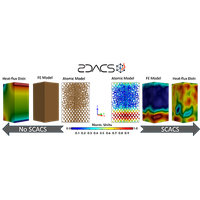
From Atoms to Devices: SCACS, Bridging the Longstanding Scale Gap in Heat Transport SCACS (Simulator Collection for Atomic-to-Continuum Scales) is a first-of-its-kind simulation framework that connects atomic-scale material structure directly to device-scale predictions of heat flow. This solves a longstanding problem in science and engineering: how to use atomic-level information to predict the behavior of real materials and devices. Statistical mechanics is a classic example of linking microscopic physics to large-scale properties such as temperature and pressure. In a similar spirit, SCACS links atomic, mesoscopic, and macroscopic descriptions of thermal transport in a continuous and practical way. The method starts from atomistic information, preserves the effects of defects, interfaces, and disorder, and transfers that information into engineering-scale heat-flow simulations. A machine-learning model is used as a computational tool to extend these predictions to much larger systems than would otherwise be practical. The result is a new route for carrying atomic-scale thermal physics into device-scale models, with potential value for designing semiconductors, energy materials, and other technologies where heat management is critical.

Anisotropic magnetism and Kondo-lattice behavior in the frustrated antiferromagnet Ce3MgBi5

Karolina Gornicka, Brenden R. Ortiz, Matthew S. Cook, Heda Zhang, Andrew D. Christianson, and Andrew F. May

Phys. Rev. Materials 10, 054413 (2026) - Published 18 May, 2026

Ce-based intermetallic compounds provide a rich platform for exploring the interplay between geometric frustration, magnetic anisotropy, and Kondo-lattice behavior. Here, the authors report the synthesis and physical characterization of single-crystalline Ce3MgBi5. Combining magnetization, transport, and thermodynamic measurements, the study reveals Kondo-lattice behavior coexisting with frustrated magnetism associated with the distorted kagome-like arrangement of Ce moments. The resulting dome-shaped H–T phase diagram and correlated magnetotransport response establish Ce3MgBi5 as a promising system for studying the interplay between geometric frustration, anisotropic exchange interactions, and Kondo hybridization in Ce-based correlated electron materials.

Magnetism of single crystalline breathing pyrochlore spinel AgInCr4S8

Andrew F. May, Christopher M. Pasco, V. O. Garlea, Karolina Gornicka, Matthias D. Frontzek, Xiaoping Wang, Pyeongjae Park, and Andrew D. Christianson

Phys. Rev. Materials 10, 054410 (2026) - Published 14 May, 2026

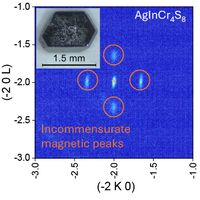
Chromium-based spinels with a breathing pyrochlore lattice provide a model platform for studying competing magnetic interactions arising from their lattice geometry. The authors report the growth of single crystals of AgInCr₄S₈ and note that the observed properties are sensitive to growth conditions, particularly sulfur overpressure. Single-crystal neutron diffraction confirms A-site ordering and reveals an incommensurate magnetic ground state that can be described by a simple helical structure. As single crystals of breathing pyrochlores are rare, this work establishes AgInCr₄S₈ as a model system for future experimental studies. Consideration of cation size trends in related compounds suggests this system lies near the upper limit of A-site ordering stability.

Second harmonic generation imaging of local antiferroelectric-ferroelectric phase transitions in a PbZrO3 thin film

A. Levchuk, P. Dufour, K. Parmar, M. Viret, T. Maroutian, S. Fusil, V. Garcia, and J.-Y. Chauleau

Phys. Rev. Materials 10, L051401 (2026) - Published 14 May, 2026

While ferroelectrics have long dominated device applications, their antiferroelectric counterparts remain largely unexplored. However, now, antiferroelectrics are stepping into the spotlight, promising breakthroughs in energy storage, solid-state cooling, and even new computing paradigms. Here, we capture the elusive transition between antipolar and polar states in epitaxial PbZrO3, using operando second-harmonic generation imaging to reveal its spatial complexity. By directly visualizing symmetry breaking and phase coexistence under electric fields, this work opens a new window onto the microscopic dynamics governing antiferroelectric-ferroelectric switching.

Strong long-wavelength electron-phonon coupling in Ta2Ni(Se,S)5

Zhibo Kang, Burak Gurlek, Weichen Tang, Xiang Chen, Jacob P. C. Ruff, Ahmet Alatas, Ayman H. Said, Robert J. Birgeneau, Steven G. Louie, Angel Rubio, Simone Latini, and Yu He

Phys. Rev. Materials 10, L053201 (2026) - Published 4 May, 2026

The candidacy of Ta2Ni(Se,S)5 as an naturally exciton-condensed system has been intensely debated. Using high-resolution inelastic x-ray scattering to obtain the momentum-resolved phonon spectral function, this study tackles the controversy by revealing the absence of the phase twisting mode expected in a condensed phase. Crucially, the authors extract an exceptionally large dimensionless electron-phonon coupling constant of g/ωph ~ 10 in the metallic normal state, placing the system in a rare ultra-strong coupling regime. By establishing Ta2Ni(Se,S)5 as a solid-state testbed for ultra-strong coupling, this work opens exciting new avenues for engineering ultrafast, lattice-driven quantum control.

Impact of magnons, defects, and rapid energy migration on the optical properties of the 2D magnet CrPS4

Jacob T. Baillie, Eden Tzanetopoulos, Rachel T. Smith, Rémi Beaulac, and Daniel R. Gamelin

Phys. Rev. Materials 10, 054001 (2026) - Published 1 May, 2026

The layered antiferromagnet CrPS4 offers a compelling platform for exploring strong coupling between optical and magnetic properties in van der Waals magnets. This study provides a new description of excitons and excitonic transitions in CrPS4. The rich fine structure observed at the optical gap by photoluminescence and photoluminescence excitation spectroscopies is shown to be dominated by on-site Cr3+ spin-flip transitions coupled to spin transitions in the surrounding CrPS4 lattice. This coupling generates resolved magnon sidebands reflecting dispersion along the lattice’s linear Cr3+ chains. Rapid exciton diffusion indicates weakly dispersive excitons that are highly susceptible to traps and luminescence activators.

β-Ga2O3(001) surface reconstructions from first principles and experiment

Konstantin Lion, Piero Mazzolini, Kingsley Egbo, Toni Markurt, Oliver Bierwagen, Martin Albrecht, and Claudia Draxl

Phys. Rev. Materials 10, 043603 (2026) - Published 30 April, 2026

Understanding how atoms arrange on semiconductor surfaces is critical for growing high-quality thin films for electronic devices. Using quantum-mechanical simulations combined with high-resolution electron microscopy, we discover a previously unknown 1 x 2 surface reconstruction of β-Ga2O3(001), a leading candidate for next-generation power electronics. In this structure, gallium and oxygen atoms form edge-sharing tetrahedral units on the surface, exhibiting remarkable stability across a wide range of experimental growth conditions. We also find that indium atoms, used as catalysts during growth, preferentially substitute into the surface in cooperative groupings, offering new guidance for optimizing film deposition.

First-principles theory of direct-gap optical emission in hexagonal Ge and its enhancement via strain engineering

Christopher A. Broderick, Xie Zhang, Mark E. Turiansky, and Chris G. Van de Walle

Phys. Rev. Materials 10, 044603 (2026) - Published 21 April, 2026

The emergence of metastable lonsdaleite germanium (2H-Ge) heralds a novel group-IV semiconductor, with the potential to address the longstanding challenge of realizing a direct-gap optical emitter for monolithic integration on Si. In this work, the nature of optical emission from direct-gap 2H-Ge is addressed theoretically. The authors’ first-principles calculations accurately account for measured photoluminescence spectra, and demonstrate that radiative recombination in 2H-Ge is significantly weaker than in a conventional direct-gap semiconductor. Strain-dependent analysis confirms the predicted emergence of an optically bright band gap under uniaxial tension, highlighting that strain engineering presents a promising route to realize 2H-Ge-based emitters for photonics.

Ab initio study of magnetoresistance effect in Mn3Sn/MgO/Mn3Sn antiferromagnetic tunnel junction

Katsuhiro Tanaka, Yuta Toga, Susumu Minami, Satoru Nakatsuji, Takuya Nomoto, Takashi Koretsune, and Ryotaro Arita

Phys. Rev. Materials 10, 044405 (2026) - Published 16 April, 2026

The electric current flowing through antiferromagnets can be spin-polarized when their magnetic structures break the macroscopic time-reversal symmetry, which leads to the emergence of the tunnel magnetoresistance (TMR) effect in the antiferromagnetic tunnel junction. In this study, the authors calculation the TMR effect from first-principles with the noncollinear antiferromagnet Mn3Sn as the electrode, and MgO, a typical barrier material, as the insulating spacer. They show that Mn3Sn/MgO/Mn3Sn junctions exhibit a sizable TMR effect owing to the spin splitting of Mn3Sn and the screening effect of MgO. This work will serve as a reasonable benchmark for further development of the antiferromagnetic TMR effect.

Bulk magnetic properties of distorted square lattice compounds M′−LnTaO4 (Ln = Tb, Dy, Ho, Er)

Nicola D. Kelly, Ivan da Silva, and Siân E. Dutton

Phys. Rev. Materials 10, 044404 (2026) - Published 14 April, 2026

Ceramic materials containing lanthanide (rare-earth) ions are important to many technologies including solid-state refrigeration, lasers, fuel cells, and the growing field of quantum computing. In this work, the authors investigated a series of four isostructural compounds with different lanthanide ions and compared them with the quantum magnet M’-YbTaO4 recently reported by others. While the lanthanide ions are chemically very similar, the materials display a wide range of electronic and magnetic properties as revealed by magnetometry and physical property measurements and detailed crystallographic analysis, including the use of neutron diffraction for magnetic structure determination.

Particle size scaling of non-Gaussian granular charge distributions

Macarena Lara, Marcos Flores, Gustavo Castillo, Santiago Tassara, Scott R. Waitukaitis, and Nicolás Mujica

Phys. Rev. Materials 10, 045604 (2026) - Published 14 April, 2026

Identical insulating particles can exchange electric charge upon contact, a process known as triboelectric charging. This phenomenon plays key roles in natural processes such as dust storms, volcanic eruptions, and planet formation, as well as in many industrial settings. Surprisingly, charge transfer also occurs between particles of the same size and material. We measure charge distributions in large ensembles of oxide particles with carefully controlled sizes and compositions. Highly charged particles arise far more often than expected, resulting in strongly non-Gaussian distributions. Their probability increases systematically with particle size, scaling with surface area. These results place new constraints on microscopic mechanisms of triboelectric charging.

Imprinting macroscopic fracture during gelation: A mechanism for tuning colloidal gels

Wilbert J. Smit, Thomas Gibaud, Sébastien Manneville, and Thibaut Divoux

Phys. Rev. Materials 10, 045602 (2026) - Published 3 April, 2026

In many practical situations – whether during casting, 3D printing, or more generally processing – colloidal suspensions of attractive particles undergo gelation while being subjected to repeated deformations. Although such flows are ubiquitous in industrial and laboratory settings, their impact on the emergence of the gel network remains poorly understood. Here, the authors show that applying oscillatory deformations on a colloidal suspension as it turns into a soft solid can imprint fracture patterns that lead to weaker gels compared to quiescent gelation, while enhancing their ability to dissipate energy. Remarkably, these cracks leave a simple and robust mechanical signature that can be captured by a minimal model, linking fracture to bulk material response. Their results reveal how mechanical perturbations reshape gelation and provide a practical route to design softer, more ductile materials.

Sign In to Your Journals Account

Filter

Section

Filter

Article Lookup

Enter a citation