Highlights

Robust Scaling in Human Brain Dynamics Despite Correlated Inputs and Limited Sampling Distortions

Rubén Calvo, Carles Martorell, Adrián Roig, and Miguel A. Muñoz

Phys. Rev. Lett. 136, 068402 (2026) - Published 9 February, 2026

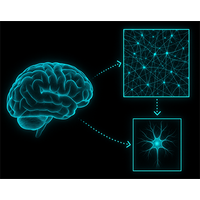
An analytical and numerical framework, applied to pooled resting-state functional magnetic resonance imaging, shows that collective brain activity is slightly subcritical yet close to criticality.

Isomer Depletion of Mo93m Triggered by Inelastic Nuclear Scattering Rather than Nuclear Excitation by Electron Capture

B. Ding (丁兵) et al.

Phys. Rev. Lett. 136, 052502 (2026) - Published 6 February, 2026

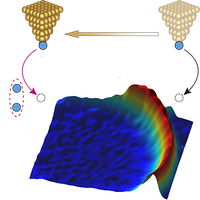
A new experiment shows that isomer depletion can be effectively induced when the highly charged isomeric ions slow down in a solid media.

Observation of Lump Solitons

Ludovica Dieli, Davide Pierangeli, Fabio Baronio, Stefano Trillo, and Claudio Conti

Phys. Rev. Lett. 136, 053804 (2026) - Published 6 February, 2026

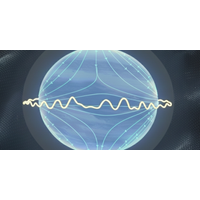
Experiments with structured light beams provide the first observation of “lump” solitions, shape-preserving solitary waves in a two-dimensional setting.

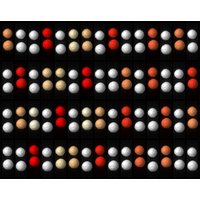
Nonreciprocal Wave-Mediated Interactions Power a Classical Time Crystal

Mia C. Morrell, Leela Elliott, and David G. Grier

Phys. Rev. Lett. 136, 057201 (2026) - Published 6 February, 2026

A pair of acoustically levitated beads powered by nonreciprocal interactions can spontaneously organize into a continuous time crystal, a state of matter that sustains steady-state oscillations without periodic driving.

Pseudo-Landau Thermal Diffusion

Jun Guo, Guoqiang Xu, Mengqi Liu, Xue Zhou, Guangming Tao, and Cheng-Wei Qiu

Phys. Rev. Lett. 136, 056306 (2026) - Published 5 February, 2026

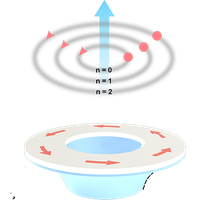
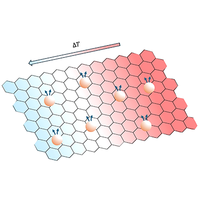
A synthetic pseudomagnetic field induces Landau-level-like quantization in heat diffusion, leading to a macroscopic quantum thermal Hall-like resistance plateau in a fundamentally dissipative system.

Visualization of Defect-Induced Interband Proximity Effect at the Nanoscale

Thomas Gozlinski, Qili Li, Rolf Heid, Oleg Kurnosikov, Alexander Haas, Ryohei Nemoto, Toyo Kazu Yamada, Jörg Schmalian, and Wulf Wulfhekel

Phys. Rev. Lett. 136, 056401 (2026) - Published 4 February, 2026

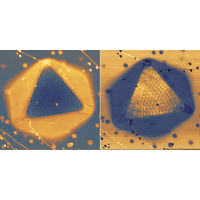
By exploiting defects in a superconductor, scientists have observed the switching of a material’s two superconducting states into one.

Purely Electronic Chirality without Structural Chirality

Takayuki Ishitobi and Kazumasa Hattori

Phys. Rev. Lett. 136, 056402 (2026) - Published 4 February, 2026

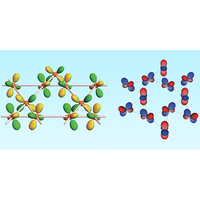
A crystal whose arrangement of atoms lacks chirality can nevertheless host a chiral electronic state.

Ab Initio Bulk Free Energy Surface of Proper Ferroelectrics

Pinchen Xie, Yixiao Chen, Xinyu Xu, Zhi Yao, Weinan E, and Roberto Car

Phys. Rev. Lett. 136, 056801 (2026) - Published 4 February, 2026

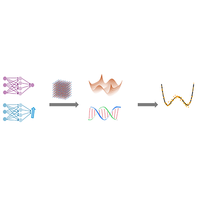
Through a combination of first-principles techniques, neural network models, and metadynamics simulations accurate free energy surfaces of ferroic materials can now be obtained without an a priori ansatz of the polynomial-based energy model.

From Spin to Pseudospin Symmetry: The Origin of Magic Numbers in Nuclear Structure

C. R. Ding, C. C. Wang, J. M. Yao, H. Hergert, H. Z. Liang, and S. K. Bogner

Phys. Rev. Lett. 136, 052501 (2026) - Published 2 February, 2026

Calculations show how the mysterious “magic numbers” that stabilize nuclear structures emerge naturally from nuclear forces—once these are described with appropriate spatial resolution.

Dynamical Superconducting Parity Effect in a Coulomb Pb Island

Wenhao Zhang, Xin Liao, James Jun He, Hui-Nan Xia, Tao Xie, Naoto Nagaosa, Tianyou Zhai, and Ying-Shuang Fu

Phys. Rev. Lett. 136, 056201 (2026) - Published 2 February, 2026

Cooper-pair condensation dynamics plays an indispensable role in a new type of superconducting parity effect in a Coulomb blockade system made up of nanosized Pb islands.

Ideal Glass and Ideal Disk Packing in Two Dimensions

Viola M. Bolton-Lum, R. Cameron Dennis, Peter K. Morse, and Eric I. Corwin

Phys. Rev. Lett. 136, 058201 (2026) - Published 2 February, 2026

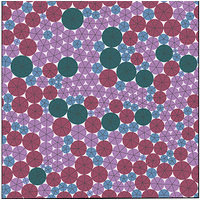
A computational minimization procedure shows how to make an ideal glass, a disordered system of particles with zero configurational entropy and with the mechanical and thermal properties of a crystal.

Black Hole Spectroscopy and Tests of General Relativity with GW250114

A. G. Abac et al. (The LIGO Scientific Collaboration, The Virgo Collaboration, and The KAGRA Collaboration)

Phys. Rev. Lett. 136, 041403 (2026) - Published 29 January, 2026

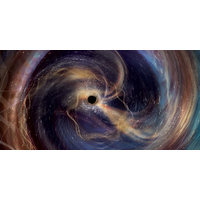
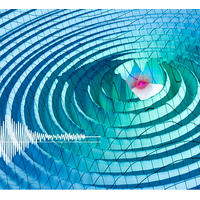
An analysis of a record-breaking gravitational-wave detection tests whether general relativity holds under extreme conditions.

Real-Space Switching of Local Moments Driven by Quantum Geometry in Correlated Graphene Heterostructures

Niklas Witt, Siheon Ryee, Lennart Klebl, Jennifer Cano, Giorgio Sangiovanni, and Tim O. Wehling

Phys. Rev. Lett. 136, 046505 (2026) - Published 29 January, 2026

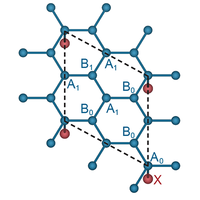
Hybridization-induced topological transition between Mott states leads to flat bands, providing an alternative to twisted bilayer graphene.

Spontaneous Symmetry Breaking of Cavity Vacuum and Emergent Gyrotropic Effects in Embedded Moiré Superlattices

Zuzhang Lin, Hsun-Chi Chan, Wenqi Yang, Yixin Sha, Cong Xiao, Shuang Zhang, and Wang Yao

Phys. Rev. Lett. 136, 046903 (2026) - Published 29 January, 2026

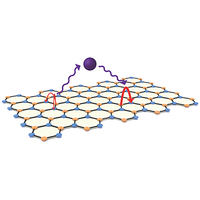
All-to-one coupling between electrons in moiré superlattice to a deep-subwavelength cavity uncovers an unprecedented dual spontaneous parity symmetry breaking simultaneously in the cavity vacuum and the electronic ground state.

Excitonic Instability Revealed by the Elastocaloric Effect in Ta2NiSe5

Elliott Rosenberg, Joss Ayres-Sims, Andrew Millis, David Cobden, and Jiun-Haw Chu

Phys. Rev. Lett. 136, 046503 (2026) - Published 28 January, 2026

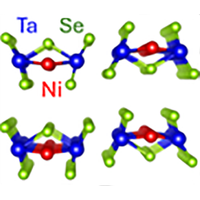
Elastocaloric effect measurements on Ta2NiSe5 show that its phase transition at ~324 K is driven by a nonacoustic instability, rather than by an acoustic shear mode, strengthening the case that the transition is largely excitonic in nature.

Breaking the Intrinsic Absorption Limit for Arbitrarily Thin Conductive Films at Grazing Incidence

Yuxuan Liu, Ren-Hao Fan, Dong-Xiang Qi, Ruwen Peng, Yun Lai, Mu Wang, and Jie Luo

Phys. Rev. Lett. 136, 046902 (2026) - Published 28 January, 2026

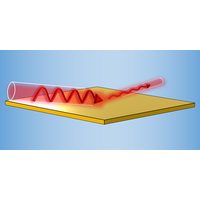
Light grazing an ultrathin conductive film can be absorbed much more strongly than previously thought.

Provable and Verifiable Quantum Advantage in Sample Complexity

Marcello Benedetti, Harry Buhrman, and Jordi Weggemans

Phys. Rev. Lett. 136, 040601 (2026) - Published 27 January, 2026

In a sample-to-sample setting, quantum computation achieves the largest possible separation over classical computation.

Geomagnetic Constraints on Millicharged Dark Matter

Ariel Arza, Yuanlin Gong, Jing Shu, Lei Wu, Qiang Yuan, and Bin Zhu

Phys. Rev. Lett. 136, 041001 (2026) - Published 27 January, 2026

Dark matter having a small electric charge would presumably generate a magnetic-field variation on Earth’s surface, but observations find no such signal.

Thermopower Probe of Fractional Quantum Hall States in Monolayer Graphene

Nishat Sultana, Robert W. Rienstra, Kenji Watanabe, Takashi Taniguchi, Joseph A. Stroscio, D. E. Feldman, and Fereshte Ghahari

Phys. Rev. Lett. 136, 046502 (2026) - Published 27 January, 2026

Thermopower is more sensitive than resistivity in detecting certain fractional quantum Hall states in monolayer graphene.

Gravitational Wave Memory from Binary Neutron Star Mergers

Jamie Bamber, Antonios Tsokaros, Milton Ruiz, Stuart L. Shapiro, Marc Favata, Matthew Karlson, and Fabrizio Venturi Piñas

Phys. Rev. Lett. 136, 041401 (2026) - Published 26 January, 2026
The full displacement memory signal from binary neutron star mergers, including both the contribution from the gravitational waves themselves and from the electromagnetic, neutrino and baryonic ejecta is quantified using general relativistic magnetohydrodynamic simulations.

Sign In to Your Journals Account

Filter

Section

Filter

Article Lookup

Enter a citation