Recent Articles

Green function and singularities in Stokes flow confined by cylindrical walls

Giuseppe Procopio

Phys. Rev. Fluids 11, 034201 (2026) - Published 13 March, 2026

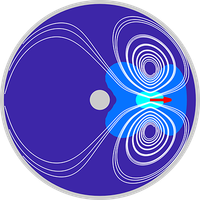
Singular solutions in the stationary Stokes regime are reported for fluids confined by cylindrical walls. The stokeslet, stresslet, couplet, point source, and point source dipole are obtained internally, externally, and within the annular region between cylindrical walls using bitensorial calculus. Beyond providing hydrodynamic solutions relevant to particle transport in confined environments, this work highlights the strength of bitensorial calculus in handling curved geometries and systematically yielding hydrodynamic singularities within a unified framework. Forces on sedimenting particles and active microswimmers near cylindrical walls are investigated as an application.

Dimensional regimes in Kolmogorov flow

Melisa Y. Vinograd, Joaquín Cullen, and Patricio Clark Di Leoni

Phys. Rev. Fluids 11, 034402 (2026) - Published 13 March, 2026

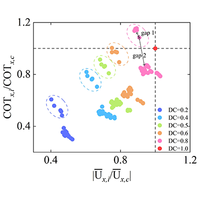
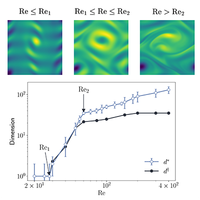
How many degrees of freedom characterize turbulent flow? We investigate the dimensionality of two-dimensional Kolmogorov flow across Reynolds numbers and forcing scales using convolutional autoencoders and Lyapunov analysis. Two dynamical transitions are identified, first associated with periodic-orbit destabilization and later with large-scale saturation. The resulting saturation dimension scales linearly with the forcing wavenumber rather than with the total number of available Fourier modes.

Wake deflection and propulsive performance of intermittently flapping foil

Bowen Jin, Jiadong Wang, and Jian Deng

Phys. Rev. Fluids 11, 034701 (2026) - Published 13 March, 2026

Intermittent swimming boosts efficiency—but at what cost? Using two-dimensional simulations of an unconstrained pitching foil, we show that burst-and-coast motion induces pronounced lateral drift and a sharp, amplitude-driven reversal in trajectory direction. The deflection is governed by Strouhal-controlled scaling and wake realignment across burst and glide phases. These results uncover how intermittent kinematics trade stability for energetic advantage.

Geometry of contraction-induced flows

Aaron Winn and Eleni Katifori

Phys. Rev. Fluids 11, 033101 (2026) - Published 12 March, 2026

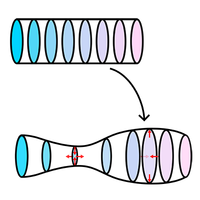
Peristaltic pumping drives flow in diverse biological and engineered systems. Previous models focus solely on radius-imposed contraction waves or neglect the elastic coupling between radial and longitudinal strains. By describing the fluid using the material coordinates of the deforming wall, we analyze flow in a tube undergoing simultaneous transverse and longitudinal contractions. We show that the elastic coupling between circumferential and longitudinal strains strongly alters net transport, reflux, and trapping, as compared to the case with radial contractions alone.

Spatiotemporally resolved measurements of CO2 distribution at the air-water interface using tunable diode laser spectroscopy

Dongfang Zhao, Yumin Shi, and Shengkai Wang

Phys. Rev. Fluids 11, 034903 (2026) - Published 12 March, 2026

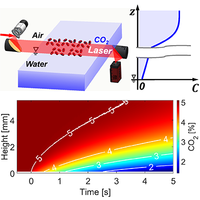
We developed a new method for high-resolution measurement of CO2 transport across the air–water interface, addressing a critical need in physical oceanography studies and in modern carbon sequestration applications. This method forgoes conventional probe-based sampling and statistical correlation, and exploits precision laser spectroscopy with rapid spatial beam scanning to directly quantify gas-phase CO2 distribution near the interface at millimeter and millisecond resolutions. To our knowledge, this is the first time such a level of resolution has been achieved. This method should prove useful in both field measurements and laboratory studies of cross-interface gas transport.

Tumbling of long flexible fibers in isotropic turbulence

Hugo Poncelet and Gautier Verhille

Phys. Rev. Fluids 11, 034301 (2026) - Published 11 March, 2026

We investigated experimentally for the first time the rotational dynamics of flexible fibers in homogeneous and isotropic turbulence. The rotation and the deformation of the fibers have been measured thanks to an efficient three-dimensional reconstruction algorithm from three simultaneous images. We show that an increase of fiber flexibility enhances the rotation rate. We show that this phenomenon is directly related to the amplitude of deformation.

From fluttering to drifting: Inertialess sedimentation of an achiral particle

Christian Vaquero-Stainer, Tymoteusz Miara, Anne Juel, Matthias Heil, and Draga Pihler-Puzović

Phys. Rev. Fluids 11, 034102 (2026) - Published 10 March, 2026

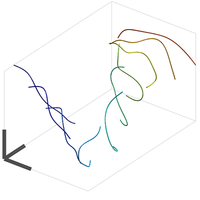
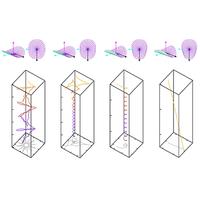
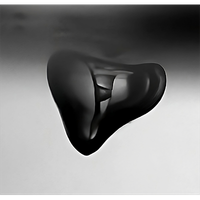
The motion of rigid bodies in viscous fluids at vanishing Reynolds number is governed entirely by its geometry. While highly symmetric particles like spheres and flat circular disks sediment without reorientation and chiral bodies follow helical trajectories, the dynamics of weakly asymmetric shapes remain difficult to predict. Here, we combine numerical simulations and experiments to investigate “pinched” U-shaped disks with a single plane of symmetry. By varying the degree of pinching, we demonstrate that this class of achiral particles can realize the complete spectrum of inertialess sedimentation behavior, from straight settling to robust quasiperiodic spiraling.

Droplet on a sugar fiber

Stéphane Dorbolo, Floriane Weyer, Alexandre Delory, Apurav Tambe, and Zhao Pan

Phys. Rev. Fluids 11, 033605 (2026) - Published 9 March, 2026

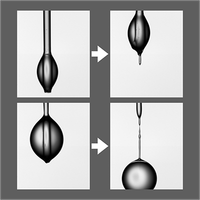
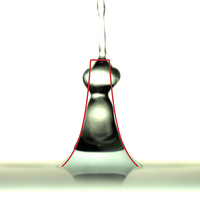
A water droplet hanging from the tip of a vertical sugar fiber seems destined to fall as gravity overcomes capillarity. However, the droplet is also gradually dissolving its own support. Will the droplet fall? Sometimes. However, it may instead suddenly jump upward and climb the very fiber it consumes. We show how this counterintuitive motion emerges from the interplay of surface tension, gravity, and dissolution, and identify the conditions that determine whether the droplet falls or rises. This process may again occur until the droplet is full.

Optically trapped particle tracking velocimetry

Tetsuro Tsuji, Shoma Hashimoto, and Satoshi Taguchi

Phys. Rev. Fluids 11, 034901 (2026) - Published 9 March, 2026

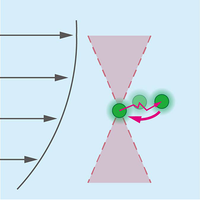
When tracers are scarce in flow measurement using particle imaging velocimetry (PIV), experimenters must wait for tracers to come in the test section, making measurements inefficient. To address this ill-suited case for PIV, the paper introduces optical trapping of a tracer; briefly let it go so the flow moves it, then pull it back at the same initial position. The method, termed as optically-trapped particle tracking velocimetry, is validated by measuring a slow microflow in a square microchannel. The authors also demonstrate an application to optothermal flows where tracers are depleted near the heat source, showing how ot-PTV can still probe tracer motion in an ill-suited case for PIV.

Exact solution for the electric field associated with charge caps on a leaky dielectric droplet at high electric Reynolds number

Darren Crowdy

Phys. Rev. Fluids 11, 034902 (2026) - Published 9 March, 2026

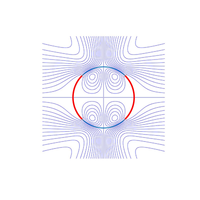
In a recent study of the formation of electric charge caps on a leaky dielectric droplet, it has been shown that, in the limit of high electric Reynolds number, the electric field problem satisfies a non-standard boundary value problem of mixed type. By using novel techniques involving consideration of a so-called prime function, this paper shows that it is possible to solve this mixed boundary value problem analytically.

Confined drying of a binary liquid mixture droplet: A quantitative interferometric study under humidity control

Ole Milark, Jean-Baptiste Salmon, and Benjamin Sobac

Phys. Rev. Fluids 11, 033603 (2026) - Published 6 March, 2026

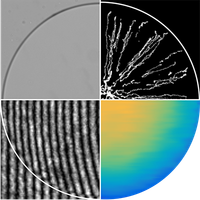
Drying of complex fluids is crucial in many natural and technological processes, yet predicting it and probing associated transport phenomena remain challenging. We introduce an original interferometry‑based method for confined two-dimensional droplets in a humidity‑controlled chamber, enabling simultaneous high‑precision, high‑resolution measurement of drying kinetics and internal concentration fields, providing a powerful tool to accurately characterize drying dynamics and transport in complex fluids.

Dynamics and universal scaling of Worthington jets in the cavity-free regime

Xingsheng Li and Jing Li

Phys. Rev. Fluids 11, 033604 (2026) - Published 6 March, 2026

Existing research on Worthington jets has paid most attention to those forced by cavity collapse. Focusing on the cavity-free regime across various sphere-liquid impact configurations, we derive a universal scaling law for the maximum jet height from first principles and identify three distinct pinch-off modes governed by Rayleigh–Plateau instability. Self-similar analysis accurately captures the evolution of jet shape and height, revealing gravity-dominated jet dynamics. These findings confirm that this jet undergoes a fundamentally different physical process from that in air-entrainment scenarios, thereby significantly enriching the classical Worthington jet phenomenon.

Laser-induced bubble dynamics near the free surface of a viscoplastic medium

S. P. Mousavi, H. Hassanzadeh, Y. Fan, F. Larachi, C. D. Ohl, and S. M. Taghavi

Phys. Rev. Fluids 11, 033301 (2026) - Published 5 March, 2026

Cavitation bubbles near free surfaces are known to move rapidly away from the liquid surface and generate high-speed microjets. We demonstrate that viscoplastic fluids can fundamentally change this outcome by arresting the bubble and trapping it beneath the surface once a critical yield number is exceeded. A regime map classifies the flow into four regimes (swelling, trapped, bullet jet, and vapor jet), and a force-balance model provides a predictive framework for the bubble penetration depth.

Modal coupling of nonlinear inviscid axisymmetric droplet shape oscillations

Schahin Akbari, Kilian Vinzenz Wilhelm, Dominik Plümacher, Florian Kummer, Yongqi Wang, and Martin Oberlack

Phys. Rev. Fluids 11, 033602 (2026) - Published 5 March, 2026

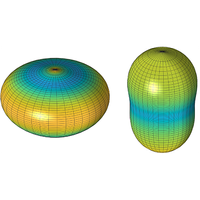
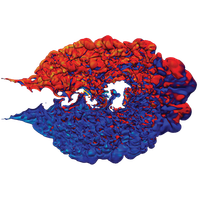
We investigate the nonlinear axisymmetric oscillations of non-viscous droplets with a focus on superimposed initial deformations, in which an even mode with large amplitude is superimposed on an odd mode at small amplitude. Our analysis of modal coupling shows that the even mode with large amplitude strongly influences the odd mode with small amplitude due to asymmetries in local curvature and restoring forces between flattened and elongated shapes (as in the image), while the odd mode with small amplitude has only a minor influence in return.

Plunging and entrainment dynamics of an unconfined hyperpycnal plume over a sloping bed

Georgios Giamagas, Cyrille Bonamy, Koen Blanckaert, and Julien Chauchat

Phys. Rev. Fluids 11, 033801 (2026) - Published 5 March, 2026

Large-eddy simulations of the Navier–Stokes equations under the Boussinesq approximation investigate the hydrodynamics of a three-dimensional hyperpycnal plume over a sloping bed. In the unconfined configuration, plunging is governed by lateral slumping rather than by a critical densimetric Froude number, producing a characteristic triangular surface pattern and a distinct downstream wake. The wake extent increases significantly with increasing inflow densimetric Froude number and agrees with field observations of the Rhone River inflow into Lake Geneva. Total entrainment increases with decreasing densimetric Froude number due to enhanced lateral spreading and increased underflow velocity.

Efficient laminar flow control

Gaspare Li Causi, Enrico Amico, and Jacopo Serpieri

Phys. Rev. Fluids 11, 033901 (2026) - Published 5 March, 2026

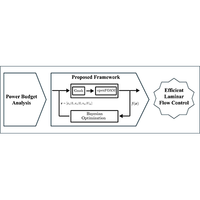
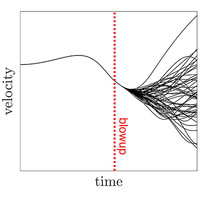
The recent literature on wall blowing flow control was here adapted to suction-based laminar flow control (LFC) to study efficient control scenarios. These are evaluated by means of a numerical framework deploying fast and relatively accurate CFD and flow transition solvers embedded in an efficient optimization routine. More than 700 combinations of LFC parameters were explored showcasing the flow sensitivity to the deployed control and yielding to power savings overcoming the value of 30%.

Data-driven discovery of a new Ginzburg-Landau reduced-order model for vortex shedding

Joseph J. Williams, Zachary G. Nicolaou, J. Nathan Kutz, and Steven L. Brunton

Phys. Rev. Fluids 11, 034401 (2026) - Published 5 March, 2026

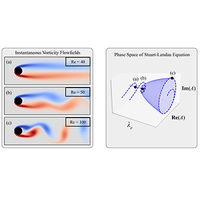
The vortex shedding phenomenon has long fascinated researchers, yet only recently has the behavior of unstable growth and saturation been placed on firm mathematical footing through the Stuart–Landau and Ginzburg–Landau equations. While these models capture key aspects of the dynamics, a complete understanding of vortex shedding remains elusive. Here, we use data-driven methods trained on coarse-grained numerical flow data to learn distinct local models at multiple stations in the downstream wake. This approach yields new insight into the nature of the instability, the wavemaker region, and vortex shedding itself.

Lagrangian chaos and the enstrophy cascade in Ekman-Navier-Stokes two-dimensional turbulence

F. M. Ventrella, V. J. Valadão, G. Boffetta, S. Musacchio, and F. De Lillo

Phys. Rev. Fluids 11, 034604 (2026) - Published 5 March, 2026

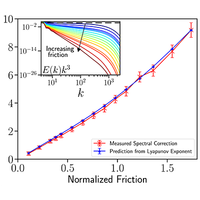
In the presence of linear friction, the properties of two-dimensional turbulence deviate from the classical Kraichnan phenomenology. The enstrophy flux in the direct cascade is suppressed resulting in a steeper energy spectrum. The spectral exponent can be predicted in terms of the statistics of the Lagrangian finite time Lyapunov exponent. We numerically verify this prediction and propose a simple phenomenological model for the dependence of the Lyapunov exponent on friction intensity.

Renormalization-group theory of spontaneous stochasticity for Sabra model of turbulence

Alexei A. Mailybaev

Phys. Rev. Fluids 11, 034605 (2026) - Published 5 March, 2026

Spontaneous stochasticity—persistent randomness in the limit of vanishing noise and viscosity—has been observed in turbulence models, yet its universality lacked a theoretical explanation. We develop a renormalization-group (RG) framework for the fluctuating Sabra shell model, showing that the ideal turbulent dynamics is governed by a fixed-point RG attractor. This approach explains universality across dissipation and noise mechanisms and predicts a complex RG eigenvalue responsible for the slow, oscillatory convergence observed numerically.

Droplet mobilization in actuated deformable tubes

Sthavishtha R. Bhopalam, Ruben Juanes, and Hector Gomez

Phys. Rev. Fluids 11, 033601 (2026) - Published 3 March, 2026
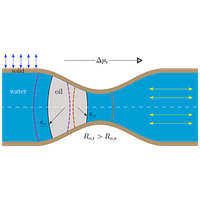
Droplet transport in deformable constrictions is important in microfluidics, enhanced oil recovery, biomedical systems, and surface-acoustic-wave-driven platforms. We study how actuation controls droplet motion in a constricted deformable tube using high resolution multicomponent fluid-structure interaction simulations. We show that oscillatory traction on the tube walls exhibits resonance, i.e., the droplet’s mobilization time is minimized when the traction frequency nears the tube’s natural frequency. However, actuation via oscillatory fluid forcing exhibits no such resonance. Our findings provide design guidelines for tunable, actuation-controlled droplet motion in soft confined geometries.

Sign In to Your Journals Account

Filter

Recent Issues

Vol. 11, Iss. 10
October 2026
Vol. 11, Iss. 9
September 2026
Vol. 11, Iss. 8
August 2026
Vol. 11, Iss. 7
July 2026
Category
Article Type
Section

Filter

Article Lookup

Enter a citation