Highlights

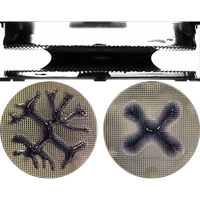
Patterning surface textured plates with a viscoplastic fluid

Vanessa R. Kern, Marcel Moura, Pål E. S. Olsen, and Andreas Carlson

Phys. Rev. Fluids 11, 093301 (2026) - Published 28 September, 2026

Viscoplastic fluids can retain complex shapes after deposition, but controlling these shapes through interfacial instabilities remains challenging. Experiments with simultaneous side and bottom imaging in a lifted Hele-Shaw cell shows that submillimetric substrate structures can direct the fingering dynamics and determine the symmetry and morphology of the deposited fluid. The adhesive force decay as the plate is lifting is an interplay between capillary, yield-stress, and viscous forces, where a dynamic permeability links the preferred invasion directions to the anisotropy introduced by the substrate texture.

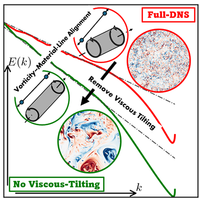
Turbulence without the viscous tilting of vorticity

Amr Emam, Mostafa Kamal, and Perry L. Johnson

Phys. Rev. Fluids 11, 094607 (2026) - Published 28 September, 2026

While vortex stretching in turbulence is commonly understood in analogy to material line stretching, the viscous tilting of vorticity prevents sustained alignment with material lines. In this paper, it is shown via numerical simulation that the surgical removal of viscous tilting from the vorticity evolution equations in isotropic turbulence results in dramatic deviations from basic turbulence scaling laws. These observations demonstrate that the viscous tilting of vorticity, and thus the difference between vorticity stretching and that of material lines, is an essential characteristic of turbulence.

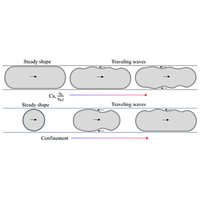
Motility and interfacial instability of confined chemically active droplets

Pawan Kumar, Sobiya Ashraf, Naveen Tiwari, Dipin Pillai, and Rahul Mangal

Phys. Rev. Fluids 11, 094005 (2026) - Published 21 September, 2026

This work investigates how confinement and the physicochemical properties of the surrounding medium influence the dynamics of chemically active droplets in a capillary channel. We demonstrate that the Yeh-Marangoni instability induces peristaltic interfacial traveling waves on confined chemically active droplets, enabling adaptive oscillatory locomotion through narrow channels.

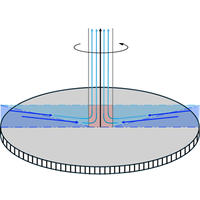
Boundary layer beneath a tornado-like vortex

Leven Davies, P. A. Davidson, and John K. Harvey

Phys. Rev. Fluids 11, 094703 (2026) - Published 21 September, 2026

How is the boundary layer structured beneath a tornado, the surface flow that feeds the vortex above it? Because field observations are challenging, much of what is known rests on theory. A classical asymptotic analysis predicts a composite layer: a thin viscous layer carrying the shear stress, capped by a thicker layer carrying the inward mass flux. We test this quantitatively using particle image velocimetry of a tornado-like vortex in a water tank. The measurements support the two-layer structure and expose a surprising feature within it: fluid is entrained downward at all radii, yet the inner layer still detrains mass into the outer layer.

Gravity-driven feeding currents in veliger larvae of the eastern oyster

Houshuo Jiang

Phys. Rev. Fluids 11, 093101 (2026) - Published 16 September, 2026

Feeding by marine invertebrate larvae depends critically on the low-Reynolds-number fluid mechanics of the feeding currents they generate. However, the relative importance of gravity-driven and drag-driven mechanisms in shaping these feeding currents has remained unresolved. By combining μPIV measurements with an analytical Stokes-flow model, this study demonstrates that feeding currents of eastern oyster (Crassostrea virginica) veligers are gravity-dominated despite their submillimeter size, and quantifies how excess weight, swimming kinematics, and ciliary propulsion together determine larval clearance rates and flow structure.

Interactions and reconnections of four-dimensional quantum vortices

H. A. J. Middleton-Spencer, B. McCanna, D. Proment, and H. M. Price

Phys. Rev. Fluids 11, 084701 (2026) - Published 31 August, 2026

Vortex reconnections are fundamental to quantum fluids. They are reconnections of quantum vortices defined by a topological change and irreversible energy transfer given by universal scaling laws, leading to quantum turbulence. We generalize this mechanism by studying reconnections of extra-dimensional quantum vortices. We find a new range of vortex interactions depending on their initial orientation – a four-dimensional generalization to the known three-dimensional case; vortex interactions with no reconnections; and a new class reconnection that keeps the same scaling law with no energy transfer, suggesting a form of reversible reconnection not allowed in three-dimensional systems.

Mixing by offshore wind infrastructure: Resolving the density stratified wakes past vertical cylinders

Charlie J. Lloyd and Robert M. Dorrell

Phys. Rev. Fluids 11, 084802 (2026) - Published 17 August, 2026

The offshore wind industry is expanding in deep, seasonally stratified waters, where infrastructure-induced mixing may alter ocean dynamics and ecosystems. We present the first fully structure-resolved direct numerical simulations of stratified flow past a vertical cylinder as an idealized model for flow interactions with offshore wind foundations. We identify two distinct wake regimes: a weakly stratified regime characterized by a narrow turbulent wake, and a strongly stratified regime characterized by thermocline-spanning recirculation cells and stationary internal waves, providing a new mechanism for far-field energy transport and a possible explanation for wake persistence discrepancies.

Intrusive particle-laden flows with implications to marine carbon dioxide removal

Haowei Qiu, Adam Jiankang Yang, and Baafour Nyantekyi-Kwakye

Phys. Rev. Fluids 11, 084503 (2026) - Published 13 August, 2026

Ocean Alkalinity Enhancement (OAE) is a promising marine carbon dioxide removal strategy involving the release of alkaline particles into the ocean. However, its effectiveness depends on how these particles disperse. This study uses high-resolution simulations to show that collective convective instabilities, rather than individual Stokes settling, fundamentally govern particle settling. These instabilities can accelerate vertical particle transport by up to two orders of magnitude, significantly limiting horizontal spread and surface residence time. These fundamental fluid-dynamic constraints provide essential guidance for optimizing future OAE deployments.

Edge-stabilized rotating flames in a circular Hele-Shaw cell

Xiangyu Nie and Shengkai Wang

Phys. Rev. Fluids 11, 083201 (2026) - Published 10 August, 2026

We report direct experimental observations of self-sustaining CH4–air flames rotating along the edge of an unheated circular Hele-Shaw cell, extending beyond previous studies in which such flames were observed only under external heating. Formed under fuel-rich conditions, these flames exhibit stable traveling-wave behavior, with edge velocities exceeding nominal laminar flame speeds and a structure comprising both premixed and diffusion branches. The rotation arises from a balance between local flame speed, flow, and wall heat loss. Parametric studies have identified regimes of single and multiple rotating waves, as well as transitions to ring flames or extinction under extreme conditions.

Orientation dynamics of gyrotactic microswimmers in turbulent flows

Suraj Kumar Nayak, Vishwanath Shukla, and Akshay Bhatnagar

Phys. Rev. Fluids 11, 084602 (2026) - Published 4 August, 2026

Direct numerical simulations reveal the orientation and transport of spherical, spheroidal, and rod-like gyrotactic microswimmers in three-dimensional turbulence. Strongly gyrotactic swimmers preferentially align with the vertical, while weakly gyrotactic swimmers are nearly isotropic. Rod-like swimmers are more strongly affected by fluid shear and align with the principal strain direction. Orientation correlations depend on the gyrotactic response time, and all shapes transition from ballistic to diffusive transport. A reduced two-dimensional model for spherical swimmers reproduces the key statistics.

Origin of the sound produced by a detaching bubble

Vincent Gourmandie, Jeanne Chauris, Remi Fechter, Valentin Leroy, Caroline Derec, and Juliette Pierre

Phys. Rev. Fluids 11, 073605 (2026) - Published 29 July, 2026

The sound produced by a detaching bubble is known to arise from its volumetric oscillations, but the factors driving the oscillation amplitude has remained an open question. We perform experiments using two bubble-generation methods, and observe that both the shape and amplitude of the pressure signal depend strongly on the bubble formation mechanisms. Using a large set of experimental data, we identify that the oscillation amplitude is mainly controlled by the initial growth velocity of the bubble. Furthermore, we propose a simple model that captures the onset of the acoustic signal as a consequence of the bubble pinch-off dynamics.

Scalings and simulation requirements in two-phase flows

Luis H. Hatashita, Pranav Nathan, and Suhas S. Jain

Phys. Rev. Fluids 11, 074303 (2026) - Published 20 July, 2026

High-fidelity simulations have become indispensable for uncovering the physics of turbulent two-phase flows, yet quantitative guidelines for the grid and time-step requirements needed to accurately resolve interface dynamics have been lacking. We derive scaling laws that predict these computational requirements as functions of Reynolds, Weber, and Capillary numbers; identify distinct inertia- and viscous-dominated regimes; and introduce a new dimensionless parameter that unifies their classification. The resulting framework provides practical a priori resolution criteria and computational cost estimates for predictive interface-resolved simulations.

Criticality of the viscous to inertial transition near jamming in non-Brownian suspensions

Nishanth Murugan, Donald Koch, and Sarah Hormozi

Phys. Rev. Fluids 11, 074302 (2026) - Published 15 July, 2026

Dense non-Brownian suspensions undergo a rheological transition with increasing shear rate, from a Newtonian scaling where stress grows linearly, to a Bagnoldian scaling where it grows quadratically. For suspensions devoid of frictional contacts due to electrostatic repulsive forces keeping the particles apart, our discrete element simulations reveal the shear rate marking the onset of the inertial regime to exhibit a critical behavior as the suspension approaches jamming. Our results show this criticality to be tied to a diverging microstructural length scale, larger than any individual particle, that governs the emergence of inertial effects within the suspension.

How elasticity affects bubble pinch-off

Coen I. Verschuur, Alexandros T. Oratis, Vatsal Sanjay, and Jacco H. Snoeijer

Phys. Rev. Fluids 11, 073302 (2026) - Published 13 July, 2026

The pinch-off of drops and bubbles from a needle are classic examples of hydrodynamic singularities, in which a fluid body splits into two. While even small amounts of polymers strongly delay drop breakup by forming long liquid threads, recent experiments show that bubble pinch-off remains largely unaffected. In this article we demonstrate that polymer stretching cannot compete with the violent inertial collapse governing bubble pinch-off. Only for sufficiently high polymer concentrations and small needle sizes can viscoelastic effects delay breakup, resulting in the formation of air cavities.

Effect of wind turbulence on wave generation over a viscous liquid

R. Mathis, S. Cazin, J. Methel, F. Charru, J. Magnaudet, F. Moisy, and M. Rabaud

Phys. Rev. Fluids 11, 064804 (2026) - Published 26 June, 2026

The growth of wind-generated waves may depend on free-stream turbulence, a parameter that is generally neglected in existing models. Here, we investigate this effect experimentally using grid-generated turbulence blowing over a viscous fluid. Our results show that free-stream turbulence enhances the amplitude of three-dimensional wrinkles and lowers the critical wind velocity for the onset of regular two-dimensional waves, while the wrinkle–wave transition remains associated with an approximately constant friction velocity. A qualitative model explains why the observed decrease of the friction velocity with the fetch results in a non-monotonic variation of the wave amplitude.

Uncertainty growth in stably stratified turbulence

Mrinal Jyoti Powdel and Samriddhi Sankar Ray

Phys. Rev. Fluids 11, 064615 (2026) - Published 23 June, 2026

We show that the spread of infinitesimal perturbations in a turbulent density-stratified fluid becomes slower with increasing degree of stratification. With a higher degree of stratification, the spatial growth of the uncertainty gets more and more compressed along the direction of stratification. Despite this, the temporal growth of perturbations follows the same universal behavior: an initial decay followed by an exponential growth, ultimately leading to saturation. The rate of growth of the perturbation, however, gets affected by stratification through the strain-mediated dynamics of the underlying velocity field, rather than through direct coupling with the density fluctuations.

Modeling flying formations as flow-mediated matter

Christiana Mavroyiakoumou, Jiajie Wu, and Leif Ristroph

Phys. Rev. Fluids 11, 063103 (2026) - Published 18 June, 2026

Collective locomotion of swimming and flying animals is fascinating in terms of individual-level fluid mechanics and group-level structure and dynamics. Here we bridge and relate these scales through a formation-flight model that views the collective as a material whose properties arise from flow-mediated interactions among its members. Our model shows that the group behaves as a soft “crystal” with regularly spaced member “atoms” whose positioning is susceptible to deformations and dynamical instabilities. Other emergent properties relevant to biological collectives include group cohesion, sensitive detection of and response to perturbations, and information transfer through traveling waves.

Mosquitoes fly forward by asymmetric rapid wing pitching

Zengshuang Chen, Xueguang Meng, Pengyuan Yang, and Gang Chen

Phys. Rev. Fluids 11, 063101 (2026) - Published 17 June, 2026

Most insects generate forward thrust by tilting the stroke plane or adjusting the wing angle of attack. This study reveals that mosquitoes adopt a fundamentally different strategy: while maintaining a nearly horizontal stroke plane, they achieve forward flight through highly asymmetric wing pitching between downstroke and upstroke. Two novel thrust mechanisms are identified under this motion pattern—asymmetric pitch-down acceleration and asymmetric pitch-up amplitude. These findings deepen our understanding of insect flight diversity and offer new design principles for micro flapping-wing vehicles.

Fluid dynamics of a liquid mirror space telescope

Israel Gabay, Omer Luria, Edward Balaban, Amir D. Gat, and Moran Bercovici

Phys. Rev. Fluids 11, 064003 (2026) - Published 16 June, 2026

Large-aperture telescopes are currently limited by launch vehicle constraints. The Fluidic Telescope (FLUTE) concept seeks to overcome this by using liquid mirrors which, in microgravity, naturally relax into a precise spherical shape. However, necessary telescope maneuvers subject the liquid to body forces that perturb this interface. This study provides an experimentally validated analytical model for such liquid dynamics by solving for the non-self-adjoint problem of a thin liquid film pinned in a circular domain. Using the model to simulate decades of operation, we show that while edge disturbances build up, the inner 80% of the aperture remains optically precise for over 20 years.

Pattern formation in rectilinear flows of noncolloidal suspensions

Parham Poureslami, Ranit Mukherjee, and Sungyon Lee

Phys. Rev. Fluids 11, 064303 (2026) - Published 10 June, 2026

Particle-induced viscous fingering (PIVF) occurs when a non-colloidal suspension displaces air inside a Hele-Shaw cell, which leads to the formation of particle clusters, or “plumes” at the advancing interface. Despite extensive studies in the last decade, the coupling between plumes and interfacial deformations remains unexamined. In this paper, we address this coupling by deriving scaling laws that connect the interplay between capillarity, local particle concentrations, and interfacial speed. We also uncover new regimes of PIVF that are unique to rectilinear geometry, in which particle plumes interact and coalesce, resulting in enhanced mixing inside the suspension.

Sign In to Your Journals Account

Filter

Section

Filter

Article Lookup

Enter a citation