Highlights

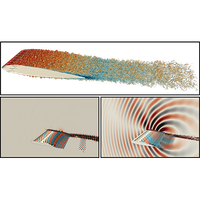
Coherent structures driving broadband trailing-edge noise: Spanwise wavenumber selection and low-order modeling

Zhenyang Yuan, Simon Demange, Kilian Oberleithner, André V. G. Cavalieri, and Ardeshir Hanifi

Phys. Rev. Fluids 11, 034606 (2026) - Published 16 March, 2026

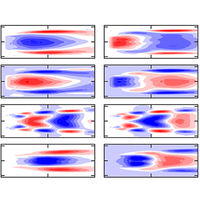
Broadband trailing edge noise is generated by the scattering of three-dimensional hydrodynamic structures, but the role of spanwise wavenumber selection in acoustic radiation for a finite spanwidth airfoil remains unresolved. Wall resolved compressible large eddy simulation of a NACA0012 airfoil shows that nonzero spanwise modes become dominant above the acoustic cut-on frequency associated with obliquely convecting wavepackets identified via spectral proper orthogonal decomposition (SPOD). A reduced-order model based on extended SPOD reproduces far-field noise using only a small number of modes, providing a compact and control oriented framework for noise prediction and mitigation.

Self-propulsion of floating ice blocks caused by melting in water

Michael Berhanu, Amit Dawadi, Martin Chaigne, Jérôme Jovet, and Arshad Kudrolli

Phys. Rev. Fluids 11, 033802 (2026) - Published 13 March, 2026

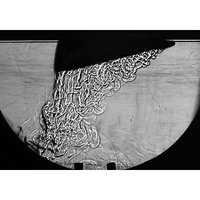
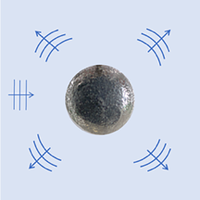
We demonstrate that asymmetric ice blocks floating in water can self‑propel while melting. Experiments with triangular ice prisms show that melting generates a directed, buoyancy‑driven gravity current along the inclined face, producing steady translation. A momentum‑balance model quantitatively predicts the propulsion velocity as a function of ice geometry and bath temperature. This mechanism persists in saltwater at sufficiently warm temperatures, highlighting melting as a generic propulsion mechanism in buoyancy‑driven flows and a possible secondary contributor to iceberg drift.

Spatiotemporally resolved measurements of CO2 distribution at the air-water interface using tunable diode laser spectroscopy

Dongfang Zhao, Yumin Shi, and Shengkai Wang

Phys. Rev. Fluids 11, 034903 (2026) - Published 12 March, 2026

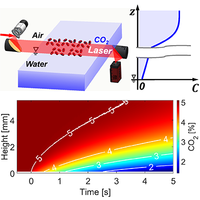
We developed a new method for high-resolution measurement of CO2 transport across the air–water interface, addressing a critical need in physical oceanography studies and in modern carbon sequestration applications. This method forgoes conventional probe-based sampling and statistical correlation, and exploits precision laser spectroscopy with rapid spatial beam scanning to directly quantify gas-phase CO2 distribution near the interface at millimeter and millisecond resolutions. To our knowledge, this is the first time such a level of resolution has been achieved. This method should prove useful in both field measurements and laboratory studies of cross-interface gas transport.

Confined drying of a binary liquid mixture droplet: A quantitative interferometric study under humidity control

Ole Milark, Jean-Baptiste Salmon, and Benjamin Sobac

Phys. Rev. Fluids 11, 033603 (2026) - Published 6 March, 2026

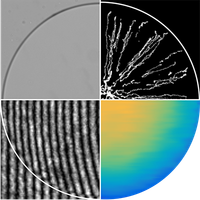
Drying of complex fluids is crucial in many natural and technological processes, yet predicting it and probing associated transport phenomena remain challenging. We introduce an original interferometry‑based method for confined two-dimensional droplets in a humidity‑controlled chamber, enabling simultaneous high‑precision, high‑resolution measurement of drying kinetics and internal concentration fields, providing a powerful tool to accurately characterize drying dynamics and transport in complex fluids.

CFD analysis of mucus bridge instability and breakup in the vocal folds

Martin Heinrich, Michael Döllinger, and Rüdiger Schwarze

Phys. Rev. Fluids 11, 023103 (2026) - Published 27 February, 2026

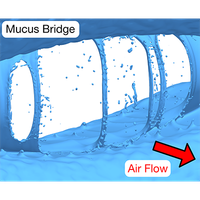
The atomization of airway mucus during speech is a primary mechanism for airborne disease transmission, yet the multiphase dynamics within the vocal folds remain largely uncharacterized. This study presents a Volume-of-Fluid CFD model to simulate the stretching and rupture of mucus bridges during phonation. Results show that small-scale surface perturbations seed realistic breakup patterns and that the bridge ruptures at a dynamic aspect ratio of approximately 20, far exceeding the quasi-static Rayleigh-Plateau stability limit. Higher transglottal pressures accelerate rupture, linking phonation intensity to aerosol generation.

Effects of compressibility and geometry on decaying shearless turbulent/nonturbulent mixing

Eunhye An and Eric Johnsen

Phys. Rev. Fluids 11, 024607 (2026) - Published 20 February, 2026

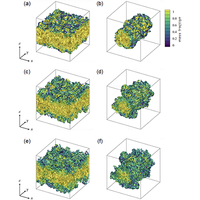
We investigate the effects of compressibility and geometry on turbulent/nonturbulent mixing in the absence of a mean shear. Focusing on initially homogeneous isotropic turbulence adjacent to a quiescent fluid in planar and cylindrical geometries, we theoretically predict the evolution of the mixing region width and turbulent kinetic energy and validate these predictions using direct numerical simulation. Compared to decaying homogeneous isotropic turbulence, we find that the decay rate is enhanced by dilatation due to energy transport to the nonturbulent region and by diverging geometries.

Stability of propagating plane inertial waves in rotating fluids

Valentin Skoutnev, Aurélie Astoul, and Adrian J. Barker

Phys. Rev. Fluids 11, 024802 (2026) - Published 11 February, 2026

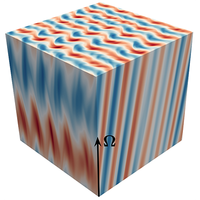
Inertial waves transport energy and momentum in rotating fluids, impacting mixing and tidal dissipation in Earth’s oceans, gaseous planets, and stellar interiors. This study examines the linear stability and nonlinear breakdown of finite-amplitude propagating plane inertial waves. We use numerical simulations to validate the frequency-dependent anisotropy of the most unstable perturbations predicted by linear Floquet theory and explore how the wave energy is partitioned between being dissipated in a cascade and accumulated in long-lived geostrophic modes.

Extending the Duchon-Robert framework for anomalous dissipation to compressible fluid flows

Georgy Zinchenko and Jörg Schumacher

Phys. Rev. Fluids 11, 024603 (2026) - Published 6 February, 2026

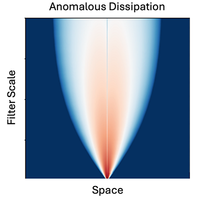
Compressible turbulence adds further mechanisms of anomalous energy dissipation in comparison to its incompressible counterpart. They are caused by pre-shocks and shocks. To quantify these contributions, we extend the framework of Duchon and Robert to the compressible flow case and analyze anomalous dissipation for one-dimensional gas dynamics examples.

Effect of inflow conditions on tip vortex breakdown in a high Reynolds number wind turbine wake

Mano Grunwald and Claudia E. Brunner

Phys. Rev. Fluids 11, 014608 (2026) - Published 27 January, 2026

We experimentally investigate the impact of different inflow conditions on the breakdown of wind turbine tip vortices in a high Reynolds number wind tunnel. The data in this paper is obtained through hot wire spectral analysis. While downstream evolution of the spectra exhibits a complex scale dependent behavior, here we focus on the decay of the signature of the tip vortices for which we identify three distinct regimes. These regimes are linked to an initial advection phase, vortex breakdown, and turbulence decay. Variations in the tip speed ratio have a significant impact on the breakdown rate in the second regime, while effects of mean shear and turbulence intensity are less pronounced.

Hydrodynamic permeability of fluctuating porous membranes

Albert Dombret, Adrien Sutter, Baptiste Coquinot, Nikita Kavokine, Benoit Coasne, and Lydéric Bocquet

Phys. Rev. Fluids 11, 014201 (2026) - Published 21 January, 2026

Building on a fluctuating Darcy framework, this work shows that porosity fluctuations can strongly and nontrivially reshape the hydrodynamic permeability of a porous matrix or membrane. The permeability is expressed in terms of the matrix fluctuation spectrum, revealing a “frequency‑matching” regime where solid and fluid modes resonate. Exploring different excitation scenarios – breathing matrices, phonon‑like modes and active forcing – unveils new strategies to optimize membrane separation processes and potentially bypass the usual permeability–selectivity trade‑off.

Hysteretic bifurcation and multiple flow states in thermal vibrational convection

Guang-Yao Xia, Jian-Zhao Wu, Bo-Fu Wang, Kai Leong Chong, and Quan Zhou

Phys. Rev. Fluids 11, 014401 (2026) - Published 21 January, 2026

The multistability and bifurcation in thermal vibrational convection have been systematically studied via direct numerical simulations. Two distinct states are clarified: a periodic one with single-roll dominance and higher mean heat/momentum transport, and a chaotic one with multimode interplay. Bifurcations occur primarily near St=1, where resonant sensitivity to initial conditions leads to hysteresis across varying vibrational Rayleigh number and aspect ratio. This work elucidates the underlying mechanisms of flow state transitions, providing a framework for understanding multistability and flow control in unsteady regimes.

Freezing and ice aging dynamics in saline water under natural convection

Feng Wang, Yihong Du, Xueyi Xie, Enrico Calzavarini, and Chao Sun

Phys. Rev. Fluids 11, 013504 (2026) - Published 15 January, 2026

In this work, we experimentally investigate the freezing and ice aging dynamics in saline water under natural convection. We show that the rapid formation of a mushy ice layer is followed by desalination processes that might lead to a slow asymptotic decrease of the ice thickness. Desalination of mushy ice reduces its porosity, which alters the dynamic thermal equilibrium and ice thickness by weakening buoyancy-driven convection within mushy ice. In turn, changes in brine convection and ice thickness further affect the desalination process. The long-term dynamics can be predicted by a one-dimensional model based on appropriate parameterizations of global heat and mass transfer properties.

Extreme vertical drafts as drivers of Lagrangian dispersion in stably stratified turbulent flows

Christian Reartes, Pablo D. Mininni, and Raffaele Marino

Phys. Rev. Fluids 11, 014501 (2026) - Published 5 January, 2026

In stably stratified turbulence, vertical transport is typically suppressed by buoyancy; however, intense vertical drafts can intermittently develop. Using direct numerical simulations and a Lagrangian approach based on particle pair dispersion, we show that these extreme events play a crucial role in vertical mixing, leading to strong departures from classical dispersion behavior. Our results demonstrate that a small fraction of particles experiencing extreme vertical drafts contributes disproportionately to vertical transport and mixing, highlighting the central role of large-scale intermittency in stratified turbulent flows.

Experiments on rapidly rotating convection: The role of the Prandtl number

Hannah M. Clercx and Rudie P. J. Kunnen

Phys. Rev. Fluids 10, 123503 (2025) - Published 26 December, 2025

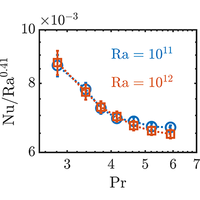
We measure the efficiency of convective heat transfer (Nusselt number) by turbulent convection in a rapidly rotating Rayleigh-Bénard convection experiment. Series of measurements are done at two constant values of the Rayleigh number. Using water at different mean temperatures, we change the Prandtl number. Raising the Prandtl number leads to a reduction of the Nusselt number with a significantly stronger dependence than without rotation. We hypothesize that this dependence is caused by the changing ratio of the thermal and kinetic boundary layer thicknesses.

Motion of magnetic vortex rings subject to Hall effect

Yasuhide Fukumoto, Satoshi Oshiro, and Taxpulat Ruzi

Phys. Rev. Fluids 10, 124703 (2025) - Published 24 December, 2025

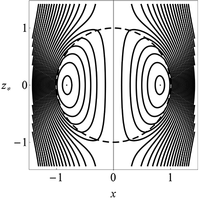
Streamlines of an exact solution of the Hall-MHD equation for a spherical vortex containing toroidal magnetic flux, wrapped by a vortex sheet. The magnetic tension acts to accelerate the traveling speed of a spherical vortex. The Hall effect, originating from relative fluctuations of electrons and ions, provides further acceleration. Besides, a singular solution specific to Hall-MHD is found for the spherical vortex, which vanishes when the Hall effect is switched off.

Resonant triad interactions of two-layer gravity waves in cylindrical basins

Matthew Durey and Paul A. Milewski

Phys. Rev. Fluids 10, 124801 (2025) - Published 3 December, 2025

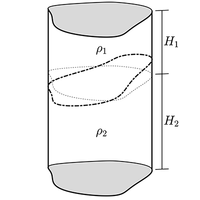
Subsurface variations of water density enable internal waves, which play a key role in oceanic mixing and energy transport. Internal waves are affected by resonant three-wave interactions, which, in the ocean, form only when different interfaces (i.e. vertical modes) interact. For confined basins, however, a new paradigm emerges: resonant triads may form between different “sloshing” modes at a single interface, so include only the lowest vertical mode. We characterize this abundant new class of triads for the case of two-layer flows in basins of arbitrary cross section with vertical walls and discuss the implications on inverse energy cascades and internal seiching in lakes and harbors.

Grooves spacing govern water retention during condensation

M. Leonard and N. Vandewalle

Phys. Rev. Fluids 10, 114001 (2025) - Published 25 November, 2025

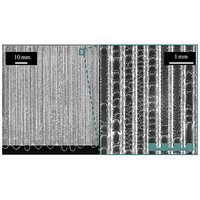
On smooth surfaces, condensing droplets grow, merge, and eventually slide away. Add narrow grooves, and the same water follows a hidden path: it drains through the surface itself. Using a high-throughput condensation setup, we show that groove spacing governs the transition between droplet shedding and capillary drainage. Below a critical spacing, grooves collect and channel all water before large drops can form, offering new routes for efficient dew harvesting and cooling.

Listening to immersed superhydrophobic surfaces: Acoustic inspection of air plastron layers

Pierre-Brice Bintein, Pierre-Yves Passaggia, Nicolas Mazellier, and Adrien Bussonnière

Phys. Rev. Fluids 10, 114905 (2025) - Published 25 November, 2025

When immersed in water, a solid coated with a superhydrophobic surface traps an air layer, called a plastron, that shields it from liquid contact. This layer enables underwater respiration in animals and provides drag reduction, anti-corrosion, and antifouling effects. However, plastrons are sensitive to external disturbances and can destabilize. This study demonstrates how plastron acoustic resonance can be used to monitor and measure the trapped air layer volume. Validated against direct observations, the method is portable, noninvasive, and effective for studying plastron stability under realistic conditions and various flow conditions.

Tracking the rotation of light magnetic particles in turbulence

Chunlai Wu, Rudie P. J. Kunnen, Ziqi Wang, Xander M. de Wit, Federico Toschi, and Herman J. H. Clercx

Phys. Rev. Fluids 10, 114903 (2025) - Published 18 November, 2025

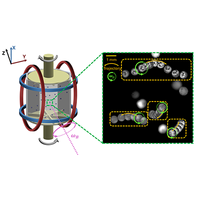
We report an experimental technique that fully resolves the three-dimensional angular velocity of magnetic particles, suspended in turbulence and actuated by an oscillating magnetic field, using only single-camera two-dimensional imaging. The particles, smaller than the Taylor microscale of the turbulent flow and less dense than water, are tracked with high accuracy to reveal their magnetically driven rotational dynamics affected by turbulence-induced hydrodynamic torque. This method to measure the rotational dynamics of small particles overcomes a key experimental limitation and the experimental apparatus enables active modulation of turbulence through external magnetic fields.

Hydrodynamic-thermoacoustic synchronization and blow-off pathways in a turbulent premixed bluff-body flame

Manikandan Balasubramaniyan, Haiqing Wang, Peijin Liu, Yu Guan, Bo Yin, and Larry K. B. Li

Phys. Rev. Fluids 10, 113201 (2025) - Published 17 November, 2025

Turbulent premixed bluff-body flames can host both hydrodynamic and self-excited thermoacoustic modes, yet their coupling remains unclear. By fixing the Reynolds number and equivalence ratio while sweeping only the combustor length, we map the route from desynchronization to two-frequency quasiperiodicity and ultimately to 1:2 mutual synchronization, accompanied by strong pressure and heat-release-rate (HRR) oscillations. Spatiotemporal analyses reveal the recirculation zone as the dominant energy-injection site. We also identify two blow-off pathways with clear, local HRR precursors.

Sign In to Your Journals Account

Filter

Section

Filter

Article Lookup

Enter a citation