Highlights

Uncertainty growth in stably stratified turbulence

Mrinal Jyoti Powdel and Samriddhi Sankar Ray

Phys. Rev. Fluids 11, 064615 (2026) - Published 23 June, 2026

We show that the spread of infinitesimal perturbations in a turbulent density-stratified fluid becomes slower with increasing degree of stratification. With a higher degree of stratification, the spatial growth of the uncertainty gets more and more compressed along the direction of stratification. Despite this, the temporal growth of perturbations follows the same universal behavior: an initial decay followed by an exponential growth, ultimately leading to saturation. The rate of growth of the perturbation, however, gets affected by stratification through the strain-mediated dynamics of the underlying velocity field, rather than through direct coupling with the density fluctuations.

Modeling flying formations as flow-mediated matter

Christiana Mavroyiakoumou, Jiajie Wu, and Leif Ristroph

Phys. Rev. Fluids 11, 063103 (2026) - Published 18 June, 2026

Collective locomotion of swimming and flying animals is fascinating in terms of individual-level fluid mechanics and group-level structure and dynamics. Here we bridge and relate these scales through a formation-flight model that views the collective as a material whose properties arise from flow-mediated interactions among its members. Our model shows that the group behaves as a soft “crystal” with regularly spaced member “atoms” whose positioning is susceptible to deformations and dynamical instabilities. Other emergent properties relevant to biological collectives include group cohesion, sensitive detection of and response to perturbations, and information transfer through traveling waves.

Mosquitoes fly forward by asymmetric rapid wing pitching

Zengshuang Chen, Xueguang Meng, Pengyuan Yang, and Gang Chen

Phys. Rev. Fluids 11, 063101 (2026) - Published 17 June, 2026

Most insects generate forward thrust by tilting the stroke plane or adjusting the wing angle of attack. This study reveals that mosquitoes adopt a fundamentally different strategy: while maintaining a nearly horizontal stroke plane, they achieve forward flight through highly asymmetric wing pitching between downstroke and upstroke. Two novel thrust mechanisms are identified under this motion pattern—asymmetric pitch-down acceleration and asymmetric pitch-up amplitude. These findings deepen our understanding of insect flight diversity and offer new design principles for micro flapping-wing vehicles.

Fluid dynamics of a liquid mirror space telescope

Israel Gabay, Omer Luria, Edward Balaban, Amir D. Gat, and Moran Bercovici

Phys. Rev. Fluids 11, 064003 (2026) - Published 16 June, 2026

Large-aperture telescopes are currently limited by launch vehicle constraints. The Fluidic Telescope (FLUTE) concept seeks to overcome this by using liquid mirrors which, in microgravity, naturally relax into a precise spherical shape. However, necessary telescope maneuvers subject the liquid to body forces that perturb this interface. This study provides an experimentally validated analytical model for such liquid dynamics by solving for the non-self-adjoint problem of a thin liquid film pinned in a circular domain. Using the model to simulate decades of operation, we show that while edge disturbances build up, the inner 80% of the aperture remains optically precise for over 20 years.

Pattern formation in rectilinear flows of noncolloidal suspensions

Parham Poureslami, Ranit Mukherjee, and Sungyon Lee

Phys. Rev. Fluids 11, 064303 (2026) - Published 10 June, 2026

Particle-induced viscous fingering (PIVF) occurs when a non-colloidal suspension displaces air inside a Hele-Shaw cell, which leads to the formation of particle clusters, or “plumes” at the advancing interface. Despite extensive studies in the last decade, the coupling between plumes and interfacial deformations remains unexamined. In this paper, we address this coupling by deriving scaling laws that connect the interplay between capillarity, local particle concentrations, and interfacial speed. We also uncover new regimes of PIVF that are unique to rectilinear geometry, in which particle plumes interact and coalesce, resulting in enhanced mixing inside the suspension.

Anisotropy development in isotropic turbulence subjected to off-axis rotation

Yijie Wang, Jun Chen, and Leonardo P. Chamorro

Phys. Rev. Fluids 11, 064605 (2026) - Published 5 June, 2026

Turbulence subjected to background rotation underlies many geophysical and engineering flows, yet its anisotropic development away from the rotation axis remains poorly constrained experimentally. This laboratory study examines nearly isotropic turbulence under controlled off-axis rotation using high-resolution PIV, revealing how rotation induces scale-dependent anisotropy in directional velocity spectra. The onset of spectral anisotropy follows a simple scaling with the inverse turbulent Rossby number, directly linking large-scale rotation to small-scale energy redistribution. These results offer experimentally grounded constraints for modeling rotating turbulence in non-inertial frames.

From oblique-wave forcing to streak reinforcement: A perturbation-based frequency-response framework

Dušan Božić, Anubhav Dwivedi, and Mihailo R. Jovanović

Phys. Rev. Fluids 11, 063901 (2026) - Published 4 June, 2026

Subcritical transition in shear flows arise from the interplay between linear non-modal amplification and nonlinear interactions, yet their quantitative connection remains unresolved. We bridge this gap by deriving a framework from the Navier–Stokes equations, in which a forcing-amplitude expansion links oblique disturbances to finite-amplitude streaks consistent with direct numerical simulations. This hierarchy shows that the same resolvent structure governing linear amplification organizes the dynamics at all orders in the perturbation series. Breakdown of this series marks the onset of secondary instability, providing a quantitative bridge between non-modal growth and classical transition theory.

Stretching water between two grooves

M. Leonard, D. Maity, N. Vandewalle, and T. Truscott

Phys. Rev. Fluids 11, 054004 (2026) - Published 22 May, 2026

Stretch an elastic sheet between your hands and let go; it snaps back. Thin water films do the same, rupturing almost as soon as they form. The authors had a simple idea: instead of changing the liquid or coating the surface, just hold the film edges. Two laser-engraved grooves on a plain acrylic plate pin a film of pure water over more than thirty centimeters. When the grooves end, the film ruptures and drips in a steady rhythm. The stability comes not from chemistry, but from geometry.

Inertial spheroids in turbulence: Director-vector reduced-order theory of anisotropy-induced drift, turbophoresis, settling, and clustering

Itzhak Fouxon, Hojun Lee, and Changhoon Lee

Phys. Rev. Fluids 11, 054903 (2026) - Published 22 May, 2026

Fluids in nature are usually turbulent and contain small particles, a phenomenon observed in paper production, rain formation, astrophysics, and the oceans, among other places. These particles are more often than not nonspherical, such as fibers in paper. Particle orientation in the flow determines how the flow drags them and, eventually, how the particles distribute in space and orient. We use a symmetry-based simplification, analogous to a classical description of neutrally buoyant spheroids, to introduce a new framework for flows with nonspherical particles, which yields a compact set of evolution equations with fewer degrees of freedom.

Electrostatics slows down the breakup of liquid bridges on solid surfaces

Salar Jabbary Farrokhi, Aaron D. Ratschow, and Steffen Hardt

Phys. Rev. Fluids 11, 054002 (2026) - Published 11 May, 2026

In recent years, the importance of previously overlooked electrostatic effects has opened a new perspective in the field of dynamic wetting. While spontaneous charging has been investigated in sliding drops, here, we show that it can substantially affect capillary wetting instabilities. The capillary breakup of a liquid bridge wetting a surface causes electrostatic charging that slows down the breakup dynamics and leads to spontaneous motion of satellite drops. Our results highlight the central importance of electrostatics in dewetting processes beyond sliding drops.

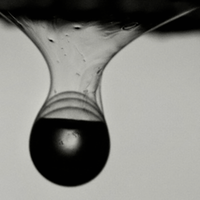
Beyond Tate's law: Geometric control of pendant drop detachment

Bauyrzhan K. Primkulov

Phys. Rev. Fluids 11, L051601 (2026) - Published 11 May, 2026

The size of a detaching pendant drop is set by Tate’s law and depends only weakly on the nozzle radius. Here, we show that simple geometric confinement can trigger early detachment at significantly reduced volumes by introducing an additional capillary force. A minimal scaling law collapses the data across geometries, providing a robust and passive route to tune drop size without external actuation.

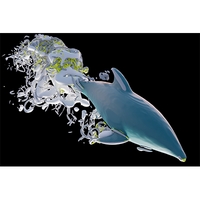
Swimming mechanism of a dolphin on the basis of the hierarchy of vortices

Yutaro Motoori, Hideki Murahata, and Susumu Goto

Phys. Rev. Fluids 11, L042601 (2026) - Published 30 April, 2026

We numerically investigate the swimming mechanism of a dolphin by focusing on the hierarchy of vortices in its turbulent wake. Using direct numerical simulations of a self-propelled dolphin and scale decomposition of the flow, we show that the caudal fin generates large vortex rings that contribute most of propulsion, whereas smaller vortices are created through the energy cascade but contribute little to propulsion. We also show that this mechanism remains robust regardless of the Reynolds number.

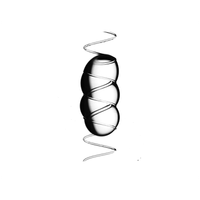
Capillary slinky: Equilibrium and dynamics of a droplet in a soft spring

Bidisha Bhatt and Andreas Carlson

Phys. Rev. Fluids 11, 043607 (2026) - Published 29 April, 2026

A droplet adopts a complex shape in a spring and can create significant spring compression, potentially functioning as a capillary weight-lifting system. By tuning the ratio between the pitch of the soft spring and the droplet size reveals a range of distinct droplet flow regimes, in which the vertical velocity is directly linked to the droplet’s rotational motion. Active control of the spring’s extension and compression demonstrates how both the static and dynamic states of the droplet can be controlled.

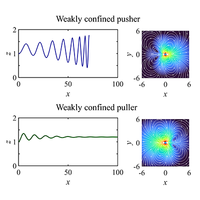
Modified far-field hydrodynamic flows induce versatile trajectories of confined microswimmers

Zehan Cao and Alan C. H. Tsang

Phys. Rev. Fluids 11, 044402 (2026) - Published 22 April, 2026

Microswimmers under weak confinement exhibit flow fields that are highly dependent on the spatial arrangement of their propulsion and drag forces, as well as their geometry. These flow fields can be approximated by placing Stokeslets and source dipoles at proper positions of the swimmer. We observe versatile swimming trajectories, such as centerline sliding and amplified oscillations, depending on the relative strengths of the Stokeslets and source dipoles.

From soap-film packed droplets to multilayer antibubbles: Formation and stability

Cyril André, Cyriaque Amerein, Jonas Miguet, Benoit Scheid, and Stéphane Dorbolo

Phys. Rev. Fluids 11, 043603 (2026) - Published 21 April, 2026

Antibubbles are the structural inverse of soap bubbles: they consist of a liquid core enclosed by a thin quasi-spherical gas shell, immersed in a liquid medium. Producing multilayer antibubbles, i.e. antibubbles enclosed by multiple soap/air films, has been a challenge in the past years, as it requires a delicate balance between surface tension and inertia. In this paper, we investigate a method that uses one or more soap films and a soapy liquid droplet to generate multilayer antibubbles. We also identify the optimal parameters for forming single-layer and multilayer antibubbles across three different viscosities.

Ray-tracing image simulations of transparent objects with complex shape and inhomogeneous refractive index

Armin Kalita, Bryan Oller, Thomas Paula, Alexander Bußmann, Sebastian Marte, Gabriel Blaj, Raymond G. Sierra, Sandra Mous, Kirk A. Larsen, Xinxin Cheng, Matt J. Hayes, Kelsey Banta, Stella Lisova, Peter Nguyen, Serge A. H. Guillet, Divya Thanasekaran, Silke Nelson, Mengning Liang, Stefan Adami, Nikolaus A. Adams, and Claudiu A. Stan

Phys. Rev. Fluids 11, 044908 (2026) - Published 20 April, 2026

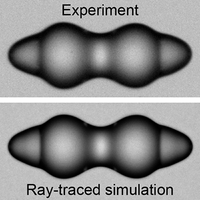
Optical images of transparent objects depend in a complicated way on their three-dimensional properties, which made it difficult to simulate such images accurately. Using ray tracing with calibrated illumination, we simulated with high fidelity images of drops with complex shapes, and images of pressure waves inside drops. The simulated images can be used to visualize, validate, and refine fluid dynamics models. They can also be used to determine multiple three-dimensional properties from experimental images.

Geometric and kinematic indicators of breaking inception in surface gravity waves

Daniel G. Boettger, Shane R. Keating, Michael L. Banner, Russel P. Morison, and Xavier Barthélémy

Phys. Rev. Fluids 11, 044803 (2026) - Published 15 April, 2026

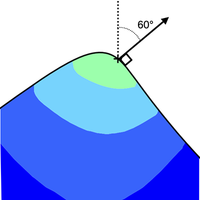
We examine an ensemble of numerically simulated breaking surface gravity waves and show that the inception of breaking can be characterized by the maximum local interface angle. In our simulations that include surface tension effects, we find that breaking inception occurs when the local interface angle exceeds 60°; a value twice that reported in previous studies without surface tension. We explore this result in the context of the commonly utilized kinematic inception parameter and show that these two indicators of breaking inception are related through the relative flux of energy into the wave crest.

Chirality tomography: Measuring local helicity from trajectory linking

M. Noseda, B. L. Español, P. D. Mininni, and P. J. Cobelli

Phys. Rev. Fluids 11, 034609 (2026) - Published 25 March, 2026

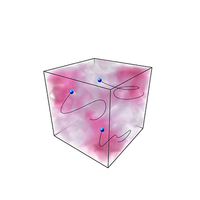
Helicity, the volume integral of the velocity-vorticity scalar product, is a key dynamical invariant encoding flow topology; however, measuring it in turbulence is a significant challenge due to the requirement for high-resolution velocity gradients. We introduce chirality tomography, a Lagrangian method that reconstructs three-dimensional helicity maps from the entanglement of particle trajectories. By establishing a robust proxy between trajectory linking and local helicity, we provide the first spatially resolved maps of chiral structures in fully developed turbulence. The approach bridges trajectory-level topology with fundamental physics, with a practical diagnostic for complex flows.

Active caustics

Rahul Chajwa, C. Rajarshi, Rama Govindarajan, and Sriram Ramaswamy

Phys. Rev. Fluids 11, 033104 (2026) - Published 20 March, 2026

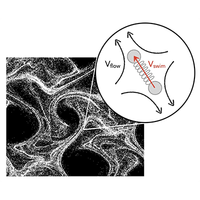
When the worldlines of inertial particles in background flows cross, they generate low-dimensional structures with diverging particle number-density, formally similar to optical caustics. We show that orientable motile particles in flows can form caustics even when their mechanical inertia is neglected. Singular perturbation analysis of self-propelled particles around a point vortex and numerical simulations of their motion in a turbulent flow uncover the various regimes of caustics, demarcating the necessary conditions for their formation. Active caustics greatly enhance encounters between Stokesian swimmers, and an order-of-magnitude estimate points to their ecological relevance.

Stability of particle clusters bound by capillary bridges in extensional flow

Sagar Chaudhary, Dimitrios Fraggedakis, and Charles M. Schroeder

Phys. Rev. Fluids 11, L032301 (2026) - Published 17 March, 2026

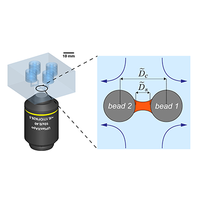
Capillary suspensions are defined by liquid-bound particle clusters, yet despite decades of study, their stability in strong flows remains incompletely understood. Here, we establish a universal set of stability criteria for a liquid-bound particle doublet in extensional flow. A critical capillary number governing stability is identified through a combination of analytical theory and experiments. Below this threshold, stability depends sensitively on initial particle separation, whereas above it, clusters are unconditionally unstable. These results provide a quantitative framework for predicting and controlling flow-induced breakup in capillary suspensions.

Sign In to Your Journals Account

Filter

Section

Filter

Article Lookup

Enter a citation