Highlights

Laboratory modeling of moist convection using a reactive fluid

Valentin Dorel, Daniel Lecoanet, and Michael Le Bars

Phys. Rev. Fluids 10, 053505 (2025) - Published 23 May, 2025

Moist convection — driven by the buoyancy released when moisture condenses — plays a central role in tropospheric dynamics. While often explored through simulations or simplified models, we present here a laboratory analog that captures key features of moist convection. The observed instabilities are interpreted using linear stability analyses.

Dynamic expulsion of magnetic flux by vortices

Jonathan Tessier, Francis J. Poulin, and David W. Hughes

Phys. Rev. Fluids 10, 053702 (2025) - Published 19 May, 2025

We study the evolution of an initially uniform magnetic field in vortical flows at high magnetic Reynolds numbers. By including the magnetic field’s back-reaction on the flow, we extend the kinematic theory of flux expulsion into the dynamical regime. Using an incompressible two-dimensional magnetohydrodynamic model with various vortex configurations and magnetic field strengths, we identify four distinct dynamical regimes. Our results suggest that even a very weak magnetic field can influence flow dynamics, indicating that purely hydrodynamic models may be inadequate for some astrophysical systems.

Collective effects in breath figures

Ambre Bouillant, Jacco H. Snoeijer, and Bruno Andreotti

Phys. Rev. Fluids 10, 053605 (2025) - Published 9 May, 2025

Breath figures (BF) form when water vapor condenses into drops on a surface. While most studies focus on the substrate influence, the allocation of vapors between the growth of existing drops and the nucleation of new ones remains unresolved, affecting BF polydispersity. We present a many-droplet theory accounting for interactions mediated by vapor diffusion using asymptotic matching. We show that after nucleation, drop count stabilizes due to collective effects, resulting in nearly monodisperse BFs on defect-free substrates under diffusion control. Our model explains sub-diffusive growth, nucleation arrest, drop density selection, and coarsening as observed in joint experiments.

Effect of capillary number and viscosity ratio on multiphase displacement in microscale pores

Samantha A. McBride, Fernando Temprano-Coleto, Paul R. Kaneelil, Reese Knopp, Aubrey J. Taylor, Mariko A. Storey-Matsutani, Jessica L. Wilson, Mohammad Sadeq Saleh, Andrew R. Konicek, Arben Jusufi, Mohsen S. Yeganeh, and Howard A. Stone

Phys. Rev. Fluids 10, 054201 (2025) - Published 5 May, 2025

Multiphase displacement is important in oil recovery, microfluidics, and CO2 capture. We study viscous oil trapping in microfluidic devices with sinusoidal pockets during water invasion. Varying capillary number (Ca), viscosity ratios, and pore geometries reveals that higher oil viscosity and water velocities increase oil trapping due to transition from meniscus displacement to viscous fingering. We find that trapping dynamics at high Ca are geometry independent. Our three-dimensional model based on the long-wave approximation predicts some experimental observations, such as increased oil retention at higher Ca and viscosity ratios, and the characteristic interfacial shape of trapped oil.

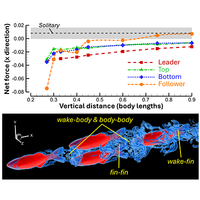
Fish schools in a vertical diamond formation: Effect of vertical spacing on hydrodynamic interactions

Alec Menzer, Yu Pan, George V. Lauder, and Haibo Dong

Phys. Rev. Fluids 10, 043104 (2025) - Published 24 April, 2025

Fish schooling is believed to provide benefits by allowing individuals to leverage vortices generated by nearby fish, thereby improving their performance. While prior works have characterized horizontal planar formations of fish, our comprehensive analysis of the hydrodynamics in the vertical diamond formation reveals significant interactions among vertically arranged fish. In the densest vertical diamond formation, fin-fin, body-body, wake-body, and wake-fin interactions enhance force generation and propulsive efficiency for each individual in the school. The findings of this study could guide school configurations that enhance the performance of fish-inspired bio-robotic swarms.

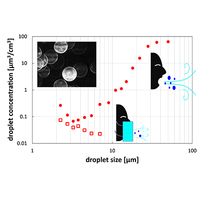
Joint size and velocity statistics of droplets exhaled while speaking, coughing, and breathing

Livia Grandoni, Loïc Méès, Nathalie Grosjean, Giovanni Leuzzi, Paolo Monti, Armando Pelliccioni, and Pietro Salizzoni

Phys. Rev. Fluids 10, 043102 (2025) - Published 17 April, 2025

Human respiration releases a droplet laden air cloud that can carry pathogens and transmit infectious diseases. Despite extensive research, the characterization of exhaled droplets remains incomplete, with significant variability in droplet size distribution and limited measurement of droplet velocity. This study employs an enhanced version of the Interferometric Laser Imaging for Droplet Sizing (ILIDS) technique to simultaneously measure droplet size and velocity in 23 volunteers during speaking, coughing, and breathing. We also evaluate the impact of protective masks on droplet size and velocity distributions, and the variability observed between and within individual volunteers.

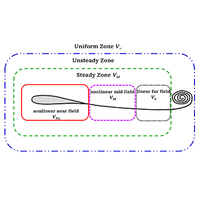
Investigation into evolution mechanisms of Lamb vectors in compressible flow

Fanrong Xue, Shufan Zou, Ming Zhao, and Wei Liu

Phys. Rev. Fluids 10, 044701 (2025) - Published 17 April, 2025

The full-life cycle evolution of the Lamb vector is investigated thoroughly. Numerical validation confirms its asymptotic behavior near no-slip boundaries and formation mechanisms within viscous sublayers of supersonic flat plate flows. Using Stokes-Helmholtz decomposition, the spatiotemporal evolution equation reveals competition between advection, stretching/tilting of generalized Lamb vectors’ transverse components, and viscosity. Defining a weakly nonlinear mid-field wake region fills gaps in its full-life cycle, with this region’s behavior and physics examined.

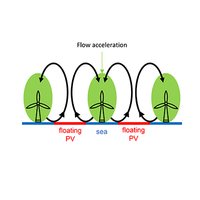
Improving wind farm efficiency in offshore hybrid wind–solar farms with thermally induced secondary motions

Thijs Bon, Vincent Van Craenenbroeck, and Johan Meyers

Phys. Rev. Fluids 10, 043801 (2025) - Published 15 April, 2025

Large-eddy simulations of atmospheric flow through hybrid wind-solar farms were performed, showing that the significant temperature difference between the sea surface and floating photovoltaic arrays can induce secondary flows in the plane perpendicular to the mean flow. These motions lead to larger wind speed in the area between the strips, from which wind turbines will benefit if they are placed in these locations. The simulations indicate that this results in a gain of up to 30% in wind power production in a hybrid wind-solar farm, as compared to an isolated wind farm.

Effect of a forward-facing step on the disturbance amplification in a flat-plate boundary layer

Nathaniel Hildebrand, Pedro Paredes, and Meelan M. Choudhari

Phys. Rev. Fluids 10, 043901 (2025) - Published 14 April, 2025

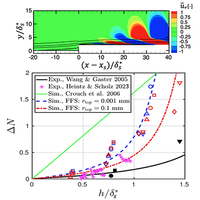
Accurately modeling boundary-layer transitions is a top research priority in the NASA CFD Vision 2030 Study and can help reduce the environmental impact of aviation. Here we apply stability analysis to subsonic flow over a two-dimensional zero-pressure-gradient boundary layer in the presence of a forward-facing step which has varying height, slope, and corner radii. The computational predictions capture the overall trend from experiments associated with a gradual upstream shift in the transition location as the step height increases. However, the critical step height corresponding to a very large upstream shift in the transition location is not well predicted compared to the measured data.

Optimum control strategies for maximum thrust production in underwater undulatory swimming

Li Fu, Sardor Israilov, Jesús Sánchez-Rodríguez, Christophe Brouzet, Guillaume Allibert, Christophe Raufaste, and Médéric Argentina

Phys. Rev. Fluids 10, 043101 (2025) - Published 11 April, 2025

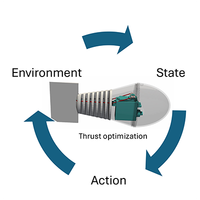
Undulatory swimming is a widespread locomotion strategy in aquatic animals, yet understanding and applying it to efficient artificial systems remains challenging. Using a biomimetic robotic swimmer and reinforcement learning, we identify an optimal control strategy that maximizes thrust. Our findings are validated through experiments, theoretical modeling, and fluid-structure simulations. They provide key insights into efficient aquatic propulsion and open new perspectives for autonomous underwater vehicles.

Optimal trajectories for Bayesian olfactory search in turbulent flows: The low information limit and beyond

R. A. Heinonen, L. Biferale, A. Celani, and M. Vergassola

Phys. Rev. Fluids 10, 044601 (2025) - Published 9 April, 2025

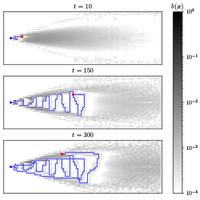
Certain animals have evolved complex strategies to track sources of odors which are advected by turbulent flows. In this paper, we model this search task as a partially observable Markov decision process, which allows us to compute optimal Bayesian search strategies in the sense that they reach the source in minimal average time. We apply this approach to realistic data taken from direct numerical simulation. Focusing on the especially difficult decision of what to do when contact with the odor has been lost, we study the optimal trajectories in this scenario — which strongly resemble known animal behaviors — and try to understand the results by way of a simplified model.

Fluid mechanical study of rotation-induced traumatic brain injury

Qifu Wang, Jiaqi Zhang, David Bates, James J. Feng, Pengtao Yue, and Qianhong Wu

Phys. Rev. Fluids 10, 030502 (2025) - Published 28 March, 2025

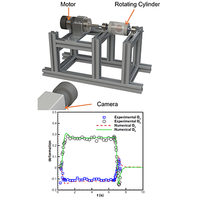
Rotation-induced traumatic brain injury is a serious health concern. We present a novel experimental and theoretical approach to studying fluid-structure interactions between soft matter and its liquid surroundings under rapid rotational impact. Our theoretical model, developed using the Arbitrary Lagrangian-Eulerian method, has been verified and validated against experimental data. This work establishes a strong foundation for future research into rotation-induced brain concussions, where the transient fluid-structure interaction between the cerebrospinal fluid and the soft brain matter plays a critical role in impact transmission and mitigation.

Shape-morphing membranes augment the performance of oscillating foil energy harvesting turbines

Ilan M. L. Upfal, Yuanhang Zhu, Eric Handy-Cardenas, and Kenneth Breuer

Phys. Rev. Fluids 10, 034702 (2025) - Published 20 March, 2025

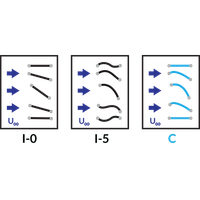
Compliant membrane oscillating foil turbines (OFTs) can enhance power generation by stabilizing leading-edge vortices (LEVs), a key mechanism for lift. Through experiments in a water flume, we map the performance of compliant OFTs across a broad range of kinematics and isolate the roles of camber and extensibility in LEV stabilization. Membrane extensibility is shown to be critical for dynamic decambering at high angles of attack, delaying stall and improving lift and power, while camber alone suffices at low angles of attack. This study provides new insights into optimizing compliant OFTs for renewable energy applications.

Droplet bag formation in turbulent airflows

Kaitao Tang, Thomas A. A. Adcock, and Wouter Mostert

Phys. Rev. Fluids 10, 033604 (2025) - Published 19 March, 2025

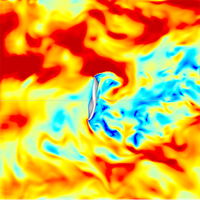
We investigate numerically the early-to-mid-time deformation of liquid droplets in turbulent airflow with a non-zero mean speed. Ambient turbulence enhances the drag coefficient of the droplet as it flattens. Concurrently, the droplet becomes tilted and increasingly corrugated under strong turbulence intensity. We quantify these phenomena and discuss their possible origins associated with turbulence intermittency.

Multiparticle dispersion in rotating-stratified turbulent flows

Sebastian Gallon, Fabio Feraco, Raffaele Marino, and Alain Pumir

Phys. Rev. Fluids 10, 034605 (2025) - Published 17 March, 2025

Rotation and stratification, which are essential in geophysical turbulence, affect the way groups of particles disperse. Unexpectedly, we find numerically, that the dispersion between pairs of particles becomes more intermittent when the stratification increases, the ratio between stratification and rotation being kept fixed. We find, however, that the time-asymmetry between forward and backwards dispersion diminishes with stratification. By studying the dependence of the dispersion between particles on the angle between the initial separation and the vertical, we find evidence that shear layers spontaneously develop in the flow.

Thin film flow over a spinning disk: Experiments and direct numerical simulations

Jason Stafford, Nwachukwu Uzo, Enrico Piccoli, Camille Petit, and Omar K. Matar

Phys. Rev. Fluids 10, 024805 (2025) - Published 25 February, 2025

We examine large-amplitude wave formation on thin films flowing over a rapidly spinning disk with experiments and direct numerical simulations. Our results capture the transition from stationary two-dimensional spiral to fully three-dimensional waves.

Route to turbulence in magnetohydrodynamic square duct flow

Mattias Brynjell-Rahkola, Yohann Duguet, and Thomas Boeck

Phys. Rev. Fluids 10, 023903 (2025) - Published 20 February, 2025

The transition route from laminar to turbulent flow in a magnetohydrodynamic duct with a square cross-section is investigated in the limit of low magnetic Reynolds number. In the presence of a transverse magnetic field, Hartmann and Shercliff layers are present on the walls orthogonal and parallel to the field direction, respectively. Independently of the initial location of a finite perturbation in either Shercliff or Hartmann layers, transition relies on a tripping of the Shercliff layer by perturbations, while the Hartmann layer plays a passive role. This is explained, using a dynamical systems interpretation, by the spatial localization of the edge states in the Shercliff layer.

Mesoscopic hydrodynamic model for spreading, sliding, and coarsening compound drops

Jan Diekmann and Uwe Thiele

Phys. Rev. Fluids 10, 024002 (2025) - Published 10 February, 2025

We consider the dynamics of compound drops that are formed by two immiscible, partially wetting liquids within a mesoscopic hydrodynamic description based on a gradient dynamics approach in full-curvature and long-wave variants. After discussing existing models we establish conditions between macroscopic and mesoscopic descriptions that ensure consistent Neumann and Young laws. As examples, we then numerically study spreading and sliding compound drops on horizontal and inclined substrates, respectively, as well as coarsening drop ensembles.

Experiments on buoyancy-driven instability ahead of a dissolution front in a porous rock

Sam Clarke, Jon Harrington, Simon Norris, and Andy Woods

Phys. Rev. Fluids 10, 024001 (2025) - Published 6 February, 2025

New experiments show the Rayleigh-Taylor instability in a partially soluble porous medium. An initially buoyant fluid invades from the top. As the fluid dissolves some of the solid material, it becomes dense relative to the underlying formation fluid. This leads to growth of Rayleigh-Taylor fingers at the fluid-fluid interface. We present a new theory to model the nonlinear growth of these fingers, as well as a novel technique to track dissolution fronts.

Gradient dynamics model for drops of volatile liquid on a porous substrate

Simon Hartmann and Uwe Thiele

Phys. Rev. Fluids 10, 014003 (2025) - Published 27 January, 2025

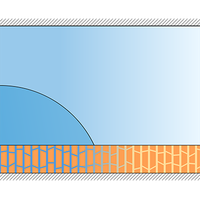
The article presents a mesoscopic hydrodynamic model for a spreading drop of volatile partially wetting liquid on a solid porous substrate. The model describes the coupled dynamics of the the three-phase system in terms of the drop height profile, the vertically averaged saturation profile in the porous layer and the vertically averaged vapor density above the substrate. Our approach is based on the gradient dynamics framework widely used for modeling thin liquid films. After developing the model, we discuss a selection of theoretical and numerical results, e.g., the resulting sorption isotherm or a simulation of coupled spreading, imbibition, and evaporation dynamics.

Sign In to Your Journals Account

Filter

Section

Filter

Article Lookup

Enter a citation