Recent Articles

Unraveling self-similar energy transfer dynamics: A case study for the one-dimensional Burgers system

Pritpal Matharu, Bartosz Protas, and Tsuyoshi Yoneda

Phys. Rev. Fluids 11, 034608 (2026) - Published 23 March, 2026

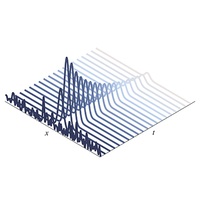
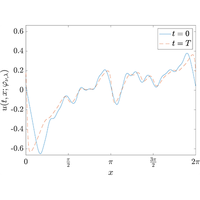
A key open question in turbulence research concerns the nature of fluid motions that can produce a self-similar energy cascade consistent with Kolmogorov’s statistical theory of turbulence. We approach this problem by considering the one-dimensional viscous Burgers equation as a toy model, and frame the question in terms of a family of partial-differential-equation-constrained optimization problems which are solved numerically. Our results represent a successful effort to construct time-dependent solutions of this model characterized by self-similar energy transfers, providing a framework that may be used to search for self-similar behavior in three-dimensional turbulence.

Vortex transition and thermal mixing by pitching a perforated flexible panel

Yicong Fu, Zhengyang Liu, Samir Tandon, Jake Gelfand, and Sunghwan Jung

Phys. Rev. Fluids 11, 034703 (2026) - Published 23 March, 2026

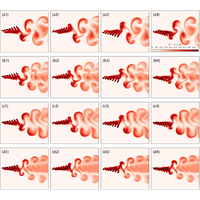
Flexible vortex generators enhance heat and mass transport, but most studies focus on solid, non-porous panels or passive flexible reeds. Inspired by porous, compliant fish-gill filaments, we demonstrate the mixing benefit of pitching flexible perforated panels. Pitching drives unsteady entrainment; perforation yields spatially discretized vortices without a conventional leading-edge contribution, while chord-wise flexibility sustains mixing via wake-mode transitions. We examined the Lagrangian coherent structures to link vortex dynamics to convective–diffusive transport, and proposed three indices to quantify mixing by uniformity, mean increase, and spatial dispersion.

GPU-accelerated simulations of turbulence: Review of current applications and future perspectives

A. Roccon, G. Amati, L. Brandt, D. Calhoun, P. Costa, W. Lu, S. Pirozzoli, D. Richter, M. Umair, D. You, T. Zahtila, and C. Marchioli

Phys. Rev. Fluids 11, 034905 (2026) - Published 23 March, 2026

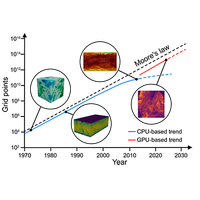
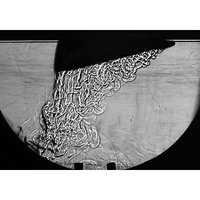
Resolving turbulent flows pushes both computations and algorithms to their limits. As a result, high-fidelity turbulence simulations increasingly rely on GPU-accelerated solvers that adapt to massive parallelism and memory constraints to overcome the computational limits of CPU-based solvers. This review maps the rapidly expanding ecosystem of GPU-accelerated DNS and LES codes for single- and multiphase turbulence for both compressible and incompressible flow, analyzing algorithmic strategies, porting challenges, and performance bottlenecks. By linking numerical methods to hardware evolution and memory constraints, we outline the path toward efficient, exascale turbulence simulations.

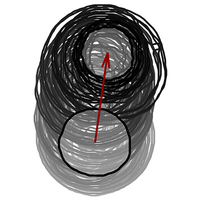
Active caustics

Rahul Chajwa, C. Rajarshi, Rama Govindarajan, and Sriram Ramaswamy

Phys. Rev. Fluids 11, 033104 (2026) - Published 20 March, 2026

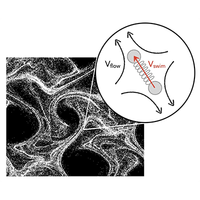
When the worldlines of inertial particles in background flows cross, they generate low-dimensional structures with diverging particle number-density, formally similar to optical caustics. We show that orientable motile particles in flows can form caustics even when their mechanical inertia is neglected. Singular perturbation analysis of self-propelled particles around a point vortex and numerical simulations of their motion in a turbulent flow uncover the various regimes of caustics, demarcating the necessary conditions for their formation. Active caustics greatly enhance encounters between Stokesian swimmers, and an order-of-magnitude estimate points to their ecological relevance.

Data-driven transient growth analysis

Zhicheng Kai, Peter Frame, and Aaron Towne

Phys. Rev. Fluids 11, 034904 (2026) - Published 20 March, 2026

The transient growth of disturbances is typically investigated using the matrix exponential of the linearized Navier-Stokes operator. We introduce a data-driven algorithm that computes optimal initial conditions, response modes, and their associated energy growth directly from snapshots of flow data. Our method simplifies and broadens the application of transient growth analysis, eliminating the need for access to the linearized operator and enabling application to experimental data. We demonstrate the method, including a regularization to mitigate the sensitivity to noise, using a Ginzburg-Landau equation, Poiseuille flow, and a transitional boundary layer.

Comparative analysis of detonation  and shock waves interacting with droplets: Characteristics and mechanisms

Hanbing Zou, Xin Jin, Haotian Chen, Wei Wang, Sheng Xu, and Bing Wang

Phys. Rev. Fluids 11, 034303 (2026) - Published 18 March, 2026

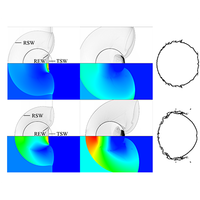
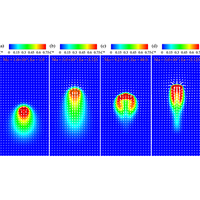
Understanding droplet dynamics under detonation loading is vital for advanced propulsion technologies like rotating detonation engines. This study reveals fundamental differences between detonation and shock wave interactions with water droplets using high-resolution simulations. We demonstrate that the rapid post-wave pressure attenuation in detonations accelerates cavitation collapse and suppresses the Rayleigh-Taylor forward jet typical of shock impacts, leading instead to unique leeward-side flattening.

Bicuspid valve closure and backflow prevention: Role of leaflet geometry

B. Kaoui, A. Bou Orm, P. Navet, J. Baish, and L. L. Munn

Phys. Rev. Fluids 11, 033103 (2026) - Published 17 March, 2026

Bicuspid valves with crescent-shaped leaflets in veins and lymphatics ensure unidirectional flow to the heart by preventing reflux. While longer leaflets increase hydrodynamic resistance and excessive stiffness hinders proper valve closure, a key question remains: why is the leaflet crescent-shaped, and to what extent should it be creased to optimize performance? This study isolates geometry by varying only leaflet length under backward flow, revealing a transition from reflux to full blockage. The threshold and, thus, valve competency depend strongly on cusp shape, explaining reflux in short, immature, or abnormal valves.

Residual-driven sensitivity analysis for pressure drop prediction in packed beds of spherical particles

Maxim Nikitin, Xiyu Xie, Qinrong Yu, and Dmitry Pashchenko

Phys. Rev. Fluids 11, 034302 (2026) - Published 17 March, 2026

Classical pressure-drop correlations for packed beds often yield inconsistent predictions across different geometric scales and flow rates. By applying a residual-driven sensitivity analysis to an extensive experimental dataset, this work reveals that while geometric wall effects initially dominate prediction errors, the superficial velocity overwhelmingly dictates residual behavior once these are minimized. This finding indicates that future model improvements should prioritize flow-regime-dependent corrections over further geometric refinement.

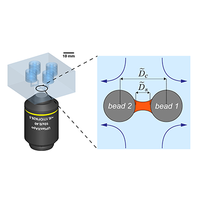
Stability of particle clusters bound by capillary bridges in extensional flow

Sagar Chaudhary, Dimitrios Fraggedakis, and Charles M. Schroeder

Phys. Rev. Fluids 11, L032301 (2026) - Published 17 March, 2026

Capillary suspensions are defined by liquid-bound particle clusters, yet despite decades of study, their stability in strong flows remains incompletely understood. Here, we establish a universal set of stability criteria for a liquid-bound particle doublet in extensional flow. A critical capillary number governing stability is identified through a combination of analytical theory and experiments. Below this threshold, stability depends sensitively on initial particle separation, whereas above it, clusters are unconditionally unstable. These results provide a quantitative framework for predicting and controlling flow-induced breakup in capillary suspensions.

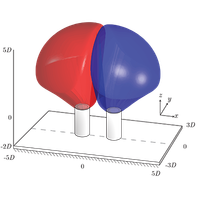
Flow structure and volume capture in idealized stereo inhalation flows at low-intermediate Reynolds number

Derek Goulet, Anna Pauls, Aaron True, and John Crimaldi

Phys. Rev. Fluids 11, 033102 (2026) - Published 16 March, 2026

Many animals leverage stereo inhalation for respiration and olfaction, drawing fluid and odors into a spatially separated pair of nares. Olfaction efficacy is known to be enhanced by the structure and dynamics of flow exterior and interior to the nares. We characterized stereo inhalation flow kinematics and capture volumes using numerical models of an idealized, dual siphon geometry, providing further context for sensory adaptations. We find capture volumes that are modulated by Reynolds number and siphon geometry, suggesting that organisms may alter morphology and inhalation dynamics at behavioral or evolutionary timescales to increase fitness.

Translational dynamics of lipid-coated microbubbles driven by ultrasound

Marco Cattaneo and Outi Supponen

Phys. Rev. Fluids 11, 033606 (2026) - Published 16 March, 2026

Acoustic radiation force can be used to steer ultrasound contrast microbubbles toward the desired clinical target, but the link between their oscillations, displacement, and stability has remained unclear. By tracking single lipid-coated microbubbles in free space, we show that their displacement is accurately captured only when history drag is included in the force balance. A simple linear scaling connects volumetric expansion to transport distance. Above a critical radial expansion, however, shape-mode oscillations emerge and dissolution rises sharply, revealing a trade-off between transport efficiency and bubble integrity.

Rheology of two-dimensional dilute emulsions

Thomas Appleford, Vatsal Sanjay, and Maziyar Jalaal

Phys. Rev. Fluids 11, 033607 (2026) - Published 16 March, 2026

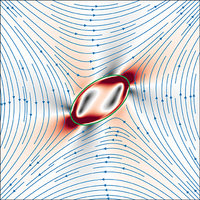
This paper addresses the problem of a two-dimensional (2D) droplet under shear. We introduce an analytical approach, utilizing a 2D Lamb solution to derive an expression for the apparent viscosity of a dilute 2D emulsion and to develop a deformation theory for small capillary numbers. Validated through direct numerical simulations, our findings establish benchmarks for computational fluid dynamics methods and for interpreting 2D droplet behavior.

Hele-Shaw flow in multi-connected regions

Amlan K. Barua, Shuwang Li, John S. Lowengrub, Wenjun Ying, and Meng Zhao

Phys. Rev. Fluids 11, 033902 (2026) - Published 16 March, 2026

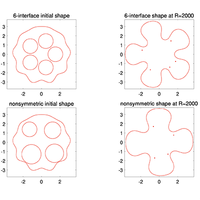
While classical Hele-Shaw models focus on single interface dynamics, the mechanisms driving instabilities in multi-connected fluid domains remain largely unexplored. We reveal that the spatial configuration and viscosity of internal fluid domains fundamentally break radial symmetry, triggering viscous fingering on the outer boundary. By strategically arranging these inner interfaces under a time dependent injection flux, one can suppress unfavorable instabilities and actively promote preselected, self-similar limiting shapes.

Advection-modulated gaseous diffusion through an orifice

Mario Sánchez Sanz and Antonio L. Sánchez

Phys. Rev. Fluids 11, 034103 (2026) - Published 16 March, 2026

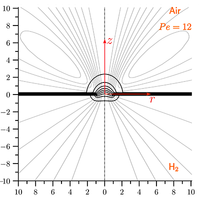
Classic orifice flow models, originally developed for low-Reynolds-number liquids, use the decoupling between velocity and concentration fields to simplify the analysis. This simplification fails for gaseous mixing, where composition changes directly alter the velocity field. Our study addresses the coupling in the Sc ∼ Pe ∼1 regime typical of gas-delivery systems. We introduce a unified framework that combines new analytical solutions for low Pe with simulations. This approach provides quantitative predictions for mass-transfer rates and pressure drops, and can help design the restrictive orifices critical to semiconductor manufacturing and precision gas-delivery technology.

Lattice Boltzmann simulation on species transfer across the two-phase interface

Chengbin Zhang, Suchen Wu, Xiangdong Liu, and Yongping Chen

Phys. Rev. Fluids 11, 034501 (2026) - Published 16 March, 2026

Simulations of interfacial mass transfer often interpolate the diffusion flux at the interface, making concentration predictions artificially sensitive to the chosen interface width. In this study, we propose a source-free phase-field-lattice-Boltzmann model that ensures bulk concentration profiles remain completely independent of interface thickness. We also introduce an additional free parameter to the evolution equation of the model, which significantly improves its numerical stability under low Henry constants. The proposed framework is highly beneficial for investigating complex multiphase systems, such as those involving surfactants or Marangoni effects.

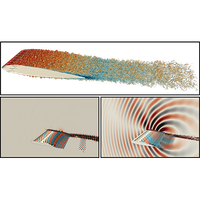
Coherent structures driving broadband trailing-edge noise: Spanwise wavenumber selection and low-order modeling

Zhenyang Yuan, Simon Demange, Kilian Oberleithner, André V. G. Cavalieri, and Ardeshir Hanifi

Phys. Rev. Fluids 11, 034606 (2026) - Published 16 March, 2026

Broadband trailing edge noise is generated by the scattering of three-dimensional hydrodynamic structures, but the role of spanwise wavenumber selection in acoustic radiation for a finite spanwidth airfoil remains unresolved. Wall resolved compressible large eddy simulation of a NACA0012 airfoil shows that nonzero spanwise modes become dominant above the acoustic cut-on frequency associated with obliquely convecting wavepackets identified via spectral proper orthogonal decomposition (SPOD). A reduced-order model based on extended SPOD reproduces far-field noise using only a small number of modes, providing a compact and control oriented framework for noise prediction and mitigation.

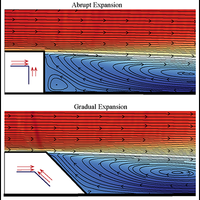
Effect of expansion geometry on turbulence in axisymmetric pipe flows

Jibu Tom Jose, Gal Friedmann, Dvir Feld, and Omri Ram

Phys. Rev. Fluids 11, 034607 (2026) - Published 16 March, 2026

Turbulent flow through sudden pipe expansions is widely studied, yet the role of expansion angle in shaping turbulence structure remains poorly understood. Using high-resolution stereo-Particle-Imaging-Velocimetry in a refractive-index-matched facility, we directly compare abrupt (90°) and gradual (45°) axisymmetric expansions. We show that slope fundamentally reorganizes the return flow, amplifying shear-layer interaction, turbulence production, and anisotropy in gradual expansions. The results provide a mechanistic explanation for the higher losses long observed in sloped geometries.

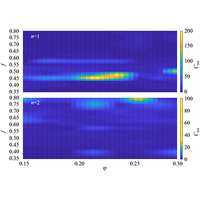
Theoretical and numerical investigation of rotating stall in a reversible pump-turbine runner

Shuangqian Han, Zhe Ma, Yonglin Qin, and Baoshan Zhu

Phys. Rev. Fluids 11, 034702 (2026) - Published 16 March, 2026

Rotating stall in reversible pump-turbines operating in the S-shaped region degrades stability and drives strong torque and pressure oscillations, yet quantitative inception prediction remains limited. Based on small-disturbance theory, we couple runner perturbation dynamics with the external system characteristic to analyze resonance and stability of disturbance waves and predict stall onset, wave speed, and cell number. Unsteady CFD ramp-downs from runaway to low flow under four guide-vane openings, with wavelet analysis of vaneless area pressure, validate the model’s accuracy in predicting stall onset.

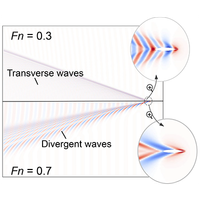
Spectral-fundamental solution approach for fully nonlinear ship wave simulations

Kaiyuan Shi, Renchuan Zhu, and Yulong Li

Phys. Rev. Fluids 11, 034801 (2026) - Published 16 March, 2026

Traditional simulations of large-scale fully nonlinear free-surface wave–body interactions remain computationally demanding. We present a spectral–fundamental solution (SFS) method that combines global spectral bases with local fundamental solutions, achieving high efficiency across large domains while maintaining accuracy near the body surface. Using this method, we investigate nonlinear ship-wave dynamics in extensive domains. The simulations reveal the physical origins of distinct energy bands in ship wakes, the effects of acceleration on wake evolution, and the mechanism behind wake-angle narrowing at high speeds.

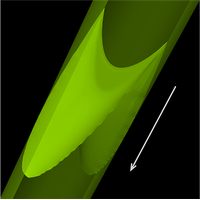
Self-propulsion of floating ice blocks caused by melting in water

Michael Berhanu, Amit Dawadi, Martin Chaigne, Jérôme Jovet, and Arshad Kudrolli

Phys. Rev. Fluids 11, 033802 (2026) - Published 13 March, 2026
We demonstrate that asymmetric ice blocks floating in water can self‑propel while melting. Experiments with triangular ice prisms show that melting generates a directed, buoyancy‑driven gravity current along the inclined face, producing steady translation. A momentum‑balance model quantitatively predicts the propulsion velocity as a function of ice geometry and bath temperature. This mechanism persists in saltwater at sufficiently warm temperatures, highlighting melting as a generic propulsion mechanism in buoyancy‑driven flows and a possible secondary contributor to iceberg drift.

Sign In to Your Journals Account

Filter

Recent Issues

Vol. 11, Iss. 10
October 2026
Vol. 11, Iss. 9
September 2026
Vol. 11, Iss. 8
August 2026
Vol. 11, Iss. 7
July 2026
Category
Article Type
Section

Filter

Article Lookup

Enter a citation