Recent Articles

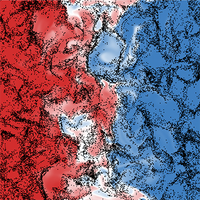
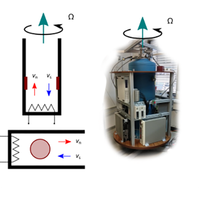
Temporal decay of vortex line density in rotating thermal counterflow of He II

F. Novotný, M. Talíř, E. Varga, and L. Skrbek

Phys. Rev. Fluids 11, 034603 (2026) - Published 3 March, 2026

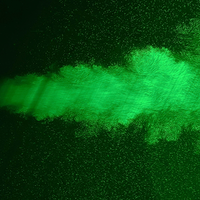
Temporal decay of rotating turbulent thermal counterflow of He II is probed by second sound and found to display interesting new features. Two effects are observed, acting against each other and affecting the late temporal decay of vortex line density, L(t). The first one is gradual decrease of the decay exponent of the power law L(t), confirming that turbulent thermal counterflow under rotation acquires 2D features. The second one is the influence of the effective Ekman layer built within the effective quantum Ekman time. For increasing rotation rates, L(t) gradually ceases to display a clear power law. Instead, rounded and ever steeper decays occur, gradually shifted toward shorter times.

Wetted-area minimum and inlet-outlet reciprocity in optimal manifolds of rarefied gas flows

Ruifeng Yuan and Lei Wu

Phys. Rev. Fluids 11, 033401 (2026) - Published 2 March, 2026

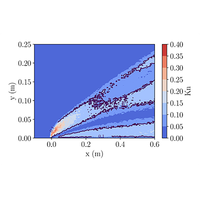
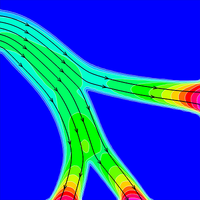
Smaller gas-solid contact area or smaller bifurcation angle? What happens when inlet and outlet conditions are exchanged? This study employs topology optimization to investigate optimal manifold configurations across gas rarefaction regimes and uncovers two counterintuitive phenomena: a wetted-area minimum in the slip regime and inlet–outlet reciprocity in free-molecular flows. These findings provide crucial guidance for microfluidic and vacuum system applications.

Physics-based machine learning closures and wall models for hypersonic transition-continuum boundary layer predictions

Ashish S. Nair, Narendra Singh, Marco Panesi, Justin Sirignano, and Jonathan F. MacArt

Phys. Rev. Fluids 11, 033402 (2026) - Published 2 March, 2026

Hypersonic boundary layers in the transition–continuum regime (Knudsen number Kn ≈ 0.1–10) challenge Navier–Stokes solvers due to the breakdown of transport laws and slip/jump wall conditions. We embed physics-constrained neural closures for viscous stress and heat flux directly in the partial differential equations and train them using adjoint-computed gradients to match direct simulation Monte Carlo target data. A distribution-function wall model built from mixtures of skewed Gaussians replaces empirical slip-velocity models, substantially improving bulk flow and boundary-layer predictions and generalizing across unseen Mach numbers, Knudsen numbers, and geometries.

Linear corner-mode instability of magnetohydrodynamic Rayleigh-Bénard convection in a rectangular domain

Thomas Boeck

Phys. Rev. Fluids 11, 033501 (2026) - Published 2 March, 2026

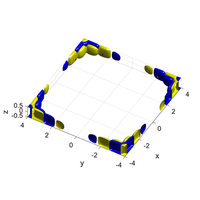
Wall-attached Rayleigh-Bénard convection arises in the presence of a damping body force, e.g. the Coriolis or Lorentz force, when this force is less effective near a lateral boundary than in the bulk. The shape of the container is important in this context. A numerical linear stability analysis of Rayleigh-Bénard magnetoconvection in a wide rectangular container with a vertical magnetic field and electrically insulating walls shows that the least stable mode of convection becomes localized in the corners rather than spread out over the whole circumference of the container. This corner mode has a similar dependence on the magnetic field strength as the ordinary wall-attached mode.

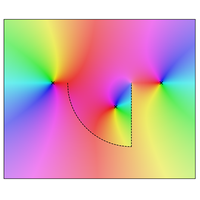
Hydrodynamic flows induced by localized torques (rotlets) in wedge-shaped geometries

Abdallah Daddi-Moussa-Ider, Jakob Mihatsch, Michael J. Mitchell, Elsen Tjhung, and Andreas M. Menzel

Phys. Rev. Fluids 11, 034101 (2026) - Published 2 March, 2026

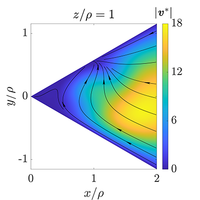
Wedge-shaped confinements are increasingly relevant in low-Reynolds-number microfluidics, yet existing Green’s functions describe only flows driven by point forces. We derive the flow induced by localized torques using a Fourier–Kontorovich–Lebedev framework combined with the Papkovich–Neuber representation. The resulting solutions reveal how geometric asymmetry couples rotation and translation and yield the full torque– mobility tensor. These analytical results provide predictive tools for controlling particle motion in confined microfluidic systems.

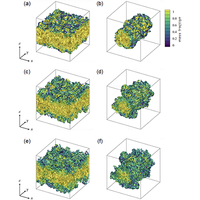
Objective identification of coherent vortices in turbulence using experimental data

Yutaro Motoori, Pierre Bragança, and Susumu Goto

Phys. Rev. Fluids 11, 034601 (2026) - Published 2 March, 2026

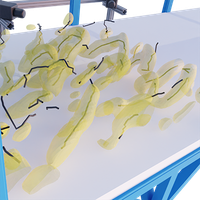
We introduce a simple method to objectively identify the axes of coherent vortices in turbulence using only the velocity-gradient tensor. The method is readily applicable to experimental data. As an example, applying it to stereo-PIV measurements of a wind-tunnel turbulent boundary layer, we quantitatively show that boundary-layer-scale vortices form hairpin shapes.

Local organization of the turbulent energy cascade in geophysical flows

Francesca De Serio

Phys. Rev. Fluids 11, 034602 (2026) - Published 2 March, 2026

In rotating geophysical flows, turbulence can either drive small-scale mixing or build large-scale coherent eddies. Here, a very large rotating-tank jet experiment with planar particle imaging velocimetry (PIV) is used to map the local energy flux across scales. The results show that stress–strain alignment and a local jet Rossby number organize where and how long inverse energy-cascade patches appear. This identifies a local control parameter for steering energy pathways in jet-like environmental flows.

CFD analysis of mucus bridge instability and breakup in the vocal folds

Martin Heinrich, Michael Döllinger, and Rüdiger Schwarze

Phys. Rev. Fluids 11, 023103 (2026) - Published 27 February, 2026

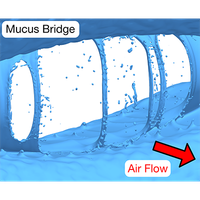
The atomization of airway mucus during speech is a primary mechanism for airborne disease transmission, yet the multiphase dynamics within the vocal folds remain largely uncharacterized. This study presents a Volume-of-Fluid CFD model to simulate the stretching and rupture of mucus bridges during phonation. Results show that small-scale surface perturbations seed realistic breakup patterns and that the bridge ruptures at a dynamic aspect ratio of approximately 20, far exceeding the quasi-static Rayleigh-Plateau stability limit. Higher transglottal pressures accelerate rupture, linking phonation intensity to aerosol generation.

Analysis of a swept impinging shock-turbulent boundary layer interaction

Thomas Bergier, Stéphane Jamme, Jérémie Gressier, Romain Gojon, and Laurent Joly

Phys. Rev. Fluids 11, 023401 (2026) - Published 26 February, 2026

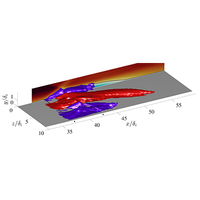
We study how the presence of a moderate sweep angle affects the behavior of shock/boundary layer interactions by means of wall-resolved Large Eddy Simulations. Several sweep angles up to 40deg are investigated. The mean properties of the flow are first reported, before analyzing the unsteady dynamics of the interaction. Intermediate frequencies at the separation location appear when sweep is present. They are related to spanwise-travelling structures detected around the interaction region.

Effects of weak buoyancy on shear instabilities in cold water

K. Bhavsar, M. Stastna, and N. Castro-Folker

Phys. Rev. Fluids 11, 023904 (2026) - Published 25 February, 2026

In fresh water between temperatures of 0 and 4 degrees Celsius, the equation of state (EOS) for density is nonlinear and the differences in density are extremely small. We call this the “cold water regime”. Using three-dimensional direct numerical simulations, we study the impact of the nonlinearity of the EOS on the development of the Kelvin-Helmholtz instability. We find that the nonlinear EOS displaces the pycnocline vertically above the shear layer which leads to differences in the onset of three-dimensional flow — both in terms of timing and scale. We further comment on how the extent of these differences changes under varying Prandtl and Reynolds numbers.

From three-dimensional cellular pattern to quasi-two-dimensional rolls: Flow reversals and elliptical instability in small-aspect-ratio magnetoconvection

Haitao Zhu, Chenmingze Li, Long Chen, and Mingjiu Ni

Phys. Rev. Fluids 11, 023703 (2026) - Published 23 February, 2026

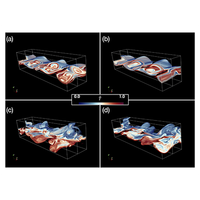
Thermal convection under a horizontal magnetic field is known to promote quasi-two-dimensionalization, yet its impact on transport in strongly confined geometries is incompletely understood. Using three-dimensional simulations of low-Prandtl-number convection in a small-aspect-ratio cell, we reveal a transition from 3D cellular structures to quasi-2D rolls accompanied by regular/irregular flow reversals. Unlike classical roll breakup and reconnection, the reversals originate from mode competition within vertically stacked vortices. Unified transport scaling and an extension of elliptical instability theory quantitatively explain the observed dimensional transition and flow-state selection.

Integral quantification and phase space analysis of heat transfer in a particle-laden shearless turbulent flow

Hamid Reza Zandi Pour, Perry L. Johnson, and Michele Iovieno

Phys. Rev. Fluids 11, 024308 (2026) - Published 23 February, 2026

The heat transfer in a turbulent thermal mixing layer of a fluid laden with inertial particles with finite heat capacity is investigated using direct numerical simulations. A reduced phase-space analysis, combined with a moment-of-total-enthalpy formulation, reveals how particle inertia and finite thermal response organize velocity–temperature correlations. These mechanisms lead to a self-similar regime in which particles dominate enthalpy transport, with maximum enhancement near a unity Stokes number. The results connect phase-space dynamics to global heat-transfer scaling in inhomogeneous turbulence.

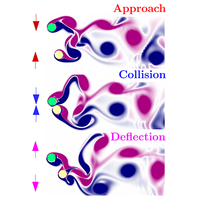
Wake of colliding initially tandem cylinders undergoing vortex-induced vibrations at varying mass ratios

Sandip Sarkar and Arnab Kumar De

Phys. Rev. Fluids 11, 024702 (2026) - Published 23 February, 2026

The present reserch investigates two-dimensional numerical simulations of vortex-induced vibrations (VIV) of initially tandem circular cylinders with two degrees of freedom in both the streamwise and transverse directions, undergoing rigid collisions for varying mass ratios. The cylinders exhibit a natural tendency to reconfigure their mean positions into a side-by-side arrangement. As the mass ratio increases, the VIV dynamics progressively evolve from chaotic behavior toward more organized, periodic-like states.

Importance of the continuous spectrum in the excitation of sheared surface gravity waves

J. R. Carpenter

Phys. Rev. Fluids 11, 024804 (2026) - Published 23 February, 2026

The behavior of waves on a water surface is usually classified in terms of the different modes of oscillation that are present. However, for water that is flowing, this description alone will miss a vital part of the physics.

Effects of compressibility and geometry on decaying shearless turbulent/nonturbulent mixing

Eunhye An and Eric Johnsen

Phys. Rev. Fluids 11, 024607 (2026) - Published 20 February, 2026

We investigate the effects of compressibility and geometry on turbulent/nonturbulent mixing in the absence of a mean shear. Focusing on initially homogeneous isotropic turbulence adjacent to a quiescent fluid in planar and cylindrical geometries, we theoretically predict the evolution of the mixing region width and turbulent kinetic energy and validate these predictions using direct numerical simulation. Compared to decaying homogeneous isotropic turbulence, we find that the decay rate is enhanced by dilatation due to energy transport to the nonturbulent region and by diverging geometries.

Capillary wells for microparticle manipulation

Gopal Verma and Wei Li

Phys. Rev. Fluids 11, 023903 (2026) - Published 19 February, 2026

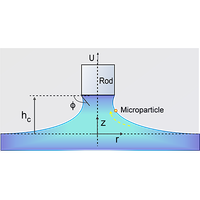
Particle motion at fluid interfaces is commonly governed by static capillary interactions, limiting active control. Here, we introduce a geometry-controlled capillary well formed by a neck-shaped meniscus around a vertically actuated rod, enabling reversible trapping and guided migration of particles. Elliptical rods generate anisotropic curvature landscapes that focus particles toward regions of maximum curvature, revealing an optimal aspect ratio for trapping efficiency. Theoretical predictions are validated through experiments and simulations.

Too large, too crowded, too sticky: Clogging of particulate suspensions

Alban Sauret

Phys. Rev. Fluids 11, 020502 (2026) - Published 18 February, 2026

From inkjet printers to irrigation lines, particle-laden flows can fail abruptly by clogging. This Perspective reviews recent work on particulate suspensions in confined geometries and the key control parameters behind clogging. Some general guidelines are provided: particles can be too large (sieving), too crowded (bridging), or too sticky (aggregation). We highlight recent efforts to characterize, model, and delay clogs, and suggest some future research questions.

Aging in the flow dynamics of dense suspensions of contactless microparticles

Jesús Fernández, Loïc Vanel, and Antoine Bérut

Phys. Rev. Fluids 11, 024307 (2026) - Published 18 February, 2026

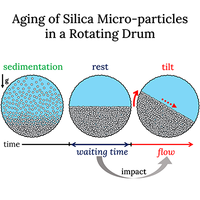
Free-surface flows of dense suspensions made of contactless silica microparticles are studied in microfluidic rotating drums experiments. We show that sedimented piles at rest exhibit aging: longer waiting times before tilting delay flow onset and reduce flow speed. This effect is not caused by compaction, crystallization, nor particle contacts, but likely arises from microscale relaxation dynamics driven by thermal agitation and time evolution of electrostatic inter-particles repulsive forces.

Shock-induced aerobreakup of parallel-arranged droplets

Jianfeng Guo, Peng Kang, Kai Mu, and Ting Si

Phys. Rev. Fluids 11, 023604 (2026) - Published 17 February, 2026

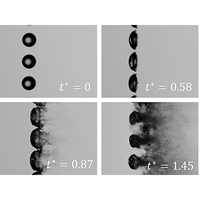
Altough many studies have focused on the aerobreakup of an isolated droplet, the coupling dynamics of multiple droplets remain less understood. By investigating the aerobreakup of parallel-arranged droplets under shock impact, this work systematically reveals how the decrease of droplet spacing induces breakup modes transition, i.e., from bag breakup to trailing and shuttlecock modes at low Weber numbers, and from open to closed configurations at high Weber numbers. Quantitative and theoretical analyses demonstrate that a reduced spacing accelerates the gas velocity between droplets, thus facilitating the homodromous bending and filament formation.

Stationary imbibition with evaporation through a flattened triangular channel

Christian Kankolongo, Didier Lasseux, Tony Zaouter, Florent Ledrappier, and Marc Prat

Phys. Rev. Fluids 11, 024004 (2026) - Published 17 February, 2026
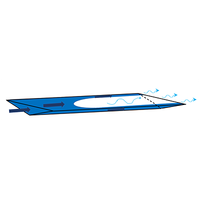
Predicting and controlling the liquid dynamics in a groove or grooved systems is of importance for various technological applications. Solutions for the flow of a wetting liquid in a channel of flattened triangular cross section are studied considering the combined effects of capillary imbibition and evaporation. Two main regimes are identified: the pure corner flow regime and the regime with partial bulk invasion. Situations where the mass transfer rate is independent of the external air relative humidity are exhibited for both regimes.

Sign In to Your Journals Account

Filter

Recent Issues

Vol. 11, Iss. 10
October 2026
Vol. 11, Iss. 9
September 2026
Vol. 11, Iss. 8
August 2026
Vol. 11, Iss. 7
July 2026
Category
Article Type
Section

Filter

Article Lookup

Enter a citation