Highlights

KamNet: An integrated spatiotemporal deep neural network for rare event searches in KamLAND-Zen

A. Li, Z. Fu, C. Grant, H. Ozaki, I. Shimizu, H. Song, A. Takeuchi, and L. A. Winslow

Phys. Rev. C 107, 014323 (2023) - Published 30 January, 2023

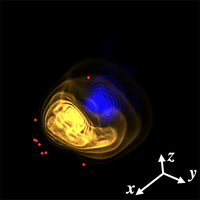
Searches for rare events employ customized detectors with large fiducial mass to effectively reduce background. Leveraging recent breakthroughs in geometric deep learning and spatiotemporal analysis, this work presents a novel machine-learning algorithm (KamNet) as a new, robust tool to maximize the information provided by the kiloton-scale KamLAND liquid-scintillator detector. Adding a so-called “attention mechanism” to KamNet, the authors demonstrate that this enhanced machine-learning approach can increase the sensitivity of the KamLAND-Zen experiment to zero-neutrino- and two-neutrino double-β decay. That mechanism also elucidates the underlying physics KamNet is using for background rejection.

Confronting anomalous kaon correlations measured in Pb-Pb collisions at sNN=2.76 TeV

Joseph I. Kapusta, Scott Pratt, and Mayank Singh

Phys. Rev. C 107, 014913 (2023) - Published 30 January, 2023

This paper uses simple models to interpret recent measurements of anomalously strong correlations between neutral and charged kaon production performed at the LHC for high-energy heavy-ion collisions. Thermal models, including charge conservation effects, are found to be insufficient to explain the data for the most central collisions. More exotic conjectures involving coherent emission can reproduce the observations if 30% of the kaons are emitted from coherent sources in the most central collisions. Such coherence might be related to the melting and re-freezing of the QCD vacuum.

Ab initio calculation of the β-decay spectrum of He6

G. B. King, A. Baroni, V. Cirigliano, S. Gandolfi, L. Hayen, E. Mereghetti, S. Pastore, and M. Piarulli

Phys. Rev. C 107, 015503 (2023) - Published 27 January, 2023

Searches for new physics can be conducted by brute force or, like the perihelion shift of Mercury, looking for subtle but persistent discrepancies. This detailed paper carries out high-precision calculations of the β-decay spectrum of 6He, and estimates the experimental precision needed to reveal hints of charged-current interactions beyond the Standard Model and/or sterile neutrinos.

Densities and momentum distributions in A≤12 nuclei from chiral effective field theory interactions

M. Piarulli, S. Pastore, R. B. Wiringa, S. Brusilow, and R. Lim

Phys. Rev. C 107, 014314 (2023) - Published 20 January, 2023

This study presents calculations of one- and two-body densities in both coordinate and momentum space for various nuclei up to 12C, using the phenomenological AV18+UX and various Norfolk NN + NNN χEFT interactions. It features new calculations of the pair density as a function of both pair separation and center-of-mass, as well as the two-body momentum distribution for short- and long-range pairs differentiated by a pair separation boundary. The full set of results are available online for general use by the nuclear physics community and are intended to provide useful insights into the short-range structure of nuclei and various reaction processes.

Multinucleon transfer mechanism in Cf250+Th232 collisions using the quantal transport description based on the stochastic mean-field approach

S. Ayik, M. Arik, O. Yilmaz, B. Yilmaz, and A. S. Umar

Phys. Rev. C 107, 014609 (2023) - Published 10 January, 2023

The production of elements close to the superheavy island of stability, with Z>100, is one of the most appealing challenges in nuclear physics. Based on a stochastic extension of the time-dependent Hartree-Fock theory, this article presents accurate microscopic calculations of multinucleon transfer for the 250Cf+232Th system at Ec.m.=950 MeV. Isotope production cross sections are described without any adjustable parameters, thus providing a benchmark to new experimental searches.

Fermi operator expansion method for nuclei and inhomogeneous matter with a nuclear energy density functional

Takashi Nakatsukasa

Phys. Rev. C 107, 015802 (2023) - Published 9 January, 2023

Calculations for nuclear structure at high excitation energy or of nuclear matter in explosive stellar phenomena and neutron stars require intensive computations. The author tests the performance of a numerical method based on Fermi operator expansion that requires neither diagonalization nor Gram-Schmidt orthonormalization. The approach is suitable for massively parallel computing with distributed memory, and the calculations promise to scale well for large space sizes. Applied to finite nuclei and inhomogeneous nuclear matter, the method is efficient at high temperature, and the calculations clearly show the liquid-gas phase transition.

Microscopic study of fusion reactions with a weakly bound nucleus: Effects of deformed halo

Xiang-Xiang Sun (孙向向) and Lu Guo (郭璐)

Phys. Rev. C 107, L011601 (2023) - Published 4 January, 2023

New modeling explains the relatively high fusion reaction probabilities of halo nuclei, which are composed of a dense core surrounded by a “satellite” of one or two nucleons.

Quasibound state in the K¯NNN system

N. V. Shevchenko

Phys. Rev. C 106, 064006 (2022) - Published 27 December, 2022

The attractive nature of the antikaon-nucleon interaction suggests that few-body systems of antikaons and nucleons can exist. The author presents a new study of the exotic K¯NNN system. Four-body Faddeev-type equations are used to evaluate the binding energy and the width of the quasi-bound state in the system. The dependence of the results on the two-body antikaon-nucleon and nucleon-nucleon interactions is quantified.

Applications of persistent homology in nuclear collisions

Greg Hamilton, Travis Dore, and Christopher Plumberg

Phys. Rev. C 106, 064912 (2022) - Published 23 December, 2022

This paper applies methods of persistent homology—an approach used in topological data analysis to identify and study features that persist over different length scales—to heavy-ion collision data. It introduces a novel set of observables for the quantitative characterization of nuclear collisions and of their evolution. The work offers new ways to analyze the long-range flow correlations that have been interpreted theoretically with relativistic fluid dynamical models.

Nonequilibrium components in the region of very low transverse momentum in high-energy nuclear collisions

Yuuka Kanakubo, Yasuki Tachibana, and Tetsufumi Hirano

Phys. Rev. C 106, 054908 (2022) - Published 18 November, 2022

The theoretical interpretation of data produced in relativistic heavy-ion collisions has relied on applying relativistic viscous fluid-dynamical modeling approaches. Recently, the focus of several studies has been on the transition between the very first instants of the collision and the hydrodynamic phase. This paper shows that the addition of a corona component to a fluid-dynamical core increases the agreement between theory and low-momentum data. This supports the importance of non-equilibrium physics in the characterization of the quark-gluon plasma.

Theoretical uncertainty quantification for heavy-ion fusion

K. Godbey, A. S. Umar, and C. Simenel

Phys. Rev. C 106, L051602 (2022) - Published 18 November, 2022

Many aspects of physics that spans from the origin of the elements to nuclear technologies rely on a robust description of nuclear reactions. One therefore needs predictive modelling of nuclear quantum many-body dynamics in which the uncertainties are well-understood. The authors use the time-dependent Hartree-Fock approach, and apply uncertainty quantification to the nuclear dynamics, considering a collection of low-energy heavy-ion fusion reactions. They find that the uncertainty in the theoretical results mainly arises from structure properties, such as the skin of neutron-rich nuclei, which are particularly ill-constrained. This work highlights the importance of including reaction data in the construction and constraint of new theoretical models that can treat dynamics and structure on the same footing.

First experiment at the Super Heavy Element Factory: High cross section of Mc288 in the Am243+Ca48 reaction and identification of the new isotope Lr264

Yu. Ts. Oganessian et al.

Phys. Rev. C 106, L031301 (2022) - Published 29 September, 2022

Initial findings of the Super Heavy Element Factory—an atom smasher in Russia—reveal details about some of the heaviest known elements.

Covariant density functional theory with localized exchange terms

Qiang Zhao (赵强), Zhengxue Ren (任政学), Pengwei Zhao (赵鹏巍), and Jie Meng (孟杰)

Phys. Rev. C 106, 034315 (2022) - Published 21 September, 2022

The authors derive a new density-dependent point-coupling covariant density functional (PCF-PK1) with exchange terms that are local and can be included in a standard relativistic mean-field calculation. This saves a considerable amount of computing time over relativistic Hartree-Fock calculations with nonlocal potentials. The PCF-PK1 is obtained by fitting nuclear matter and finite nuclei, including the results of ab-initio calculations; it eliminates spurious shell closures at Z=58 and 92; and it accurately reproduces Gamow-Teller resonances in closed-shell nuclei. This new covariant density functional PCF-PK1 with exchange correlation is expected to provide a unified and consistent description for both nuclear ground states and excited states, in particular for unstable nuclei far from stability.

In-medium Λ isospin impurity from charge symmetry breaking in the Λ4H−Λ4He mirror hypernuclei

M. Schäfer, N. Barnea, and A. Gal

Phys. Rev. C 106, L031001 (2022) - Published 20 September, 2022

Charge-symmetry breaking, or CSB, is a fundamental concept in nuclear physics. Adding a Λ hyperon, a sibling of the nucleon with a strange quark, to light nuclei promises new insights as its isospin impurity must impact CSB in mirror hypernuclei, where the only good data available are for A=4. The authors use an ansatz that relates the charge-symmetry-breaking ΛN interaction to the ΛN↔ΣN strong-interaction coupling via the small isospin-one admixture the Λ obtains from the Σ0, as both are members of an SU(3) baryon octet and have an u-d-s quark structure. Once the large CSB observed in mirror hypernuclei Λ4H and Λ4He is reproduced, the deduced isospin-one admixture of the Λ when inside these hypernuclei matches that in free space, provided SU(3) symmetry is partially conserved for these baryons. This approach can be tested in heavier hypernuclei when precise data for CSB become available.

Exploring the effects of Δ baryons in magnetars

K. D. Marquez, M. R. Pelicer, S. Ghosh, J. Peterson, D. Chatterjee, V. Dexheimer, and D. P. Menezes

Phys. Rev. C 106, 035801 (2022) - Published 2 September, 2022

Strong magnetic fields can modify the microscopic composition of matter affecting also the properties and evolution of massive objects such as compact stars. This paper explores the combined effect of heavy baryons—hyperons and Δ’s—on the structure of neutron stars with strong magnetic fields, so-called magnetars. The authors show that Δ’s are favored over hyperons and that contrary to expectations they do not make the nuclear matter equation of state softer.

Double-weak decays of Xe124 and Xe136 in the XENON1T and XENONnT experiments

E. Aprile et al. (XENON Collaboration )

Phys. Rev. C 106, 024328 (2022) - Published 26 August, 2022

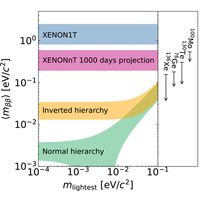
This work uses two liquid-xenon detectors in the Gran Sasso Underground Laboratory, originally designed to search for dark matter, to find evidence for neutrinoless double-β decay. The results indicate that such dark-matter detectors can provide important constraints and potential discoveries beyond their original purpose and design. This is further illustrated by the first statistically significant observation of a rare two-neutrino decay of 124Xe.

Bulk medium evolution has considerable effects on jet observables

Yasuki Tachibana, Chun Shen, and Abhijit Majumder

Phys. Rev. C 106, L021902 (2022) - Published 26 August, 2022

Collisions of heavy ions at relativistic energies produce strongly interacting matter in a state of high energy density, known as the quark-gluon plasma. Such events also produce energetic QCD jets that will interact, excite, and probe the plasma before being measured by the surrounding detectors. Using numerical modeling, this paper shows that the reconstructed jets have the potential to distinguish among different possible flow patterns of the underlying strongly interacting hadronic fluid.

Neutron-deuteron scattering cross sections with chiral NN interactions using wave-packet continuum discretization

Sean B. S. Miller, Andreas Ekström, and Kai Hebeler

Phys. Rev. C 106, 024001 (2022) - Published 10 August, 2022

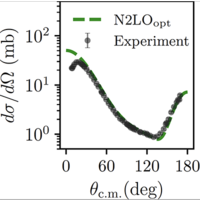
This paper presents a framework to solve the Faddeev equations for three-nucleon scattering using the wave-packet continuum-discretization method. The authors perform benchmark calculations with chiral nucleon-nucleon interactions. The paper represents a first step toward a systematic inclusion of three-nucleon scattering in the construction of next-generation nuclear interactions.

Nuclear masses learned from a probabilistic neural network

A. E. Lovell, A. T. Mohan, T. M. Sprouse, and M. R. Mumpower

Phys. Rev. C 106, 014305 (2022) - Published 13 July, 2022

Modeling of nuclear masses is important for many areas of nuclear science including nuclear astrophysics, reaction modeling, and nuclear data evaluations, but accuracy is challenging. This paper shows how judicious use of physics knowledge—so-called feature-space engineering—in machine learning, coupled with sophisticated models of theoretical uncertainties, can lead to better predictions.

Measurement of ψ(2S) nuclear modification at backward and forward rapidity in p+p, p+Al, and p+Au collisions at sNN=200 GeV

U. A. Acharya et al. (PHENIX Collaboration )

Phys. Rev. C 105, 064912 (2022) - Published 29 June, 2022

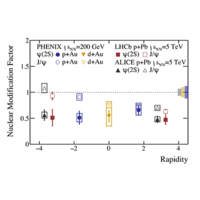
In relativistic heavy-ion collisions, the analysis of charmonium yields normalized to those in pp collisions has been shown to reveal final-state interactions occurring in the hot and dense strongly interacting matter created in such events. However, until recently, similar analyses of charmonium measured in smaller collision systems—pA versus pp—were performed in terms of cold nuclear matter effects. The measurements reported by the PHENIX Collaboration of the production of J/Ψ and Ψ(2S) states at forward and backward rapidity, strongly suggest the presence of final-state effects also in small collision systems.

Sign In to Your Journals Account

Filter

Section

Filter

Article Lookup

Enter a citation