Highlights

β-decay spectrum of tritiated graphene: Combining nuclear quantum mechanics with density functional theory

Andrea Casale, Angelo Esposito, Guido Menichetti, and Valentina Tozzini

Phys. Rev. C 113, 054607 (2026) - Published 13 May, 2026

New density-functional-theory calculations describe the radioactive decay of tritium bound to graphene, offering a way to model experiments that could open cleaner windows onto neutrino mass.

Mechanism to synthesize superheavy element 120: A dinuclear system model approach with microscopic inputs

Wei Zhang (张炜), Shi-Jie Zhang (张士杰), and Peng-Hui Chen (陈鹏辉)

Phys. Rev. C 113, 054604 (2026) - Published 7 May, 2026

To overcome the challenge of synthesizing nuclei of superheavy elements (SHEs) beyond Z=118, the authors developed a new calculation method using the dinuclear system model. The novel approach consistently and microscopically derives all necessary structure inputs—including nuclear masses, fission barriers, and level density parameters—from finite-temperature covariant density functional theory. After validating the method against data for nobelium and flerovium isotopes, the approach provides meaningful predictions for the production of Z=120 isotopes, which should be useful for planning future SHE synthesis experiments.

Stochastic many-body perturbation theory for high-order calculations

X. Zhen, R. Z. Hu, J. C. Pei, and F. R. Xu

Phys. Rev. C 113, L051302 (2026) - Published 4 May, 2026

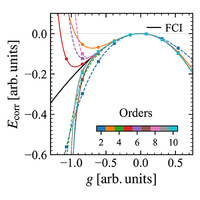
The authors introduce a perturbation theory quantum Monte Carlo (PTQMC) method to compute high-order many-body perturbative corrections. The approach avoids exponential scaling inherent to conventional constructions of high-rank excitation operators. Benchmark calculations for the Richardson pairing model reproduce exact many-body perturbation-theory calculations up to 16th order even in strongly divergent regimes. The results are relevant for future applications of PTQMC to realistic nuclear matter and finite nuclei, as well as for the systematic assessment of perturbative uncertainties in ab-initio nuclear theory.

High-voltage and electrode system for a cryogenic experiment to search for the neutron electric dipole moment

M. A. Blatnik, S. M. Clayton, S. A. Currie, B. W. Filippone, M. Makela, C. M. O'Shaughnessy, N. S. Phan, J. C. Ramsey, G. V. Riley, A. Roberts, T. Sandborn, T. J. Schaub, G. M. Seidel, E. Smith, I. L. Smythe, J. Surbrook, W. Wei, W. Yao, and T. M. Ito

Phys. Rev. C 113, 045503 (2026) - Published 30 April, 2026

The neutron electric dipole moment (nEDM) is a key probe of CP violation and physics beyond the Standard Model. Experimental sensitivity scales with the applied electric field, making higher fields essential for improved measurements. A 1994 proposal to perform an nEDM experiment in superfluid 4He suggested several potential advantages, including in-situ production of ultracold neutrons with reduced loss and the possibility of higher electric fields. Here, the authors report the outcome of a comprehensive program to develop the high-voltage and electrode system for such an experiment, including new insights into relevant physical phenomena and detailing selected technical solutions with their corresponding experimental demonstrations. The results demonstrate the necessary technology for operation at electric fields up to E=75 kV/cm, compared with E≈10 kV/cm in recent nEDM experiments—a major step toward significantly enhanced sensitivity.

Radiative strength functions from the energy-localized Brink-Axel hypothesis

Oliver C. Gorton, Konstantinos Kravvaris, Jutta E. Escher, and Calvin W. Johnson

Phys. Rev. C 113, 044327 (2026) - Published 29 April, 2026

Radiative strength functions (RSFs) are crucial inputs for statistical nuclear reaction codes but are difficult to calculate because they require wave functions of highly excited states. The authors used large-scale shell model calculations to identify a key result of the energy-localized Brink-Axel hypothesis: the shape of the RSF evolves smoothly with wave-function energy. Combined with an efficient Lanczos strength-function method, this insight leads to a practical new approach for computing RSFs which was validated for 24Mg and provided novel results for 56Fe. The method is expected to simplify RSF calculations while motivating the use of energy-dependent RSFs in modern reaction codes.

Microscopic triaxial quadrupole-octupole collective Hamiltonian for low-energy nuclear excitations

J. Xiang, J. Zhao, Z. P. Li, and D. Vretenar

Phys. Rev. C 113, 044328 (2026) - Published 29 April, 2026

The importance of quadrupole degrees of freedom has long been a hallmark of nuclear structure studies, while octupole degrees of freedom become increasingly important as proton and neutron numbers increase. This work introduces a microscopic collective Hamiltonian built upon multidimensionally constrained covariant density functional theory, incorporating both axial and triaxial quadrupole and octupole modes and their mutual couplings. As an example application, the complex excitation spectrum of 152Sm is well reproduced, along with a good replication of E0, E1, and E2 transitions. The unifying microscopic collective Hamiltonian proposed here is relevant for achieving a microscopic description of shape coexistence in nuclei and their associated excitation modes.

Mass spectrometry of Zn75 ground and isomeric states from in-trap decay of Cu75

M. Müller, N. A. Althubiti, D. Atanasov, K. Blaum, R. B. Cakirli, T. E. Cocolios, F. Herfurth, S. Kreim, D. Lunney, V. Manea, N. Minkov, D. Neidherr, M. Rosenbusch, L. Schweikhard, A. Welker, F. Wienholtz, and R. N. Wolf

Phys. Rev. C 113, 044321 (2026) - Published 27 April, 2026

Located just beyond the Z=28 proton-shell closure, the odd-N zinc isotopes (Z=30) provide a sensitive testing ground for the evolution of neutron orbitals through their low-lying states. The authors report high-precision Penning-trap mass measurements of the ground and first isomeric state in 75Zn at ISOLTRAP, with both states populated via the decay of 75Cu inside a Penning trap. Earlier work had identified only a single long-lived state in 75Zn and assigned its mass to the ground state. The new measurements show that the previously observed state is instead the first isomeric state, restoring a smooth trend in the two-neutron separation energies and supporting a ground-state spin-parity assignment of Jπ=1/2−. The results of the new high-precision measurements also provide benchmarks for improving theoretical models in this region of rapidly evolving nuclear structure.

Separable character of ab initio no-core shell model one-body densities

J. Foy, Ch. Elster, P. Maris, S. P. Weppner, and S. K. Bogner

Phys. Rev. C 113, 044323 (2026) - Published 27 April, 2026

Optical potentials are necessary for modeling scattering and reactions, but are challenging to derive rigorously; practitioners often resort to phenomenology instead. Inspired by other recent work, this paper investigates a key input into optical potentials, the off-shell densities, here computed in the ab-initio no-core shell model. The authors find these densities are well approximated by a handful of separable terms, with the number of needed terms depending only upon the number of protons and neutrons. Such insights will likely influence the future development of both phenomenological and first-principles optical potentials.

Wavefunction-based emulation of coupled-channels scattering with nonaffinely parametrized interactions

M. Catacora-Rios, K. Beyer, P. Giuliani, K. Godbey, R. J. Furnstahl, and F. M. Nunes

Phys. Rev. C 113, 044623 (2026) - Published 27 April, 2026

Accurate modeling of nuclear reactions is relevant to understanding the structure and dynamics of atomic nuclei, as well as for nuclear science applications and for understanding how nuclei are created in the universe. The authors generalize the reduced basis method, a physics-based emulator used for elastic scattering, to coupled-channels equations for nuclear reactions. They apply the method to neutron scattering on 48Ca and 208Pb and show that the calculated elastic and inelastic cross sections match those obtained using traditional accurate methods. Because emulators can offer a fast and reliable alternative to the exact solution of several scattering problems in nuclear physics, and because many reactions can be cast as a coupled-channels problem, the new developments will have significant impact on future research.

Peripheral heavy-ion collisions below the Fermi energy: The case of Kr86+Ni64 and Kr86+Sn124 at 15 MeV/nucleon

O. Fasoula, G. A. Souliotis, S. Koulouris, A. Pakou, M. Veselsky, S. J. Yennello, and A. Bonasera

Phys. Rev. C 113, 034621 (2026) - Published 27 March, 2026

The efficient production of neutron-rich nuclei has been a challenge and is a central theme at current and future rare-isotope facilities. Nuclides with high neutron excess can be reached by transferring multiple neutrons from the target to the projectile and/or by stripping protons from the projectile in multinucleon transfer reactions. Beam energies range from the Coulomb barrier to Fermi energies, about 15–35 MeV/nucleon. The authors analyze two reactions, 86Kr+86Ni and 86Kr+124Sn, each previously measured at 15 MeV/nucleon at the MARS recoil separator at the Texas A&M Cyclotron Institute. Systematic comparisons with calculations from two well-known models followed by a deexcitation description provide significant insight into the reaction mechanisms and indicate that multiple charge-exchange channels, along a diagonal `southeast’ path in the nuclear chart, offer an efficient route to neutron-rich nuclides.

Toward scalable quantum computations of atomic nuclei

Chenyi Gu, Matthias Heinz, Oriel Kiss, and Thomas Papenbrock

Phys. Rev. C 113, 034321 (2026) - Published 24 March, 2026

Quantum computers offer new ways to solve the nuclear many-body problem, but realistic applications remain out of reach. Computations on a position-space lattice are promising as they exploit the short-range nature of nuclear forces. Using a local effective field theory Hamiltonian with two- and three-nucleon forces, this paper analyzes the resources required to compute ground states using adaptive variational algorithms. Demonstrations for the deuteron and helium-3 illustrate how such approaches may scale toward future quantum computations of nuclei.

First measurement of Σ+n→Λp and Σ+n→Σ0p cross sections via Σ+-nucleus scattering at an electron-positron collider

M. Ablikim et al. (BESIII Collaboration)

Phys. Rev. C 113, L032201 (2026) - Published 23 March, 2026

Experimental data on hyperon-nucleon interactions are scarce even though measurements of hyperon-nucleon scattering have been performed since the 1960s. This work takes advantage of 1010 J/ψ particles produced at an e+e− collider to extract unique hyperon-nucleon cross sections. Following the decay J/ψ→Σ+Σ¯−, the experiment tracked the nearly monoenergetic hyperons through the collider beam pipe and their interactions with bound neutrons in the pipe. Cross sections for two final states are extracted with >3σ sensitivity. These results should aid theory progress on hyperon-nucleon interactions and may be useful in constraining hyperons in the equation of state of neutron star cores.

Di-nucleons do not form bound states at heavy pion mass

John Bulava, M. A. Clark, Arjun S. Gambhir, Andrew D. Hanlon, Ben Hörz, Bálint Joó, Christopher Körber, Ken McElvain, Aaron S. Meyer, Henry Monge-Camacho, Colin Morningstar, Joseph Moscoso, Amy Nicholson, Fernando Romero-López, Ermal Rrapaj, Andrea Shindler, Sarah Skinner, Pavlos M. Vranas, and André Walker-Loud (Baryon Scattering Collaboration)

Phys. Rev. C 113, 024002 (2026) - Published 17 February, 2026

Predicting the low-energy, two-nucleon (NN) forces directly from quantum chromodynamics (QCD), the underlying theory of strong interactions, remains a challenge for theory. The authors present a high-statistics, technically sophisticated lattice QCD calculation of p-n and n-n scattering amplitudes at equal (heavy) pion and kaon masses of 714 MeV and find that deuteron and di-neutron bound states do not exist. The results help diagnose a long-standing disagreement in the literature regarding the methods used to determine the NN spectra and amplitudes with such calculations. The work represents a significant step toward deriving nuclear physics from first principles.

Charged particle scattering in renormalizable pionless effective field theory at next-to-leading order: The pd, dd, and pHe3 cases

Matúš Rojik, Martin Schäfer, Mirko Bagnarol, and Nir Barnea

Phys. Rev. C 113, 024001 (2026) - Published 13 February, 2026

This work presents an extensive theoretical and numerical study of charged few-nucleon systems (pd, dd, and p-3He bound states and scattering) in the framework of pionless effective field theory (EFT) up to next-to-leading order (NLO). The authors treat the Coulomb interaction nonperturbatively, while NLO interactions, including three-body forces and a four-body force, are treated in perturbation theory. Special attention is given to renormalization issues. Only a mild cutoff dependence is seen, consistent with the expectations of power counting in pionless EFT. The results hold significant promise for ab-initio studies of charged-particle scattering at very low energies, with applications to reactions of astrophysical interest.

Backscattering study of electrons from 0.1 to 3.4 MeV

M. Kanafani, X. Fléchard, O. Naviliat-Cuncic, R. Garreau, T. E. Haugen, L. Hayen, S. Leblond, E. Liénard, X. Mougeot, G. Quéméner, A. Rani, J.-C. Thomas, and S. Vanlangendonck

Phys. Rev. C 113, 025501 (2026) - Published 9 February, 2026

Benchmarking simulation codes for electron transport and scattering in matter is a crucial step for estimating uncertainties in precision measurements in β decay and other applications. This work reports the measurement and the quantitative analysis of backscattering probabilities of electrons in the energy range 0.1 to 3.4 MeV where experimental data are scarce. Using a setup for precise identification of backscattered events impinging on a YAP:Ce scintillator, the authors achieved meaningful agreement between simulations and experimental data covering a large range of energies and large incident angles. The results should help mitigate the usually large relative uncertainties considered for electron backscattering probabilities. Reaching an improved understanding of the systematic uncertainties at the percent level, compared to the previous 10% level, promises to be of high value to the community engaged in precision β spectroscopy.

Bayesian framework for the SE1(300 keV) and SE2(300 keV) factors for C12(α,γ)O16 from subthreshold and ground-state asymptotic normalization coefficients

A. M. Mukhamedzhanov

Phys. Rev. C 113, 025803 (2026) - Published 9 February, 2026

The 12C(α,γ)16O reaction sets the carbon-to-oxygen ratio after core helium burning and strongly influences late stellar evolution. Because direct measurements near E≈300 keV are not available, this work combines existing experimental constraints in a Bayesian analysis to determine a well-defined range for the astrophysical factors SE1(300 keV) and SE2(300 keV). The resulting S(300 keV) range has important implications for the final outcomes of massive stars, including the formation of heavy black-hole remnants relevant to gravitational-wave observations.

Electromagnetic moments of ground and excited states calculated in heavy odd-N open-shell nuclei

J. Dobaczewski, A. E. Stuchbery, G. Danneaux, A. Nagpal, P. L. Sassarini, and H. Wibowo

Phys. Rev. C 113, 024306 (2026) - Published 5 February, 2026

Nuclear moments are fundamental nuclear characteristics such as whether an individual nuclear state is deformed, or whether the nucleus carries its angular momentum as a collective whole or as individual nucleons with contributions from both their orbital motion and their intrinsic spin. However, calculations of nuclear moments have long been carried out mostly for certain classes of nuclei rather than seamlessly across an entire region. The authors report comprehensive calculations of spectroscopic magnetic dipole and electric quadrupole moments in odd-N, even-Z nuclei with their code HFODD. The calculations cover gadolinium to osmium nuclei, ranging from near-spherical to well-deformed nuclei, within nuclear density functional theory with the Skyrme functional UNEDEF1. Comparison with experimental data for 82 states without parameter adjustment demonstrates that the study captures the main features of magnetic dipole and electric quadrupole moments. The holistic approach to an entire region of the nuclear chart provides valuable insight into the evolution of the underlying nuclear structure and will help guide future fine-tuning of the functionals.

Impact of shape coexistence on the symmetric to asymmetric fission mode transition in Th isotopes

Shengyuan Chen, Zeyu Li, Minghui Zhou, and Zhipan Li

Phys. Rev. C 113, 024601 (2026) - Published 2 February, 2026

The thorium isotopes exhibit a transition from symmetric to asymmetric fission. To study this transition, the authors carry out a systematic investigation of fission modes across the thorium isotopic chain, based on state-of-the-art microscopic models. They show that it is strongly correlated with rapid changes in the configuration of the nucleus at scission as the thorium isotopes become more neutron-rich. Furthermore, they find that the change in configuration is driven by a deformed shell closure for krypton and strontium isotopes which dominate the light asymmetric fragment yields. This work can point the way toward finding other isotopic chains where such fission-mode transitions occur.

Correlation of multiple physical quantities in multinucleon transfer reactions: Insight into production of isotopes near the N=152 shell closure

Zimeng Shen, Zehong Liao, and Long Zhu

Phys. Rev. C 113, L021601 (2026) - Published 2 February, 2026

Synthesizing neutron-rich superheavy elements such as those near the N=152 shell closure is experimentally challenging and requires reliable guidance from nuclear theory. This work reports on the multinucleon transfer (MNT) reaction 238U+238U to synthesize neutron-rich 244U. The authors use a semi-classical approach based on solving a master equation, the DNS-sysu model, to obtain the fragment distribution probability. Using a multidimensional analysis of the correlations among the scattering angle, the kinetic energy, and the angular momentum, the authors focus on how these physical parameters influence the optimal detection angle for 244U production. They find that the optimal production kinematic window corresponds to peripheral collisions with high angular momentum and kinetic energy, at a scattering angle near those for grazing collisions. The results can help guide experiments toward optimizing the detection geometry for MNT experiments to synthesize and detect 244U and similar neutron-rich actinides, which are important to better understand the evolution of nuclear stability near the predicted “island of stability” of superheavy elements.

Structure of high-lying excited states in Ca47 with ℓ≥3 populated in fast-beam γ-ray-tagged one-neutron pickup reactions

T. Parry, A. Gade, B. A. Brown, D. Weisshaar, S. A. Gillespie, D. Bazin, T. Beck, P. C. Bender, J. Belarge, C. M. Campbell, B. A. Elman, K. W. Kemper, B. Longfellow, E. M. Lunderberg, and A. O. Macchiavelli

Phys. Rev. C 113, 014328 (2026) - Published 29 January, 2026

This work is a new and impressive example for the potential of γ-ray-tagged neutron-adding transfer reactions at high beam velocities. By tuning the desired angular momentum transfer, this reaction allows selecting specific neutron configurations and complements spectroscopic information from the more common neutron-removal and low-energy (d,p) transfer reactions. The experiment selectively populated excited states in 47Ca—a neighbor of the doubly magic 48Ca nucleus—based on ℓ≥3 neutron configurations following one-neutron pickup by 46Ca from a 12C target, and recorded their decay with the GRETINA detector array. The experimental results demonstrate that the ℓ=3 spectroscopic strength is rather fragmented, in contrast to shell-model calculations, which predict it to be strongly concentrated in only a few states. The work not only suggests opportunities for a modern (d,p) measurement to complement the present selective high-ℓ data but more generally introduces γ-ray-tagged neutron-adding transfer reactions as a complementary tool for exploring neutron single-particle excitations.

Sign In to Your Journals Account

Filter

Section

Filter

Article Lookup

Enter a citation