Highlights

Refining the nuclear mass surface with the mass of Sn103

L. Nies, D. Atanasov, M. Athanasakis-Kaklamanakis, M. Au, C. Bernerd, K. Blaum, K. Chrysalidis, P. Fischer, R. Heinke, C. Klink, D. Lange, D. Lunney, V. Manea, B. A. Marsh, M. Müller, M. Mougeot, S. Naimi, Ch. Schweiger, L. Schweikhard, and F. Wienholtz

Phys. Rev. C 111, 014315 (2025) - Published 9 January, 2025

Expected to be doubly magic, 100Sn is the heaviest proton-bound, self-conjugate (N=Z) nucleus. Its mass and those of nearby nuclei are key to understanding nuclear structure and reactions near the proton dripline, including neutron-star-surface nucleosynthesis. The mass of 103Sn, previously an outlier due to a discrepant β-decay measurement, was precisely determined by an international team at CERN ISOLDE using multireflection time-of-flight mass spectrometry, their results agreeing well with those from another, complementary technique at FRIB. This new value enables re-evaluating the masses of five parent nuclei connected via decays. Comparing their results with theory calculations, the authors recovered a smooth trend of the local nuclear mass surface for tin, tellurium, and xenon isotopes, with possible impact on nuclear structure and astrophysics. Insights into ISOL target and source performances also suggest a path toward improved production of lighter tin isotopes for future studies.

Equation of state of nuclear matter from collective flows and stopping in intermediate-energy heavy-ion collisions

M. D. Cozma

Phys. Rev. C 110, 064911 (2024) - Published 23 December, 2024

The equation of state (EOS) of isospin-asymmetric nuclear matter plays a crucial role in many different realms of modern physics, from nuclear structure and heavy-ion reaction dynamics to the modeling of compact stellar objects. The author presents an in-depth comparison of calculations based on an improved transport model with heavy-ion collision data at intermediate energies. Accurate constraints on several features of the nuclear effective interaction, namely nucleon effective masses, in-medium elastic nucleon-nucleon cross-sections, and EOS can be extracted. This study paves the way toward comprehensive analyses that combine constraints derived from various EOS-sensitive physical phenomena.

Centrality dependence of Lévy-stable two-pion Bose-Einstein correlations in sNN=200 GeV Au+Au collisions

N. J. Abdulameer et al. (PHENIX Collaboration)

Phys. Rev. C 110, 064909 (2024) - Published 20 December, 2024

Color deconfinement and chiral-symmetry restoration have long been predicted by QCD theory. Color deconfinement in the form of a nearly perfect fluid of quarks was reported by all four RHIC experiments in 2005. Now, the PHENIX Collaboration details two-pion Lévy-stable Bose-Einstein correlation data in Au+Au collisions at the top RHIC energy. They report a significant reduction of the mass of the η′ meson in hot and dense hadronic, color-confining matter. This implies a second transition in QCD by the return of the so-called prodigal Goldstone boson—a specific kind of partial chiral-symmetry restoration—and calls for further, challenging experimental studies, aiming at direct measurements of identified η′ spectra in high-energy heavy-ion collisions.

Diagrammatic ab initio methods for infinite nuclear matter with modern chiral interactions

F. Marino, W. G. Jiang, and S. J. Novario

Phys. Rev. C 110, 054322 (2024) - Published 22 November, 2024

A realistic description of the equation of state of nuclear matter is of paramount importance for understanding neutron-star structure and astrophysical phenomena. The authors perform benchmark ab initio calculations for nuclear matter with several modern chiral interactions using three diagrammatic methods: coupled-cluster theory, self-consistent Green’s functions, and many-body perturbation theory. They obtain robust predictions for the equation of state of both pure neutron matter and symmetric nuclear matter, especially for soft chiral potentials. The very good agreement between different techniques, in particular between the nonperturbative coupled-cluster and Green’s functions methods, suggests that these many-body approaches can reach high accuracy, and uncertainties on the equation of state are mostly related to the nuclear interaction.

Magnetic structure of A≤10 nuclei using the Norfolk nuclear models with quantum Monte Carlo methods

G. Chambers-Wall, A. Gnech, G. B. King, S. Pastore, M. Piarulli, R. Schiavilla, and R. B. Wiringa

Phys. Rev. C 110, 054316 (2024) - Published 18 November, 2024

This paper presents a new detailed study of magnetic moments and form factors of nuclei with mass number A up to 10, based on ab-initio approaches and chiral effective field theory. The results of quantum Monte Carlo calculations for elastic magnetic form factors show excellent agreement with experimental data out to momentum transfers q≈3 fm−1. Benchmarking such electroweak current models against available data over a wide range of kinematics allows for accurate predictions, which are very important to disentangle signals of new physics from nuclear physics effects.

Role of momentum in the generator-coordinate method applied to barrier penetration

K. Hagino and G. F. Bertsch

Phys. Rev. C 110, 054610 (2024) - Published 18 November, 2024

This manuscript introduces a fresh theory perspective on nuclear fission. The typical approach to fission uses collective coordinates with, e.g., the potential energy derived from semiclassical microscopic-macroscopic models or from density functional theories. The novel approach is based on the configuration-interaction framework, which has been successful for calculating energies and spectroscopic properties, along with the generator-coordinate method introduced by Hill and Wheeler. Here the total wavefunction is represented by a superposition of Slater determinants characterized by the collective coordinate along the fission path. As an important new step, configurations with finite momenta are taken into account. With Kohn’s reaction theory to treat barrier penetration assuming a Gaussian-shaped barrier, the authors show that including the finite momentum configurations leads to a more stable and more accurate solution. This method, while applied to fission here, could be useful for other systems involving interacting fermions.

Ab initio electroweak corrections to superallowed β decays and their impact on Vud

Vincenzo Cirigliano, Wouter Dekens, Jordy de Vries, Stefano Gandolfi, Martin Hoferichter, and Emanuele Mereghetti

Phys. Rev. C 110, 055502 (2024) - Published 18 November, 2024

The authors propose a new approach for the calculation of nuclear-dependent corrections to superallowed β decays based on effective field theory (EFT). The calculation is timely given the observation in recent years of a 2–3 σ anomaly in the test of the first row of the Cabibbo-Kobayashi-Maskawa matrix. Within a comprehensive assessment, the authors methodically develop a master formula for superallowed β decays, paving the way for ab-initio nuclear many-body computations of nuclear-structure-dependent corrections. The results show promise for state-of-the-art extractions of Vud from nuclear processes with controlled uncertainty quantification, and for using precision β-decay experiments to search for physics beyond the standard model.

Vortex rings in event-by-event relativistic heavy-ion collisions

David Dobrigkeit Chinellato, Michael Annan Lisa, Willian Matioli Serenone, Chun Shen, Jun Takahashi, and Giorgio Torrieri

Phys. Rev. C 110, 054908 (2024) - Published 15 November, 2024

Vortices such as smoke rings in air are familiar features in hydrodynamics. They appear when fast-moving local currents are embedded in the larger medium. This paper reports on results of realistic simulations of relativistic heavy-ion collisions using relativistic fluid dynamics. The work highlights the formation of a novel toroidal vortex ring structure which could manifest itself in the polarization of the Λ hyperon. This proposed new observable is argued to have great potential as a probe of hydrodynamic behavior in small collision systems, and of early-time dynamics in general. The predictions made in this work can be tested by experiments performed at current heavy-ion colliders such as RHIC at BNL and the LHC at CERN, as well as by future fixed-target experiments to be carried out at the LHC.

Radial and orbital decomposition of charge radii of Ca nuclei: Comparative study of Skyrme and Fayans functionals

T. Inakura, N. Hinohara, and H. Nakada

Phys. Rev. C 110, 054315 (2024) - Published 14 November, 2024

Accurate computation of nuclear radii is surprisingly challenging. By decomposing the contributions into orbital occupations and radial wave functions, the authors tease out a sensitive dependence upon the details of the pairing force, providing an improved description of the radii of stable calcium isotopes. Measurements of the radii of neutron-deficient calcium isotopes would help further constrain these insights.

Magnetic dipole γ-ray strength functions in the crossover from spherical to deformed neodymium isotopes

A. Mercenne, P. Fanto, W. Ryssens, and Y. Alhassid

Phys. Rev. C 110, 054313 (2024) - Published 13 November, 2024

The γ-ray strength function is an important input into Hauser-Feshbach calculations of neutron capture in compound nuclear reactions. Experiments suggest an enhancement of the strength function at low energy, but this enhancement has not been reproduced in models of heavy nuclei as conventional shell-model methods become computationally intractable. Using shell-model Monte Carlo methods, the authors have successfully reproduced the low-energy enhancement (LEE) for magnetic dipole transitions in neodymium isotopes, while also illuminating the role of the scissors and spin-flip modes in these M1 transitions. If the LEE persists in heavy neutron-rich nuclei, thus significantly enhancing the radiative neutron-capture rates of nuclei near the neutron drip line, it would likely have profound effects on r-process nucleosynthesis.

Bayesian analysis of (3+1)D relativistic nuclear dynamics with the RHIC beam energy scan data

Syed Afrid Jahan, Hendrik Roch, and Chun Shen

Phys. Rev. C 110, 054905 (2024) - Published 13 November, 2024

The state-of-the-art in the modeling and analysis of relativistic heavy-ion collisions involves multistage approaches to simulate the evolving strongly interacting matter and uses Bayesian analysis to obtain statistically relevant physical quantities. This work features a (3+1)D model applied to collision energies lower than those considered so far to explore the full range of the RHIC beam energy scan. This enables an exploration of the behavior of QCD at large baryon chemical potentials. The results of such comprehensive and systematic phenomenological studies have promise to advance knowledge of QCD in extreme conditions.

Laser-based approach to verify nuclear excitation by electron capture

Jintao Qi, Boqun Liu, and Xu Wang

Phys. Rev. C 110, L051601 (2024) - Published 12 November, 2024

When the conditions are right, the energy released in a downward electronic transition in an atom can excite its atomic nucleus, potentially creating a path to controlling excited nuclear quantum states. Among these processes, nuclear excitation by electron capture (NEEC) stands out as the only one that has not yet been unambiguously confirmed by experiment, despite theoretical proposals spanning nearly half a century. The authors propose using intense femtosecond laser pulses on clusters of 235U atoms, demonstrating that with suitable laser parameters, the 76.7-eV nuclear isomer in 235U is almost entirely (more than 99.9%) excited via NEEC. The long, 26-minute lifetime of the isomer allows for efficient detection and diminishes atomic processes disturbing the detection. An experimental confirmation would represent a robust and conclusive verification of this elusive phenomenon.

Dynamics of dilute nuclear matter with light clusters and in-medium effects

Rui Wang, Stefano Burrello, Maria Colonna, and Francesco Matera

Phys. Rev. C 110, L031601 (2024) - Published 16 September, 2024

The treatment of particle correlations and the description of clusters in the nuclear medium are important aspects that need to be better understood in the theoretical description of nuclear matter and the simulation of heavy-ion collisions. The authors propose a novel treatment of clustering for transport calculations based on a mechanism that suppresses cluster formation due to the Pauli principle via a medium-dependent cutoff in the momentum distribution of the clusters. The impact of clusters on the dynamics of unstable nuclear matter is clearly seen, and a `distillation’ mechanism is observed that affects the distribution of clusters between the low- and high-density regions. Although the approach has room for improvements, it captures the essential physics, and promises to have an impact on the further development of the field.

Dark matter scattering off H2 and He4 nuclei within chiral effective field theory

Elena Filandri and Michele Viviani

Phys. Rev. C 110, 034002 (2024) - Published 6 September, 2024

The nature of dark matter is one of the outstanding problems in particle physics and cosmology. To assist in the search for dark matter (DM), the authors examine the most general interactions between weakly interacting massive particles (WIMPs), assumed to be spin-1/2 fermions, and isotopes of the lightest nuclei, hydrogen and helium, using chiral effective field theory for a wide range of masses and coupling constants. The authors conclude that the scalar nuclear response functions are much greater than the others and severely constrained by the existing limits provided by experiments. The present study could be extended to other possible types of DM interactions, lighter DM candidates or heavier nuclei, such as lithium, argon, and xenon, currently widely used in dark matter detectors.

Observation and spectroscopy of the proton-unbound nucleus Al21

D. Kostyleva et al.

Phys. Rev. C 110, L031301 (2024) - Published 3 September, 2024

The proton dripline demarcates the nuclear landscape on the neutron-deficient side. A measurement at the SIS/FRS facility at GSI in Darmstadt, Germany of the anatomy of the immediate breakup of fragile 21Al into 20Mg + proton has now established that 21Al is unbound against proton emission in its ground state. The result thus places 21Al as the first Al isotope beyond the proton dripline. Its precise, negative proton separation energy will be a benchmark for nuclear structure models that treat nuclei as open quantum systems.

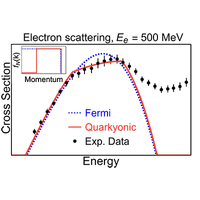
Examining the possibility that normal nuclear matter is quarkyonic

Volker Koch, Larry McLerran, Gerald A. Miller, and Volodymyr Vovchenko

Phys. Rev. C 110, 025201 (2024) - Published 5 August, 2024

Lattice QCD calculations at finite temperature and zero or small baryon chemical potential have shown that there is no phase transition separating quasi-free quarks and those confined in baryons. Quarkyonic matter is a hypothetical state where quarks and baryons can coexist in a single Fermi sphere; quarks occupy the low momenta levels, hadrons the high momenta ones. This paper puts forward the idea that normal nuclear matter may, in fact, be quarkyonic and that the existence of this exotic phase may already have been seen in current electron-nucleus scattering data.

First direct measurement of the spectrum emitted by the H3(H2,γ)He5 reaction and assessment of the relative yield γ1 to γ0

Marica Rebai, Davide Rigamonti, Andrea Dal Molin, Giulia Marcer, Angela Bracco, Franco Camera, Daniela Farina, Giuseppe Gorini, Evgeniy Khilkevitch, Massimo Nocente, Enrico Perelli Cippo, Oscar Putignano, Jimmy Scionti, Alexander Shevelev, Andrej Zohar, and Marco Tardocchi

Phys. Rev. C 110, 014625 (2024) - Published 30 July, 2024

Experiments at the Joint European Torus make the case for using gamma rays to determine the fusion reaction rate in a magnetically confined plasma.

Precise neural network predictions of energies and radii from the no-core shell model

Tobias Wolfgruber, Marco Knöll, and Robert Roth

Phys. Rev. C 110, 014327 (2024) - Published 25 July, 2024

Ab-initio calculations of atomic nuclei have revolutionized nuclear structure physics. Yet challenges remain, not least the reliable calculation of nuclear radii. In a concurrent development, modern machine-learning algorithms have excelled in a variety of computational tasks such as pattern recognition and interpolation. The authors have applied artificial neural networks (ANNs) to the extrapolation of no-core shell model calculations to infinite model spaces, effectively circumventing their computational limitations. In particular, the results show that min-max normalization, a common technique in machine learning, leads to the best results for radii. These advances offer hope that the ANN architecture is capable of handling other observables such as electromagnetic moments and transition strengths.

Ab initio computations of strongly deformed nuclei near Zr80

B. S. Hu, Z. H. Sun, G. Hagen, and T. Papenbrock

Phys. Rev. C 110, L011302 (2024) - Published 24 July, 2024

Atomic nuclei near mass 80 with approximately equal numbers of protons and neutrons are known to be strongly deformed while different shapes coexist in the same nucleus. These phenomena have challenged nuclear models but are also an opportunity to test the advances in theoretical approaches. The authors perform ab-initio coupled-cluster calculations for even-even nuclei near neutron-deficient 80Zr, including calculations of B(E2) transitions, using chiral NN and NNN forces. The results adequately describe shape coexistence even if they cannot unambiguously determine ground-state shapes. The calculations are a significant step forward in mass number for ab-initio computations of deformed nuclei.

Ab initio investigation of the Li7(p,e+e−)Be8 process and the X17 boson

P. Gysbers, P. Navrátil, K. Kravvaris, G. Hupin, and S. Quaglioni

Phys. Rev. C 110, 015503 (2024) - Published 10 July, 2024

Recent observations by the ATOMKI Collaboration of anomalies in electron-positron pair production following proton capture on light nuclides has led to the postulation of a new boson with mass around 17 MeV. Here a team of scientists from the United States, Canada, and France presents the most detailed microscopic calculations to date of the proton capture reactions, and is unable to find a conventional explanation for the anomalies. While these calculations do not confirm the existence of the so-called X17 boson, they provide strong motivation for continued and independent experiments to investigate the ATOMKI results. Further refinements of the calculations may provide theoretical constraints for future data.

Sign In to Your Journals Account

Filter

Section

Filter

Article Lookup

Enter a citation