Highlights

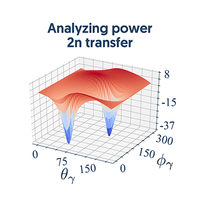
Transient Joule- and (ac) Josephson-like photon emission in one- and two- nucleon tunneling processes between superfluid nuclei: Blackbody and coherent spectral functions

R. A. Broglia, F. Barranco, G. Potel, and E. Vigezzi

Phys. Rev. C 105, L061602 (2022) - Published 28 June, 2022

In analogy with the phenomena occurring when two superconductors are placed in proximity, effectively charged neutrons involved in one- and two-nucleon tunneling processes in heavy-ion collisions between superfluid nuclei are expected to emit photons. Based on T-matrix calculations, a quantal coherent, or AC Josephson-like, character of the emission is predicted in the case of the Cooper-pair transfer (a two-nucleon channel), whereas a thermally equilibrated (Joule-like) character is obtained for the quasiparticle (one-nucleon channel) transfer. These findings provide a new microscopic insight into superfluidity in finite quantum systems and may stimulate new experimental analyses.

Nuclear coherent population transfer to the Th229m isomer using x-ray pulses

Tobias Kirschbaum, Nikolay Minkov, and Adriana Pálffy

Phys. Rev. C 105, 064313 (2022) - Published 24 June, 2022

Pumping electrons in atoms via a gateway state to metastable states is a common and important tool with many applications, but the same process has yet to be achieved in atomic nuclei. The authors provide detailed mechanisms to pump a metastable state of 229Th at the extraordinarily low nuclear excitation energy of 8 eV, while also pointing out important gaps in our knowledge of this system. A population inversion to this state could be the basis for a novel “nuclear clock” to rival atomic clocks.

Impact of fragment formation on shear viscosity in the nuclear liquid-gas phase transition region

X. G. Deng (邓先概), P. Danielewicz, Y. G. Ma (马余刚), H. Lin (林豪), and Y. X. Zhang (张英逊)

Phys. Rev. C 105, 064613 (2022) - Published 23 June, 2022

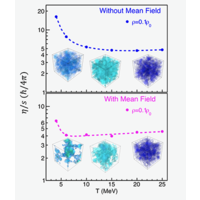
The dimensionless ratio of shear viscosity to entropy density η/s typically has a minimum at a phase transition as observed in many atomic and molecular systems. This quantity has been under intense study in high-energy heavy-ion collisions as a sign of a QCD phase transition or rapid crossover between hadronic and quark-gluon degrees of freedom. The authors perform numerical simulations of matter at lower density and temperature associated with a minimum in η/s which may shed light on the nuclear liquid-gas phase transition and its connection to the QCD transition.

Search for electron-neutrino transitions to sterile states in the BEST experiment

V. V. Barinov et al.

Phys. Rev. C 105, 065502 (2022) - Published 9 June, 2022

First results from the BEST Collaboration searching for short-baseline neutrino oscillations to sterile neutrinos with a high-intensity 51Cr monoenergetic neutrino source reaffirm that the so-called gallium anomaly, a deficit in electron neutrinos, persists. 4σ deficits were observed in the 71Ge production rates at two different distance scales, which could be interpreted as oscillations between an electron neutrino and a hypothetical sterile neutrino. The results are consistent with oscillations with a mass squared difference above about 0.5 eV2 and a large mixing angle sin22θ≈0.4.

New narrow resonances observed in the unbound nucleus F15

V. Girard-Alcindor et al.

Phys. Rev. C 105, L051301 (2022) - Published 11 May, 2022

The unbound nucleus 15F was studied in proton-induced reactions on 14O, producing three narrow resonances above the 2p decay threshold in 15F. In comparison to calculations that account for the particle continuum, it was found that the properties of these resonances are determined by the proximity to proton decay channels rather than by carrying the imprint of 14O(0+)+1p configurations. Systematic investigations of such narrow resonances in unstable nuclei will open new perspectives in studies of effective interactions in nuclear open quantum systems.

Finite-temperature electron-capture rates for neutron-rich nuclei near N=50 and effects on core-collapse supernova simulations

S. Giraud, R. G. T. Zegers, B. A. Brown, J.-M. Gabler, J. Lesniak, J. Rebenstock, E. M. Ney, J. Engel, A. Ravlić, and N. Paar

Phys. Rev. C 105, 055801 (2022) - Published 4 May, 2022

Electron capture on neutron-rich nuclei near N=50 plays an important role during the gravitational collapse of massive stars prior to a supernova explosion, as neutrinos emitted in the electron-capture process can freely leave the stellar core. At the high temperatures in the stellar core the electron-capture rates are determined from thermally excited states whose properties differ from those of the ground state. The authors perform finite-temperature calculations with different theoretical approaches and use the resulting electron-capture rates as input in core-collapse supernova simulations. This work shows that the various sets of electron-capture rates lead to very small differences in the simulations suggesting that the rates are well-constrained.

Incomplete electromagnetic response of hot QCD matter

Zeyan Wang, Jiaxing Zhao, Carsten Greiner, Zhe Xu, and Pengfei Zhuang

Phys. Rev. C 105, L041901 (2022) - Published 27 April, 2022

The magnetic field generated in a high-energy collision of heavy ions might be weaker than previously thought, hindering the experimental search for field-related effects.

Qualifying collective behavior in expanding ultracold gases as a function of particle number

Stefan Floerchinger, Giuliano Giacalone, Lars H. Heyen, and Leena Tharwat

Phys. Rev. C 105, 044908 (2022) - Published 26 April, 2022

The collective behavior of strongly interacting subatomic particles produced in high-energy proton and nuclear collisions is often interpreted using fluid dynamics. This paper considers systems of interacting cold atoms to explore the emergence of hydrodynamic behavior as a function of particle number. It proposes methods that have the potential to connect results of experiments performed with mesoscopic atomic systems with those performed at the Large Hadron Collider.

Effective field theory of pairing rotations

T. Papenbrock

Phys. Rev. C 105, 044322 (2022) - Published 22 April, 2022

Low-energy effective theories have become a powerful tool in nuclear physics and elsewhere in the past several decades. This paper describes a large amount of experimental data in this framework as “pairing rotational bands” with just a few parameters. The pairing rotational tensor is akin to a moment of inertia in the gauge space of two interacting superfluids. Its eigenvectors rotate with respect to the (N,Z) coordinate system, and they approximately point in the direction of the valley of β stability and perpendicular to it. Combining superfluidity with deformation shows that the lowest-lying excitations in atomic nuclei are model-independent and based on emergent symmetry breaking.

Differential measurements of jet substructure and partonic energy loss in Au + Au collisions at sNN=200 GeV

M. S. Abdallah et al. (STAR Collaboration)

Phys. Rev. C 105, 044906 (2022) - Published 21 April, 2022

QCD jets initially produced in relativistic heavy-ion collisions propagate through the quark-gluon plasma and act as tomographic probes of that dense medium. Measurements by the STAR Collaboration employ differential measurements of partonic energy loss to suggest that hard fragmenting jets at RHIC lose energy as a single color charge, over a range of jet opening angles.

Probing triaxial deformation of atomic nuclei in high-energy heavy ion collisions

Jiangyong Jia

Phys. Rev. C 105, 044905 (2022) - Published 20 April, 2022

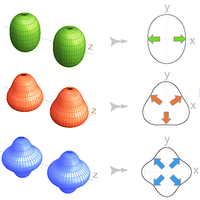
The structure of atomic nuclei is shown to influence a collection of observables measured in relativistic heavy-ion collisions. Details of the nuclear shape—here its triaxial nature—and of its fluctuations are reflected in the angular correlations between the detected particles, establishing a connection between high-energy nuclear collisions and low-energy nuclear structure.

Mapping the N=40 island of inversion: Precision mass measurements of neutron-rich Fe isotopes

W. S. Porter et al.

Phys. Rev. C 105, L041301 (2022) - Published 19 April, 2022

The authors report precise measurements of the masses of neutron-rich iron isotopes with A=63 to 70 with the multiple-reflection time-of-flight mass spectrometer of the ion trap facility TITAN at TRIUMF. This work constitutes the first use of Fe beams at an ISOL facility, owing in part to a novel laser ionization scheme. A newly discovered isomeric state in 69Fe, together with the new masses, benchmarks state-of-the-art nuclear structure models in a region of rapid structural change.

Deblurring for nuclei: 3D characteristics of heavy-ion collisions

Pawel Danielewicz and Mizuki Kurata-Nishimura

Phys. Rev. C 105, 034608 (2022) - Published 9 March, 2022

A deblurring technique pioneered in optics could correct for measurement-induced smearing of particle distributions in a high-energy nuclear collision experiment.

Glassy quantum nuclear pasta in neutron star crusts

William G. Newton, Sarah Cantu, Shuxi Wang, Amber Stinson, Mark Alexander Kaltenborn, and Jirina Rikovska Stone

Phys. Rev. C 105, 025806 (2022) - Published 24 February, 2022

Nuclear pasta is an exotic form of nuclear matter that occurs in the crust of neutron stars below saturation density. Various exotic nuclear structures with cylindrical, planar, and more complicated geometries evolve from the Coulomb lattice of nuclei immersed in a fluid of neutrons. Such structures in the crust should not only affect how a neutron star cools and rotates but also the height of the “mountains” that the crust can sustain—potentially detectable as persistent sources of gravitational waves. By performing a large set of quantum calculations the authors show that the energy landscape of nuclear pasta consists of multiple local minima with very similar energies. Hence, at the characteristic temperatures nuclear pasta becomes a self-organized glassy amorphous solid similar to soft-matter systems found on Earth.

Electron scattering on A=3 nuclei from quantum Monte Carlo based approaches

Lorenzo Andreoli, Joseph Carlson, Alessandro Lovato, Saori Pastore, Noemi Rocco, and R. B. Wiringa

Phys. Rev. C 105, 014002 (2022) - Published 14 January, 2022

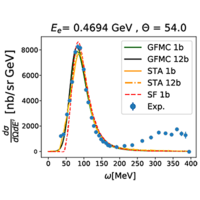
Response functions and inclusive cross sections for lepton-nucleus scattering provide a window to aspects of long- and short-range nuclear structure. The authors’ microscopic calculations of electron-nucleus scattering on 3H and 3He, using quantum Monte Carlo methods and realistic interactions, quantify the accuracy and range of validity of different factorization schemes and analyze the relevance of relativistic effects. The benchmarking of theoretical approaches to calculating electron-nucleus scattering will enhance experimental programs at major facilities such as Jefferson Lab.

Experimental study of the Si30(He3,d)P31 reaction and thermonuclear reaction rate of Si30(p,γ)P31

D. S. Harrouz, N. de Séréville, P. Adsley, F. Hammache, R. Longland, B. Bastin, T. Faestermann, R. Hertenberger, M. La Cognata, L. Lamia, A. Meyer, S. Palmerini, R. G. Pizzone, S. Romano, A. Tumino, and H.-F. Wirth

Phys. Rev. C 105, 015805 (2022) - Published 14 January, 2022

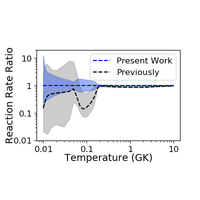
Element abundance anomalies in globular star clusters may be used to understand their history and to identify the nature of the stars responsible for these anomalies. The 30Si(p,γ)31P thermonuclear rate is a key ingredient in addressing that topic, and a high-resolution indirect measurement of this radiative proton-capture reaction has been undertaken at relevant stellar temperatures. The strength of key resonances has been determined, and the major contributions to the remaining uncertainty are now well known.

Bayesian approach to long-range correlations and multiplicity fluctuations in nucleus-nucleus collisions

Kianusch Vahid Yousefnia, Atharva Kotibhaskar, Rajeev Bhalerao, and Jean-Yves Ollitrault

Phys. Rev. C 105, 014907 (2022) - Published 7 January, 2022

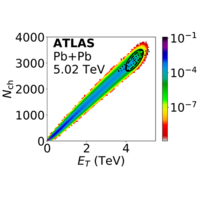
A Bayesian analysis is used to study the long-range rapidity correlations and multiplicity fluctuations in Pb-Pb collisions at the LHC. In particular, the authors are able to reconstruct, using LHC data, the correlations and fluctuations of multiplicities in collisions at zero impact parameter. This sheds light on the initial states of these collisions and the ability to infer the impact parameter.

Shape of atomic nuclei in heavy ion collisions

Jiangyong Jia

Phys. Rev. C 105, 014905 (2022) - Published 5 January, 2022

The author presents compelling arguments that measurements of collective flow in high-energy nuclear collisions can provide information on the shape of atomic nuclei on time scales several orders of magnitude shorter than are probed in low-energy experiments.

Deep-inelastic electron-deuteron scattering with spectator nucleon tagging at the future Electron Ion Collider: Extracting free nucleon structure

Alexander Jentsch, Zhoudunming Tu, and Christian Weiss

Phys. Rev. C 104, 065205 (2021) - Published 27 December, 2021

The authors provide the first comprehensive and quantitative discussion of deep-inelastic scattering on the deuteron with spectator nucleon tagging at the future Electron Ion Collider (EIC), using the baseline far-forward detector design. They explore the feasibility of extracting free neutron structure with proton tagging, as well as free proton structure with neutron tagging.

Measurement of the EMC effect in light and heavy nuclei

J. Arrington et al.

Phys. Rev. C 104, 065203 (2021) - Published 22 December, 2021

The authors present landmark measurements of the nuclear dependence of quark momentum distributions in nuclei, also known as the EMC effect. The experiment covers a wide range of nuclei and focuses on quarks carrying a large part of a nucleon’s longitudinal momentum. The measurements delineate the manifestation of the EMC effect over a wide range of nuclear masses.

Sign In to Your Journals Account

Filter

Section

Filter

Article Lookup

Enter a citation