Highlights

Finite-amplitude method for collective inertia in spontaneous fission

Kouhei Washiyama, Nobuo Hinohara, and Takashi Nakatsukasa

Phys. Rev. C 103, 014306 (2021) - Published 11 January, 2021

The finite-amplitude method is used in solving the local quasiparticle random-phase approximation to calculate the collective inertia along a fission path obtained by the constrained Hartree-Fock-Bogoliubov method with a Skyrme energy-density functional. The collective inertia obtained for the symmetric fission of 240Pu and 256Fm is considerably larger than that obtained in the cranking approximation. Including such dynamical residual effects leads to an orders of magnitude difference in the half-lives compared to those calculated using the WKB approximation.

Preparation of excited states for nuclear dynamics on a quantum computer

Alessandro Roggero, Chenyi Gu, Alessandro Baroni, and Thomas Papenbrock

Phys. Rev. C 102, 064624 (2020) - Published 28 December, 2020

The authors explore methods for developing excited states for a nuclear system in a quantum computer and apply them to the thermal neutron-proton capture reaction, n+p→d+γ. The applications of this work are a step toward computing nuclear reactions on quantum devices and hold promise for low-energy nuclear theory problems that are hard to solve on classical computers.

Reaction channel contributions to the triton optical potential

N. Keeley and R. S. Mackintosh

Phys. Rev. C 102, 064611 (2020) - Published 11 December, 2020

The authors clearly establish that inelastic and reaction channel couplings (for example transfer) must contribute to the elastic scattering potential. This strongly suggests that folding models widely used in the literature without including such couplings omit essential physical processes.

Improved calculations of β decay backgrounds to new physics in liquid xenon detectors

S. J. Haselschwardt, J. Kostensalo, X. Mougeot, and J. Suhonen

Phys. Rev. C 102, 065501 (2020) - Published 11 December, 2020

Understanding the exact shape of the β-decay backgrounds in present and future large liquid xenon detectors is crucial to exploring new physics from experiments using such detectors. This paper presents a state-of-the-art evaluation of such backgrounds, including previously ignored contributions. The results provide an improved understanding of the β-decay background shape and its possible systematic uncertainties and motivate future direct measurements of the relevant spectra.

Direct astrophysical tests of chiral effective field theory at supranuclear densities

Reed Essick, Ingo Tews, Philippe Landry, Sanjay Reddy, and Daniel E. Holz

Phys. Rev. C 102, 055803 (2020) - Published 4 November, 2020

Neutron stars (NSs) contain the densest matter in the universe, and the pressure at densities between 1–3 times nuclear density (2.8×10¹⁴ g/cm3) determines the relationship between their macroscopic properties, such as mass and radius. The authors compare NS observations from gravitational-wave, X-ray, and radio observations with state-of-the-art theoretical predictions for nuclear forces from chiral effective field theory (χEFT) to determine its validity at high density and when it might break down. The combination of astrophysical observations and χEFT predictions improves the constraints on NS radii and the pressure of dense matter in the NS core. These constraints provide new insights about the phase diagram of dense matter at low temperature and the role of many-body nuclear forces at work within NS cores.

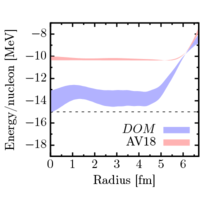
Reexamining the relation between the binding energy of finite nuclei and the equation of state of infinite nuclear matter

M. C. Atkinson, W. H. Dickhoff, M. Piarulli, A. Rios, and R. B. Wiringa

Phys. Rev. C 102, 044333 (2020) - Published 30 October, 2020

The volume term of the semi-empirical mass formula (16 MeV) is usually assumed to be the binding energy per nucleon in symmetric nuclear matter—a considerable extrapolation from finite nuclei. The authors use the dispersive optical model to estimate the nucleon self-energy by fitting a wide range of cross sections for nucleon elastic scattering and ground-state properties. The binding energy per nucleon obtained for saturated matter in the interior of 208Pb is 13–14 MeV, which casts doubt on the widely used 16 MeV from symmetric nuclear matter.

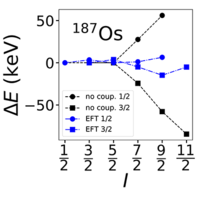
Effective field theory for deformed odd-mass nuclei

T. Papenbrock and H. A. Weidenmüller

Phys. Rev. C 102, 044324 (2020) - Published 26 October, 2020

Effective field theories (EFTs) have become powerful tools in nuclear physics, first for describing the interactions between nucleons, but later expanded to other topics ranging from dark matter scattering to halo nuclei. This paper presents a master class in applying EFTs to an old idea, the particle-rotor model. In so doing, it shows not only how to construct the model, but also how to organize terms in order of importance and estimate the uncertainty in the calculation.

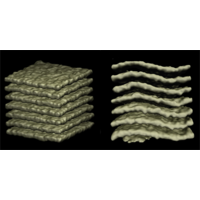
Fast neutrino cooling of nuclear pasta in neutron stars: Molecular dynamics simulations

Zidu Lin, Matthew E. Caplan, Charles J. Horowitz, and Cecilia Lunardini

Phys. Rev. C 102, 045801 (2020) - Published 6 October, 2020

Simulations find that pasta phases beneath a neutron star’s crust could dominate the star’s neutrino emission.

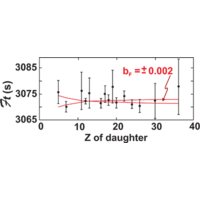
Superallowed 0+→0+ nuclear β decays: 2020 critical survey, with implications for Vud and CKM unitarity

J. C. Hardy and I. S. Towner

Phys. Rev. C 102, 045501 (2020) - Published 2 October, 2020

Superallowed β-decay between nuclear analog states with isospin 1 and spin-parity 0+ offers access to fundamental tests of the properties of the electroweak interaction. With 15 such transitions precisely measured, the data collectively probe the conservation of the weak vector current, set tight limits on the presence of beyond-standard-model scalar currents, and yield the most precise value for the Vud element of the CKM quark-mixing matrix. Vud is a critical ingredient required to test the unitarity of that matrix. This work provides an in-depth review of the relevant nuclear physics input and connects these data to the fundamental couplings.

Spectroscopic factors, overlaps, and isospin symmetry from an R-matrix point of view

Carl R. Brune

Phys. Rev. C 102, 034328 (2020) - Published 29 September, 2020

R-matrix theory has long been used for phenomenological analyses of data from low-energy nuclear reactions, by connecting the interior nuclear structure to the exterior asymptotic continuum at a specified boundary channel radius. This paper reviews relationships of such quantities as interior spectroscopic amplitudes and single-particle wave functions with their physical counterparts such as asymptotic normalization coefficients and widths. The author provides examples in light nuclei including isospin and mirror symmetry applications to nucleosynthesis that suggest an enhanced 17F(p,γ)18Ne reaction rate in novae.

Strange hadron production in Au+Au collisions at sNN=7.7, 11.5, 19.6, 27, and 39 GeV

J. Adam et al. (STAR Collaboration)

Phys. Rev. C 102, 034909 (2020) - Published 29 September, 2020

Strange hadrons are an excellent probe for identifying the phase boundary and onset of deconfinement in the QCD phase diagram. The STAR Collaboration has performed precision measurements of the abundances and transverse-momentum distributions for 8 species of strange mesons and baryons, as functions of centrality during a Au+Au beam-energy scan at RHIC. The results point to a possible change in strange-hadron production dynamics for sNN<20 GeV. The results significantly improve the experimental knowledge in the energy range where key features of the QCD phase diagram are nowadays being studied.

Global description of β− decay with the axially deformed Skyrme finite-amplitude method: Extension to odd-mass and odd-odd nuclei

E. M. Ney, J. Engel, T. Li (李通), and N. Schunck

Phys. Rev. C 102, 034326 (2020) - Published 28 September, 2020

Accurate modeling of r-process nucleosynthesis requires reliable calculations for β decay of nuclei far from stability. The quasiparticle random-phase approximation (QRPA) has been widely used, but deformation and odd numbers of protons and/or neutrons introduce challenges. The authors explain and apply novel advances in the QRPA that address these challenges, providing an enhanced tool for describing astrophysically important decays.

Ab initio multishell valence-space Hamiltonians and the island of inversion

T. Miyagi, S. R. Stroberg, J. D. Holt, and N. Shimizu

Phys. Rev. C 102, 034320 (2020) - Published 16 September, 2020

One of the strongest challenges to the shell-model concept of nuclei are the islands of inversion, where empirical evidence shows the ground states being dominated by intruder configurations, i.e., states that would be excitations in the normal shell-model picture. Whereas phenomenological calculations have previously supported this concept, the work of Miyagi et al. demonstrates how one can arrive at these non-intuitive results from an ab initio perspective.

Transverse momentum fluctuations and their correlation with elliptic flow in nuclear collisions

Björn Schenke, Chun Shen, and Derek Teaney

Phys. Rev. C 102, 034905 (2020) - Published 14 September, 2020

In high-energy nuclear collisions, the spatial distribution of the initial energy density fluctuates between individual collision events. These fluctuations (and their gradients) drive the collective flow of the system, and thus leave a measurable imprint. The authors propose observables that quantify the relative fluctuations in the total transverse momentum at fixed multiplicity. The observables can be used to diagnose the quark gluon plasma in different regimes, for instance to gain insight into the entropy initially produced at a given system size, or to provide new constraints on the temperature dependence of energy loss.

Proton-number fluctuations in sNN=2.4 GeV Au + Au collisions studied with the High-Acceptance DiElectron Spectrometer (HADES)

J. Adamczewski-Musch et al. (HADES Collaboration)

Phys. Rev. C 102, 024914 (2020) - Published 24 August, 2020

The QCD critical endpoint (CEP) is a very distinct feature of the phase diagram of nuclear matter, but it can presently not be located from first-principle calculations; experimental observations are needed to constrain its position. The HADES Collaboration at GSI measured cumulants and correlators for net-proton number fluctuations, the most important observable so far to search for the CEP. This extends experimental results below the lowest beam energies available at RHIC and will be useful to discern the possibility of a critical point in the QCD phase diagram.

Chiral effective field theory calculations of weak transitions in light nuclei

G. B. King, L. Andreoli, S. Pastore, M. Piarulli, R. Schiavilla, R. B. Wiringa, J. Carlson, and S. Gandolfi

Phys. Rev. C 102, 025501 (2020) - Published 20 August, 2020

Quantum Monte Carlo calculations of electroweak transitions are performed for A≤10 nuclei based upon two- and three-nucleon chiral interactions and the associated one- and two-body axial currents. Except for β decay of 8He, 8Li, and 8B, two-body currents contribute less than 3%. The exceptional nuclei exhibit matrix elements suppressed in impulse approximation based on the leading order (GT) transition operator. For a given interaction, the two-body transition densities exhibit a universal behavior at short distance for all systems under study.

Momentum-dependent potential and collective flows within the relativistic quantum molecular dynamics approach based on relativistic mean-field theory

Yasushi Nara, Tomoyuki Maruyama, and Horst Stoecker

Phys. Rev. C 102, 024913 (2020) - Published 19 August, 2020

A relativistic quantum molecular dynamics model, including momentum-dependent mean fields, is used to study directed and elliptic flow of protons in relativistic heavy ion collisions. The model agrees well with experimental data up to a center-of-momentum energy of about 10 GeV. However, above that energy the measured directed flow collapses to near zero, suggesting a transition to a different state of matter with a softened equation of state.

Toward a bridge between relativistic and nonrelativistic density functional theories for nuclei

Z. X. Ren and P. W. Zhao

Phys. Rev. C 102, 021301(R) (2020) - Published 13 August, 2020

The authors perform a nonrelativistic reduction of covariant density-functional theory via a similarity renormalization method to decouple the upper and lower components of the Dirac wave function. The exact solutions are well reproduced providing a possible means to directly compare relativistic and nonrelativistic density-functional theories.

Bayesian analysis of the Zn70(d,He3)Cu69 transfer reaction

C. Marshall, P. Morfouace, N. de Séréville, and R. Longland

Phys. Rev. C 102, 024609 (2020) - Published 10 August, 2020

Particle transfer reactions provide information on the single-particle structure of nuclei, with the caveat of imperfect reaction theory. In this paper, Bayesian analysis is applied in order to estimate the theoretical uncertainties associated with both the extraction of spectroscopic factors and the assignment of orbital angular momentum values from a pickup reaction. The authors find that these uncertainties are closely tied to experimental conditions, and discuss how to reduce their influence on future measurements.

Using γ rays to disentangle fusion-fission and quasifission near the Coulomb barrier: A test of principle in the fusion-fission and quasielastic channels

E. Vardaci et al.

Phys. Rev. C 101, 064612 (2020) - Published 15 June, 2020

Competition between the fusion-fission process and quasifission is currently actively debated. This paper discusses and tests an experimental approach to distinguish between quasifission and fusion-fission based on the different time scales for these two mechanisms. The emitted fragment angular momenta increase with longer interaction times, and hence are larger for the slower fusion-fission process. These angular momenta are inferred from the measured multiplicities of the emitted γ rays.

Sign In to Your Journals Account

Filter

Section

Filter

Article Lookup

Enter a citation