Highlights

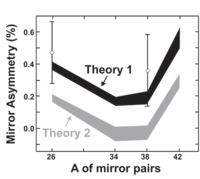
Precise branching ratio measurement for the superallowed β+ decay of Si26: Completion of a second mirror pair

M. Bencomo, J. C. Hardy, V. E. Iacob, H. I. Park, L. Chen, V. Horvat, N. Nica, B. T. Roeder, A. Saastamoinen, and I. S. Towner

Phys. Rev. C 100, 015503 (2019) - Published 26 July, 2019

Superallowed β decay is an important tool in characterizing the vector component of the weak interaction. Precise β-decay results presently give the best measurement of the up-down quark weak-mixing element, Vud. This new result completes the measurement of a second set of superallowed mirror transitions (26Si-26mAl and 26mAl-26Mg in this case) and has the precision to constrain the theoretical isospin-symmetry-breaking corrections needed in the extraction of Vud.

Time-dependent Hartree-Fock plus Langevin approach for hot fusion reactions to synthesize the Z=120 superheavy element

K. Sekizawa and K. Hagino

Phys. Rev. C 99, 051602(R) (2019) - Published 22 May, 2019

Creating new elements becomes increasingly difficult because the colliding nuclei must be sufficiently neutron-rich and heavy, and live long enough to be suitable as a target or beam. The authors develop a new hybrid model that combines two proven reaction techniques, time-dependent-Hartree-Fock and diffusion over a fusion barrier using the Langevin approach. By comparing different pairs of collision partners to form superheavy nuclei with Z=120, an initial, simplified version of the model already sheds some light on the way to synthesize the heaviest elements.

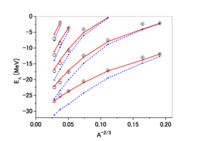
Extended-soft-core baryon-baryon model ESC16. II. Hyperon-nucleon interactions

M. M. Nagels, Th. A. Rijken, and Y. Yamamoto

Phys. Rev. C 99, 044003 (2019) - Published 26 April, 2019

This hyperon-nucleon paper is part of a simultaneous treatment of all baryon-baryon systems: NN, YN, and YY. Utilizing a meson-exchange potential approach, all 8×8 baryon-baryon channels are described in a model with SU(3)-symmetric couplings consistent with the constituent quark model. A high-quality fit is achieved for the NN data (TLab<350 MeV) and the available p-Λ and p-Σ data.

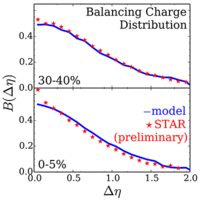
Evolving charge correlations in a hybrid model with both hydrodynamics and hadronic Boltzmann descriptions

Scott Pratt and Christopher Plumberg

Phys. Rev. C 99, 044916 (2019) - Published 23 April, 2019

Because quarks carry conserved charges, they are produced in pairs. After combining into hadrons, these conservation laws manifest themselves as measurable correlations that are sensitive to when charges are created, and how they diffuse apart from one another. This work describes a full simulation of the evolving correlations superimposed on a state-of-the-art microscopic description of the relativistic heavy-ion collision. The results largely describe preliminary experimental results and suggest that the early matter in those collisions comes close to maintaining chemical equilibrium.

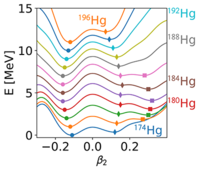
Shape staggering of midshell mercury isotopes from in-source laser spectroscopy compared with density-functional-theory and Monte Carlo shell-model calculations

S. Sels et al.

Phys. Rev. C 99, 044306 (2019) - Published 12 April, 2019

The neutron-deficient Hg isotopes have been a paradigm for nuclear shape coexistence. The ground states of these nuclei exhibit striking structural differences from the neighboring Pb isotopes, and are very challenging to study experimentally. Here, new state-of-the-art data extend information on the charge radii (and electromagnetic moments) to the lightest Hg isotopes ever measured using laser spectroscopy. The results suggest a sudden decrease in deformation for the lightest isotopes and an end to the region of ground-state shape staggering. These data provide constraints on future large-scale microscopic shell model and density functional calculations.

Microscopic study of deuteron production in PbPb collisions at s=2.76TeV via hydrodynamics and a hadronic afterburner

Dmytro Oliinychenko, Long-Gang Pang, Hannah Elfner, and Volker Koch

Phys. Rev. C 99, 044907 (2019) - Published 11 April, 2019

Pions could catalyze reactions between protons and neutrons, allowing the stable production of deuterons in high-energy ion-ion collisions.

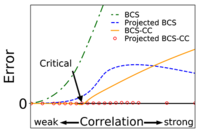
Particle-number projected Bogoliubov-coupled-cluster theory: Application to the pairing Hamiltonian

Y. Qiu, T. M. Henderson, T. Duguet, and G. E. Scuseria

Phys. Rev. C 99, 044301 (2019) - Published 1 April, 2019

A many-body formalism is developed to consistently combine particle-number projection techniques with Bogoliubov coupled-cluster theory. Applied to the Richardson pairing Hamiltonian, the method produces highly accurate solutions over the complete range of pairing strengths (from weak to strong correlations). The next step will be to apply the method to realistic nuclear Hamiltonians and treat similarly the angular-momentum breaking and restoration.

Natural orbitals for ab initio no-core shell model calculations

Alexander Tichai, Julius Müller, Klaus Vobig, and Robert Roth

Phys. Rev. C 99, 034321 (2019) - Published 19 March, 2019

Researchers have long argued over the best basis for nuclear structure calculations. The authors apply natural orbitals, single-particle states that diagonalize the one-body density matrix, to ab initio calculations in the no-core shell model. For binding energies and other physical observables they find dramatic improvement in both convergence and independence from the choice of the underlying harmonic oscillator basis. This helps reduce the uncertainty in the final results and makes comparison to experiment more robust.

Femtoscopy of stopped protons

Andrzej Bialas, Adam Bzdak, and Volker Koch

Phys. Rev. C 99, 034906 (2019) - Published 15 March, 2019

As the beam energy increases colliding nuclei are expected to become more transparent to each other, with not only fewer baryons in the central rapidity region, but even possibly separated in the configuration space. This is an important property which the authors propose to study via Hanbury-Brown–Twiss intensity interferometry of stopped protons. Their calculations suggest that such measurements may help obtain information on the equation of state of nuclear matter relevant to a wide range of nuclear phenomena including neutron stars and their mergers.

Form factors and generalized parton distributions of heavy quarkonia in basis light front quantization

Lekha Adhikari, Yang Li, Meijian Li, and James P. Vary

Phys. Rev. C 99, 035208 (2019) - Published 15 March, 2019

The authors calculate electromagnetic observables for a selection of spin-1 heavy quarkonia using the basis light front quantization method. They solve the relativistic Hamiltonian mass eigenvalue problem in a convenient basis representation that provides a compact form of the eigenfunctions. The approach provides insight into the spin-sensitive structure and internal dynamics of hadrons at low and medium momentum transfer.

Impact of magnetic-field fluctuations on measurements of the chiral magnetic effect in collisions of isobaric nuclei

Xin-Li Zhao, Guo-Liang Ma, and Yu-Gang Ma

Phys. Rev. C 99, 034903 (2019) - Published 14 March, 2019

Colliding relativistic heavy ions can create a strong magnetic field. The authors perform theoretical calculations of the initial electromagnetic field in collisions of isobaric nuclei at RHIC. They determine which observable correlations are most sensitive to the so-called chiral magnetic effect, which results from the characteristics of the axial charge density in a strong magnetic field. The results address a long-standing problem in the field.

Establishing the geometry of α clusters in C12 through patterns of polarized γ rays

Lorenzo Fortunato

Phys. Rev. C 99, 031302(R) (2019) - Published 11 March, 2019

For decades physicists have speculated if 12C could be understood in terms of a cluster arrangement of three α particles. This paper suggests a novel experimental way to test these ideas, using polarized γ rays, as for example in the new EU-funded facility, the Extreme Light Infrastructure or ELI. The work should stimulate both theory and experiment, and possibly address long-standing ideas about clustering in light nuclei.

Defining the proton radius: A unified treatment

Gerald A. Miller

Phys. Rev. C 99, 035202 (2019) - Published 7 March, 2019

An analysis of the proton radius puzzle helps to define what the proton radius really means.

Kurtosis of elliptic flow fluctuations

Rajeev S. Bhalerao, Giuliano Giacalone, and Jean-Yves Ollitrault

Phys. Rev. C 99, 014907 (2019) - Published 30 January, 2019

Kurtosis is a measure of non-Gaussian fluctuations which is highly sought after in fields such as cosmology and the early universe. The authors show that with future high-statistics experiments of heavy-ion collisions at the LHC, this observable could be applied to event-by-event fluctuations of elliptic flow—a measure of final-state anisotropy. It could be used to provide insightful tests of hydrodynamic behavior and the equation of state of quark-gluon plasma.

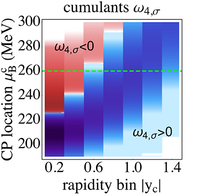
Searching for the QCD critical point via the rapidity dependence of cumulants

Jasmine Brewer, Swagato Mukherjee, Krishna Rajagopal, and Yi Yin

Phys. Rev. C 98, 061901(R) (2018) - Published 13 December, 2018

Near a critical point in a phase diagram, certain observables show characteristic fluctuations. The authors qualitatively predict how such fluctuations depend on the rapidity in relativistic heavy-ion collisions, and thereby present a distinctive observable to search for the critical endpoint in the QCD phase diagram. This is particularly relevant to the coming low-beam-energy scan at RHIC.

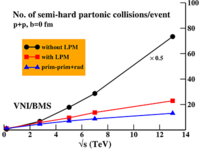
Landau-Pomeranchuk-Midgal effect and charm production in pp collisions at energies available at the CERN Large Hadron Collider using the parton cascade model

Dinesh K. Srivastava, Rupa Chatterjee, and Steffen A. Bass

Phys. Rev. C 98, 054910 (2018) - Published 28 November, 2018

For a quark-gluon plasma to form in nuclear collisions, the resulting partonic medium must be dense, and its constituents must interact. The authors examined proton-proton collisions at LHC energies, and focused on the production of charm quarks, since these are only produced in hard perturbative QCD interactions. The results indicate the formation of an interacting medium that is dense enough for the suppression of radiation to set in and yet permits multiple scatterings among partons. Their study shows the importance of multiple parton interactions even in proton-proton collisions.

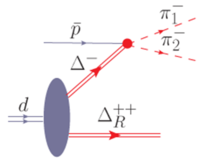
Theoretical study of the Δ++−Δ− configuration in the deuteron using an antiproton beam

A. B. Larionov, A. Gillitzer, J. Haidenbauer, and M. Strikman

Phys. Rev. C 98, 054611 (2018) - Published 21 November, 2018

Evidence of non-nucleonic degrees of freedom in nuclei has long been sought. The authors show that the use of relativistic (light-cone) wave functions for the Δ++-Δ− component of the deuteron leads to a shape of the signal for this contribution that is significantly different from the use of nonrelativistic wave functions in the p¯d→π−π−Δ++ reaction. Comparing with background reactions the results suggest that components as low as 0.3% could be observed.

Hydrodynamic response in simulations within a multiphase transport model

De-Xian Wei, Xu-Guang Huang, and Li Yan

Phys. Rev. C 98, 044908 (2018) - Published 26 October, 2018

In relativistic heavy-ion collisions it is of significant interest to study the nature of microscopic transport theories such as the multiphase transport theory (AMPT), which is based on simulated parton scattering. Such studies allow one to determine whether or to what extent these simulations are compatible with a traditional and well-established hydrodynamic description. The authors find that AMPT simulations indeed display the same “hydrodynamic” response to initial conditions. In particular, just as in hydrodynamics, various measured properties of elliptic flow can be understood in AMPT directly from properties of the initial eccentricity, including the expected dependence on the viscosity of the system.

Critical examination of constraints on the equation of state of dense matter obtained from GW170817

I. Tews, J. Margueron, and S. Reddy

Phys. Rev. C 98, 045804 (2018) - Published 22 October, 2018

The detection of gravitational waves from the neutron-star merger GW170817 provided the first firm observational constraint on the radius of neutron stars—nature’s densest visible objects. The authors find that modern nuclear-physics-based calculations of the equation of state of dense neutron-rich matter predict radii that are compatible but more restrictive. They critically examine associated uncertainties and determine how improved constraints from future observations can provide new insights into dense matter and possible phase transitions in the neutron-star core.

Symmetry conserving configuration mixing description of odd mass nuclei

M. Borrajo and J. Luis Egido

Phys. Rev. C 98, 044317 (2018) - Published 19 October, 2018

The excitation spectrum and other properties of nuclei with odd proton or neutron numbers have long been interpreted in terms of the Nilsson and particle-plus-rotor models which, however, provide a rather rudimentary description of these systems. In this work, beyond-mean-field calculations, which are well-established for even-even nuclei, have been extended to odd-mass nuclei by means of the generator-coordinate method based on particle-number- and angular-momentum-projected triaxially deformed blocked Hartree-Fock-Bogoliubov states, and the Gogny force. As an example, the authors present a complete spectroscopic description, including energies, transition probabilities, and collective wave functions, of the classical, textbook case 25Mg.

Sign In to Your Journals Account

Filter

Section

Filter

Article Lookup

Enter a citation