Highlights

Cluster formation in precompound nuclei in the time-dependent framework

B. Schuetrumpf and W. Nazarewicz

Phys. Rev. C 96, 064608 (2017) - Published 15 December, 2017

A new model provides a detailed visualization of the clustering of protons and neutrons within the hot nuclear compound formed just after two nuclei collide and fuse.

Quantum Monte Carlo calculations of light nuclei with local chiral two- and three-nucleon interactions

J. E. Lynn, I. Tews, J. Carlson, S. Gandolfi, A. Gezerlis, K. E. Schmidt, and A. Schwenk

Phys. Rev. C 96, 054007 (2017) - Published 30 November, 2017

The authors present a detailed report on quantum Monte Carlo (QMC) calculations of light nuclei with local two- and three-body interactions from chiral effective field theory. They establish QMC methods with local chiral interactions as a versatile and systematic approach to ab-initio calculations of light nuclei.

Global Λ polarization in heavy-ion collisions from a transport model

Hui Li, Long-Gang Pang, Qun Wang, and Xiao-Liang Xia

Phys. Rev. C 96, 054908 (2017) - Published 29 November, 2017

Off-central relativistic heavy ion collisions impart very large orbital angular momenta onto the quark-gluon plasma, creating a strong vortex in the initial hot fluid and appearing eventually, via spin-vorticity coupling, as particle polarization. From the vorticity field given by a multi-phase transport model the authors compute the global polarization of Λ baryons which is in agreement with experimental data. This suggests that the spin of a hadron could provide information on quark-gluon plasma flow.

Compton scattering from He4 at 61 MeV

M. H. Sikora et al.

Phys. Rev. C 96, 055209 (2017) - Published 27 November, 2017

Compton scattering, where the electromagnetic field of a real photon induces radiation multipoles by displacing charges and currents inside the nucleon, is an important probe of both the structure of light nuclei and the nucleon polarizabilities. This paper presents the first extensive and precise measurements of elastic Compton scattering on 4He. These results should allow precision comparisons with new calculations expected from both lattice gauge and effective field theories.

Bulk properties of the medium produced in relativistic heavy-ion collisions from the beam energy scan program

L. Adamczyk et al. (STAR Collaboration)

Phys. Rev. C 96, 044904 (2017) - Published 13 October, 2017

The beam-energy scan at RHIC aims to discover whether a critical point exists in the phase diagram of QCD. This paper reports on the most comprehensive measurement of single-particle spectra for a multitude of hadrons from the first run, taken with the STAR experiment. From these the authors infer the kinetic and chemical freeze-out temperatures and the baryon chemical potential as functions of beam energy and centrality. The results provide an opportunity for the beam-energy scan program at RHIC to enlarge the (T,μB) region of the phase diagram to search for the QCD critical point.

Consistent implementation of non-zero-range terms into hydrodynamics

Scott Pratt

Phys. Rev. C 96, 044903 (2017) - Published 12 October, 2017

As the hot and dense matter created in relativistic heavy-ion collisions expands and cools, theory must accurately treat its thermodynamic properties as well as its transport behavior. Because gradient terms probe the local environment within the evolving system, they are important in modeling the growth of thermal fluctuations, especially near a critical point, where knowledge of the size and spread of correlations is crucial. This paper demonstrates how gradient terms can be incorporated into the hydrodynamic equations of motion and how those modifications can be consistently applied to all thermodynamic quantities.

Refining mass formulas for astrophysical applications: A Bayesian neural network approach

R. Utama and J. Piekarewicz

Phys. Rev. C 96, 044308 (2017) - Published 6 October, 2017

The masses of nuclei between the experimentally known region and the neutron drip line are key inputs for a variety of astrophysical applications. Particularly near the drip lines, unstable nuclei are also at the core of fundamental questions about the limits of nuclear binding. The authors use two existing mass models that capture the essential underlying physics and then refine their predictions by training an artificial neural network. The results significantly reduce the root-mean-square deviation relative to experiment. These newly refined mass tables are used to map the neutron drip lines and to study a few critical r-process nuclei.

Convergence of the hole-line expansion with modern nucleon-nucleon potentials

Jia-Jing Lu (陆家靖), Zeng-Hua Li (李增花), Chong-Yang Chen (陈重阳), M. Baldo, and H.-J. Schulze

Phys. Rev. C 96, 044309 (2017) - Published 6 October, 2017

The accurate computation of nuclear matter properties, such as its binding energy, is still a challenge to nuclear theory, largely because the quark substructure of nucleons creates a strong repulsion at short distances that renders a straightforward perturbative calculation impossible. In this work, the authors study the Brueckner-Bethe-Goldstone expansion of dense Fermi systems in terms of hole-line contributions, of the associated Goldstone diagrams, to the binding energy of nuclear matter. They use various modern nucleon-nucleon potentials of high precision. In all cases the three-hole-line contributions are sufficiently small suggesting that the expansion converges. Yet, the empirical saturation properties of nuclear matter are not reproduced for any potential. This means that very strong nuclear three-body forces are required in order to achieve satisfactory saturation properties of nuclear matter, and that such forces are essential for all considered potentials.

Bayesian truncation errors in chiral effective field theory: Nucleon-nucleon observables

J. A. Melendez, S. Wesolowski, and R. J. Furnstahl

Phys. Rev. C 96, 024003 (2017) - Published 3 August, 2017

Chiral effective field theory (EFT) predictions are necessarily truncated at some order in the EFT expansion. Bayesian analysis has been proposed as a means to quantify the theoretical uncertainties that are induced by that truncation, in order to provide a robust statistical comparison with experiment. The authors apply a Bayesian model to an extended set of observables calculated for a class of EFT interactions, and demonstrate that a subset of these potentials are consistent with their statistical model for order-by-order convergence.

First measurement of the S34(p,γ)Cl35 reaction rate through indirect methods for presolar nova grains

S. A. Gillespie, A. Parikh, C. J. Barton, T. Faestermann, J. José, R. Hertenberger, H.-F. Wirth, N. de Séréville, J. E. Riley, and M. Williams

Phys. Rev. C 96, 025801 (2017) - Published 2 August, 2017

Isotope ratios in meteoritic inclusions or grains can help identify the astrophysical origin of the grain. In particular the 34S/32S ratio has been suggested as an optimal observable for this. Depending on the rate of proton capture on 34S one may be able to distinguish between nova and supernova origin. The authors observed 10 new levels in the compound nucleus (35Cl) and have reduced the uncertainty in the capture cross section. They propose that the 34S/32S isotope ratio can be used as a nucleosynthesis marker.

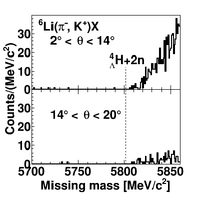
Missing-mass spectroscopy with the Li6(π−,K+)X reaction to search for HΛ6

R. Honda et al. (J-PARC E10 Collaboration )

Phys. Rev. C 96, 014005 (2017) - Published 31 July, 2017

Hypernuclei, in which a proton or neutron in an atomic nucleus is replaced by a baryon that includes some number of valence strange quarks, are a unique probe of nuclear structure as well as of the strong interaction. This work provides significantly improved cross section data as well as missing-mass spectra in search of a possible ground state of the Λ6H hypernucleus, whose existence had been suggested in an earlier experiment using a different reaction. While the new experiment had considerable sensitivity, the authors observed zero events in the mass range of the previous experiment, suggesting that the binding energy of this hypernucleus is not as large as previously suggested.

First-excited state g factor of Te136 by the recoil in vacuum method

A. E. Stuchbery, J. M. Allmond, M. Danchev, C. Baktash, C. R. Bingham, A. Galindo-Uribarri, D. C. Radford, N. J. Stone, and C.-H. Yu

Phys. Rev. C 96, 014321 (2017) - Published 27 July, 2017

Electromagnetic properties of atomic nuclei such as E2 transition rates and M1 magnetic moments (or g factors) are crucial characteristics of structure. For unstable nuclei produced as reaccelerated radioactive beams, measurements of g factors present numerous challenges. This paper develops the important recoil-in-vacuum technique to obtain a g factor for the 2+ state in 136Te. The result fits existing systematics but also highlights anomalous values in other N=84 isotones, thus presenting an important challenge to theory in the region just above doubly magic 132Sn.

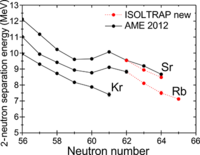
Nuclear deformation in the A≈100 region: Comparison between new masses and mean-field predictions

A. de Roubin, D. Atanasov, K. Blaum, S. George, F. Herfurth, D. Kisler, M. Kowalska, S. Kreim, D. Lunney, V. Manea, E. Minaya Ramirez, M. Mougeot, D. Neidherr, M. Rosenbusch, L. Schweikhard, A. Welker, F. Wienholtz, R. N. Wolf, and K. Zuber

Phys. Rev. C 96, 014310 (2017) - Published 14 July, 2017

The nuclear mass region around ≈100 is one of the most important for understanding the origin of non-spherical shapes in heavy nuclei, as well as the evolution from spherical to deformed shapes as a function of neutron and proton number. Precise mass measurements are often key to delineating such regions of structural change. The present paper, using state-of-the-art Penning-trap and time-of-flight mass spectrometry techniques, further maps out the locus of shape change in this region through measurements of new masses, particularly in the rubidium isotopes. The results, and accompanying theoretical calculations, point to the importance of further mass measurements in the neighboring krypton isotopes, promising key insights into the evolution of competing prolate and oblate shapes.

Hydrodynamic predictions for Pb+Pb collisions at 5.02 TeV

Scott McDonald, Chun Shen, François Fillion-Gourdeau, Sangyong Jeon, and Charles Gale

Phys. Rev. C 95, 064913 (2017) - Published 28 June, 2017

This work demonstrates that the “standard model” of heavy ion collisions, starting with initial-state fluctuations, followed by viscous hydrodynamic expansion, and concluding with conversion to hadrons that undergo rescattering and resonance decays, describes data at the highest LHC energy.

Calculation of Gamow-Teller and two-neutrino double-β decay properties for Te130 and Xe136 with a realistic nucleon-nucleon potential

L. Coraggio, L. De Angelis, T. Fukui, A. Gargano, and N. Itaco

Phys. Rev. C 95, 064324 (2017) - Published 23 June, 2017

The authors tackle the important subject of nuclear matrix elements governing double-β decay in a first-principles shell-model calculation. They derive the shell-model effective interaction and the Gamow-Teller transition operator from a realistic nucleon-nucleon interaction. The procedure is tested on the two-neutrino double-β decays of 130Te and 136Xe for which experimental data exist. This test precedes an application to the neutrinoless double-β decay of the same nuclei.

Multiplicity derivative: A new signature of a first-order phase transition in intermediate-energy heavy-ion collisions

S. Mallik, G. Chaudhuri, P. Das, and S. Das Gupta

Phys. Rev. C 95, 061601(R) (2017) - Published 22 June, 2017

The thermodynamic properties of nuclear matter can be probed by collisions between heavy nuclei at various energies, and then studying the resulting nuclear fragment distributions. The authors propose an observable which will indicate that nuclear matter has undergone a first-order liquid-gas phase transition. That observable is based on the total multiplicity of the fragmenting system (its first derivative) for collisions between heavy nuclei, and is directly accessible by experiments. It maximizes at the same energy as the specific heat, Cv, which typically happens at any first-order phase transition. Other potential indicators of a phase transition are less indicative due to the long-range Coulomb interaction and the fact that the atomic nucleus has a finite size.

Doubly magic Pb208: High-spin states, isomers, and E3 collectivity in the yrast decay

R. Broda, R. V. F. Janssens, Ł. W. Iskra, J. Wrzesinski, B. Fornal, M. P. Carpenter, C. J. Chiara, N. Cieplicka-Oryńczak, C. R. Hoffman, F. G. Kondev, W. Królas, T. Lauritsen, Zs. Podolyak, D. Seweryniak, C. M. Shand, B. Szpak, W. B. Walters, S. Zhu, and B. A. Brown

Phys. Rev. C 95, 064308 (2017) - Published 12 June, 2017

The nucleus 208Pb provides an iconic test of the nuclear shell model because its 82 protons and 126 neutrons are both magic numbers. When excited levels are discovered and characterized, this nucleus provides a means to investigate the mechanisms responsible for the generation of angular momentum and, ultimately, for the development of collectivity. This experiment is a tour de force that reveals extensive new information on 208Pb about high-angular-momentum states, isomeric states, and collective states of octupole nature; thus it serves as a showcase for shell-model descriptions. Many of the states explored show good overall agreement with theory, but others at the highest energies reveal discrepancies, pointing to the need for improved calculations. Above the highest-lying 28- isomer γ transitions arising from yet higher spin levels could be identified in two separate experiments as displayed in the figure.

Full jet in quark-gluon plasma with hydrodynamic medium response

Yasuki Tachibana, Ning-Bo Chang, and Guang-You Qin

Phys. Rev. C 95, 044909 (2017) - Published 19 April, 2017

The authors develop a coupled jet-fluid model that includes interactions between jets and a fluid medium in a heavy-ion collision. The model treats both the effect of the medium on the jet shower as well as the back-reaction of this energy deposition on the medium itself. The authors show how the energy that is lost by a jet is deposited in and evolves with the medium, and how that deposited energy might appear in measured observables.

Hydrodynamic predictions for mixed harmonic correlations in 200 GeV Au+Au collisions

Fernando G. Gardim, Frederique Grassi, Matthew Luzum, and Jacquelyn Noronha-Hostler

Phys. Rev. C 95, 034901 (2017) - Published 1 March, 2017

Recent measurements of Pb+Pb collisions at the CERN LHC have provided correlations between different characteristics of the flow of matter at such high energies. An analysis with a hydrodynamic model of these event-by-event measurements of correlated particle distributions leads to predictions for similar measurements that could be carried out in Au+Au collisions at a lower energy at BNL RHIC. The combined results might help pin down the initial states in high-energy heavy-ion collisions as well as the temperature dependence of transport coefficients.

Nuclear shape evolution based on microscopic level densities

D. E. Ward, B. G. Carlsson, T. Døssing, P. Möller, J. Randrup, and S. Åberg

Phys. Rev. C 95, 024618 (2017) - Published 27 February, 2017

The authors treat the nuclear shape evolution as a random walk on a multidimensional potential-energy surface using shape-dependent microscopic level densities. The resulting fission-fragment mass distributions agree remarkably well with data, and the gradual disappearance of pairing and shell effects with increasing energy is accounted for without additional parameters.

Sign In to Your Journals Account

Filter

Section

Filter

Article Lookup

Enter a citation