Highlights

Sub-shell closure and shape coexistence in the transitional nucleus Zr98

W. Witt, V. Werner, N. Pietralla, M. Albers, A. D. Ayangeakaa, B. Bucher, M. P. Carpenter, D. Cline, H. M. David, A. Hayes, C. Hoffman, R. V. F. Janssens, B. P. Kay, F. G. Kondev, W. Korten, T. Lauritsen, O. Möller, G. Rainovski, G. Savard, D. Seweryniak, J. Smith, R. Stegmann, S. Zhu, and C. Y. Wu

Phys. Rev. C 98, 041302(R) (2018) - Published 16 October, 2018

As zirconium gains neutrons, its nucleus morphs in shape—changing from a soccer ball to an American football—and researchers have found the exact moment of the transition.

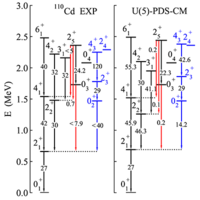
Quadrupole phonons in the cadmium isotopes

A. Leviatan, N. Gavrielov, J. E. García-Ramos, and P. Van Isacker

Phys. Rev. C 98, 031302(R) (2018) - Published 26 September, 2018

The cadmium isotopes have been a classic testing ground for vibrational models of atomic nuclei with various multiphonon states identified. However, intruder states arising from the promotion of two protons across the Z=50 shell gap are also present at low energy. Most models have trouble accounting for all the experimental data. The present paper takes a unique approach to obtain improved agreement with an extensive data set for 110Cd, by including proton excitations in the phonon basis and exploiting a partial dynamical symmetry that mixes only certain classes of normal states.

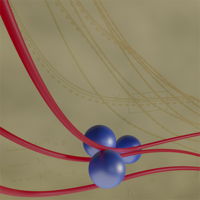
Signatures of few-body resonances in finite volume

P. Klos, S. König, H.-W. Hammer, J. E. Lynn, and A. Schwenk

Phys. Rev. C 98, 034004 (2018) - Published 24 September, 2018

The authors explore the detectability (signatures) of true few-body resonances, involving the separation of all particles in the system, through avoided level crossings in energy spectra in a finite box. In so doing they adapt the numerical method of a discrete variable representation (DVR) for fermions and bosons in periodic boxes and describe thoroughly its implementation.

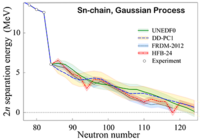
Bayesian approach to model-based extrapolation of nuclear observables

Léo Neufcourt, Yuchen Cao (曹宇晨), Witold Nazarewicz, and Frederi Viens

Phys. Rev. C 98, 034318 (2018) - Published 24 September, 2018

The Bayesian statistical approaches have a recognized utility in improving the quantified predictions for nuclear masses away from stability that provide key inputs for a variety of astrophysical applications. The present paper is devoted to the methodology of such efforts. It applies Bayesian Gaussian processes and neural networks to two-neutron separation energies of nuclei. The authors find that Gaussian processes deliver a more stable performance.

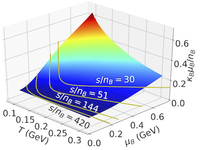
Net-baryon diffusion in fluid-dynamic simulations of relativistic heavy-ion collisions

Gabriel S. Denicol, Charles Gale, Sangyong Jeon, Akihiko Monnai, Björn Schenke, and Chun Shen

Phys. Rev. C 98, 034916 (2018) - Published 24 September, 2018

For the first time, the baryon current and its diffusive effects have been incorporated into one of the 3D relativistic viscous hydrodynamics models, successfully used to describe heavy-ion collisions at the top RHIC energies and at the LHC. This approach will be very useful in the interpretation of data coming from the low-energy Beam Energy Scan (BES) at RHIC, and for the search for a critical point in the QCD phase diagram.

Statistical theory of deformation distributions in nuclear spectra

M. T. Mustonen, C. N. Gilbreth, Y. Alhassid, and G. F. Bertsch

Phys. Rev. C 98, 034317 (2018) - Published 21 September, 2018

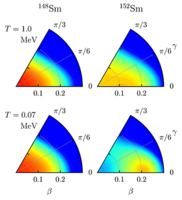
The shape of atomic nuclei affects their density of states, a dependence needed to understand nuclear processes such as fission. This paper offers a new, model-independent method to extract nuclear shape distributions via a Landau-like expansion and without invoking a mean-field approximation. This allows the authors to track how nuclear deformation changes as a function of temperature and neutron number in a rotationally invariant framework, and to calculate the dependence of the state density on deformation.

Current status and desired precision of the isotopic production cross sections relevant to astrophysics of cosmic rays: Li, Be, B, C, and N

Yoann Génolini, David Maurin, Igor V. Moskalenko, and Michael Unger

Phys. Rev. C 98, 034611 (2018) - Published 21 September, 2018

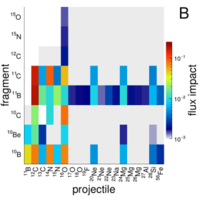
The precision of the current generation of space-based cosmic-ray experiments, such as AMS-02, PAMELA, CALET, and ISS-CREAM, is now reaching ≈1–3%, from energies of GeV/nucleon to multi-TeV/nucleon. These and future measurements of the isotopic composition and energy spectra of cosmic rays may reveal signatures of as-yet unknown phenomena in a wide range of topics, provided that the currently large uncertainties of 20–50% in many of the isotopic production cross sections can be reduced. This paper provides a systematic study of the reaction channels to produce particular isotopes and identifies the most important channels for reducing the present uncertainties. It provides a first road map for planning new measurement campaigns worldwide to reach the desired uncertainties.

Reconstructing the impact parameter of proton-nucleus and nucleus-nucleus collisions

Rudolph Rogly, Giuliano Giacalone, and Jean-Yves Ollitrault

Phys. Rev. C 98, 024902 (2018) - Published 2 August, 2018

The impact parameter of a heavy-ion collision is not a directly measurable quantity but is inferred, e.g., from the amount of particles or energy measured by a specific detector. That relationship, however, is not one-to-one. The authors devise an interesting method to reconstruct the impact parameters for relativistic proton-nucleus and nucleus-nucleus collisions in all experiments at the CERN Large Hadron Collider, without reference to any particular model, using a Bayesian approach. This should facilitate better comparisons between model calculations and data.

Structure of even-even cadmium isotopes from the beyond-mean-field interacting boson model

K. Nomura and J. Jolie

Phys. Rev. C 98, 024303 (2018) - Published 1 August, 2018

The cadmium isotopes have been a classic testing ground for vibrational models with various multiphonon states identified. The present calculation follows a well-defined prescription in which the potential energy surface (PES) from a microscopic calculation is input to an interacting boson model calculation by matching that PES. This reduces the number of parameters and allows one to distinguish the vibrational states from cross-shell intruder states.

High-resolution (p,t) study of low-spin states in Pu240: Octupole excitations, α clustering, and other structure features

M. Spieker, S. Pascu, D. Bucurescu, T. M. Shneidman, T. Faestermann, R. Hertenberger, H.-F. Wirth, N.-V. Zamfir, and A. Zilges

Phys. Rev. C 97, 064319 (2018) - Published 25 June, 2018

Nucleon transfer reactions are sensitive nuclear structure probes. The authors used ultrahigh-resolution two-nucleon transfer (p,t) reactions to identify 15 new excited 0+ states of 240Pu, some 7 times the number previously known, plus other states also seen for the first time. These data, combined with existing γ-ray data and model calculations, provide nuclear structure information on pairing correlations and two-phonon octupole excitations in the difficult-to-investigate actinide nuclei.

Relativistic effects in ab initio electron-nucleus scattering

Noemi Rocco, Winfried Leidemann, Alessandro Lovato, and Giuseppina Orlandini

Phys. Rev. C 97, 055501 (2018) - Published 4 May, 2018

This work reports on a study of relativistic effects in ab initio calculations of electron-nucleus scattering, which permits extension to larger values of momentum transfer. The application of this technique to neutrino-nucleus scattering should be particularly useful, because comparison with data requires averages over large kinematic regions.

Solution of the n−He4 elastic scattering problem using the Faddeev-Yakubovsky equations

Rimantas Lazauskas

Phys. Rev. C 97, 044002 (2018) - Published 16 April, 2018

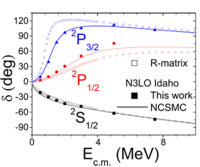
The first full 5-body calculation for n-4He elastic scattering in terms of Faddeev-Yakubovsky equations is presented for three different realistic NN interactions. The s-wave and p-wave phase shifts are compared among the models and with R-matrix-extracted “experimental” values. The similarity of deviations from the experimental data may indicate strong correlations between the sectors of four and five nucleons. The approach allows the description of 5-nucleon systems considering realistic nuclear Hamiltonians.

Magnetic field in expanding quark-gluon plasma

Evan Stewart and Kirill Tuchin

Phys. Rev. C 97, 044906 (2018) - Published 16 April, 2018

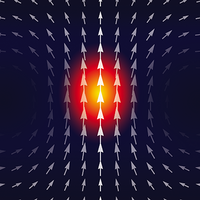
Relativistic heavy ion collisions may produce the strongest magnetic fields anywhere in the universe. This paper shows that expansion of the hot hadronic plasma produced in these collisions can affect the magnetic field by at most 10%. This result solidifies earlier estimates and suggests a significant simplification of the magneto-hydrodynamic treatment for many scenarios.

Probing the fusion of neutron-rich nuclei with re-accelerated radioactive beams

J. Vadas, Varinderjit Singh, B. B. Wiggins, J. Huston, S. Hudan, R. T. deSouza, Z. Lin, C. J. Horowitz, A. Chbihi, D. Ackermann, M. Famiano, and K. W. Brown

Phys. Rev. C 97, 031601(R) (2018) - Published 27 March, 2018

This paper demonstrates a novel technique for measuring heavy-ion fusion cross sections of nuclei far from stability. The new technique is very efficient allowing measurement of reactions using low-intensity beams with exotic ratios of neutrons to protons. The reactions of unstable nuclei far from stability provide a test of the character of neutron-rich nuclear matter relevant for understanding fusion dynamics, nucleosynthesis, and astrophysical phenomena.

New result for the neutron β-asymmetry parameter A0 from UCNA

M. A.-P. Brown et al. (UCNA Collaboration)

Phys. Rev. C 97, 035505 (2018) - Published 26 March, 2018

A neutron β-decay asymmetry measurement using polarized ultracold neutrons (UCN) determines the correlation between the spin of the neutron and the momentum of the decay electron. The authors extract the ratio of the weak axial-vector to vector couplings with reduced uncertainties. This new result from the first measurement of this asymmetry using UCN contributes a benchmark for lattice QCD calculations and the possibility for improved precision on the CKM matrix element Vud from neutron β decay.

Signatures of α clustering in ultrarelativistic collisions with light nuclei

Maciej Rybczyński, Milena Piotrowska, and Wojciech Broniowski

Phys. Rev. C 97, 034912 (2018) - Published 19 March, 2018

The authors show through detailed calculations that α clustering in the ground state of nuclei colliding at high energy could manifest itself in the collective flow of particle correlations observed in the final state. This is an interesting connection between nuclear structure and high-energy heavy-ion collisions in which the impact of the deformed intrinsic shape of the light nucleus yields a deformed fireball in the transverse plane of the collision.

Electron time-of-flight: A new tool in β-decay spectroscopy

C. Roick, D. Dubbers, B. Märkisch, H. Saul, and U. Schmidt

Phys. Rev. C 97, 035502 (2018) - Published 7 March, 2018

The authors demonstrate an enhanced electron time-of-flight (ToF) method that overcomes limitations of conventional ToF experiments. They use an inverse magnetic mirror configuration in which the ToF is almost independent of emission angle. In particular at lower β-decay energies, where flight times are long, one can obtain the electron kinetic energy with significantly improved accuracy. Applications range from the precise calibration of energy-sensitive scintillators to future neutron-decay experiments.

Direct measurement of astrophysically important resonances in K38(p,γ)Ca39

G. Christian, G. Lotay, C. Ruiz, C. Akers, D. S. Burke, W. N. Catford, A. A. Chen, D. Connolly, B. Davids, J. Fallis, U. Hager, D. Hutcheon, A. Mahl, A. Rojas, and X. Sun

Phys. Rev. C 97, 025802 (2018) - Published 21 February, 2018

Measurements of a nuclear reaction relevant to the synthesis of calcium, potassium, and argon in stars boost the accuracy of models for predicting the elements’ abundance.

Femtoscopy with identified charged pions in proton-lead collisions at sNN=5.02 TeV with ATLAS

M. Aaboud et al. (ATLAS Collaboration)

Phys. Rev. C 96, 064908 (2017) - Published 28 December, 2017

Hanbury-Brown–Twiss (HBT) quantum correlations between identical hadrons provide information about the space-time evolution of the matter created in high-energy collisions of atomic nuclei. This paper reports on HBT measurements of charged pions created in proton-lead collisions at the LHC. The ATLAS Collaboration finds that even when one of the colliding partners is a proton, rather than a large nucleus, hallmarks of collectivity are seen, similar to those associated with the quark-gluon plasma produced in lead-lead collisions at the LHC: the HBT source size increases with multiplicity and decreases with transverse momentum of the pair.

Determination of the proton spin structure functions for 0.05<Q2<5GeV2 using CLAS

R. G. Fersch et al. (CLAS Collaboration)

Phys. Rev. C 96, 065208 (2017) - Published 27 December, 2017

The basic properties of the proton, the lightest baryon, are determined by its quark and gluon composition. In particular, its spin of ħ/2 has been a challenge to understand in terms of the proton’s constituents. The comprehensive results presented here are based on measurements with high precision and dense kinematic coverage carried out with the CLAS detector at Jefferson Lab. They provide new insight into the proton substructure at resolutions on the length scale of the whole nucleon down to the quark level. A variety of strong interaction models are tested with these new data, to further constrain the quark and gluon contribution to the proton spin.

Sign In to Your Journals Account

Filter

Section

Filter

Article Lookup

Enter a citation