Highlights

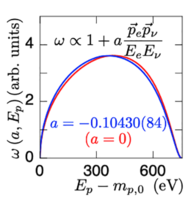
Improved determination of the β−ν¯e angular correlation coefficient a in free neutron decay with the aSPECT spectrometer

M. Beck, F. Ayala Guardia, M. Borg, J. Kahlenberg, R. Muñoz Horta, C. Schmidt, A. Wunderle, W. Heil, R. Maisonobe, M. Simson, T. Soldner, R. Virot, O. Zimmer, M. Klopf, G. Konrad, S. Baeßler, F. Glück, and U. Schmidt

Phys. Rev. C 101, 055506 (2020) - Published 26 May, 2020

This work presents the until now most precise measurement of the angular correlation coefficient a between the momenta of the electron and the electron-antineutrino in free neutron decay. The coefficient a is inferred from a detailed analysis of the integral proton recoil spectrum measured with the aSPECT setup, a MAC-E-Filter type spectrometer with 4π acceptance. The result can be used to determine the axial-vector coupling constant gA in the weak interaction and shows a tantalizing disagreement with recent measurements of gA via the β-decay asymmetry in neutron decay.

Production of charged pions, kaons, and (anti-)protons in Pb-Pb and inelastic pp collisions at sNN=5.02 TeV

S. Acharya et al. (ALICE Collaboration )

Phys. Rev. C 101, 044907 (2020) - Published 29 April, 2020

The ALICE Collaboration reports unique data on particle production in Pb-Pb and inelastic p-p collisions at the LHC at 5.02 TeV. The measurements range from very peripheral to the most central collisions, and cover particles with transverse momenta from hundreds of MeV/c to 20 GeV/c. The precision and breadth of the data provide tight constraints on our understanding of particle production mechanisms in these collisions.

Shape evolution of neutron-rich Mo106,108,110 isotopes in the triaxial degree of freedom

J. Ha et al.

Phys. Rev. C 101, 044311 (2020) - Published 20 April, 2020

Regions of nuclei which exhibit sudden shape changes in a short span of neutron numbers, such as in the A~100 region, are of particular importance for understanding the role of the proton-neutron interaction. This paper explores experimental and theoretical aspects of the Mo isotopes, which comprise the region’s upper boundary, with a focus on axial asymmetry using several complementary observables and suggests a rare candidate for a 2-phonon gamma vibrational excitation for 110Mo.

Improved many-body expansions from eigenvector continuation

P. Demol, T. Duguet, A. Ekström, M. Frosini, K. Hebeler, S. König, D. Lee, A. Schwenk, V. Somà, and A. Tichai

Phys. Rev. C 101, 041302(R) (2020) - Published 9 April, 2020

The authors demonstrate that the proposed framework of eigenvector continuation can robustly recover exact values of nuclear observables from a formally divergent low-order perturbative expansion without requiring any analytic knowledge of the expansion. The results illustrate that eigenvector continuation provides an efficient and powerful tool applicable to strongly interacting systems.

Benchmark calculations of pure neutron matter with realistic nucleon-nucleon interactions

M. Piarulli, I. Bombaci, D. Logoteta, A. Lovato, and R. B. Wiringa

Phys. Rev. C 101, 045801 (2020) - Published 8 April, 2020

With the advent of nuclear interactions based on chiral effective field theory, it is becoming possible to accurately describe atomic nuclei and infinite nuclear matter as found in neutron stars. A key challenge is the simultaneous quantification of uncertainties associated to the nuclear interaction and many-body approaches. By performing benchmark calculations of pure neutron matter with realistic interactions and several many-body approaches, this manuscript presents a first step in this direction.

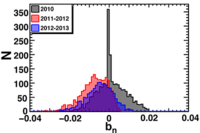
Improved limits on Fierz interference using asymmetry measurements from the Ultracold Neutron Asymmetry (UCNA) experiment

X. Sun et al. (UCNA Collaboration)

Phys. Rev. C 101, 035503 (2020) - Published 16 March, 2020

The UCNA Collaboration reanalyzed and combined results from previous experiments that measured the β-decay asymmetry for polarized ultracold neutrons confined in a trap in order to search for the so-called Fierz interference term. They demonstrate that systematic uncertainties from the asymmetry analysis related to the experimental efficiency and calibration can be reduced. This work suggests that a robust path forward to improved limits on the Fierz term in next-generation neutron-decay experiments exists and holds promise of providing an improved probe of whether physics beyond the Standard Model is at play.

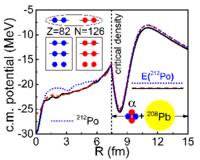
α decay to a doubly magic core in the quartetting wave function approach

Shuo Yang, Chang Xu, Gerd Röpke, Peter Schuck, Zhongzhou Ren, Yasuro Funaki, Hisashi Horiuchi, Akihiro Tohsaki, Taiichi Yamada, and Bo Zhou

Phys. Rev. C 101, 024316 (2020) - Published 28 February, 2020

This microscopic calculation for the α decay of heavy nuclei provides a solution to what has long been an outstanding problem. In the authors’ model, the α particle exists only below about one-fifth of saturation density, corresponding to a large radius, inside of which the α particle transitions into an unbound four-nucleon shell-model state. The model reproduces the half-life of 212Po (a classic test case) as well as some neighboring nuclei, and calculations are also made for 104Te.

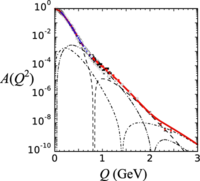
Covariant spectator theory of np scattering: Deuteron form factors

Franz Gross

Phys. Rev. C 101, 024001 (2020) - Published 3 February, 2020

This paper uses the covariant spectator theory to calculate the deuteron electromagnetic form factors, yielding impressive quantitative results for deuteron observables. Special attention is given to a consistent treatment of currents generated by the nuclear force models obtained from the 2008 high-precision fits to the NN scattering data. Noteworthy results are (1) the neutron charge form factor prediction and (2) determination of two off-shell nucleon form factors that contribute to electron-deuteron scattering.

Stability of the heaviest elements: K isomer in No250

J. Kallunkathariyil et al.

Phys. Rev. C 101, 011301(R) (2020) - Published 6 January, 2020

Decay spectroscopy of 250No, aided by digital pulse-shape analysis, is reported and identifies this nucleus to be one of the rare breed of very heavy nuclei with an isomeric state living considerably longer than its ground state. This phenomenon has interesting consequences for nuclear structure models aiming to determine the borders of the island of stability of superheavy elements.

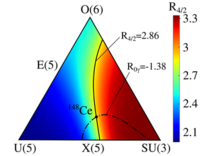
Low-Z boundary of the N=88–90 shape phase transition: Ce148 near the critical point

P. Koseoglou et al.

Phys. Rev. C 101, 014303 (2020) - Published 6 January, 2020

Delineating the evolution, with proton and neutron numbers, of nuclear phase transitions from spherical to deformed shapes is one of the most challenging tests of nuclear models. This paper presents new data—taken by an international collaboration centered at the Institut Laue-Langevin in Grenoble, France, and analyzed by an international team of researchers led by scientists from TU Darmstadt, Germany—on transition rates in 148Ce, a neutron-rich nucleus located near the iconic N=88–90 shape-phase-transition region. In standard geometric models the known experimental data would place 148Ce on the spherical side. However, this paper shows that a more sophisticated analysis that takes into account the finite number of valence nucleons and axial asymmetry places 148Ce just on the deformed side of the transition, thus delimiting for the first time its low-Z edge.

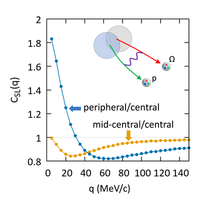
Probing ΩΩ and pΩ dibaryons with femtoscopic correlations in relativistic heavy-ion collisions

Kenji Morita, Shinya Gongyo, Tetsuo Hatsuda, Tetsuo Hyodo, Yuki Kamiya, and Akira Ohnishi

Phys. Rev. C 101, 015201 (2020) - Published 6 January, 2020

The authors investigate correlations between protons and Ω baryons, and between two Ω baryons, in heavy-ion collisions at RHIC and LHC. Given sufficient statistics in upcoming experiments, such measurements could provide valuable information on the existence of strange dibaryons and on the equation of state relevant to neutron stars.

Measurement of the 2+→0+ ground-state transition in the β decay of F20

O. S. Kirsebom et al.

Phys. Rev. C 100, 065805 (2019) - Published 24 December, 2019

The discovery of an exceptionally strong “forbidden” beta decay involving fluorine and neon could change our understanding of the fate of intermediate-mass stars.

Cross section of α-induced reactions on Au197 at sub-Coulomb energies

T. Szücs, P. Mohr, Gy. Gyürky, Z. Halász, R. Huszánk, G. G. Kiss, T. N. Szegedi, Zs. Török, and Zs. Fülöp

Phys. Rev. C 100, 065803 (2019) - Published 10 December, 2019

The so-called γ process is responsible for the production of the majority of the heavy proton-rich stable nuclei. For modeling the extended reaction network of the process, the reaction rates are derived mainly from statistical model calculations, which are validated with experimental α-induced reaction cross sections. In the present work, the key parameter of the statistical model is constrained by measuring cross sections a hundred times smaller than those in previous experiments, reaching down to the relevant stellar energies. It is expected that this work will reduce the uncertainty in the calculation of stellar production of these proton-rich nuclei.

Equation of state effects in the core collapse of a 20−M⊙ star

A. S. Schneider, L. F. Roberts, C. D. Ott, and E. O'Connor

Phys. Rev. C 100, 055802 (2019) - Published 7 November, 2019

Stars heavier than several times the mass of the Sun undergo a core-collapse event at the end of their lives. The dynamics of this process, which may lead to a supernova explosion, is mainly determined by the equation of state of dense matter, which also determines whether the collapse gives birth to a neutron star or a black hole. Whereas it is relatively well understood how the properties of neutron stars are affected by variations in the nuclear equation of state, the authors probe the rather unexplored effects of such variations on supernova dynamics and their neutrino signals. The authors demonstrate that the core collapse is mainly affected by changes in the nucleon effective masses which, within the Skyrme model employed, control the yet poorly constrained finite temperature dependence of the equation of state.

Pseudospin symmetry restoration and the in-medium balance between nuclear attractive and repulsive interactions

Jing Geng (耿晶), Jia Jie Li (李佳杰), Wen Hui Long (龙文辉), Yi Fei Niu (牛一斐), and Shi Yao Chang (常士尧)

Phys. Rev. C 100, 051301(R) (2019) - Published 4 November, 2019

Relativistic mean-field calculations (pure Hartree calculations) have problems reproducing the single-particle energies for some pseudo-spin doublets (orbits with n, l, j=l+1/2 and n−1, l+2, j=l+3/2) and can lead to incorrect magic numbers. The authors show how this can be corrected in a relativistic Hartree-Fock calculation. In particular, the ρ-tensor coupling plays an important role. The results provide qualitative guidance for treating the delicate balance between attractive and repulsive interactions in the dynamic nuclear medium.

Electroweak probes of ground state densities

Junjie Yang, Jesse A. Hernandez, and J. Piekarewicz

Phys. Rev. C 100, 054301 (2019) - Published 1 November, 2019

The weak nuclear force is a crucial probe of both fundamental physics and nuclear structure. This paper reviews the idea of using precision electroweak probes to measure the neutron skin of nuclei. This, in turn, is used to tune parameters in density functional theory not otherwise tightly constrained in finite nuclei—but which have a critical impact on the equation of state for neutron stars.

Survey of nuclear pasta in the intermediate-density regime: Shapes and energies

B. Schuetrumpf, G. Martínez-Pinedo, Md. Afibuzzaman, and H. M. Aktulga

Phys. Rev. C 100, 045806 (2019) - Published 30 October, 2019

The likely existence of nonuniform nuclear matter (nuclear pasta) in astrophysical scenarios has been studied for some time. It is believed to emerge due to the competition between the long-range Coulomb force and the short-range strong force. This paper performs a comparative study of different nuclear pasta shapes and shows that all studied configurations are lower in energy than uniform matter for a large range of proton fractions and that different shapes can coexist, both at low and high temperatures.

Centrality and pseudorapidity dependence of the transverse energy density in pPb collisions at sNN=5.02 TeV

A. M. Sirunyan et al. (CMS Collaboration, CMS Collaboration)

Phys. Rev. C 100, 024902 (2019) - Published 1 August, 2019

Using p-Pb collisions measured with the CMS detector at the LHC, this work studies particle production and correlations over an unprecedented angular range. The characterization of the distributions provides insight into the QCD plasma at the core of such collisions, and is also crucial to better understand very-high-energy collisions of cosmic-ray particles with air nuclei. Since it includes the relevant forward region, this is a key measurement to better understand the origin and nature of very-high-energy cosmic-ray particles.

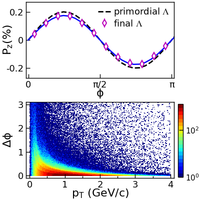
Feed-down effect on Λ spin polarization

Xiao-Liang Xia, Hui Li, Xu-Guang Huang, and Huan Zhong Huang

Phys. Rev. C 100, 014913 (2019) - Published 31 July, 2019

The recent observation of spin polarization of Λ hyperons indicates the existence of a strong vorticity in heavy-ion collisions. However, experimental measurements and theoretical calculations of the azimuthal-angle dependence of the longitudinal and transverse spin polarization of Λ hyperons at mid-rapidity have opposite signs. The authors present a detailed study of the feed-down effect of higher-mass hyperons, but the discrepancy persists which challenges the connection between spin polarization and thermal vorticity.

Primordial non-Gaussianity in heavy-ion collisions

Rajeev S. Bhalerao, Giuliano Giacalone, and Jean-Yves Ollitrault

Phys. Rev. C 100, 014909 (2019) - Published 26 July, 2019

Experimental data on azimuthal correlations among produced particles is offered as evidence that the primordial energy density fluctuations in high energy nuclear collisions do not follow Gaussian statistics. This may shed light on how entropy is created from pure quantum states in these collisions.

Sign In to Your Journals Account

Filter

Section

Filter

Article Lookup

Enter a citation