Highlights

Charge radii in covariant density functional theory: A global view

U. C. Perera, A. V. Afanasjev, and P. Ring

Phys. Rev. C 104, 064313 (2021) - Published 15 December, 2021

The authors provide a systematic global study of differential charge radii of nuclei within covariant density functional theory. They present results for chains of isotopes as they cross major closed neutron shell numbers, where there is usually a change of slope (kink) in the charge radii. The odd-even staggering of charge radii is also investigated, and particle-vibration coupling in odd-mass nuclei is suggested to play a significant role in addition to pairing. This detailed study lays a solid foundation to assess how various forms of interactions within the nuclear many-body system affect fundamental nuclear properties such as nuclear radii and how they evolve with nucleon number.

Isospin mixing and the cubic isobaric multiplet mass equation in the lowest T=2, A=32 quintet

M. Kamil et al.

Phys. Rev. C 104, L061303 (2021) - Published 15 December, 2021

The isobaric multiplet mass equation (IMME) relates the masses of an isospin multiplet quadratically, and it plays an important role in studies of nuclear structure, nuclear astrophysics, and fundamental symmetries. This work uses shell-model calculations, together with data from 32Ar β decay and 32S(3He,t) experiments to provide an important step in explaining an observed IMME violation in the A=32, T=2 quintet. It is shown that a small but finite cubic term is required for this case due to T=1 isospin mixing. The analysis also provides a means to obtain isospin nonconserving corrections for T=2 32Ar→32Cl superallowed decay, which belongs to a category of decays that are used to extract the Vud element of the CKM quark-mixing matrix.

Fission-fragment yields and prompt-neutron multiplicity for Coulomb-induced fission of U234,235 and Np237,238

J.-F. Martin et al.

Phys. Rev. C 104, 044602 (2021) - Published 4 October, 2021

The anatomy of nuclear fission—a complex many-body process that has challenged precise modeling for decades—is explored via a comprehensive inverse-kinematics experiment. A Coulomb-fission measurement of relativistic 234,235U and 237,238Np projectiles at the GSI R3B/SOFIA setup has provided some of the most precise fission-fragment yields yet for these uranium isotopes and the first isotopic yields for two neptunium isotopes. The data precision and the extensive comparisons aim to confirm certain previous hypotheses regarding the fission process and to refute others.

Deuteron production in relativistic heavy ion collisions via stochastic multiparticle reactions

J. Staudenmaier, D. Oliinychenko, J. M. Torres-Rincon, and H. Elfner

Phys. Rev. C 104, 034908 (2021) - Published 24 September, 2021

The puzzling observation that deuterons, having a binding energy of only 2.2 MeV, survive final-state temperatures of more than 100 MeV in high-energy heavy-ion collisions, has been explained as a delicate balance between creation and destruction at similar rates. However, because the process involves collisions between more than two particles, one had to use workarounds for a satisfactory description. The authors treat deuteron catalysis from nucleons and pions with stochastic multiparticle reactions, making previous workarounds for collisions between more than two particles obsolete.

Pauli energy contribution to the nucleus-nucleus interaction

A. S. Umar, C. Simenel, and K. Godbey

Phys. Rev. C 104, 034619 (2021) - Published 17 September, 2021

Attempts to understand effects of the Pauli exclusion principle in nucleus-nucleus potentials and the resulting barrier to fusion have a long history. The authors propose a method to quantify the Pauli kinetic energy that allows one to distinguish between neutron and proton contributions. Their analysis suggests that Pauli repulsion effects occur primarily in the “neck” between fragments at a distance of approach comparable to the barrier radius. Moreover, inside the barrier neutron contributions dominate in neutron-rich systems, which hinders sub-barrier fusion.

Implications of PREX-2 on the electric dipole polarizability of neutron-rich nuclei

J. Piekarewicz

Phys. Rev. C 104, 024329 (2021) - Published 26 August, 2021

The nuclear symmetry energy plays a key role in understanding physics of neutron-rich matter from the valley of stability up to neutron-star masses. Analysis of two of the best symmetry energy constraints—the neutron-skin thickness of 208Pb recently extracted from parity-violating electron scattering and the electric dipole polarizability measured in photoabsorption experiments—lead to different conclusions, which highlights a long-standing question in nuclear physics.

Neutron-neutron scattering length from the He6(p,pα)nn reaction

Matthias Göbel, Thomas Aumann, Carlos A. Bertulani, Tobias Frederico, Hans-Werner Hammer, and Daniel R. Phillips

Phys. Rev. C 104, 024001 (2021) - Published 9 August, 2021

The authors analyze a proposed measurement of a high-energy reaction on the neutron-rich nucleus 6He. After the sudden knockout of the α particle (4He) by a proton in inverse kinematics all final-state particles are detected. This gives access to the final-state interaction between the two neutrons, thereby allowing extraction of the nn scattering length, which pertains to charge-symmetry breaking in the nucleon-nucleon interaction. The focus is on the theoretical uncertainties in the extraction of the nn scattering length from the relative-energy distribution of the two neutrons.

Nucleon-pair approximation for nuclei from spherical to deformed regions

G. J. Fu and Calvin W. Johnson

Phys. Rev. C 104, 024312 (2021) - Published 6 August, 2021

The shell-model space for low-lying states can be reduced by building wave functions from a limited number of collective pairs of nucleons. The authors choose these pairs using the generalized seniority scheme, the conjugate gradient method (slow), and the Hartree-Fock approach (fast). Results are tested against full configuration-interaction calculations for medium-heavy transitional and deformed nuclei (up to A=114). The selection of pairs (e.g., angular momentum) that works in each case is determined, and then the calculations are extended beyond the capabilities of the full shell model.

Angular momentum of fission fragments from microscopic theory

Petar Marević, Nicolas Schunck, Jørgen Randrup, and Ramona Vogt

Phys. Rev. C 104, L021601 (2021) - Published 4 August, 2021

An enhanced comprehension of the fission process is essential to our understanding of nuclear dynamics as well as other phenomena such as stellar nucleosynthesis and nuclear reactor spectra that probe fundamental physics. In this paper the authors take an important step toward understanding the role of angular momentum in nuclear fission.

From noise to information: The transfer function formalism for uncertainty quantification in reconstructing the nuclear density

P. G. Giuliani and J. Piekarewicz

Phys. Rev. C 104, 024301 (2021) - Published 2 August, 2021

Two important nuclear theory issues collide: experimental extraction of information about nuclear forces and uncertainty quantification of theories. Adapting ideas from signal processing into a new method for propagating uncertainties (the transfer function formalism), the authors provide a concrete application to precision measurements of the neutron skin of nuclei via parity-nonconserving electron scattering. The authors obtain improved statistical support for a simpler model, or prior in Bayesian analyses, than previously hypothesized, providing a pathway to more reliably constrain theory through experiment.

Testing isospin symmetry breaking in ab initio nuclear theory

M. S. Martin, S. R. Stroberg, J. D. Holt, and K. G. Leach

Phys. Rev. C 104, 014324 (2021) - Published 30 July, 2021

Superallowed β decay, resulting when near-exact isospin symmetry exists between the initial and final nuclei, is an important test of the Standard Model. Understanding the minute breaking of isospin in such nuclei is thus crucially important. The authors calculate signatures of isospin breaking in all relevant superallowed systems, starting from underlying two- and three-nucleon forces. While their results agree with experiment, simpler phenomenological models reproduce these effects more accurately, showing that work remains to be done.

Stellar s-process neutron capture cross sections on Kr78,80,84,86 determined via activation, atom trap trace analysis, and decay counting

M. Tessler, J. Zappala, S. Cristallo, L. Roberti, M. Paul, S. Halfon, T. Heftrich, W. Jiang, D. Kijel, A. Kreisel, M. Limongi, Z.-T. Lu, P. Müller, R. Purtschert, R. Reifarth, A. Shor, D. Veltum, D. Vescovi, M. Weigand, and L. Weissman

Phys. Rev. C 104, 015806 (2021) - Published 29 July, 2021

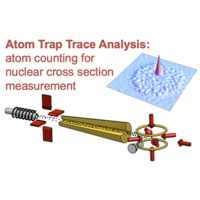
Understanding stellar s-process nucleosynthesis requires knowledge of neutron capture cross sections. In this work krypton gas is activated by an intense neutron beam at stellar energies. Applying for the first time atom-trap trace analysis (ATTA), long-lived reaction products are individually trapped and counted via fluorescence using cycling atomic transitions excited by precisely tuned lasers. Absolute isotope production is determined by comparison with reference samples. Improved capture cross sections are determined for four krypton isotopes, and the effect of the new values on relative s-process abundances in medium- and high-mass stars is investigated.

Shadow poles in the alternative parametrization of R-matrix theory

Pablo Ducru, Benoit Forget, Vladimir Sobes, Gerald Hale, and Mark Paris

Phys. Rev. C 103, 064608 (2021) - Published 14 June, 2021

As a trilogy, this first paper along with the authors’ two companion articles introduces alternate approaches to standard R-matrix parametrization of nuclear cross sections. The authors present first evidence of so-called shadow poles in R-matrix theory for 134Xe. The number and location of shadow poles depends upon how one continues the R-matrix operators to complex wave numbers. The authors also establish a new pole parametrization of R-matrix cross sections, called the windowed multipole parametrization, which can be Doppler-broadened analytically. This averaging of cross sections over the thermal motion of target atoms is crucial as it ensures the stability of many nuclear reactors; yet, computing it is a major bottleneck. Doppler-broadened windowed multipole cross sections and their uncertainty can be stored and computed with breakthrough performance.

F19(p,γ)20Ne and F19(p,α)O16 reaction rates and their effect on calcium production in Population III stars from hot CNO breakout

R. J. deBoer, O. Clarkson, A. J. Couture, J. Görres, F. Herwig, I. Lombardo, P. Scholz, and M. Wiescher

Phys. Rev. C 103, 055815 (2021) - Published 26 May, 2021

New analysis of nuclear reaction data finds holes in a theory about the first stars.

Light nuclei with semilocal momentum-space regularized chiral interactions up to third order

P. Maris, E. Epelbaum, R. J. Furnstahl, J. Golak, K. Hebeler, T. Hüther, H. Kamada, H. Krebs, Ulf-G. Meißner, J. A. Melendez, A. Nogga, P. Reinert, R. Roth, R. Skibiński, V. Soloviov, K. Topolnicki, J. P. Vary, Yu. Volkotrub, H. Witała, and T. Wolfgruber (LENPIC Collaboration)

Phys. Rev. C 103, 054001 (2021) - Published 5 May, 2021

This Low Energy Nuclear Physics International Collaboration (LENPIC) paper provides an example of ab-initio nuclear structure calculations worth noting. Using chiral effective field theory starting from two-body and three-body nuclear data, the authors work up through p-shell nuclei, with careful attention paid to quantifying the theoretical uncertainties. The remaining discrepancies with experiment, particularly overbinding in the upper p shell, point to next steps to be taken. As a caveat, known excited states that cannot be well described within current computational limitations are missing.

Proton-He3 elastic scattering at intermediate energies

A. Watanabe et al.

Phys. Rev. C 103, 044001 (2021) - Published 12 April, 2021

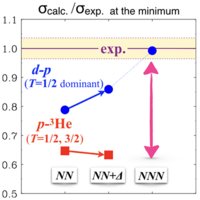
Precise measurements, in proton-3He elastic scattering near 65 MeV, of cross sections, proton and 3He analyzing powers, and the spin correlation coefficient Cy,y are compared with rigorous neutron-3H scattering calculations based upon realistic two-nucleon potentials. Proton-3He scattering at intermediate energies is found to be an excellent tool with which to test nuclear interaction models. Moreover, outstanding features that differ from those seen in nucleon-2H elastic scattering suggest the possibility of exploring T=3/2 three-nucleon forces, which are not accessible in three-nucleon scattering.

Quantum entanglement in nuclear Cooper-pair tunneling with γ rays

G. Potel, F. Barranco, E. Vigezzi, and R. A. Broglia

Phys. Rev. C 103, L021601 (2021) - Published 25 February, 2021

A new analysis of heavy-ion collision experiments uncovers evidence that two colliding nuclei behave like a Josephson junction—a device in which Cooper pairs tunnel through a barrier between two superfluids.

Fission fragment distributions and their impact on the r-process nucleosynthesis in neutron star mergers

J.-F. Lemaître, S. Goriely, A. Bauswein, and H.-T. Janka

Phys. Rev. C 103, 025806 (2021) - Published 19 February, 2021

Neutron star merger ejecta are currently the most viable astrophysical site for r-process nucleosynthesis. Fission plays a fundamental role. The manuscript presents an updated scission-point model for fission fragment distributions, which improves agreement with experimental fission yields. Two astrophysical scenarios, based on alternative weak-interaction hypotheses, are employed to reanalyze the role of fission. Regions of the nuclear chart where fission is important are identified, and the impact of fission yields on the final r-process abundance distribution is elaborated.

Projection on particle number and angular momentum: Example of triaxial Bogoliubov quasiparticle states

Benjamin Bally and Michael Bender

Phys. Rev. C 103, 024315 (2021) - Published 15 February, 2021

The authors provide a state-of-the-art overview of projection techniques employed in beyond-mean-field many-body methods. They focus on two symmetries that are of critical importance for the description of nuclear spectroscopy, particle number, and angular momentum. The presentation covers formal aspects of symmetry restoration (group theory) and practical aspects related to numerical implementation. A number of illustrative examples are given, including cranked states in odd-A nuclei.

Correlation studies of fission-fragment neutron multiplicities

M. Albertsson, B. G. Carlsson, T. Døssing, P. Möller, J. Randrup, and S. Åberg

Phys. Rev. C 103, 014609 (2021) - Published 19 January, 2021

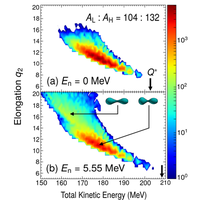
Describing fission as a diffusion process guided by shape-dependent microscopic level densities, the authors address how the available energy at scission is divided into shape distortion and statistical excitation. For the first time, they extract the resulting total fragment kinetic energy for various mass partitions, and study how this observable correlates with the neutron multiplicity. With increasing neutron energy a superlong fission mode appears which drastically changes the observables.

Sign In to Your Journals Account

Filter

Section

Filter

Article Lookup

Enter a citation