Highlights

Complete identification of states in Pb208 below Ex=6.2 MeV

A. Heusler, R. V. Jolos, T. Faestermann, R. Hertenberger, H.-F. Wirth, and P. von Brentano

Phys. Rev. C 93, 054321 (2016) - Published 23 May, 2016

The 208Pb nucleus, with “magic” numbers of 82 protons and 126 neutrons, has been a touchstone for the study of nucleon motion in the nucleus for 65 years. This exhaustive study analyzes high-resolution particle reaction data obtained by this group (and others) over more than a decade, using a variety of reactions, to determine the first essentially complete level scheme of 208Pb up to about 6 MeV of excitation energy. Comparison with schematic shell model calculations tests the completeness of that model and provides estimates of missing ingredients.

Time-dependent Hartree-Fock calculations for multinucleon transfer and quasifission processes in the Ni64+U238 reaction

Kazuyuki Sekizawa and Kazuhiro Yabana

Phys. Rev. C 93, 054616 (2016) - Published 23 May, 2016

The authors performed extensive simulations for the 64Ni + 238U reaction, which is a promising candidate for synthesizing the superheavy element 120. They place special emphasis on the effects of nuclear deformation and shell structure on quasifission dynamics, which prevents the fusion of the colliding nuclei. The authors suggest an interesting possibility, that element 120 may be synthesized with high probability when 64Ni collides with 238U side-on and at higher incident energies than in past experiments.

Mapping the deformation in the “island of inversion”: Inelastic scattering of Ne30 and Mg36 at intermediate energies

P. Doornenbal, H. Scheit, S. Takeuchi (武内聡), N. Aoi (青井考), K. Li (李闊昂), M. Matsushita (松下昌史), D. Steppenbeck, H. Wang (王赫), H. Baba (馬場秀忠), E. Ideguchi (井手口栄治), N. Kobayashi (小林信之), Y. Kondo (近藤洋介), J. Lee (李曉菁), S. Michimasa (道正新一郎), T. Motobayashi (本林透), A. Poves, H. Sakurai (櫻井博儀), M. Takechi (武智麻耶), Y. Togano (栂野泰宏), and K. Yoneda (米田健一郎)

Phys. Rev. C 93, 044306 (2016) - Published 11 April, 2016

With new-generation facilities able to provide beams of very unstable nuclei, one can explore how the traditional magic numbers and shell closures become fragile and break down in neutron-rich regions of the chart of nuclides. One important such region is near 32Mg, the so-called ”island of inversion”, suggesting a rearrangement of the nuclear shell structure. This study reports on B(E2) transition probabilities for the most neutron-rich nuclei yet measured in that region, 30Ne and 36Mg. The results help map the evolution and extent of anomalous shell structure toward the neutron drip line.

Accelerator mass spectrometry measurements of the C13(n,γ)C14 and N14(n,p)C14 cross sections

A. Wallner, M. Bichler, K. Buczak, I. Dillmann, F. Käppeler, A. Karakas, C. Lederer, M. Lugaro, K. Mair, A. Mengoni, G. Schätzel, P. Steier, and H. P. Trautvetter

Phys. Rev. C 93, 045803 (2016) - Published 11 April, 2016

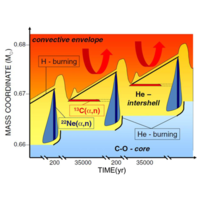
Many heavy elements in the universe are produced by slow neutron capture (the s process) in stars, and one needs detailed knowledge of both neutron production and capture to understand the physics. This paper reports new measurements of neutron capture on 13C and 14N that both lead to 14C and which act as neutron ”poisons” that starve the s process of neutrons, thus hampering the formation of the heavier elements. The authors use different accelerators, one to perform the capture reaction and one to measure, via accelerator mass spectrometry, the number of produced 14C nuclei. These data reduce the uncertainty in the predicted stellar neutron densities and the resulting heavy-element yields from the s process.

High resolution spectroscopic study of BeΛ10

T. Gogami et al. (HKS(JLab E05-115) Collaboration)

Phys. Rev. C 93, 034314 (2016) - Published 10 March, 2016

This new JLab measurement demonstrates the capability of the facility to determine the ground state binding energy of Λ hypernuclei. Comparison of the measured Λ10Be result with that of its mirror hypernucleus is consistent with the small charge-symmetry breaking for p-shell Λ hypernuclei as exhibited in the A=8 systems. The results also suggest a 0.54 MeV shift for reported binding energies of Λ hypernuclei extracted from (π+,K+) experiments.

Event-by-event fluctuations in a perturbative QCD + saturation + hydrodynamics model: Determining QCD matter shear viscosity in ultrarelativistic heavy-ion collisions

H. Niemi, K. J. Eskola, and R. Paatelainen

Phys. Rev. C 93, 024907 (2016) - Published 10 February, 2016

This paper introduces an event-by-event perturbative QCD plus saturation framework for the initial state of high-energy heavy-ion collisions and evolves the matter using dissipative fluid dynamics. The results favor a ratio of shear viscosity-to-entropy density that has a minimum near a temperature of 150 MeV, in line with theoretical expectations.

Toward a deeper understanding of how experiments constrain the underlying physics of heavy-ion collisions

Evan Sangaline and Scott Pratt

Phys. Rev. C 93, 024908 (2016) - Published 10 February, 2016

High-energy heavy ion collisions at RHIC and LHC are complex dynamical phenomena. To understand them one typically relies upon complex numerical simulations that are compared to an array of experimental measurements. This paper presents a novel extension of the standard Bayesian Markov chain Monte Carlo method that helps establish a relationship of the model parameters to the measurements, as well as determine the uncertainties in the inferred parameters. The approach may have applications in other areas of physics and astrophysics.

Centrality dependence of pion freeze-out radii in Pb-Pb collisions at sNN=2.76 TeV

J. Adam et al. (ALICE Collaboration)

Phys. Rev. C 93, 024905 (2016) - Published 4 February, 2016

Relativistic heavy-ion collisions create a new state of hot hadronic matter which, as it expands and cools, undergoes a phase transition from deconfined to ordinary hadronic matter. By studying the correlations between identical particles produced by these collisions (pions in this case), one can unravel their spacetime evolution. The ALICE Collaboration finds qualitative agreement with certain specific predictions from hydrodynamic models regarding the hadronization scenario. The results show effects at the LHC that were not seen at the lower energies at RHIC, and present new trends in femtoscopy, the study of the dynamics of such very small, femtometer-size systems.

High-precision γ-ray spectroscopy of the cardiac PET imaging isotope Rb82 and its impact on dosimetry

M. N. Nino, E. A. McCutchan, S. V. Smith, C. J. Lister, J. P. Greene, M. P. Carpenter, L. Muench, A. A. Sonzogni, and S. Zhu

Phys. Rev. C 93, 024301 (2016) - Published 1 February, 2016

Knowledge of the decay properties of radionuclides used in medical imaging is essential for quantifying and minimizing the ancillary dose received. The present, highly sensitive experiment identified new levels and 50 new γ-ray transitions in 82Rb decay. The significance lies in linking modern nuclear spectroscopy and applications to obtain a more precise dose estimate for 82Rb PET imaging and in demonstrating the value of fundamental measurements to improve understanding of radionuclide applications in medical diagnostics.

Nuclear mass predictions for the crustal composition of neutron stars: A Bayesian neural network approach

R. Utama, J. Piekarewicz, and H. B. Prosper

Phys. Rev. C 93, 014311 (2016) - Published 20 January, 2016

Nuclear mass models provide essential input for astrophysical applications such as r-process nucleosynthesis and neutron-star structure. By using a Bayesian neural network formalism, the authors obtain a significant improvement of about 40% in the mass predictions, complemented with statistical errors, of existing models. From an average of these predictions a mass model is obtained that is used to predict the composition of the outer crust of a neutron star.

Global description of β− decay in even-even nuclei with the axially-deformed Skyrme finite-amplitude method

M. T. Mustonen and J. Engel

Phys. Rev. C 93, 014304 (2016) - Published 11 January, 2016

β-decay rates are an important ingredient in simulations of the astrophysical r process, but parts of the r-process path are still not accessible to experiment. The authors develop a computationally efficient method that provides Skyrme-QRPA β-transition strengths for essentially all even-even nuclei, both spherical and deformed, between the valley of stability and the neutron drip line. The results will be important for global nucleosynthesis calculations.

Measurement of the branching ratio for the β decay of O14

P. A. Voytas, E. A. George, G. W. Severin, L. Zhan, and L. D. Knutson

Phys. Rev. C 92, 065502 (2015) - Published 30 December, 2015

A new measurement significantly lowers the uncertainty on the branching ratio of the 14O 0+→0+ superallowed β-decay transition. Combined with the recently improved Q value, this result renders the 14O system the third most precise among the “traditional 14” transitions that are used in the determination of the CKM Vud matrix element.

Numerical assessment of post-prior equivalence for inclusive breakup reactions

Jin Lei and Antonio M. Moro

Phys. Rev. C 92, 061602(R) (2015) - Published 14 December, 2015

The authors provide a numerical resolution for a decades-old controversy involving the post versus prior descriptions of inclusive breakup reactions. This is the first calculation to compare the two formalisms at the heart of the controversy and lays it to rest

Effective field theory for nuclear vibrations with quantified uncertainties

E. A. Coello Pérez and T. Papenbrock

Phys. Rev. C 92, 064309 (2015) - Published 14 December, 2015

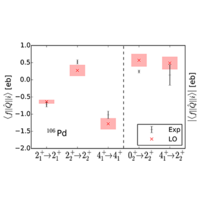
The authors develop an effective field theory for low-energy nuclear vibrations and use Bayesian statistics to estimate uncertainties for the model energies and transition rates. From the consistent description of a range of Ni, Ru, Pd, Cd, and Te isotopes within the theoretical uncertainties, they conclude that these nuclei can be described as anharmonic vibrators, consistent with older “textbook” interpretations but in contrast to some more recent interpretations.

Neutron skin thickness from the measured electric dipole polarizability in Ni68, Sn120, and Pb208

X. Roca-Maza, X. Viñas, M. Centelles, B. K. Agrawal, G. Colò, N. Paar, J. Piekarewicz, and D. Vretenar

Phys. Rev. C 92, 064304 (2015) - Published 8 December, 2015

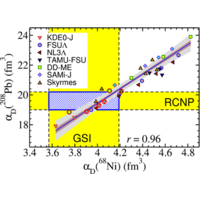
The authors use recent available experimental data on the electric dipole polarizability of 68Ni, 120Sn, and 208Pb to constrain physically important quantities including the symmetry energy, its slope, and the neutron skin thickness. The strong correlation between the electric dipole polarizabilities of two nuclei is instrumental in predicting the values of electric dipole polarizabilities in other nuclei. The results are of interest for future observational, experimental, and theoretical work on these interconnected nuclear quantities.

Broad levels in O17 and their relevance for the astrophysical s process

T. Faestermann, P. Mohr, R. Hertenberger, and H.-F. Wirth

Phys. Rev. C 92, 052802(R) (2015) - Published 17 November, 2015

New results on the properties of energy levels in 17O improve our understanding of the slow or s process which produces more than half of the nuclei heavier than Fe in the cosmos. One of the main sources of neutrons for the s process is the 13C + α→16O + n reaction where position and width of energy levels in 17O near the reaction threshold can change the reaction rate. In contrast, depending on the width of other levels in 17O, the 16O+n→17O+γ reaction can be a neutron “poison” reducing the production of heavy elements. This new work reduces uncertainties for both of these reactions.

Twist-averaged boundary conditions for nuclear pasta Hartree-Fock calculations

B. Schuetrumpf and W. Nazarewicz

Phys. Rev. C 92, 045806 (2015) - Published 21 October, 2015

The authors provide a significant advance in the description of nuclear pasta, a form of nuclear matter present in the inner crust of neutron stars. The authors achieve this in a 3-D Hartree-Fock approach by removing spurious contributions, to the energy, that appeared in prior approaches when periodic boundary conditions were used. The authors benchmark so-called twist-averaged boundary conditions for a free nucleonic gas and obtain reliable results for nuclear rods and slabs and for more elaborate phases.

Quantifying low-energy fusion dynamics of weakly bound nuclei from a time-dependent quantum perspective

Maddalena Boselli and Alexis Diaz-Torres

Phys. Rev. C 92, 044610 (2015) - Published 19 October, 2015

This work presents a promising new approach to the study of fusion cross sections, especially for light halo projectile nuclei. The authors calculate the reactions that can occur when 6Li is incident on 209Bi in a three-body model using the time-evolution operator to propagate a wave packet representing 6Li as 4He + d. Restricting the motion to one dimension, they are able to separate breakup, incomplete fusion, and two forms of complete fusion in a transparent manner.

Evidence for the virtual β−γ transition in Ni59 decay

M. Pfützner, K. Pachucki, and J. Żylicz

Phys. Rev. C 92, 044305 (2015) - Published 7 October, 2015

The authors present first evidence for the contribution of a virtual β-γ transition—a second-order process—to the radiative electron-capture decay of 59Ni. The key feature is a reliable theory of radiative capture for a second-forbidden β decay, developed and tested previously by the authors. A sharp upturn in the γ spectrum at energies above 600 keV is attributed to Gamow-Teller β decay occurring through a 1.1-MeV level in 59Co, followed by E2 γ emission.

First measurement of the Ru96(p,γ)Rh97 cross section for the p process with a storage ring

Bo Mei et al.

Phys. Rev. C 92, 035803 (2015) - Published 2 September, 2015

By trapping nuclei in a particle storage ring, researchers characterize previously inaccessible nuclear reactions that take place in stellar explosions.

Sign In to Your Journals Account

Filter

Section

Filter

Article Lookup

Enter a citation