Highlights

Measurement of the J/ψ photoproduction cross section over the full near-threshold kinematic region

S. Adhikari et al. (GlueX Collaboration)

Phys. Rev. C 108, 025201 (2023) - Published 3 August, 2023

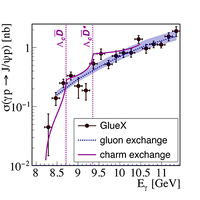
New results from the GlueX experiment provide improved cross sections for the photoproduction from the proton of J/ψ mesons via the γ+p→J/ψ+p reaction. Such mesons have charm/anti-charm heavy-quark content. Measurements of this reaction near the kinematic threshold can help constrain aspects of the density distribution of gluons in the proton and how they contribute to the proton mass, under the assumption that J/ψ production proceeds primarily through the exchange of gluons with the proton. However, these new measurements suggest contributions in addition to gluon exchange, pointing to the need for further theoretical work and more precise experimental measurements.

Evidence for ground-state electron capture of K40

L. Hariasz et al. (KDK Collaboration)

Phys. Rev. C 108, 014327 (2023) - Published 31 July, 2023

Potassium-40 (40K) is a long-lived, naturally occurring radioisotope whose decay properties impact geochronology as well as rare-event searches. The KDK Collaboration reports first experimental evidence for the existence of the very rare electron-capture branch from 40K to the ground state of 40Ar, suppressed by two orders of magnitude as compared to the decay to the excited state of 40Ar. This measurement quantifies a previously ill-known background in rare-event searches, resolves a longstanding uncertainty in potassium-based geological age estimates, and benchmarks the theoretical modeling of highly forbidden weak decays including a neutrinoless double-β decay.

Information-field-based global Bayesian inference of the jet transport coefficient

Man Xie, Weiyao Ke, Hanzhong Zhang, and Xin-Nian Wang

Phys. Rev. C 108, L011901 (2023) - Published 26 July, 2023

All recent analyses of heavy-ion data that extract information about the transport properties of excited strongly interacting matter use Bayesian techniques to fit parameters of functional forms motivated by physical insight. These explicit parameterizations may introduce undesired long-range correlations between different regions of parameter space. This paper develops an information field approach to avoid an explicit functional parameterization and obtain a global Bayesian inference of the jet transport coefficient q̂ as a function of the temperature.

Eigenvector continuation for emulating and extrapolating two-body resonances

Nuwan Yapa, Kévin Fossez, and Sebastian König

Phys. Rev. C 107, 064316 (2023) - Published 26 June, 2023

Connecting bound states and unbound resonant states continues to be a key challenge for the description of nuclei as open quantum systems. This paper uses eigenvector continuation, a newly popular method of extrapolating tractable calculations to otherwise intractable parameter regions, to go from bound-state data to resonances in the continuum. The successful benchmarking in a two-body system promises possible applications to otherwise inaccessible systems of physical interest.

Microscopic study of the hot-fusion reaction Ca48+U238 with the constraints from time-dependent Hartree-Fock theory

Xiang-Xiang Sun (孙向向) and Lu Guo (郭璐)

Phys. Rev. C 107, 064609 (2023) - Published 22 June, 2023

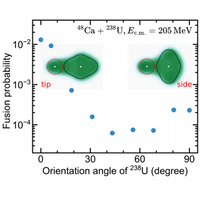
The hot fusion reaction 48C + 238U is studied with time-dependent Hartree-Fock theory in combination with coupled-channels and fusion-by-diffusion models. The authors find that the fusion probability is strongly dependent on the orientation of the 238U nucleus, with the probability being greatest for the tip collision orientation. This understanding will be applied in the future to determine optimal target and projectile combinations for the synthesis of elements Z=119 and 120.

Effect of the N3LO three-nucleon contact interaction on p−d scattering observables

L. Girlanda, E. Filandri, A. Kievsky, L. E. Marcucci, and M. Viviani

Phys. Rev. C 107, L061001 (2023) - Published 16 June, 2023

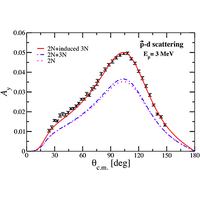
Chiral effective field theory allows one to express nuclear physics observables in terms of low-energy constants (LECs), representing physics at unresolved scales. In this work the authors focus on the two-nucleon contact interaction at fourth order (N3LO) and use a unitary transformation to reduce the number of involved LECs. This procedure induces a three-nucleon (3N) interaction depending on five unconstrained LECs. Those can be used, in association with a two-nucleon (2N) interaction, to fit very accurate data on polarization observables at low energies, in particular the p-d Ay polarization asymmetry. Thereby, adjusting the induced 3N N3LO LECs can solve the long-standing Ay puzzle.

Few-nucleon scattering in pionless effective field theory

Martin Schäfer and Betzalel Bazak

Phys. Rev. C 107, 064001 (2023) - Published 6 June, 2023

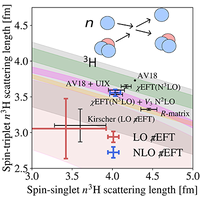
In nuclear physics, effective field theory is a low-energy manifestation of QCD with baryons and pions as its constituents, rather than quarks and gluons. At very low energies, even the pions can be integrated out, providing a simple yet thorough framework to study nuclear physics with controlled theoretical uncertainties. This work extends previous studies to A≤4 with accurate predictions for low-energy few-nucleon scattering, comparable to those from the best current analyses. The work confirms that a four-body force is needed at next-to-leading order to achieve cutoff-independent results.

Nonlocal optical potential in inelastic deuteron scattering off Mg24

A. Deltuva and D. Jurčiukonis

Phys. Rev. C 107, 064602 (2023) - Published 6 June, 2023

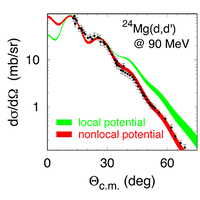
Nuclear reactions are a powerful tool for obtaining information on yet unknown aspects of nuclear structure. This work combines an elaborate reaction framework, based on the Faddeev equations, with novel nonlocal nucleon-nucleus potentials including core excitations. The authors show that nonlocalities lead to an improved description of inelastic deuteron scattering data and may impact the extracted structure information. These results may serve as motivation for exploring a wider range of reaction frameworks.

Measurements of the suppression and correlations of dijets in Pb+Pb collisions at sNN=5.02 TeV

G. Aad et al. (ATLAS Collaboration)

Phys. Rev. C 107, 054908 (2023) - Published 11 May, 2023

When two nuclei collide at relativistic energies, the collisions between nucleons create back-to-back streams (jets) of particles. These jets traverse the hot and dense strongly interacting medium produced in these collisions. The ATLAS Collaboration measured the differential yields of dijets as a function of the dijet momentum balance for selections on collisional geometry in Pb+Pb collisions at the LHC. They quantified the centrality dependence of dijet suppression and studied the suppression of the leading and sub-leading jets constituting the dijet. These results provide important information on dijet suppression and provide new insights into the path-length dependence on jet medium interactions.

Measurement of muon pairs produced via γγ scattering in nonultraperipheral Pb+Pb collisions at sNN=5.02 TeV with the ATLAS detector

G. Aad et al. (ATLAS Collaboration )

Phys. Rev. C 107, 054907 (2023) - Published 5 May, 2023

In ultrarelativistic heavy-ion collisions the Lorentz-contracted electromagnetic fields of the nuclei are a source of high-energy quasireal photons which can produce muon pairs via the process γ+γ→μ++μ−. In hadronic Pb+Pb collisions the two leptons in the final state provide a sensitive probe of the quark-gluon plasma created in the Pb+Pb collision or the strong magnetic fields that the plasma generates. This work presents new measurements by the ATLAS collaboration at the LHC of the Pb+Pb collision centrality dependence of the angular decorrelation of muon pairs created via the γγ process. Comparisons of the results to theoretical calculations suggest that the observed decorrelation in more central collisions results from an initial-state broadening of the photon transverse momenta and not from the interaction of the muons with the plasma or its magnetic field.

Examination of cluster production in excited light systems at Fermi energies from new experimental data and comparison with transport model calculations

C. Frosin et al. (INDRA-FAZIA Collaboration)

Phys. Rev. C 107, 044614 (2023) - Published 28 April, 2023

High-energy collisions result in the formation of clusters of neutrons and protons inside atomic nuclei and in the emission of energetic ions.

Microscopic calculation of fission product yields for odd-mass nuclei

N. Schunck, M. Verriere, G. Potel Aguilar, R. C. Malone, J. A. Silano, A. P. D. Ramirez, and A. P. Tonchev

Phys. Rev. C 107, 044312 (2023) - Published 17 April, 2023

Fission data are essential inputs to reaction networks involved in nucleosynthesis simulations and nuclear forensics. In nuclear density functional theory (DFT), the description of fissioning systems with an odd number of particles is markedly more involved, both formally and computationally. This article combines coupled-channels reaction theory, which provides the spin distribution of the fissioning system, and nuclear DFT, which describes the collective dynamics of fission, to predict the charge and mass distribution of fission fragments of odd-mass uranium isotopes. The new methodology offers a path forward to properly account for the entrance channel in the description of fission observables.

Relativistic approach to the nuclear breathing mode

Elena Litvinova

Phys. Rev. C 107, L041302 (2023) - Published 5 April, 2023

Nuclear compressibility governs fluctuations around the saturation density of nuclear matter, and is therefore crucial for understanding the structure of nuclei as well as of neutron stars. QRPA calculations using a nuclear compression modulus that reproduces the position of the isoscalar giant monopole resonance in 208Pb predict too high an energy for the same excitation in the Sn isotopes. The author shows that the self-consistent inclusion of quasiparticle-vibration coupling beyond QRPA in a relativistic framework can solve the problem. This indicates that a consensus between a softer equation of state extracted from the compressibility of finite nuclei and a stiffer one required by recent analyses of neutron star data can be achieved by systematic incorporation of beyond-QRPA many-body correlations in the theory.

Cross-section measurement of the Kr82(p,γ)Rb83 reaction in inverse kinematics

A. Tsantiri, A. Palmisano-Kyle, A. Spyrou, P. Mohr, H. C. Berg, P. A. DeYoung, A. C. Dombos, P. Gastis, E. C. Good, C. M. Harris, S. N. Liddick, S. M. Lyons, O. Olivas-Gomez, G. Owens-Fryar, J. Pereira, A. L. Richard, A. Simon, M. K. Smith, and R. G. T. Zegers

Phys. Rev. C 107, 035808 (2023) - Published 29 March, 2023

Although most nuclei heavier than Fe are likely produced by the slow and the rapid neutron-capture (s and r) processes, a number of medium-mass, proton-rich nuclei are thought to be produced via photo-disintegration (γ process). To confirm this, one needs detailed statistical model calculations that are constrained by experimental input. In this work, the authors measured the (γ,p) reaction on the unstable 83Rb nucleus, via detailed balance, using the 82Kr(p,γ)83Rb reaction with a 82Kr beam and detecting the produced γ rays. The results put important constraints on the parameters of the statistical model calculations, allowing improved tests of the γ process in hot stellar environments.

Dispersive formalism for the nuclear structure correction δNS to the β decay rate

Chien-Yeah Seng and Mikhail Gorchtein

Phys. Rev. C 107, 035503 (2023) - Published 27 March, 2023

Searches for new physics are often performed along the precision frontier, requiring more careful treatment of corrections previously treated approximately. For example, interpretation of high-precision measurements of β decay require the radiative correction arising from nuclear structure that was previously estimated using oversimplified nuclear models. In this paper, the authors carefully work out the formalism needed to use input from microscopic nuclear calculations, including a multipole expansion of the relevant matrix elements. This work prepares a path to a more rigorous theory framework and more precise limits on physics beyond the Standard Model.

Statistical analysis of initial-state and final-state response in heavy-ion collisions

Nicolas Borghini, Marc Borrell, Nina Feld, Hendrik Roch, Sören Schlichting, and Clemens Werthmann

Phys. Rev. C 107, 034905 (2023) - Published 10 March, 2023

High-energy nuclear collisions are analyzed theoretically using multistage models assembled to simulate the different stages of the reaction. This paper presents a new method for systematically characterizing the early-time density of a heavy-ion collision system. It is then used to analyze events from different models as well as the system response to these initial conditions. This method will help distinguish between different approaches to describing the dynamics of relativistic heavy-ion collisions at very early times.

Low-pT direct-photon production in Au+Au collisions at sNN=39 and 62.4 GeV

N. J. Abdulameer et al. (PHENIX Collaboration)

Phys. Rev. C 107, 024914 (2023) - Published 24 February, 2023

The PHENIX experiment at RHIC presents a measurement of thermal photons emitted from the quark-gluon plasma produced in collisions of Au ions at sNN=39 and 62.4 GeV. The yield of these photons exceeds what is expected from appropriately scaled proton collisions and is qualitatively consistent with a significant thermal contribution. Compared to results from other beam energies, the data suggest that the bulk of thermal photons are emitted under similar conditions near the transition of the quark-gluon plasma to hadronic matter.

Equation of state of superfluid neutron matter with low-momentum interactions

Viswanathan Palaniappan, S. Ramanan, and Michael Urban

Phys. Rev. C 107, 025804 (2023) - Published 15 February, 2023

The behavior of the unbound neutrons in the inner crust of neutron stars is linked to various neutron-star characteristics such as glitches in the repetition rate of pulsars. This paper presents a novel calculation of low-density superfluid neutron matter using techniques and interactions previously applied to the study of finite nuclei. The starting point is a two-body interaction softened using renormalization-group techniques. The resulting interaction is used in a Hartree-Fock-Bogoliubov calculation that includes pairing. This provides a good starting point for the many-body perturbation expansion, and for including more sophisticated nuclear interactions in future work.

Microscopic aspects of γ softness in atomic nuclei

Nazira Nazir, S. Jehangir, S. P. Rouoof, G. H. Bhat, J. A. Sheikh, N. Rather, and S. Frauendorf

Phys. Rev. C 107, L021303 (2023) - Published 14 February, 2023

One of the main research themes in quantum many-body systems is the emergence of collective features from microscopic degrees of freedom. Using the microscopic approach of the triaxial projected shell model, the authors demonstrate that admixing a few quasiparticle excitations into the vacuum configuration with a fixed triaxiality parameter γ provides a quantitative description of the shape fluctuations of the γ-soft nucleus 104Ru. The collective features are elucidated using the quadrupole shape invariant analysis, and also the staggering phase classification of the γ band.

Higher-order cumulants and correlation functions of proton multiplicity distributions in sNN=3 GeV Au+Au collisions at the RHIC STAR experiment

M. S. Abdallah et al. (The STAR Collaboration)

Phys. Rev. C 107, 024908 (2023) - Published 13 February, 2023

Various models of the QCD phase diagram favor a first-order phase transition to quark-gluon plasma, and therefore a critical endpoint which could manifest itself in measurable fluctuations and correlations. The authors report measurements of the moments of the net proton multiplicity fluctuations (cumulants) and correlation functions from the RHIC beam energy scan. They establish that at sNN=3 GeV the produced system is dominated by hadronic rather than thermal interactions. This puts a limit on the search for the elusive critical point in the QCD phase diagram to energies higher than 3 GeV.

Sign In to Your Journals Account

Filter

Section

Filter

Article Lookup

Enter a citation