Recent Articles

Signatures of infinite randomness in transport properties of strongly disordered spin chains

L. F. C. Faria, Victor L. Quito, João C. Getelina, José A. Hoyos, and E. Miranda

Phys. Rev. B 114, 014206 (2026) - Published 17 July, 2026

Detection of Mpemba effect through observables in open quantum systems

Pitambar Bagui, Arijit Chatterjee, and Bijay Kumar Agarwalla

Phys. Rev. B 114, 014311 (2026) - Published 17 July, 2026

Electric dipole spin-flip resonances in semiconductors: A personal perspective

Bruce D. McCombe

Phys. Rev. B 114, 019603 (2026) - Published 17 July, 2026

Emmanuel Rashba is responsible for a body of theory that demonstrates the profound effects of spin-orbit interaction on charge carriers in semiconductors. This notably includes the discovery of important effects on confined carriers in the presence of structural inversion asymmetry. The present article describes, from a personal perspective, experimental discovery and studies of electric-field-excited spin-flip resonances in semiconductors motivated by these theoretical predictions. Initial experiments in 1960 focused on electric-dipole excited spin resonance (EDSR) and combined cyclotron plus spin resonance (in 1967). Recent experiments on quasi-two-dimensional electrons in the quantum Hall effect regime in an asymmetric quantum-well structure have revealed unusual multiline EDSR spectra attributed to effects of Rashba spin-orbit effective fields of electrons in quantum Hall edge channels.

Crystal structures of ytterbium to 293 GPa

C. V. Storm, J. D. McHardy, C. M. Lonsdale, C. R. Roy, and M. I. McMahon

Phys. Rev. B 114, 024107 (2026) - Published 17 July, 2026

Anomalous semiconductorlike transport induced by the Curie transition in a Co51V31Ga18 metamagnetic Heusler alloy

Hongwei Liu, Qi Chen, Yuanlei Zhang, Tianzhi Xia, Yanru Kang, Yiming Cao, Kun Xu, Zhe Li, Changqin Liu, Yongsheng Liu, Liang Zuo, and Zongbin Li

Phys. Rev. B 114, 024416 (2026) - Published 17 July, 2026

Ferroelastic domain wall motion and collective domain switching in RbSCN

V. Soprunyuk, A. Tröster, J. Pils, W. Schranz, I. Rychetsky, A. Klic, and M. A. Carpenter

Phys. Rev. B 114, 034113 (2026) - Published 17 July, 2026

Combined low-frequency elastodynamics and resonant ultrasound spectroscopy on RbSCN across its improper ferroelastic phase transition reveal superelastic softening and, uniquely, a discontinuous Young’s modulus jump with frequency-dependent damping at T* < Tc, mimicking a first-order transition. Thermal cycling above T* erases ferroelastic domains. A compressible pseudospin model links T* to collective domain switching when the critical pinning stress σc(T) falls below the applied stress, yielding σc(T) in excellent accord with experiment.

Quantum melting of spin-1 dimer solid induced by interchain couplings

Yi Xu (徐熠), Tianfu Fu, Juraj Hasik, and Andriy H. Nevidomskyy

Phys. Rev. B 114, 034418 (2026) - Published 17 July, 2026

Room-temperature two-dimensional ferromagnetism, large magnetic anisotropy, and anomalous Hall effect: From supported to freestanding monolayers GdM2 (M=Cu, Ag, Au)

Jia-wan Li, Xunwu Hu, Dao-Xin Yao, and Yusheng Hou

Phys. Rev. B 114, 034419 (2026) - Published 17 July, 2026

Here, the authors demonstrate that decoupling rare-earth GdM2 (M=Cu, Ag, and Au) monolayers from metallic substrates transforms low-temperature supported surface alloys into room-temperature ferromagnets. Substrate removal enhances magnetic exchange interactions through charge redistribution, and eliminating structural buckling further modifies the competing exchange interactions. Freestanding GdAu2 exhibits perpendicular magnetic anisotropy and a symmetry-tunable anomalous Hall effect, providing a platform for two-dimensional magnetic and topological spintronics.

Phases of interacting Fibonacci anyons on a ladder at half-filling

Nico Kirchner, Roderich Moessner, Frank Pollmann, and Adam Gammon-Smith

Phys. Rev. B 114, 045117 (2026) - Published 17 July, 2026

Complex magnetic behavior of the Ce sawtooth chains in CeRhSn2

P. Opletal, J. Fikáček, E. Duverger–Nédellec, A. Thamizhavel, Z. Hossain, R. Tarasenko, V. Tkáč, D. Legut, Bin Shen, P. Gegenwart, and J. Custers

Phys. Rev. B 114, 045118 (2026) - Published 17 July, 2026

Topological phonons in anomalous Hall crystals

Mark R. Hirsbrunner, Félix Desrochers, Joe Huxford, and Yong Baek Kim

Phys. Rev. B 114, 045119 (2026) - Published 17 July, 2026

Erratum: Integer quantum Hall transition: An S-matrix approach to random networks [Phys. Rev. B 110, L081112 (2024)]

H. Topchyan, I. Gruzberg, W. Nuding, A. Klümper, and A. Sedrakyan

Phys. Rev. B 114, 049902 (2026) - Published 17 July, 2026

Topological phases of bosons with local parity coupling on a dimerized lattice

Ashirbad Padhan and Harsh Nigam

Phys. Rev. B 114, 055121 (2026) - Published 17 July, 2026

Noninteracting tight-binding models for Fock parafermions

Edward McCann

Phys. Rev. B 114, 055122 (2026) - Published 17 July, 2026

Two-component nuclear spin relaxation dynamics in GaAs:Mn

P. S. Bazhin, V. S. Berdnikov, M. S. Kuznetsova, V. M. Litvyak, R. I. Dzhioev, and K. V. Kavokin

Phys. Rev. B 114, 055201 (2026) - Published 17 July, 2026

Real-space Wigner transport for ballistic phonons

D. Mai and D. Schulz

Phys. Rev. B 114, 055415 (2026) - Published 17 July, 2026

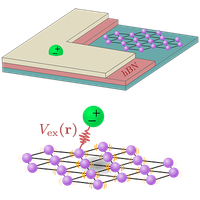
Exciton interacting with the phonons of an electronic Wigner crystal

Jens Havgaard Nyhegn, Esben Rohan Christensen, and Georg M. Bruun

Phys. Rev. B 114, 065122 (2026) - Published 17 July, 2026

In monolayer transition metal dichalcogenides, an electronic Wigner crystal imprints a weak umklapp branch in the exciton spectrum. The authors develop here a field-theoretical description of an exciton coupled to the crystal’s gapless phonons and solve it using a self-consistent Born approximation. The interactions create new exciton polarons, with phonon-assisted interband processes playing a key role and substantially weakening the umklapp peak. The authors map out the density dependence and predict when phonons qualitatively modify the optical Wigner-crystal signature.

Self-consistent GW + extended dynamical mean field theory for semiconductors and insulators

Viktor Christiansson, Francesco Petocchi, and Philipp Werner

Phys. Rev. B 114, 065123 (2026) - Published 17 July, 2026

Two-dimensional bound excitons in real space and Landau quantization space: A comparative study

Kunxiang Li and Yi-Xiang Wang

Phys. Rev. B 114, 065418 (2026) - Published 17 July, 2026

Thermodynamic constraints on perfect equilibrium superconducting diodes

Pavan Hosur

Phys. Rev. B 114, L020505 (2026) - Published 17 July, 2026

Why are perfect superconducting diodes so elusive? Here, the author shows that near-perfect diode behavior requires singularities in the equilibrium free energy landscape. This explains why high efficiencies arise more naturally in engineered Josephson devices and predicts that unexpectedly large efficiencies in equilibrium superconductors imply hidden structure in the free energy landscape.

Sign In to Your Journals Account

Filter

Recent Issues

Vol. 114, Iss. 24
15 October 2026
Vol. 114, Iss. 23
15 October 2026
Vol. 114, Iss. 22
15 October 2026
Vol. 114, Iss. 21
1 October 2026
Category
Article Type
Section

Filter

Article Lookup

Enter a citation