

- Perspective
Electric dipole spin-flip resonances in semiconductors: A personal perspective
Phys. Rev. B 114, 019603 – Published 17 July, 2026
DOI: https://doi.org/10.1103/l17b-q33x
Abstract
I discuss experimental work that is closely connected to, and was largely motivated by, the seminal theoretical work of Rashba [Rashba et al., Fiz. Tverd. Tela Collect. Papers 2, 162 (1959); Fiz. Tverd. Tela 3, 1735 (1961); Fiz. Tverd. Tela 3, 1863 (1961); Sheka, Fiz. Tverd. Tela 6, 3099 (1964); Rashba et al., Elsevier Science Publishers B.V., Amsterdam (1991)] on the importance of spin-orbit coupling in bulk semiconductors and semiconductor nanostructures. I focus selectively on electric-dipole spin-flip resonances, and especially electric-dipole spin resonance and combined spin-plus cyclotron resonance. I summarize and trace the chronological development of our experimental work on these topics in both bulk materials and in quasi-two-dimensional structures in the quantum Hall effect regime, as well as related studies by two other groups. These experimental studies have verified theoretical predictions, demonstrated the importance of spin-orbit coupling, and impacted the field of spintronics.
Physics Subject Headings (PhySH)
Collections
This article appears in the following collection:
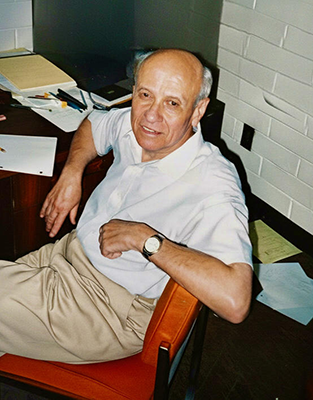
Honoring the legacy of Emmanuel Rashba
The passing of Professor Emmanuel Rashba in early 2025 was an irreparable loss to the physics community. For many decades prior, his numerous significant contributions have been driving solid state physics to surprising new places, realizations, and applications. To pay tribute to his many enduring, groundbreaking ideas, Physical Review B presents a special Collection with contributions by some of his disciples, collaborators, and connoisseurs of his mastery in top-shelf solid state research. Papers belonging to the collection will be published through 2026. It was initiated by Mark Dykman and Alexander Efros and colleagues. An Editorial from them and the contributed articles are linked below.
