Recent Articles

Complex dispersion relation of Rayleigh-Bloch waves trapped by slow inclusions

Vincent Laude

Phys. Rev. B 111, L220101 (2025) - Published 20 June, 2025

Intrinsic quantum Mpemba effect in Markovian systems and quantum circuits

Dongheng Qian (钱栋珩), Huan Wang, and Jing Wang (王靖)

Phys. Rev. B 111, L220304 (2025) - Published 20 June, 2025

Quasispins of vacancy defects and their interactions in disordered antiferromagnets

Muhammad Sedik, Shijun Sun, Arthur P. Ramirez, and Sergey Syzranov

Phys. Rev. B 111, 214427 (2025) - Published 18 June, 2025

Theory of the magnon Purcell effect in a cavity magnonic system

Guogan Zhao, Yong Wang, and Xiao-Feng Qian

Phys. Rev. B 111, 214428 (2025) - Published 18 June, 2025

Higher-order magnetic interactions and topological textures in Fe3GeTe2: Influence of spin-orbit coupling

Hongxi Jiang, Jia Zhang, and Yan Zhou

Phys. Rev. B 111, 214429 (2025) - Published 18 June, 2025

Superconducting proximity effect in two-dimensional hole gases

Serafim S. Babkin, Benjamin Joecker, Karsten Flensberg, Maksym Serbyn, and Jeroen Danon

Phys. Rev. B 111, 214518 (2025) - Published 18 June, 2025

In superconductor–semiconductor heterostructures, superconducting correlations can be induced in the semiconductor via the proximity effect. The authors propose here a model for such superconductivity in a two-dimensional hole gas, where multiple strongly spin-orbit-coupled bands are involved. Using three interface parameters, they derive explicit intraband and interband pairing terms for heavy-hole and light-hole bands. The obtained model opens the door to systematic modeling of proximized hole gases and predicts a coexistence of s-wave and d-wave singlet pairings, as well as triplet-type superconducting correlations.

Cross-nonlinear generation induced by electric current and temperature gradient in MoGe/Y3Fe5O12

Hiroki Arisawa, Yuto Fujimoto, Takashi Kikkawa, Satoshi Okamoto, Maki Umeda, Hiroyuki Chudo, and Eiji Saitoh

Phys. Rev. B 111, 214519 (2025) - Published 18 June, 2025

Rare events and Griffiths phases in topological quantum error correction

Adithya Sriram, Nicholas O'Dea, Yaodong Li, Tibor Rakovszky, and Vedika Khemani

Phys. Rev. B 111, 224208 (2025) - Published 18 June, 2025

Method for simulating open-system dynamics using midcircuit measurements on a quantum computer

John P. T. Stenger, Gloria Bazargan, Nicholas T. Bronn, and Daniel Gunlycke

Phys. Rev. B 111, 224307 (2025) - Published 18 June, 2025

Experimental realization of antiferromagnetic Ising ground state on the triangular lattice

Ke Wang, Xing-Jian Liu, Li-Ming Tu, Jia-Jie Zhang, Vladimir N. Gladilin, and Jun-Yi Ge

Phys. Rev. B 111, 224418 (2025) - Published 18 June, 2025

Here, the authors experimentally realize an antiferromagnetic Ising ground state on a rigid triangular lattice using macroscopic magnets. The as grown protocol, vibrational thermalization, and simulations reveal that magnets spontaneously form a striped phase in cylindrical cavities, where the lowest-energy configuration emerges from collective dipolar interactions rather than pairwise Ising behavior. These results demonstrate the observation of a long-predicted geometrically frustrated ground state and establish a tunable macroscopic platform for studying ideal frustration physics.

Capacitance-based fermion parity readout and predicted Rabi oscillations in a Majorana nanowire

Jay D. Sau and Sankar Das Sarma

Phys. Rev. B 111, 224509 (2025) - Published 18 June, 2025

Electron-magnon dynamics triggered by an ultrashort laser pulse: A real-time dual GW study

Nagamalleswararao Dasari, Hugo U. R. Strand, Martin Eckstein, Alexander I. Lichtenstein, and Evgeny A. Stepanov

Phys. Rev. B 111, 235129 (2025) - Published 18 June, 2025

From degenerate flat bands to topological states with high Chern numbers

Hong-Chang Zeng, Ming-Da Dai, Xiao-Ping Liu, Wei-Wei Luo, and Yi-Fei Wang

Phys. Rev. B 111, 235130 (2025) - Published 18 June, 2025

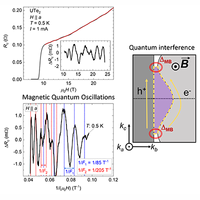
Slow magnetic quantum oscillations in the c-axis magnetoresistance of UTe2

Freya Husstedt, Motoi Kimata, Sajal Naduvile Thadathil, Beat Valentin Schwarze, Markus König, Gerard Lapertot, Jean-Pascal Brison, Georg Knebel, Dai Aoki, J. Wosnitza, and Toni Helm

Phys. Rev. B 111, 235131 (2025) - Published 18 June, 2025

The authors investigate here the Fermi surface of the potential spin-triplet superconductor UTe2 to gain insight in its dimensionality and properties. They perform transport measurements on bulk and microfabricated samples that show low-frequency quantum oscillations perpendicular to the quasi-2D Fermi surface sheets, most likely of unconventional origin such as quantum interference or quasiparticle lifetime oscillations. Their findings do not support the presence of a 3D pocket. Additionally, two distinct frequencies indicate a change in the Fermi surface topology, associated with a Lifshitz transition.

Machine learning force field model for kinetic Monte Carlo simulations of itinerant Ising magnets

Alexa Tyberg, Yunhao Fan, and Gia-Wei Chern

Phys. Rev. B 111, 235132 (2025) - Published 18 June, 2025

Antiferromagnetic and bond-order-wave phases in the half-filled two-dimensional optical Su-Schrieffer-Heeger-Hubbard model

Andy Tanjaroon Ly, Benjamin Cohen-Stead, and Steven Johnston

Phys. Rev. B 111, 245138 (2025) - Published 18 June, 2025

Designing flat bands and pseudo-Landau levels in GaAs with patterned gates

Pierre A. Pantaleón, Zhen Zhan, Siddhartha E. Morales, and Gerardo G. Naumis

Phys. Rev. B 111, 245303 (2025) - Published 18 June, 2025

Signatures of valley drift in the diversified band dispersions of bright, gray, and dark excitons in MoS2 monolayers under uniaxial strains

Ching-Hung Shih, Guan-Hao Peng, Ping-Yuan Lo, Wei-Hua Li, Mei-Ling Xu, Chao-Hsin Chien, and Shun-Jen Cheng

Phys. Rev. B 111, 245422 (2025) - Published 18 June, 2025

The authors present here a comprehensive theoretical investigation of the excitonic band dispersions in uniaxially strained MoS2 monolayers by solving the Bethe-Salpeter equation within a first-principles based Wannier tight-binding framework. As a consequence of strain-induced valley drift, applying uniaxial strain to a MoS2 monolayer is found to lead to diversified exciton band dispersions, diffusive transport properties, and angle-resolved optical patterns of bright, gray, and dark excitons. Interestingly, the band dispersion of the dark exciton undergoes the most significant reshaping, accompanied by an unusual sign reversal of the exciton effective mass.

Molecular dynamics of cis-polybutadiene across the glass transition revealed by muonated-radical spin relaxation

S. Takeshita, H. Okabe, M. Hiraishi, K. M. Kojima, A. Koda, H. Seto, T. Masui, N. Wakabayashi, F. L. Pratt, and R. Kadono

Phys. Rev. B 111, 214208 (2025) - Published 17 June, 2025

Two-photon coupling via Josephson element: Breaking the symmetry with magnetic fields

E. V. Stolyarov, V. L. Andriichuk, and A. M. Sokolov

Phys. Rev. B 111, 214517 (2025) - Published 17 June, 2025

Sign In to Your Journals Account

Filter

Recent Issues

Vol. 114, Iss. 24
15 October 2026
Vol. 114, Iss. 23
15 October 2026
Vol. 114, Iss. 22
15 October 2026
Vol. 114, Iss. 21
1 October 2026
Category
Article Type
Section

Filter

Article Lookup

Enter a citation