Recent Articles

Magnon nesting in driven two-dimensional quantum magnets

Hossein Hosseinabadi, Yaroslav Tserkovnyak, Eugene Demler, and Jamir Marino

Phys. Rev. B 113, 014404 (2026) - Published 5 January, 2026

Revisiting vestigial order in nematic superconductors: Gauge-field mechanisms and model constraints

I. Maccari, E. Babaev, and J. Carlström

Phys. Rev. B 113, 014501 (2026) - Published 5 January, 2026

Angular momentum of vortex-core Majorana zero modes

Giulia Venditti, Christophe Berthod, and Louk Rademaker

Phys. Rev. B 113, 014502 (2026) - Published 5 January, 2026

When putting a d+id superconductor on the surface of a three-dimensional topological insulator, the Majorana zero modes (MZMs) appearing inside vortices can have a nontrivial angular momentum. Here, the authors show the emergence of distinct Majorana “flavors”, beyond Chern-based classifications. They also assess the stability and topological protection of these MZMs, as well as possible experimental signatures.

Revealing superconducting chiral edge modes via resistance distributions

Linghao Huang, Dongheng Qian, and Jing Wang

Phys. Rev. B 113, 014503 (2026) - Published 5 January, 2026

Strategy to obtain large negative linear compressibility in framework structures

Chengxi Li, Geng Wang, Jiayue He, Qingxin Zeng, Yan Sun, Xiao Liu, Lei Wang, Jian Hao, and Yinwei Li

Phys. Rev. B 113, 024101 (2026) - Published 5 January, 2026

Emergent curved space and gravitational lensing in quantum materials

Yugo Onishi, Nisarga Paul, and Liang Fu

Phys. Rev. B 113, 024401 (2026) - Published 5 January, 2026

Nontrivial spin textures can give rise to emergent fields on electrons moving on the textures, such as emergent electromagnetic field. Here, the authors show that nonadiabatic corrections lead to an emergent gravitational field. Electrons strongly coupled to these textures behave as a spinless particle in curved space, whose curvature results in the electron lensing effect, an analog of the gravitational lensing. The picture of emergent curved space allows us to explore novel “gravitational” phenomena in condensed matter systems.

Photodriven spin dynamics and magnetic phase transition in an altermagnetic MnTe monolayer

Yinlu Gao, Tianxia Guo, Yupeng Zhi, Yingcong Wei, Cuihong Lv, Xue Jiang, Yuanping Chen, and Jijun Zhao

Phys. Rev. B 113, 024402 (2026) - Published 5 January, 2026

Chiral geometry driven chiral magnetism

Yonglong Ga, Dongxing Yu, Jiawei Jiang, Liming Wang, Fengjun Zhuo, Kai Chang, and Hongxin Yang

Phys. Rev. B 113, 024403 (2026) - Published 5 January, 2026

Strain-stabilized high-topological-charge skyrmions and field-tunable phase switching in frustrated monolayer NiBr2

Zhen Sun, Shiwei Zhu, Xinyuan Guan, Xiaoping Wu, and Changsheng Song

Phys. Rev. B 113, 024404 (2026) - Published 5 January, 2026

Spectroscopy and complex-time correlations using minimally entangled typical thermal states

Zhenjiu Wang, Paul McClarty, Dobromila Dankova, Andreas Honecker, and Alexander Wietek

Phys. Rev. B 113, 024406 (2026) - Published 5 January, 2026

Dynamics of quantum matter at nonzero temperature is the central link between microscopic models and spectroscopy or transport measurements in actual materials. The authors introduce here a tensor network technique to efficiently simulate time-dependent response functions using minimally entangled typical thermal states. Complex-time correlation functions are shown to solve the issue of unbounded entanglement growth. Two variants, an analytic and a Hermitian time correlator, are used to solve the outstanding problem of the anomalous thermal broadening in SrCu2(BO3)2.

Superconductivity in multi-Weyl semimetals: Conditions for the coexistence of topological and conventional phases

Alonso Tapia and Enrique Muñoz

Phys. Rev. B 113, 024501 (2026) - Published 5 January, 2026

Higher-dimensional Euclidean and non-Euclidean structures in planar circuit quantum electrodynamics

Alberto Saa, Eduardo Miranda, and Francisco Rouxinol

Phys. Rev. B 113, 035108 (2026) - Published 5 January, 2026

Gaplessness from disorder and quantum geometry in gapped superconductors

Omri Lesser, Sagnik Banerjee, Xuepeng Wang, Jaewon Kim, Ehud Altman, and Debanjan Chowdhury

Phys. Rev. B 113, 035109 (2026) - Published 5 January, 2026

Few-meV resolution Floquet band-gap mapping via high-order sideband generation

Yu-Xuan Chen, Gan Wang, Mingjie Li, and Tao-Yuan Du

Phys. Rev. B 113, 035110 (2026) - Published 5 January, 2026

Polarons and bipolarons in the Rydberg-dressed extended Bose-Hubbard model

G. A. Domínguez-Castro, L. Santos, and L. A. Peña Ardila

Phys. Rev. B 113, 035111 (2026) - Published 5 January, 2026

The authors explore here how a single and a pair of impurities behave across the superfluid and insulating (charge density wave) phases of a hard-core bosonic bath. In the superfluid regime, an impurity becomes a polaron-like quasiparticle, while in the insulating phase it regains its particle-like nature, moving through a potential landscape shaped by the charge density wave order. Furthermore, the authors show that two impurities can bind into a stable pair even without direct mutual interactions.

Chiral anomaly-induced nonlinear Hall effect in spin-orbit coupled noncentrosymmetric metals

Gautham Varma K., Mohd. Hashim Raza, and Azaz Ahmad

Phys. Rev. B 113, 035112 (2026) - Published 5 January, 2026

Coupling-dependent electronic structure in InSe-based lateral heterostructures

Jiaming Lou, Bo Li, Shuangping Liao, Sahar Izadi Vishkayi, Li Zhang, Yuan Tian, Long-Jing Yin, Meysam Bagheri Tagani, Lijie Zhang, and Zhihui Qin

Phys. Rev. B 113, 035302 (2026) - Published 5 January, 2026

Excitons in moiré superlattices with disordered electrons

Junghwan Kim, Dinh Van Tuan, and Hanan Dery

Phys. Rev. B 113, 035303 (2026) - Published 5 January, 2026

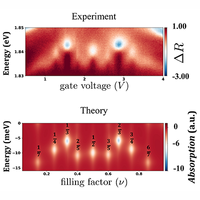
How do excitons probe electron crystals in moiré superlattices? The authors investigate here how the absorption amplitude and energy of excitons are influenced by charge order at fractional fillings of moiré superlattices. In addition to the sensitivity from s-p orbital mixing of excitonic states that stems from the charge order, this study also demonstrates how the moiré physics is suppressed by atomic defects and thermal fluctuations. This work provides a comprehensive picture that bridges theory and recent experimental observations.

Hyperfine interaction of electrons confined in CsPbI3 nanocrystals with nuclear spin fluctuations

Sergey R. Meliakov, Evgeny A. Zhukov, Vasilii V. Belykh, Kirill V. Kavokin, Mikhail O. Nestoklon, Evgeniya V. Kulebyakina, Mikhail L. Skorikov, Elena V. Kolobkova, Maria S. Kuznetsova, Manfred Bayer, and Dmitri R. Yakovlev

Phys. Rev. B 113, 035304 (2026) - Published 5 January, 2026

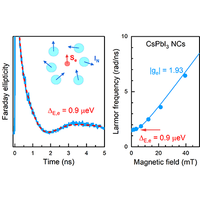
The authors measure coherent spin dynamics of electrons in CsPbI3 perovskite nanocrystals using time-resolved Faraday ellipticity. They find a finite Larmor precession frequency at zero magnetic field, corresponding to the electron spin splitting of 0.8 µeV induced by the hyperfine interaction of the electron with nuclear spin fluctuations. Using this experimental value and density functional calculations of the material band structure, the atomic hyperfine constant for the 5s orbital of iodine is evaluated as 190 µeV.

Specific heat and thermoelectric investigation of the charge density wave in single crystal Cu1.90Te

Ramesh Lalmani Yadav, Pallab Bag, Yung-Kang Kuo, Chia-Nung Kuo, and Chin Shan Lue

Phys. Rev. B 113, 035405 (2026) - Published 5 January, 2026

Sign In to Your Journals Account

Filter

Recent Issues

Vol. 114, Iss. 24
15 October 2026
Vol. 114, Iss. 23
15 October 2026
Vol. 114, Iss. 22
15 October 2026
Vol. 114, Iss. 21
1 October 2026
Category
Article Type
Section

Filter

Article Lookup

Enter a citation