




Minimal loop currents and cat states in doped Mott insulators
Can Cui, Jing-Yu Zhao, and Zheng-Yu Weng
Phys. Rev. B 114, 185101 (2026) - Published 1 September, 2026
Observation of charge dressing in topological insulator thin films: A terahertz and infrared spectroscopic study
Veronica Stopponi, Johannes Schmidt, Andrea Perucchi, Gregor Mussler, Abdur Rehman Jalil, Alexander Grüneis, Michele Zacchigna, Stefano Lupi, and Paola Di Pietro
Phys. Rev. B 114, 185102 (2026) - Published 2 September, 2026
Variational preparation and characterization of chiral spin liquids in quantum circuits
Zi-Yang Zhang, Donghoon Kim, and Ji-Yao Chen
Phys. Rev. B 114, 185103 (2026) - Published 2 September, 2026
Fermi surface studies of altermagnetic CrSb from Shubnikov–de Haas oscillations
Sajal Naduvile Thadathil, Beat Valentin Schwarze, Jaafar Ansari, Tommy Kotte, Sven Luther, Marc Uhlarz, Freya Husstedt, Rafael Gonzalez-Hernandez, Libor Šmejkal, Thanassis Speliotis, Markéta Žáčková, Jiří Pospíšil, Christoph Müller, Dominik Kriegner, Helena Reichlová, Jochen Wosnitza, and Toni Helm
Phys. Rev. B 114, 185104 (2026) - Published 3 September, 2026
The authors present here results from electrical magnetotransport measurements on microstructures of altermagnetic CrSb in pulsed fields up to 68 T. They study the temperature and field-orientation dependence of magnetic quantum oscillations in combination with first-principles calculations. The observed frequency spectrum agrees well with density functional theory calculations that take spin-orbit coupling into account, without invoking significant band shifts. The findings validate the predicted electronic band structure of CrSb hosting multiple semimetallic bands and a locally alternating spin polarization.
Fermion condensation in a generalized Hatsugai-Kohmoto model with momentum-mixing Landau interactions
Jan Heinrich, Andreas Rückriegel, and Peter Kopietz
Phys. Rev. B 114, 185105 (2026) - Published 4 September, 2026
Sign of the Rashba parameter in image-potential states
Fabian Schöttke, Kaishu Kawaguchi, Kenta Kuroda, Peter Krüger, Thorsten Deilmann, Ayumi Harasawa, Shuntaro Tani, Yohei Kobayashi, Takeshi Kondo, and Markus Donath
Phys. Rev. B 114, 185106 (2026) - Published 4 September, 2026
Coexisting magnetic, charge, and superconducting orders in the two-dimensional Hubbard model
Robin Scholle, Pietro M. Bonetti, Walter Metzner, and Demetrio Vilardi
Phys. Rev. B 114, 185107 (2026) - Published 8 September, 2026
The authors analyze here the competition and coexistence of magnetic, charge, and -wave superconducting orders in the two-dimensional Hubbard model using renormalization-group-improved Hartree–Fock calculations. The resulting phase diagram reveals superconductivity coexisting with Néel order on the electron-doped side and with spiral or stripe order on the hole-doped side. In the stripe phase, the superconducting gap is spatially modulated together with the charge order.
Quantum geometry of the non-Hermitian skin effect
Ken-Ichiro Imura and Kohei Kawabata
Phys. Rev. B 114, 185108 (2026) - Published 8 September, 2026
Geometric quantum drives and topological dynamical responses: Hyperbolically driven quantum systems and beyond
Jihong Wu, Chuan Liu, Daniel Bulmash, and Wen Wei Ho
Phys. Rev. B 114, 185109 (2026) - Published 8 September, 2026
Bridging the gap between numerics and experiment in freestanding graphene
Maksim Ulybyshev, Savvas Zafeiropoulos, Christopher Winterowd, and Fakher Assaad
Phys. Rev. B 114, 185110 (2026) - Published 8 September, 2026
Here, the authors revisit the question of the logarithmic renormalization of the Fermi velocity in graphene. Using large-scale Quantum Monte Carlo simulations of lattices with up to interacting electrons, they directly connect experimental data with unbiased, nonperturbative calculations starting from a microscopic Hamiltonian. Their results reveal that even random-phase approximation corrections are quantitatively insufficient at realistic interaction strengths for suspended graphene, while continuum perturbation theory misses important lattice-scale effects. Remarkably, the optical conductivity still remains constant pointing to exact cancellation of different corrections.
Pairing and charge distribution in Emery ladders preserving the ratio of Cu to O atoms
Gökmen Polat and Eric Jeckelmann
Phys. Rev. B 114, 185111 (2026) - Published 9 September, 2026
Nearly topological flat bands in altermagnets
Xu-Hui Yan, Dong-Hao Guan, Ying Han, Lu Qi, and Ai-Lei He
Phys. Rev. B 114, 185112 (2026) - Published 11 September, 2026
Engineering edge states in the two-leg Su-Schrieffer-Heeger ladder and their topoelectric circuit realization
Anish Kuanr, Rajashri Parida, Prabhu Prasad Tripathy, Saralasrita Mohanty, and Tapan Mishra
Phys. Rev. B 114, 185113 (2026) - Published 14 September, 2026
Topological edge states emerging from twisted moiré bands
Yasser Saleem, Paweł Potasz, Anna Dyrdał, Björn Trauzettel, and Ewelina M. Hankiewicz
Phys. Rev. B 114, 185114 (2026) - Published 14 September, 2026
Data-efficient surrogate modeling of spectral functions using Gaussian processes: An application to the model
Sanket Jantre, Nathan M. Urban, Weiguo Yin, and Niraj Aryal
Phys. Rev. B 114, 185115 (2026) - Published 14 September, 2026
Quadrupolar and dipolar phases of excitons in transition-metal dichalcogenide trilayer heterostructures
Michal Zimmerman, Daniel Podolsky, Ronen Rapaport, and Snir Gazit
Phys. Rev. B 114, 185116 (2026) - Published 15 September, 2026
In trilayer transition metal dichalcogenides, strong quantum fluctuations stabilize quadrupolar excitons. This study reveals how this state breaks down due to strong correlations at high exciton densities. Attractive interactions drive antiparallel dipolar correlations, explaining the redshift to blueshift transition observed in recent experiments. Furthermore, the authors predict novel correlation driven quantum phases, specifically an exciton droplet and a staggered dipolar crystal, and detail their distinct experimental signatures to guide future experimental explorations.
Spatiotemporal spin transport from first principles
Mayada Fadel, Joshua Quinton, Mani Chandra, Mayank Gupta, Aron W. Cummings, Yuan Ping, and Ravishankar Sundararaman
Phys. Rev. B 114, 185117 (2026) - Published 15 September, 2026
Structural and magnetic phases of topological kagome metal under pressure
Sumanta Chattopadhyay, Laure Thomarat, Kuldeep Kargeti, Chin Shen Ong, Lipika, Jean-Pascal Rueff, Lucie Nataf, Kaustuv Manna, S. K. Panda, Chandra Shekhar, and Victor Balédent
Phys. Rev. B 114, 185118 (2026) - Published 15 September, 2026
In search of diabolical critical points
Naren Manjunath and Dominic V. Else
Phys. Rev. B 114, 185119 (2026) - Published 15 September, 2026
We usually understand a critical point as occurring at a phase transition separating two distinct phases. Certain quantum many-body systems host unusual critical points that are entirely contained in a single phase of matter but are nonetheless protected for topological reasons. Here, the authors give general conditions when such “diabolical” critical points should exist and explore new types of classical phase transitions in which they might occur.
Hamiltonian Monte Carlo enhanced by exact diagonalization
Finn L. Temmen, Martina Gisti, David J. Luitz, Thomas Luu, and Johann Ostmeyer
Phys. Rev. B 114, 185120 (2026) - Published 17 September, 2026
Hall viscosity of the Laughlin state on noisy quantum computers
Ammar Kirmani, Andrew A. Allocca, Jian-Xin Zhu, Armin Rahmani, Sriram Ganeshan, and Pouyan Ghaemi
Phys. Rev. B 114, 185121 (2026) - Published 17 September, 2026
Electronic structure and resonant circular dichroism of from soft x-ray angle-resolved photoemission
Øyvind Finnseth, Damian Brzozowski, Anders Christian Mathisen, Stefanie Suzanne Brinkman, Xin Liang Tan, Fabian Göhler, Benjamin A. D. Williamson, Kristoffer Eggestad, Meng-Jie Huang, Jens Buck, Moritz Hoesch, Kai Rossnagel, Sverre M. Selbach, Hendrik Bentmann, and Ingrid Hallsteinsen
Phys. Rev. B 114, 185122 (2026) - Published 18 September, 2026
Symmetry analysis of the non-Hermitian electro-optic effect in crystals
Sylvain Lannebère, Tatiana G. Rappoport, Tiago A. Morgado, Ivo Souza, and Mário G. Silveirinha
Phys. Rev. B 114, 185123 (2026) - Published 21 September, 2026
Wavefront-dislocation evolution via quadratic band touching annihilation
Rasoul Ghadimi, Jaehyeon Ahn, and Sangmo Cheon
Phys. Rev. B 114, 185124 (2026) - Published 21 September, 2026
Constructing exceptional knots and links with arbitrary braiding topology
Bin Jiang, Aolong Guo, Qilin Cai, and Jian-Hua Jiang
Phys. Rev. B 114, 185125 (2026) - Published 21 September, 2026
Long-range hopping in the confined electronic states of atomically constructed Cs chains on InSb(110)
Niek. M. M. Aarts, Anna M. H. Krieg, Emil Sierda, Anna Reinhold, Danis Badrtinov, Yann in ‘t Veld, Brian Kiraly, Elze J. Knol, Malte Rösner, Daniel Wegner, and Alexander A. Khajetoorians
Phys. Rev. B 114, 185126 (2026) - Published 23 September, 2026
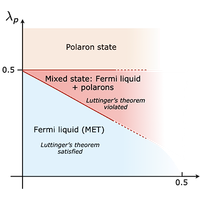
Breakdown of the Migdal-Eliashberg theory for electron-phonon systems: Role of polarons and bipolarons
Andrey Chubukov, Ilya Esterlis, Artem Abanov, and Nikolay Prokof'ev
Phys. Rev. B 114, 185127 (2026) - Published 23 September, 2026
The Migdal-Eliashberg theory (MET) describes electrons interacting with phonons at weak/moderate couplings. A conventional belief is that MET holds even at strong coupling, and, for an interaction with an optical phonon, breaks down only near the point where the dressed phonon softens. Here, the authors analyze numerically and analytically a different option — a collapse to a polaronic/bipolaronic ground state. They show in detail how this happens and demonstrate that away from near-half-filling, a polaron/bipolaron state develops well before a dressed phonon softens.
Nonequilibrium topological response under charge dephasing
Shuangyuan Lu, Lucas Q. Silveira, and Yizhi You
Phys. Rev. B 114, 185128 (2026) - Published 24 September, 2026
Probing La-based nickelates with core-level photoelectron spectroscopy
Daisuke Takegami, Naoki Ito, Koto Fujinuma, Masato Yoshimura, Grace A. Pan, Dan Ferenc Segedin, Qi Song, Hanjong Paik, Charles M. Brooks, Hanjie Guo, Alexander C. Komarek, Takanori Taniguchi, Masaki Fujita, Julia A. Mundy, Takashi Mizokawa, Liu Hao Tjeng, Berit H. Goodge, and Atsushi Hariki
Phys. Rev. B 114, 185129 (2026) - Published 25 September, 2026
Quantum interference corrections in a magnetic-fluctuation-controlled metallic state of
Sankararao Yadam, Tatarao Donepudi, Bunty Rani Roy, Rajasekhar Boya, S. Shanmukharao Samatham, Swathi Anem, Prabhu Rajagiri, Muralikrishna Patwari, Tirupathi Patri, R. Rawat, and V. Ganesan
Phys. Rev. B 114, 185130 (2026) - Published 25 September, 2026
Ab initio quantum embedding description of magic-angle twisted bilayer graphene at even-integer fillings
Raehyun Kim, Woochang Kim, Kevin D. Stubbs, Steven G. Louie, and Lin Lin
Phys. Rev. B 114, 185131 (2026) - Published 28 September, 2026
The correlated phase diagram of magic-angle twisted bilayer graphene (MATBG) is very sensitive to both material parameters and modeling choices. To limit the impact of these factors, here, the authors propose an embedding workflow for modeling MATBG and other moiré materials that incorporates automatic gauge fixing and is consistent with density functional theory. Using this workflow, the authors find that in MATBG, the Hartree-Fock ground state at is a fragile semimetal with intervalley coherence.
Fermiology of the kagome compound probed by de Haas–van Alphen oscillations
Tucker Beekmann, Caue Kaufmann Ribeiro, Kyryl Shtefiienko, Jiaqiang Yan, Brenden R. Ortiz, Christopher A. Mizzi, and Keshav Shrestha
Phys. Rev. B 114, 185132 (2026) - Published 28 September, 2026
Discernible signatures of fractionally charged anyons in a Pfaffian-Laughlin state
Vadym Apalkov and Tapash Chakraborty
Phys. Rev. B 114, 185133 (2026) - Published 29 September, 2026
Magnetic-field-driven phase switching in the antiferromagnetic Mott insulator
Ksenia S. Rabinovich, Tim Priessnitz, Nils Gross, George Jackeli, Maximilian J. Krautloher, Pascal Reiss, Eberhard J. Goering, Jurgen H. Smet, Bernhard Keimer, and Alexander V. Boris
Phys. Rev. B 114, 185134 (2026) - Published 30 September, 2026
Isovalent 1% Ti substitution tunes the polar metal CaRuO to the edge of its Mott transition. While electronic kinetic energy and strong electron-lattice coupling contribute to the system’s free-energy balance, its magnetic - phase diagram is remarkably simple, closely resembling that of a canonical anisotropic antiferromagnet, albeit with substantially renormalized critical fields. Along the easy axis, a first-order spin-flop transition near 6 Tesla reorients the Ru moments while the system remains insulating; a forced-ferromagnetic metal emerges above 10.5 Tesla field.
Entanglement properties of the one-dimensional dimerized Fermi-Hubbard model
Min-Chul Cha, Hoon Beom Kwon, Ji-Woo Lee, and Myung-Hoon Chung
Phys. Rev. B 114, 185135 (2026) - Published 30 September, 2026
Graph neural networks in the Wilson loop representation of Abelian lattice gauge theories
Ali Rayat and Gia-Wei Chern
Phys. Rev. B 114, 185136 (2026) - Published 30 September, 2026