Browse Issues:

HIGHLIGHTED ARTICLES

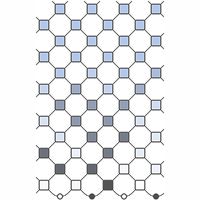
Spin Hall effect driven photocurrent in nonmagnetic single metals

Taiki Nishijima, Ryo Ohshima, Youichi Yanase, Ryota Ishii, Masashi Shiraishi, and Yuichiro Ando

Phys. Rev. B 111, L140406 (2025) - Published 10 April, 2025

The authors unveil here the unexplored potential of nonmagnetic single-element metals by focusing on one type of nonlinear phenomenon: photocurrent generation induced by spin accumulation at the material edges. Distinctive behavior at the material edges, where the spatial symmetry is intrinsically broken, leads to observation of the nonlinear phenomenon. The resulting photocurrent is associated with both time-reversal symmetry breaking and space-inversion symmetry breaking. This groundbreaking observation challenges the prevailing notion that nonlinear phenomena are exclusively observed in more exotic materials.

Electron-magnon coupling mediated magnetotransport in antiferromagnetic van der Waals heterostructures

Sujan Maity, Soumik Das, Mainak Palit, Koushik Dey, Bikash Das, Tanima Kundu, Rahul Paramanik, Binoy Krishna De, Hemant Singh Kunwar, and Subhadeep Datta

Phys. Rev. B 111, L140407 (2025) - Published 16 April, 2025

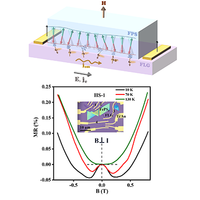
Magnons — wavelike spin excitations in magnets — transfer energy and information without moving charge, like ripples on water. Here, the authors find that in FePS3, an antiferromagnetic insulator, magnons interact with the electrons of few-layer graphene when in a heterostructure, enabling spin waves to convert into electrical signals. In FePS3, magnons soften below 40 K, reducing stiffness with cooling, while few-layer graphene exhibits negative magnetoresistance at low fields (±0.2 T) up to 100 K, transitioning to positive beyond this point. This experiment also proposes a “magnon capacitor”, where spin waves regulate charge transport by influencing carrier dynamics at the interface. With possible applications in energy-efficient computing, this breakthrough advances next-generation spintronic technologies.

Slow measurement-only dynamics of entanglement in Pauli subsystem codes

Benedikt Placke and S. A. Parameswaran

Phys. Rev. B 111, 144308 (2025) - Published 15 April, 2025

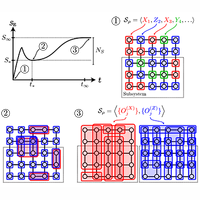
The authors explore here the measurement-only dynamics of a class of models built from subsystem error correcting codes and uncover a wide range of features in entanglement dynamics, with a surprising connection to Hilbert-space fragmentation.

Exact spectral form factors of noninteracting fermions with Dyson statistics

Tatsuhiko N. Ikeda, Lev Vidmar, and Michael O. Flynn

Phys. Rev. B 111, 144312 (2025) - Published 23 April, 2025

Random matrix theory (RMT) is a cornerstone of quantum dynamics that predicts universal features of interacting many-body systems. Here, the authors establish exact methods to compute the spectral form factor (SFF) of noninteracting models whose single-particle states exhibit random matrix statistics. This regime is characterized by exponential growth of the SFF, in sharp contrast to the linear growth of typical interacting systems. These exact results provide a rigorous foundation for future studies of the crossover to many-body RMT and the onset of thermalization.

Probing Hilbert space fragmentation with strongly interacting Rydberg atoms

Fan Yang, Hadi Yarloo, Hua-Chen Zhang, Klaus Mølmer, and Anne E. B. Nielsen

Phys. Rev. B 111, 144313 (2025) - Published 24 April, 2025

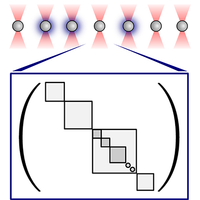
Hilbert space fragmentation provides a novel route to ergodicity breaking in isolated quantum many-body systems. The authors present here a feasible scheme to systematically explore Hilbert space fragmentation in a Rydberg atom array. They show that asymmetric quasiparticle transport can be used to tune Krylov-subspace ergodicity, and that atomic position disorder can selectively induce a many-body localization transition. The proposed scheme is expected to be realized on state-of-the-art Rydberg quantum simulators.

Estimation of spin-orbit torques in the presence of current-induced magnon creation and annihilation

Paul Noel, Emir Karadža, Richard Schlitz, Pol Welter, Charles-Henri Lambert, Luca Nessi, Federico Binda, Christian L. Degen, and Pietro Gambardella

Phys. Rev. B 111, 144409 (2025) - Published 9 April, 2025

Current-induced spin-orbit torques (SOTs) are widely used to control magnetization in spintronic devices. However, the electrical injection of spin currents, which drives the SOTs, also generates and annihilates magnons, affecting both magnetization and magnetoresistance. This work demonstrates that neglecting magnonic effects can significantly overestimate the damping-like torque and misestimate the magnitude and sign of the field-like torque. By combining magneto-optical Kerr effect and magnetotransport measurements, the authors propose here a method for accurately assessing SOTs. These findings highlight the importance of considering magnon contributions to improve the reliability of SOT quantification across different material systems.

Moving skyrmions in antiferromagnets by sublattice displacements

Michael Lau, Wolfgang Häusler, and Michael Thorwart

Phys. Rev. B 111, 144411 (2025) - Published 11 April, 2025

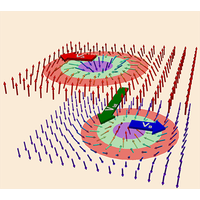
Magnetic skyrmions are topologically protected swirls in magnets. They behave like quasiparticles which, in ferromagnets, don’t exhibit inertial mass. In antiferromagnets, a skyrmion can be viewed as composed of two coupled ferromagnetic skyrmions of opposite orientation. Interestingly, antiferromagnetic skyrmions behave like classical particles, with finite inertial mass. Here, the authors trace this mass generation back to a small displacement between the sublattice skyrmions that arises when applying forces to the skyrmion. They further predict the velocity of a current-driven antiferromagnetic skyrmion.

Eliashberg theory and superfluid stiffness of band-off-diagonal pairing in twisted graphene

Bernhard Putzer and Mathias S. Scheurer

Phys. Rev. B 111, 144513 (2025) - Published 28 April, 2025

Superconductivity typically involves Cooper pairs forming between degenerate electronic states. This work examines an unconventional case where pairing occurs exclusively between nondegenerate, off-resonant bands, motivated by recent experimental observations in twisted graphene systems. The authors uncover a range of unusual phenomena, including modified thermal phase transitions, coexistence of normally incompatible frequency dependencies, and distinctive temperature behavior of the superfluid stiffness. These results provide theoretical insights into the mechanisms and signatures of band-off-diagonal superconductivity and offer a compelling framework for interpreting experimental results.

Translation symmetry restoration under random unitary dynamics

Katja Klobas, Colin Rylands, and Bruno Bertini

Phys. Rev. B 111, L140304 (2025) - Published 8 April, 2025

The authors study here how a system initialized in a non translationally symmetric initial state eventually becomes translationally invariant. They consider the average distance between the time-evolved state, and its translationally symmetric counterpart under the dynamics given by a brickwork circuit with randomly chosen local unitary gates. They find that the timescale for the restoration of translational symmetry coincides with the thermalization time, suggesting that the memory of initial state is not immediately lost, but rather persists until times comparable with the system size.

Near room-temperature ferromagnetism from double exchange in the van der Waals material CrGeTe3: Evidence from optical conductivity under pressure

Jihaan Ebad-Allah, Daniel Guterding, Meera Varma, Mangesh Diware, Shraddha Ganorkar, Harald O. Jeschke, and Christine A. Kuntscher

Phys. Rev. B 111, L140402 (2025) - Published 1 April, 2025

The van der Waals material CrGeTe3 is a ferromagnetic charge-transfer insulator at ambient pressure. When compressed, the material transforms into a semimetal with near room temperature ferromagnetism. Here, the authors present temperature- and pressure-dependent measurements of its optical conductivity, combined with density functional theory and dynamical mean-field theory calculations. A novel approach to analyzing the experimental data reveals that the pressure-induced insulator-to-metal transition alters the mechanism of ferromagnetism in CrGeTe3 from superexchange to double exchange.

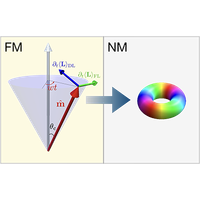
Orbital pumping by magnetization dynamics in ferromagnets

Dongwook Go, Kazuya Ando, Armando Pezo, Stefan Blügel, Aurélien Manchon, and Yuriy Mokrousov

Phys. Rev. B 111, L140409 (2025) - Published 16 April, 2025

The authors theoretically predict here that magnetization dynamics in ferromagnets can pump orbital angular momentum, establishing it as the Onsager reciprocal process of orbital torque, where orbital angular momentum drives magnetization dynamics. This orbital pumping mechanism enables the generation of orbital angular momentum through ferromagnetic resonance via an rf field, incoherent magnons from laser heating, and other means. First-principles calculations reveal that orbital pumping in ferromagnetic Ni is significantly stronger than in Fe, aligning with recent experimental observations.

Pressure-induced superconductivity, amorphization, and topological phase transitions in the topological semimetal MoP4

Chutong Zhang, Xiangzhuo Xing, Song Huang, Xiao Tang, Linchao Yu, Na Zuo, Bin Li, Xiaolei Yi, Yan Meng, Xiaoran Zhang, Bingchao Yang, Xin Chen, Xiaofeng Xu, and Xiaobing Liu

Phys. Rev. B 111, L140502 (2025) - Published 3 April, 2025

Pressure-induced superconductivity in topological materials offers a promising avenue for discovering the so-called topological superconductors. Here, the authors report the emergence of pressure-induced superconductivity, amorphization, and topological quantum phase transitions in the topological semimetal MoP4. Notably, they observed unexpected superconducting fluctuations concurrent with the amorphous phase transition, extending up to Tsf ~ 20 K, an exceptionally high value besides high-temperature superconductors. These findings position MoP4 as a compelling platform for investigating the intricate interplay between superconductivity, amorphization, and topological phenomena.

LETTERS

Structure, structural phase transitions, mechanical properties, defects

Evidence for reduced periodic lattice distortion within the Sb-terminated surface layer of the kagome metal CsV3Sb5

Felix Kurtz, Gevin von Witte, Lukas Jehn, Alp Akbiyik, Igor Vinograd, Matthieu Le Tacon, Amir A. Haghighirad, Dong Chen, Chandra Shekhar, Claudia Felser, and Claus Ropers

Phys. Rev. B 111, L140101 (2025) - Published 9 April, 2025

Perturbation theory for dispersion relations of spacetime-periodic materials

E. O. Hiltunen

Phys. Rev. B 111, L140102 (2025) - Published 30 April, 2025

Inhomogeneous, disordered, and partially ordered systems

Scale-free localization versus Anderson localization in unidirectional quasiperiodic lattices

Yu Zhang, Luhong Su, and Shu Chen

Phys. Rev. B 111, L140201 (2025) - Published 11 April, 2025

Unsupervised machine learning for detecting mutual independence among eigenstate regimes in interacting quasiperiodic chains

Colin Beveridge, Kathleen Hart, Cassio Rodrigo Cristani, Xiao Li, Enrico Barbierato, and Yi-Ting Hsu

Phys. Rev. B 111, L140202 (2025) - Published 25 April, 2025

Dynamics, dynamical systems, lattice effects

Biermann battery effect in laser-excited metals

Ivan Oladyshkin

Phys. Rev. B 111, L140301 (2025) - Published 1 April, 2025

Entanglement Hamiltonians and the quasiparticle picture

Federico Rottoli, Colin Rylands, and Pasquale Calabrese

Phys. Rev. B 111, L140302 (2025) - Published 3 April, 2025

Entanglement spectrum dynamics as a probe for non-Hermitian bulk-boundary correspondence in systems with periodic boundaries

Pablo Bayona-Pena, Ryo Hanai, Takashi Mori, and Hisao Hayakawa

Phys. Rev. B 111, L140303 (2025) - Published 7 April, 2025

Translation symmetry restoration under random unitary dynamics

Katja Klobas, Colin Rylands, and Bruno Bertini

Phys. Rev. B 111, L140304 (2025) - Published 8 April, 2025

The authors study here how a system initialized in a non translationally symmetric initial state eventually becomes translationally invariant. They consider the average distance between the time-evolved state, and its translationally symmetric counterpart under the dynamics given by a brickwork circuit with randomly chosen local unitary gates. They find that the timescale for the restoration of translational symmetry coincides with the thermalization time, suggesting that the memory of initial state is not immediately lost, but rather persists until times comparable with the system size.

Constrained dynamics and confinement in the two-dimensional quantum Ising model

Luka Pavešić, Daniel Jaschke, and Simone Montangero

Phys. Rev. B 111, L140305 (2025) - Published 10 April, 2025

Magnetism

Efficient electric field control of the magnetic phase in bilayer magnets via interlayer hopping modulation

B. Liu, J. S. Feng, H. J. Xiang, Z. Dai, and Zhi-Xin Guo

Phys. Rev. B 111, L140401 (2025) - Published 1 April, 2025

Near room-temperature ferromagnetism from double exchange in the van der Waals material CrGeTe3: Evidence from optical conductivity under pressure

Jihaan Ebad-Allah, Daniel Guterding, Meera Varma, Mangesh Diware, Shraddha Ganorkar, Harald O. Jeschke, and Christine A. Kuntscher

Phys. Rev. B 111, L140402 (2025) - Published 1 April, 2025

The van der Waals material CrGeTe3 is a ferromagnetic charge-transfer insulator at ambient pressure. When compressed, the material transforms into a semimetal with near room temperature ferromagnetism. Here, the authors present temperature- and pressure-dependent measurements of its optical conductivity, combined with density functional theory and dynamical mean-field theory calculations. A novel approach to analyzing the experimental data reveals that the pressure-induced insulator-to-metal transition alters the mechanism of ferromagnetism in CrGeTe3 from superexchange to double exchange.

First-principles calculations study of valley polarization in antiferromagnetic bilayer systems

San-Dong Guo, Ping Li, and Guangzhao Wang

Phys. Rev. B 111, L140404 (2025) - Published 2 April, 2025

Ferroelectric control of spin and orbital Rashba effects at the Ni/HfO2 interface

Armando Pezo, Andrés Saul, Aurélien Manchon, and Rémi Arras

Phys. Rev. B 111, L140405 (2025) - Published 9 April, 2025

Spin Hall effect driven photocurrent in nonmagnetic single metals

Taiki Nishijima, Ryo Ohshima, Youichi Yanase, Ryota Ishii, Masashi Shiraishi, and Yuichiro Ando

Phys. Rev. B 111, L140406 (2025) - Published 10 April, 2025

The authors unveil here the unexplored potential of nonmagnetic single-element metals by focusing on one type of nonlinear phenomenon: photocurrent generation induced by spin accumulation at the material edges. Distinctive behavior at the material edges, where the spatial symmetry is intrinsically broken, leads to observation of the nonlinear phenomenon. The resulting photocurrent is associated with both time-reversal symmetry breaking and space-inversion symmetry breaking. This groundbreaking observation challenges the prevailing notion that nonlinear phenomena are exclusively observed in more exotic materials.

Electron-magnon coupling mediated magnetotransport in antiferromagnetic van der Waals heterostructures

Sujan Maity, Soumik Das, Mainak Palit, Koushik Dey, Bikash Das, Tanima Kundu, Rahul Paramanik, Binoy Krishna De, Hemant Singh Kunwar, and Subhadeep Datta

Phys. Rev. B 111, L140407 (2025) - Published 16 April, 2025

Magnons — wavelike spin excitations in magnets — transfer energy and information without moving charge, like ripples on water. Here, the authors find that in FePS3, an antiferromagnetic insulator, magnons interact with the electrons of few-layer graphene when in a heterostructure, enabling spin waves to convert into electrical signals. In FePS3, magnons soften below 40 K, reducing stiffness with cooling, while few-layer graphene exhibits negative magnetoresistance at low fields (±0.2 T) up to 100 K, transitioning to positive beyond this point. This experiment also proposes a “magnon capacitor”, where spin waves regulate charge transport by influencing carrier dynamics at the interface. With possible applications in energy-efficient computing, this breakthrough advances next-generation spintronic technologies.

Integrable and critical Haagerup spin chains

Luke Corcoran and Marius de Leeuw

Phys. Rev. B 111, L140408 (2025) - Published 16 April, 2025

Orbital pumping by magnetization dynamics in ferromagnets

Dongwook Go, Kazuya Ando, Armando Pezo, Stefan Blügel, Aurélien Manchon, and Yuriy Mokrousov

Phys. Rev. B 111, L140409 (2025) - Published 16 April, 2025

The authors theoretically predict here that magnetization dynamics in ferromagnets can pump orbital angular momentum, establishing it as the Onsager reciprocal process of orbital torque, where orbital angular momentum drives magnetization dynamics. This orbital pumping mechanism enables the generation of orbital angular momentum through ferromagnetic resonance via an rf field, incoherent magnons from laser heating, and other means. First-principles calculations reveal that orbital pumping in ferromagnetic Ni is significantly stronger than in Fe, aligning with recent experimental observations.

Subsystem evolution speed as indicator of relaxation

Jiaju Zhang (张甲举), M. A. Rajabpour, Markus Heyl, and Reyhaneh Khasseh

Phys. Rev. B 111, L140410 (2025) - Published 17 April, 2025

Dynamic magnetic ground state in the dimer based compound Yb2Te5O13

Rahul Kumar, Anita Gemmy Francis, Rhea Stewart, Peter J. Baker, Ralf Feyerherm, Devesh Chandra Binwal, Bella Lake, Swapan K. Pati, and A. Sundaresan

Phys. Rev. B 111, L140411 (2025) - Published 21 April, 2025

Crosstalk between magnetostriction and magnetoelectric coupling in type-II multiferroic TbFeO3

A. Indra, S. Mukherjee, K. Dey, O. Fabelo, L. Canadillas-Delgado, T. Chatterji, J. Strempfer, S. Majumdar, and S. Giri

Phys. Rev. B 111, L140412 (2025) - Published 24 April, 2025

Dynamics of electromagnons in GdMn2O5: Role of Gd-Mn exchange interaction

Taek Sun Jung, Jong Hyuk Kim, Nara Lee, Young Jai Choi, and Jae Hoon Kim

Phys. Rev. B 111, L140413 (2025) - Published 24 April, 2025

Revealing the magnetic dimensional crossover in the Heisenberg ferromagnet CrSiTe3 through picosecond strain pulses

Anjan Kumar N M, Soumya Mukherjee, Abhirup Mukherjee, Ajinkya Punjal, Shubham Purwar, Thirupathaiah Setti, Shriganesh Prabhu S., Siddhartha Lal, and N. Kamaraju

Phys. Rev. B 111, L140414 (2025) - Published 25 April, 2025

Deciphering the origin of spin current in spintronic terahertz emitters and its imprint on their electromagnetic radiation via time-dependent density functional theory

Ali Kefayati, Yafei Ren, M. Benjamin Jungfleisch, Lars Gundlach, John Q. Xiao, and Branislav K. Nikolić

Phys. Rev. B 111, L140415 (2025) - Published 25 April, 2025

Anomalous valley Hall effect in monolayer chromium-based triple-Q magnets

Xiu-Cai Jiang, Li-Ya Qiao, and Yu-Zhong Zhang

Phys. Rev. B 111, L140416 (2025) - Published 28 April, 2025

Spin texture and tunneling magnetoresistance in atomically thin CrSBr

Ziqi Liu, Yichang Sun, Chengfeng Zhu, Canyu Hong, Yuchen Gao, Zeyuan Sun, Kenji Watanabe, Takashi Taniguchi, Shiwei Wu, Zuxin Chen, Pingfan Gu, and Yu Ye

Phys. Rev. B 111, L140417 (2025) - Published 30 April, 2025

Twisted magnetocaloric effect by spin-glass driven large exchange bias

Manisha Bansal, Wasim Akram, Samir Kumar Giri, and Tuhin Maity

Phys. Rev. B 111, L140418 (2025) - Published 30 April, 2025

Superfluidity and superconductivity

High-temperature superconductivity in Li2AuH6 mediated by strong electron-phonon coupling under ambient pressure

Zhenfeng Ouyang, Bo-Wen Yao, Xiao-Qi Han, Peng-Jie Guo, Ze-Feng Gao, and Zhong-Yi Lu

Phys. Rev. B 111, L140501 (2025) - Published 2 April, 2025

Pressure-induced superconductivity, amorphization, and topological phase transitions in the topological semimetal MoP4

Chutong Zhang, Xiangzhuo Xing, Song Huang, Xiao Tang, Linchao Yu, Na Zuo, Bin Li, Xiaolei Yi, Yan Meng, Xiaoran Zhang, Bingchao Yang, Xin Chen, Xiaofeng Xu, and Xiaobing Liu

Phys. Rev. B 111, L140502 (2025) - Published 3 April, 2025

Pressure-induced superconductivity in topological materials offers a promising avenue for discovering the so-called topological superconductors. Here, the authors report the emergence of pressure-induced superconductivity, amorphization, and topological quantum phase transitions in the topological semimetal MoP4. Notably, they observed unexpected superconducting fluctuations concurrent with the amorphous phase transition, extending up to Tsf ~ 20 K, an exceptionally high value besides high-temperature superconductors. These findings position MoP4 as a compelling platform for investigating the intricate interplay between superconductivity, amorphization, and topological phenomena.

Thermodynamics of non-Hermitian Josephson junctions with exceptional points

D. Michel Pino, Yigal Meir, and Ramón Aguado

Phys. Rev. B 111, L140503 (2025) - Published 4 April, 2025

Coexistence of chiral Majorana edge states and Bogoliubov Fermi surfaces in two-dimensional nonsymmorphic Dirac semimetal/superconductor heterostructures

Yijie Mo, Xiao-Jiao Wang, Zheng-Yang Zhuang, and Zhongbo Yan

Phys. Rev. B 111, L140504 (2025) - Published 9 April, 2025

Mesoscopic theory of the Josephson junction

Thomas J. Maldonado, Hakan E. Türeci, and Alejandro W. Rodriguez

Phys. Rev. B 111, L140505 (2025) - Published 14 April, 2025

Unconventional Josephson supercurrent diode effect induced by chiral spin-orbit coupling

Andreas Costa, Osamu Kanehira, Hiroaki Matsueda, and Jaroslav Fabian

Phys. Rev. B 111, L140506 (2025) - Published 17 April, 2025

Edge modes in chiral electron double layers

Klaus Ziegler and Roman Ya. Kezerashvili

Phys. Rev. B 111, L140507 (2025) - Published 21 April, 2025

Charge density wave, superconductivity, and nontrivial topology in monolayer NbSi2As4

Xiuying Liu, Kaiming Han, ShuaiYu Wang, Yapeng Wu, Bing Zhang, Guo-Jun Zhao, Xiao-Ping Li, Xing-Qiu Chen, and Lei Wang

Phys. Rev. B 111, L140508 (2025) - Published 23 April, 2025

ARTICLES

Structure, structural phase transitions, mechanical properties, defects

Pressure- and temperature-induced transformation processes in PbTiO3−BiMeO3 ferroelectrics

Irina Margaritescu, Zenghui Liu, Thomas Malcherek, Carsten Paulmann, Zuo-Guang Ye, and Boriana Mihailova

Phys. Rev. B 111, 144101 (2025) - Published 1 April, 2025

Curved stacking pathways along the γ-surface of diamond

Chunxia Chi, Hairui Ding, Xiang-Feng Zhou, and Xiao Dong

Phys. Rev. B 111, 144102 (2025) - Published 3 April, 2025

Pressure-induced evolution of superconductivity and structural stability in a bulk 4Hb -TaSeS heterostructure

Yehua Huang, Hang Li, Xin Yang, Wenju Zhou, Donghan Jia, Jiajia Feng, He Zhang, Guoliang Niu, Bingmin Yan, Fuyang Liu, Qingchao Zeng, Guangwei Che, Runze Jiang, Junwei Li, Luhong Wang, Haozhe Liu, Ricardo D. dos Reis, Renbiao Tao, Xiaohui Yu, Qingyang Hu, Bin Chen, and Huiyang Gou

Phys. Rev. B 111, 144103 (2025) - Published 8 April, 2025

Machine learning accelerates composition design of lead-free high performance piezoceramics based on potassium sodium niobate

Xingshuai Ma (马星帅), Shiqing Deng (邓世清), He Qi (祁核), and Jun Chen (陈骏)

Phys. Rev. B 111, 144104 (2025) - Published 11 April, 2025

Correlation between thermodynamic stability and mechanical properties of Cu50Zr50 metallic glasses: Insights from atomistic simulations

Shidong Feng, Lin Li, Xiaoqian Lu, Yun-Jiang Wang, Kia Ling Ngai, Maozhi Li, Weihua Wang, Li-Min Wang, and Ri-Ping Liu

Phys. Rev. B 111, 144105 (2025) - Published 16 April, 2025

Comparison of liquid-vapor relations and the critical points of CaO and MgO

T. F. J. Bögels and R. Caracas

Phys. Rev. B 111, 144106 (2025) - Published 17 April, 2025

Impact of local structure on melt dynamics in Cu-Ti alloys: Insights from ab initio molecular dynamics simulations

Lucas P. Kreuzer, Fan Yang, Andreas Meyer, and Noël Jakse

Phys. Rev. B 111, 144107 (2025) - Published 23 April, 2025

Low viscosity of solid MgO at high pressures and strain rates measured using the laser-driven Richtmyer-Meshkov instability

Tyler M. Perez, Sonya C. Dick, Raymond F. Smith, Peter M. Celliers, Jon H. Eggert, Suzanne J. Ali, Eric Johnsen, and June K. Wicks

Phys. Rev. B 111, 144108 (2025) - Published 23 April, 2025

200-fold increase in dynamic strength of platinum at 430 GPa without a phase transformation

Gaia Righi, Yong-Jae Kim, Robert E. Rudd, Tom E. Lockard, Matthew P. Hill, James M. McNaney, Anna M. Murphy, Camelia V. Stan, and Hye-Sook Park

Phys. Rev. B 111, 144109 (2025) - Published 25 April, 2025

High-pressure structural behavior of silicon telluride Si2Te3 nanoplates

Bohan Li, Frank Cerasoli, Ethan Chen, Martin Kunz, Davide Donadio, and Kristie J. Koski

Phys. Rev. B 111, 144110 (2025) - Published 25 April, 2025

Inhomogeneous, disordered, and partially ordered systems

Revisiting the phonon theory of liquid heat capacity: Low-frequency shear modes and intramolecular vibrations

Yu Liu and Matteo Baggioli

Phys. Rev. B 111, 144201 (2025) - Published 2 April, 2025

Spectral width of maximum deposition eigenchannels in diffusive media

Rohin E. McIntosh, Arthur Goetschy, Nicholas Bender, Alexey Yamilov, Chia Wei Hsu, Hasan Yılmaz, and Hui Cao

Phys. Rev. B 111, 144202 (2025) - Published 11 April, 2025

Surface magnetic order driven electronic anisotropy in Sr3Ru2O7

Buddhadeb Debnath and Shantanu Mukherjee

Phys. Rev. B 111, 144203 (2025) - Published 28 April, 2025

Dynamics, dynamical systems, lattice effects

Learning out-of-time-ordered correlators with classical kernel methods

John Tanner, Jason Pye, and Jingbo Wang

Phys. Rev. B 111, 144301 (2025) - Published 1 April, 2025

Projected ensemble in a system with locally supported conserved charges

Sandipan Manna, Sthitadhi Roy, and G. J. Sreejith

Phys. Rev. B 111, 144302 (2025) - Published 3 April, 2025

Electron stopping power of protons in aluminum at finite electron temperature

Ya-Ting Sun, Feng Wang, Fei Mao, and Cong-Zhang Gao

Phys. Rev. B 111, 144303 (2025) - Published 3 April, 2025

Revealing the acoustic spin and beam invariants from the Dirac-like equation

Yang Tan, Yanqiu Wang, Jingjing Liu, Bin Liang, and Jianchun Cheng

Phys. Rev. B 111, 144304 (2025) - Published 7 April, 2025

Quantum geometry embedded in unitarity of evolution: Revealing its impacts as geometric oscillation and dephasing in spin resonance and crystal bands

B. Q. Song, J. D. H. Smith, T. Jiang, Y. X. Yao, and J. Wang

Phys. Rev. B 111, 144305 (2025) - Published 8 April, 2025

Exact real-time dynamics with free fermions in disguise

István Vona, Márton Mestyán, and Balázs Pozsgay

Phys. Rev. B 111, 144306 (2025) - Published 10 April, 2025

Critical non-Hermitian skin effect induced by boundary defects

Yifei Yi

Phys. Rev. B 111, 144307 (2025) - Published 14 April, 2025

Slow measurement-only dynamics of entanglement in Pauli subsystem codes

Benedikt Placke and S. A. Parameswaran

Phys. Rev. B 111, 144308 (2025) - Published 15 April, 2025

The authors explore here the measurement-only dynamics of a class of models built from subsystem error correcting codes and uncover a wide range of features in entanglement dynamics, with a surprising connection to Hilbert-space fragmentation.

First-principles equation for coherent phonons: Dynamics and polaron distortions

Gianluca Stefanucci and Enrico Perfetto

Phys. Rev. B 111, 144309 (2025) - Published 17 April, 2025

Hilbert subspace ergodicity

Leonard Logarić, John Goold, and Shane Dooley

Phys. Rev. B 111, 144310 (2025) - Published 18 April, 2025

Controlling discrete time crystals via single-site operations in zero-field diamond quantum simulators

Naoya Egawa, Kaoru Mizuta, and Joji Nasu

Phys. Rev. B 111, 144311 (2025) - Published 21 April, 2025

Exact spectral form factors of noninteracting fermions with Dyson statistics

Tatsuhiko N. Ikeda, Lev Vidmar, and Michael O. Flynn

Phys. Rev. B 111, 144312 (2025) - Published 23 April, 2025

Random matrix theory (RMT) is a cornerstone of quantum dynamics that predicts universal features of interacting many-body systems. Here, the authors establish exact methods to compute the spectral form factor (SFF) of noninteracting models whose single-particle states exhibit random matrix statistics. This regime is characterized by exponential growth of the SFF, in sharp contrast to the linear growth of typical interacting systems. These exact results provide a rigorous foundation for future studies of the crossover to many-body RMT and the onset of thermalization.

Probing Hilbert space fragmentation with strongly interacting Rydberg atoms

Fan Yang, Hadi Yarloo, Hua-Chen Zhang, Klaus Mølmer, and Anne E. B. Nielsen

Phys. Rev. B 111, 144313 (2025) - Published 24 April, 2025

Hilbert space fragmentation provides a novel route to ergodicity breaking in isolated quantum many-body systems. The authors present here a feasible scheme to systematically explore Hilbert space fragmentation in a Rydberg atom array. They show that asymmetric quasiparticle transport can be used to tune Krylov-subspace ergodicity, and that atomic position disorder can selectively induce a many-body localization transition. The proposed scheme is expected to be realized on state-of-the-art Rydberg quantum simulators.

Phonon vibrational and transport properties of SnSe/SnS superlattice at finite temperatures

Feng-ning Xue, Wei Li, Zi Li, and Yong Lu

Phys. Rev. B 111, 144314 (2025) - Published 28 April, 2025

Coarsening dynamics of Ising-nematic order in a frustrated Heisenberg antiferromagnet

Yang Yang, Yi-Hsuan Liu, Rafael M. Fernandes, and Gia-Wei Chern

Phys. Rev. B 111, 144315 (2025) - Published 29 April, 2025

Magnetism

Magnetic properties and magnetization reversal in L10 FePt/FeCo exchange bias thin films with in-plane magnetocrystalline anisotropy

Yiwei Zhou, Liwang Liu, Robert Wieser, Cuihong Yang, Lu Wang, Weifeng Rao, and Xuan Wang

Phys. Rev. B 111, 144401 (2025) - Published 2 April, 2025

Scaling behavior of magnetoresistance and Hall resistivity in the altermagnet CrSb

Xin Peng, Yuzhi Wang, Shengnan Zhang, Yi Zhou, Yuran Sun, Yahui Su, Chunxiang Wu, Tingyu Zhou, Le Liu, Hangdong Wang, Jinhu Yang, Bin Chen, Zhong Fang, Jianhua Du, Zhiwei Jiao, Quansheng Wu, and Minghu Fang

Phys. Rev. B 111, 144402 (2025) - Published 3 April, 2025

Magnetic metastability driven anomalous Hall effect in FexTaS2

Mohamad Numan, Prasanta Chowdhury, Sanat Kumar Adhikary, Saurav Giri, Jhuma Sannigrahi, Matthias Gutmann, Souvik Chatterjee, and Subham Majumdar

Phys. Rev. B 111, 144403 (2025) - Published 4 April, 2025

Magnetic anisotropy and dipolar interactions in the frustrated triangular-lattice magnet NaGdS2

J. Grumbach, E. Häußler, S. Luther, J. Sichelschmidt, K. M. Ranjith, T. Herrmannsdörfer, M. Rotter, S. Granovsky, H. Kühne, M. Uhlarz, J. Wosnitza, H.-H. Klauß, M. Baenitz, T. Doert, and M. Doerr

Phys. Rev. B 111, 144404 (2025) - Published 4 April, 2025

Skyrmion phase in polycrystalline GdRu2Si2 revealed by magnetic susceptibility, topological Hall effect, and Shubnikov–de Haas-like quantum oscillations

Surbhi Gupta, Akhilesh Kumar Patel, Anu, Sudip Mukherjee, P. D. Babu, Nirat Ray, and K. G. Suresh

Phys. Rev. B 111, 144405 (2025) - Published 7 April, 2025

Evaluating SCAN and r2SCAN meta-GGA functionals for predicting transition temperatures in antiferromagnetic materials

Nafise Rezaei, Mojtaba Alaei, and Artem R. Oganov

Phys. Rev. B 111, 144406 (2025) - Published 8 April, 2025

Dipolar Aleppo lattice: Ground state ordering and ergodic dynamics in the absence of vertex frustration

Davis Crater, Gopi Mahato, Christian Hoyt, Duncan Miertschin, Balaram Regmi, Kevin Hofhuis, Scott Dhuey, Barat Achinuq, Francesco Caravelli, and Alan Farhan

Phys. Rev. B 111, 144407 (2025) - Published 8 April, 2025

Role of domain nucleation and domain wall motion in all-optical helicity-dependent switching

Tian Xun Huang, Wei Zhang, Michel Hehn, Grégory Malinowski, Stéphane Mangin, and Julius Hohlfeld

Phys. Rev. B 111, 144408 (2025) - Published 8 April, 2025

Estimation of spin-orbit torques in the presence of current-induced magnon creation and annihilation

Paul Noel, Emir Karadža, Richard Schlitz, Pol Welter, Charles-Henri Lambert, Luca Nessi, Federico Binda, Christian L. Degen, and Pietro Gambardella

Phys. Rev. B 111, 144409 (2025) - Published 9 April, 2025

Current-induced spin-orbit torques (SOTs) are widely used to control magnetization in spintronic devices. However, the electrical injection of spin currents, which drives the SOTs, also generates and annihilates magnons, affecting both magnetization and magnetoresistance. This work demonstrates that neglecting magnonic effects can significantly overestimate the damping-like torque and misestimate the magnitude and sign of the field-like torque. By combining magneto-optical Kerr effect and magnetotransport measurements, the authors propose here a method for accurately assessing SOTs. These findings highlight the importance of considering magnon contributions to improve the reliability of SOT quantification across different material systems.

How quantum selection rules influence the magneto-optical effects of driven ultrafast magnetization dynamics

Mohamed F. Elhanoty, Olle Eriksson, Chin Shen Ong, and Oscar Grånäs

Phys. Rev. B 111, 144410 (2025) - Published 11 April, 2025

Moving skyrmions in antiferromagnets by sublattice displacements

Michael Lau, Wolfgang Häusler, and Michael Thorwart

Phys. Rev. B 111, 144411 (2025) - Published 11 April, 2025

Magnetic skyrmions are topologically protected swirls in magnets. They behave like quasiparticles which, in ferromagnets, don’t exhibit inertial mass. In antiferromagnets, a skyrmion can be viewed as composed of two coupled ferromagnetic skyrmions of opposite orientation. Interestingly, antiferromagnetic skyrmions behave like classical particles, with finite inertial mass. Here, the authors trace this mass generation back to a small displacement between the sublattice skyrmions that arises when applying forces to the skyrmion. They further predict the velocity of a current-driven antiferromagnetic skyrmion.

Interfacial Dzyaloshinskii-Moriya interaction in nonmagnetic/noncollinear-antiferromagnetic bilayers

Yuta Yamane, Yasufumi Araki, and Shunsuke Fukami

Phys. Rev. B 111, 144412 (2025) - Published 11 April, 2025

Spontaneous chirality selection and nonreciprocal spin wave in breathing-kagome antiferromagnets at zero field

Kazushi Aoyama and Hikaru Kawamura

Phys. Rev. B 111, 144413 (2025) - Published 14 April, 2025

Dynamics of metastable contact soliton dissipative exchange flows in one-dimensional ferromagnetic channels

Medhanie Estiphanos and Ezio Iacocca

Phys. Rev. B 111, 144414 (2025) - Published 14 April, 2025

Intrinsic spin Nernst effect and chiral edge modes in van der Waals ferromagnetic insulators: Dzyaloshinskii-Moriya versus Kitaev interactions

Verena Brehm, Paweł Sobieszczyk, and Alireza Qaiumzadeh

Phys. Rev. B 111, 144415 (2025) - Published 15 April, 2025

Microscopic theory of Rashba-Edelstein magnetoresistance

Masaki Yama, Mamoru Matsuo, and Takeo Kato

Phys. Rev. B 111, 144416 (2025) - Published 16 April, 2025

Angular-dependent tunneling magnetoresistance in a tunnel junction with ferromagnetic and noncollinear antiferromagnetic electrodes

Qing-Qing Luo, Xiao-Yan Guo, Hang Zhou, Gautam Gurung, Jun-Min Xu, Wen-Jian Lu, Yu-Ping Sun, Evgeny Y. Tsymbal, and Ding-Fu Shao

Phys. Rev. B 111, 144417 (2025) - Published 18 April, 2025

Ferroelectricity-driven metallicity and magnetic skyrmions in the van der Waals Cr2Ge2Te6/Hf2Ge2Te6 multiferroic heterostructure

Zheng Chen, Hongliang Hu, Xiaoping Wu, Wenjun Zhang, Ping Li, and Changsheng Song

Phys. Rev. B 111, 144418 (2025) - Published 21 April, 2025

Optimizing supercell structures for Heisenberg exchange interaction calculations

Mojtaba Alaei and Artem R. Oganov

Phys. Rev. B 111, 144419 (2025) - Published 21 April, 2025

Spin dynamics and 1/3 magnetization plateau in the coupled distorted diamond chain compound K2Cu3(MoO4)4

G. Senthil Murugan, J. Khatua, Suyoung Kim, Eundeok Mun, K. Ramesh Babu, Heung-Sik Kim, C.-L. Huang, R. Kalaivanan, U. Rajesh Kumar, I. Panneer Muthuselvam, W. T. Chen, Sritharan Krishnamoorthi, K.-Y. Choi, and R. Sankar

Phys. Rev. B 111, 144420 (2025) - Published 21 April, 2025

Ultrafast electron-phonon scattering in an antiferromagnetic Dirac semimetal

Marius Weber, Kai Leckron, Libor Šmejkal, Jairo Sinova, Baerbel Rethfeld, and Hans Christian Schneider

Phys. Rev. B 111, 144421 (2025) - Published 21 April, 2025

Topological Hall effect in ferromagnetic Weyl semimetal Mn5Ge3 originating in competing dipolar interaction and magnetocrystalline anisotropy

Achintya Low, Tushar Kanti Bhowmik, Susanta Ghosh, Susmita Changdar, and Setti Thirupathaiah

Phys. Rev. B 111, 144422 (2025) - Published 22 April, 2025

Dynamically generated spin interactions and nutational spin inertia in normal metal–ferromagnet heterostructures

Christian Svingen Johnsen and Asle Sudbø

Phys. Rev. B 111, 144423 (2025) - Published 24 April, 2025

Topological and magnetic properties of a noncollinear spin state on a honeycomb lattice in a magnetic field

Randy S. Fishman and Daniel M. Pajerowski

Phys. Rev. B 111, 144424 (2025) - Published 28 April, 2025

Tunable Carr-type temperature dependence of uniaxial magnetocrystalline anisotropy in Fe-deficient Fe3−xGeTe2

Jiawei Liu, Liang Zhou, Rui Liang, Shuilin Li, Ziying Li, Li Zhang, Zishuang Li, Haozhe Wang, Yi Huang, Ronghua Liu, and Nujiang Tang

Phys. Rev. B 111, 144425 (2025) - Published 28 April, 2025

Anomalous spin-lattice coupling in the quasi-one-dimensional spin-1 corrugated skew-chain antiferromagnet: Ni2V2O7

Hemant Singh Kunwar, Koushik Chakraborty, Aditi Agrawal, Arvind Kumar Yogi, Binoy Krishna De, Pragati Sharma, Shalini Mishra, Suman Karmakar, D. T. Adroja, Mayanak Kumar Gupta, R. Mittal, R. Venkatesh, and V. G. Sathe

Phys. Rev. B 111, 144426 (2025) - Published 30 April, 2025

Superfluidity and superconductivity

Surface-dependent Majorana vortex phases in topological crystalline insulators

Xun-Jiang Luo, Xiao-Hong Pan, Yilin Shi, and Fengcheng Wu

Phys. Rev. B 111, 144501 (2025) - Published 1 April, 2025

Spin-density wave and superconductivity in La4Ni3O10 under ambient pressure

Ming Zhang, Hongyi Sun, Yu-Bo Liu, Qihang Liu, Wei-Qiang Chen, and Fan Yang

Phys. Rev. B 111, 144502 (2025) - Published 2 April, 2025

Three magnetization peaks in HgBa2Ca2Cu3O8+δ single crystals

Yongze Ye, Yuhao Liu, Wenshan Hong, Yuan Li, and Hai-Hu Wen

Phys. Rev. B 111, 144503 (2025) - Published 2 April, 2025

Anisotropic modulations of superconductivity in an isolated superconducting layer of the iron-based superconductor KCa2Fe4As4F2

Zongyuan Zhang, Qing Wang, Lichuan Wang, Yu-bing Tu, Shuai Shao, Teng Wang, Fan Zhang, Jie Hou, Xing-yuan Hou, Gang Mu, Ning Hao, and Lei Shan

Phys. Rev. B 111, 144504 (2025) - Published 11 April, 2025

Superconducting dome and structural changes in LaRu3Si2 under pressure

Z. Li, S. Huyan, E. C. Thompson, T. J. Slade, D. Zhang, Y. J. Ryu, W. Bi, S. L. Bud'ko, and P. C. Canfield

Phys. Rev. B 111, 144505 (2025) - Published 16 April, 2025

Manipulating and braiding Majorana corner modes on a kagome lattice

San-Ren He, Xiu-Lian Bi, Jing Fan, Zhen-Hua Wang, Lin Li, and Dong-Hui Xu

Phys. Rev. B 111, 144506 (2025) - Published 16 April, 2025

Borophane as substrate for adsorption of He4: A journey across dimensionality

Stefania De Palo, Saverio Moroni, Francesco Ancilotto, Pier Luigi Silvestrelli, and Luciano Reatto

Phys. Rev. B 111, 144507 (2025) - Published 17 April, 2025

Classification of pair symmetries in superconductors with unconventional magnetism

Kazuki Maeda, Yuri Fukaya, Keiji Yada, Bo Lu, Yukio Tanaka, and Jorge Cayao

Phys. Rev. B 111, 144508 (2025) - Published 18 April, 2025

Effect of quantum anharmonicity on the superconductivity of I4¯3m CH4−H3S at high pressures: A first-principles study

Pugeng Hou, Francesco Belli, Tiange Bi, Eva Zurek, and Ion Errea

Phys. Rev. B 111, 144509 (2025) - Published 18 April, 2025

Supercurrent flow in inhomogeneous superconductors

Mikhail A. Skvortsov, Oleg B. Zuev, and Dina I. Fazlizhanova

Phys. Rev. B 111, 144510 (2025) - Published 23 April, 2025

MPd5 kagome superconductors studied by density functional calculations

Dan Li, Zhengxuan Wang, Panshi Jing, Mehrdad Shiri, Kun Wang, Chunlan Ma, Shijing Gong, Chuanxi Zhao, Tianxing Wang, Xiao Dong, Lin Zhuang, Wuming Liu, and Yipeng An

Phys. Rev. B 111, 144511 (2025) - Published 24 April, 2025

Higgs amplitude mode in optical conductivity in the presence of a supercurrent: Gauge-invariant formulation with disorder

Ke Wang, Rufus Boyack, and K. Levin

Phys. Rev. B 111, 144512 (2025) - Published 28 April, 2025

Eliashberg theory and superfluid stiffness of band-off-diagonal pairing in twisted graphene

Bernhard Putzer and Mathias S. Scheurer

Phys. Rev. B 111, 144513 (2025) - Published 28 April, 2025

Superconductivity typically involves Cooper pairs forming between degenerate electronic states. This work examines an unconventional case where pairing occurs exclusively between nondegenerate, off-resonant bands, motivated by recent experimental observations in twisted graphene systems. The authors uncover a range of unusual phenomena, including modified thermal phase transitions, coexistence of normally incompatible frequency dependencies, and distinctive temperature behavior of the superfluid stiffness. These results provide theoretical insights into the mechanisms and signatures of band-off-diagonal superconductivity and offer a compelling framework for interpreting experimental results.

Out-of-plane bond-order phase, superconductivity, and their competition in the t- J∥−J⊥ model: Possible implications for bilayer nickelates

Matías Bejas, Xianxin Wu, Debmalya Chakraborty, Andreas P. Schnyder, and Andrés Greco

Phys. Rev. B 111, 144514 (2025) - Published 28 April, 2025

Pressure-induced superconducting and structural properties of noncentrosymmetric LaPtGe

Sathiskumar Mariappan, Dilip Bhoi, Boby Joseph, R. P. Singh, Govindaraj Lingannan, R. K. Kushwaha, P. K. Meena, Arumugam Sonachalam, and Yoshiya Uwatoko

Phys. Rev. B 111, 144515 (2025) - Published 30 April, 2025

COMMENTS

Comment on “Reconsidering nonlinear emergent inductance: Time-varying Joule heating and its impact on AC electrical response”

Tomoyuki Yokouchi, Aki Kitaori, Daiki Yamaguchi, Naoya Kanazawa, Max Hirschberger, Naoto Nagaosa, and Yoshinori Tokura

Phys. Rev. B 111, 146401 (2025) - Published 4 April, 2025

Sign In to Your Journals Account

Filter

Filter

Article Lookup

Enter a citation