Highlights

Surface dynamics of graphite probed by soft x-ray linear dichroism in Auger-emission yield

G. Schiwietz, T. Kachel, R. Mitzner, and K. Holldack

Phys. Rev. B 107, 054306 (2023) - Published 13 February, 2023

Element-specific investigation of the dynamics of surface atoms is not a trivial task. Here, the authors show that time-resolved near-edge x-ray absorption for strongly anisotropic excitation resonances – combined with Auger-electron detection – yields such information, whereby the small Auger-electron escape depth provides surface sensitivity. The method is applied to highly oriented graphite in a pump-probe scheme, based on femtosecond laser excitation and x-ray probe pulses with variable polarization direction and delay time, both of which influence transient changes in the KVV Auger yield.

Influence of chirp and carrier-envelope phase on noninteger high-harmonic generation

Maximilian Graml, Maximilian Nitsch, Adrian Seith, Ferdinand Evers, and Jan Wilhelm

Phys. Rev. B 107, 054305 (2023) - Published 8 February, 2023

For high-harmonic generation, an intense laser pulse is targeted on a substrate producing high-frequency electromagnetic radiation. The high-harmonic spectrum emitted is strongly influenced by the properties of the substrate material and the laser pulse waveform. Here, the authors derive a simple analytical formula that describes the relation between laser pulse parameters and peak positions in the high-harmonic spectrum. The formula explains quantitatively why the high-harmonic spectrum may peak at frequencies that are not integer multiples of the laser pumping frequency.

Influence of local symmetry on lattice dynamics coupled to topological surface states

Jonathan A. Sobota, Samuel W. Teitelbaum, Yijing Huang, José D. Querales-Flores, Robert Power, Meabh Allen, Costel R. Rotundu, Trevor P. Bailey, Ctirad Uher, Tom Henighan, Mason Jiang, Diling Zhu, Matthieu Chollet, Takahiro Sato, Mariano Trigo, Éamonn D. Murray, Ivana Savić, Patrick S. Kirchmann, Stephen Fahy, David A. Reis, and Zhi-Xun Shen

Phys. Rev. B 107, 014305 (2023) - Published 12 January, 2023

An ongoing challenge is to manipulate topological states using ultrafast pulses of light. One strategy is lattice engineering, whereby the surface state wavefunctions are modified through light-induced structural distortions. Here, the authors perform time-resolved photoemission, time-resolved diffraction, and theoretical calculations to reveal how topological surface states couple to photoinduced lattice vibrations. They show how the surface vibrational spectrum is qualitatively different from that of the bulk due to the translational and inversion symmetries broken at the surface.

Entanglement phases in large-N hybrid Brownian circuits with long-range couplings

Subhayan Sahu, Shao-Kai Jian, Gregory Bentsen, and Brian Swingle

Phys. Rev. B 106, 224305 (2022) - Published 9 December, 2022

The interplay of unitary gates and quantum measurements leads to quantum many-body states with unique patterns of entanglement, and can even drive phase transitions between distinct entanglement phases. Here, the authors construct analytically solvable models to study the effects of long-range coupling on such measurement-induced phases, and also provide a minimal theoretical understanding of the phases and the phase transition in both spin and fermionic models. They show that power law couplings and measurements result in a rich entanglement phase diagram, including robust dynamical quantum phases with good error correcting properties, namely a power-law code distance.

Disorder-free localization with Stark gauge protection

Haifeng Lang, Philipp Hauke, Johannes Knolle, Fabian Grusdt, and Jad C. Halimeh

Phys. Rev. B 106, 174305 (2022) - Published 18 November, 2022

A paradigm of strong ergodicity breaking – disorder-free localization (DFL) – offers a fundamental probe of out-of-equilibrium quantum many-body physics and also promises potential applications in quantum information technology. As such, stabilizing DFL against errors on modern quantum simulators becomes of paramount importance. Here, the authors introduce the concept of Stark gauge protection, which comprises an experimentally friendly sum of local symmetry generators each weighted by its spatial location. This stabilizes DFL up to all investigated evolution times.

Zero-point renormalization of the band gap of semiconductors and insulators using the projector augmented wave method

Manuel Engel, Henrique Miranda, Laurent Chaput, Atsushi Togo, Carla Verdi, Martijn Marsman, and Georg Kresse

Phys. Rev. B 106, 094316 (2022) - Published 29 September, 2022

Electron-phonon physics has become an integral part of today’s materials science world. In this work, the authors present ab initio results for the zero-point renormalization of the band gap of various semiconductors and insulators. They use a new implementation of the VASP code that utilizes the sophisticated projector augmented wave method to calculate the electron-phonon perturbation. Two complementary ways of treating the all-electron information are discussed in this context.

Ultrafast carrier and lattice dynamics in the Dirac semimetal NiTe2

L. Cheng, F. C. Fei, H. Hu, Y. M. Dai, F. Q. Song, and J. Qi

Phys. Rev. B 106, 104308 (2022) - Published 26 September, 2022

The nonequilibrium fermionic quasiparticle responding to bosonic modes is critical to understand the electromagnetic response of different materials. Using ultrafast optical spectroscopy, this work reveals that sudden variation in the Fermi surface topology induces exotic carrier and phonon dynamics via electron-phonon interaction in the type-II Dirac semimetal NiTe2. This provides the feasibility to manipulate the nonequilibrium carrier and lattice responses in a variety of materials with similar electronic structure, and benefits the development of future ultrafast optoelectronic devices.

Classical algorithms for many-body quantum systems at finite energies

Yilun Yang, J. Ignacio Cirac, and Mari Carmen Bañuls

Phys. Rev. B 106, 024307 (2022) - Published 15 July, 2022

Properties of quantum many-body systems at finite energy densities, such as microcanonical averages, are in general difficult to compute with classical algorithms. Quantum algorithms that combine quantum dynamics with filtering and sampling techniques can however access some of these quantities. Here, the authors show that simulating the time evolution part with tensor networks provides quantum-inspired classical algorithms that reach much larger systems than other numerical methods.

Cumulant methods for electron-phonon problems. I. Perturbative expansions

Paul J. Robinson, Ian S. Dunn, and David R. Reichman

Phys. Rev. B 105, 224304 (2022) - Published 7 June, 2022

The cumulant expansion has become a popular tool for describing the dynamics of electrons coupled to phonons. Here, using the Holstein model, the authors study the behavior of low-order cumulants, and present a self-consistent formulation of the cumulant expansion. They find that the second-order cumulant performs well at zero electronic momentum or high temperature, and the fourth order cumulant becomes pathological, preventing its general application. The self-consistent formulation greatly improves the spectra by including non-perturbative effects, but also presents pathologies. These results have implications for calculations of transport properties and ab initio systems.

Entanglement phase transitions in random stabilizer tensor networks

Zhi-Cheng Yang, Yaodong Li, Matthew P. A. Fisher, and Xiao Chen

Phys. Rev. B 105, 104306 (2022) - Published 10 March, 2022

The authors explore a class of random tensor network models with stabilizer local tensors and study the entanglement phase transitions in these models. They find that an entanglement phase transition can be induced by randomly breaking bulk tensor legs and they extract a set of universal data characterizing the conformal invariance at the critical points. The results clearly demonstrate regimes where a geometric bond percolation picture does or does not apply at the transitions. This work may open new connections to holographic quantum error correcting codes, built from tensor networks.

Phase space crystal vibrations: Chiral edge states with preserved time-reversal symmetry

Lingzhen Guo, Vittorio Peano, and Florian Marquardt

Phys. Rev. B 105, 094301 (2022) - Published 3 March, 2022

Phase-space crystal is a solidlike crystalline state in phase space formed by atoms, subject to a time-periodic drive. The authors show that interactions between these atoms can give rise to vibrational band structures with nontrivial Chern numbers and chiral edge states in phase space. Remarkably, these arise even in the presence of time-reversal symmetry in contrast to all topological transport scenarios in real space. Phase-space crystal vibrations offer a new platform for phononic topological transport whereby chiral properties arise naturally.

Nonequilibrium stationary states of quantum non-Hermitian lattice models

A. McDonald, R. Hanai, and A. A. Clerk

Phys. Rev. B 105, 064302 (2022) - Published 8 February, 2022

While the band theory of non-Hermitian Hamiltonians and the dynamics they generate have received considerable recent interest, the quantum steady states of such models remain largely unexplored. Here, the authors systematically characterize such states for fermions and bosons using an open quantum system approach. Surprisingly, these steady states exhibit features that cannot be extracted readily from the non-Hermitian Hamiltonian. This includes a macroscopic length scale which characterizes the steady-state occupation but differs from the localization length of the eigenvectors.

Noninteracting fermionic systems with localized losses: Exact results in the hydrodynamic limit

Vincenzo Alba and Federico Carollo

Phys. Rev. B 105, 054303 (2022) - Published 3 February, 2022

Within a hydrodynamic framework, the authors describe the out-of-equilibrium dynamics of noninteracting one-dimensional fermionic systems, featuring localized gain and loss of particles at the center of the system. They discuss quenches from equilibrium and nonequilibrium homogeneous initial states as well as from inhomogeneous ones. The results demonstrate the existence of a Zeno effect for large loss rates and the emergence of exotic nonequilibrium steady states with a stepwise uniform density profile that is discontinuous in correspondence with the localized loss.

Temporal equivalent of the Brewster angle

Victor Pacheco-Peña and Nader Engheta

Phys. Rev. B 104, 214308 (2021) - Published 20 December, 2021

Can the Brewster angle have a temporal equivalent? Here, the authors exploit time-dependent metamaterials to propose the idea of such a temporal analog. When the permittivity of the medium rapidly changes in time from an isotropic to anisotropic value, the backward wave may be absent for such an angle of incidence. A closed-form mathematical expression, along with numerical simulations, for this temporal analog of the Brewster angle is provided.

Thermalization dynamics and spectral statistics of extended systems with thermalizing boundaries

Pavel Kos, Tomaž Prosen, and Bruno Bertini

Phys. Rev. B 104, 214303 (2021) - Published 6 December, 2021

Quantitatively understanding the role of chaos and ergodicity in the thermalization process is crucial in our quest to decipher out-of-equilibrium quantum matter. Here, the authors address this question for a finite time-periodic quantum circuit coupled to an extended dual-unitary circuit acting as a perfect Markovian bath. The system’s dynamics can thus be described by a simple quantum channel, the ergodicity of which is completely characterized. A class of gates is identified for which the channel is preserving the memory of the initial condition, while for generic gates the channel is ergodic. Moreover, the authors provide a quantitative characterization of the thermalization rate for nearly dual-unitary gates.

Nonunitary entanglement dynamics in continuous-variable systems

Tianci Zhou and Xiao Chen

Phys. Rev. B 104, L180301 (2021) - Published 1 November, 2021

Entanglement can experience a phase transition in quantum circuits with measurements. Though widely expected for qudit systems, the authors show the absence of transition in continuous variable models. They construct generic circuits with Gaussian unitaries and Gaussian measurements, whose entanglement always satisfies an area-law scaling for any finite measurement rate. The authors ascribe this to the imbalance of time scales, whereby the time to destroy entanglement is much shorter than the time to build it up due to the unbounded local Hilbert space.

Incipient geometric lattice instability of cubic fluoroperovskites

R. M. Dubrovin, A. C. Garcia-Castro, N. V. Siverin, N. N. Novikova, K. N. Boldyrev, Aldo H. Romero, and R. V. Pisarev

Phys. Rev. B 104, 144304 (2021) - Published 25 October, 2021

Metal halide perovskites are promising materials for modern technologies with unique physical properties. In particular, search and investigation for ferroelectricity and multiferroicity in them are very active research topics. Here, the authors study the lattice dynamics of cubic fluoroperovskites AMF3, and show that these materials exhibit affinity to incipient ferroelectrics, which manifests itself in the softening of polar phonons. The value of this softening correlates with the perovskite tolerance factor t, which speaks for the geometric origin of the observed effect.

Ultrafast nonlinear phonon response of few-layer hexagonal boron nitride

Taehee Kang, Jia Zhang, Achintya Kundu, Klaus Reimann, Michael Woerner, Thomas Elsaesser, Bernard Gil, Guillaume Cassabois, Christos Flytzanis, Giorgia Fugallo, Michele Lazzeri, Ryan Page, and Debdeep Jena

Phys. Rev. B 104, L140302 (2021) - Published 11 October, 2021

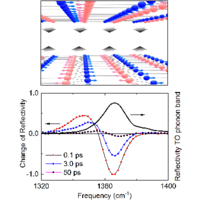
Ultrafast optical-phonon dynamics and the related nonlinear lattice response of few-layer hexagonal boron nitride (h-BN) are elucidated in a combined experimental and theoretical study. The lifetimes of transverse optical (TO) phonons and interlayer modes are 1.2 and 20 ps. In-plane TO phonon displacements are shown to couple to interlayer shear and breathing motions. In the nonlinear phonon response, a transient reduction of the TO phonon frequency arises from this anharmonic coupling, which is a particular property of few-layer h-BN.

Classical approaches to prethermal discrete time crystals in one, two, and three dimensions

Andrea Pizzi, Andreas Nunnenkamp, and Johannes Knolle

Phys. Rev. B 104, 094308 (2021) - Published 27 September, 2021

Prethermal discrete time crystals (pDTC) are new collective nonequilibrium phases of matter that break, up to exponentially long times, the discrete time translational symmetry of a periodic drive. Previously studied as a quantum phenomenon, this paper establishes that pDTCs also emerge for classical Hamiltonian dynamics even in their ‘higher-order and fractional’ version. This enables efficient simulations of such phenomena in experimentally relevant settings, including a study of the interplay between dimensionality and interaction range.

Conformal invariance and quantum nonlocality in critical hybrid circuits

Yaodong Li, Xiao Chen, Andreas W. W. Ludwig, and Matthew P. A. Fisher

Phys. Rev. B 104, 104305 (2021) - Published 14 September, 2021
Local measurements in random quantum circuits lead to a new class of “entanglement phase transitions”. Through extensive calculations at the critical point of “stabilizer” circuits — organized by a mapping from the finite rectangular geometry to the semi-infinite plane — the authors find here an emergent conformal field theory description of the entanglement dynamics, whose critical exponents are beyond any known theory. As we show, conformal symmetry implies a measurement-induced Bell-like nonlocality, where distant qubits become entangled with an infinite speed.

Sign In to Your Journals Account

Filter

Section

Filter

Article Lookup

Enter a citation