Highlights

Decodable hybrid dynamics of open quantum systems with Z2 symmetry

Yaodong Li and Matthew P. A. Fisher

Phys. Rev. B 108, 214302 (2023) - Published 4 December, 2023

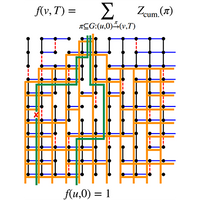
Within a toy model of open quantum systems, this work discusses the relation between measurement-induced phase transitions (MIPTs) of quantum entanglement and quantum error correction (QEC), which also has a phase transition at an “error threshold”. In particular, the authors show how concepts from QEC can facilitate the observation of MIPTs and, conversely, how insights from MIPTs can inform the design of decoding algorithms.

Understanding muon diffusion in perovskite oxides below room temperature based on harmonic transition state theory

T. U. Ito, W. Higemoto, and K. Shimomura

Phys. Rev. B 108, 224301 (2023) - Published 4 December, 2023

In certain perovskite oxides, positive muon (μ+) diffusion occurs with a small activation energy of ∼0.1 eV, contrary to the conventional assumption in μ+ spin spectroscopy for oxides that μ+ is tightly bound to an oxygen atom and immobile below room temperature. Here, the authors analyze the over-barrier diffusion of μ+ observed in KTaO3 using harmonic transition state theory and show that μ+ zero-point vibrations may significantly lower the activation barrier to facilitate fast μ+ diffusion below room temperature.

Building entanglement entropy out of correlation functions for interacting fermions

Saranyo Moitra and Rajdeep Sensarma

Phys. Rev. B 108, 174309 (2023) - Published 22 November, 2023

There are very few analytical methods to calculate entanglement entropy (EE) of large quantum many-body states. Here, the authors show how to construct EE of generic interacting fermions in arbitrary spatial dimensions in terms of measurable correlation functions. They provide approximate answers for EE when only few-particle correlations are known. The field theory they construct is applicable to systems both in and out of thermal equilibrium.

Multipartite entanglement in the measurement-induced phase transition of the quantum Ising chain

Alessio Paviglianiti and Alessandro Silva

Phys. Rev. B 108, 184302 (2023) - Published 6 November, 2023

Quantum systems subject to external monitoring manifest a rich phenomenology in their entanglement properties. Here, the authors use quantum Fisher information to uncover a multipartite entanglement phase transition in the monitored quantum Ising chain. By changing the measurement rate, they observe a shift from bounded to long-range multipartiteness of quantum correlations. They show that the quantum Fisher information displays distinct behavior from the entanglement entropy, and the two outline different phase boundaries.

Scrambling and operator entanglement in local non-Hermitian quantum systems

Brian Barch, Namit Anand, Jeffrey Marshall, Eleanor Rieffel, and Paolo Zanardi

Phys. Rev. B 108, 134305 (2023) - Published 12 October, 2023

In weakly monitored quantum systems, traditional diagnostics of operator spreading such as out-of-time-ordered-correlators and Lieb-Robinson bounds can break down, as entanglement can spread at seemingly unbounded velocity. This has the adverse effect of making integrable and chaotic quantum dynamics appear identical. However, as the authors show here, the humble quantity of global operator entanglement remains a reliable metric of chaoticity in these systems. They elucidate this by studying entanglement phase transitions in a local, non-Hermitian transverse-field Ising model under the lens of operator and quenched entanglement dynamics.

Deep thermalization in constrained quantum systems

Tanmay Bhore, Jean-Yves Desaules, and Zlatko Papić

Phys. Rev. B 108, 104317 (2023) - Published 26 September, 2023

Generic quantum systems thermalize as entanglement builds up between a subsystem and its complement. Performing measurements on a complementary subsystem, however, can reveal finer nuances in the system’s ability to thermalize. The authors show here that systems that look ‘thermal’ under the lens of the Eigenstate Thermalization Hypothesis (ETH) can be highly ‘nonthermal’ when probed deeper. They illustrate this finding on several constrained models that describe slow relaxation in quantum glasses and quantum many-body scars in Rydberg atom arrays.

Topology, criticality, and dynamically generated qubits in a stochastic measurement-only Kitaev model

Adithya Sriram, Tibor Rakovszky, Vedika Khemani, and Matteo Ippoliti

Phys. Rev. B 108, 094304 (2023) - Published 15 September, 2023

Even in the absence of unitary evolution, measurements alone can induce a rich variety of dynamical phases and phenomena in many-body quantum systems. Inspired by the Kitaev honeycomb Hamiltonian, a paradigmatic model of topological physics, the authors construct here a stochastic measurement-only dynamics on a honeycomb lattice and show that it hosts distinct entanglement phases, including phases that protect topological qubits for an exponential amount of time and a critical phase with exotic dynamical scaling.

Role of dimensionality and size in controlling the drag Seebeck coefficient of doped silicon nanostructures: A fundamental understanding

Raja Sen, Nathalie Vast, and Jelena Sjakste

Phys. Rev. B 108, L060301 (2023) - Published 16 August, 2023

It is commonly believed that phonon drag, a phenomenon where electrons are dragged from the hot to the cold side of the sample by out-of-equilibrium phonons, does not play any significant role on the nanoscale. Here, the authors show that, even if the phonon-drag contribution is strongly reduced by nanostructuring, a silicon thin film of 100 nm thickness can still preserve more than 20% of the bulk phonon-drag contribution at 300 K along the in-plane direction of the thin film.

Braiding fractional quantum Hall quasiholes on a superconducting quantum processor

Ammar Kirmani, Derek S. Wang, Pouyan Ghaemi, and Armin Rahmani

Phys. Rev. B 108, 064303 (2023) - Published 2 August, 2023

Using a noisy quantum computer, the authors emulate direct braiding in a fractional quantum Hall system via a simplified model for a thin cylinder. The quantum algorithm prepares a ground state with two quasiholes, performs a unitary operation controlled by an ancilla to move one quasihole around the other, and measures the ancilla with error mitigation to extract the wave function’s acquired phase. This approach offers a method for studying braiding statistics in fractional Hall states in digitized devices.

Surprises in the deep Hilbert space of all-to-all systems: From superexponential scrambling to slow entanglement growth

Zihao Qi, Thomas Scaffidi, and Xiangyu Cao

Phys. Rev. B 108, 054301 (2023) - Published 1 August, 2023

Quantum dynamics of spin systems with uniform infinite-range interaction are often considered “simple” because they become semiclassical in the thermodynamic limit. However, the standard semiclassical theory only applies to a shallow surface of the vast many-body Hilbert space. What happens away from this? Here, the authors dive into the “deep Hilbert space” and unveil a number of exotic phenomena in this rarely charted territory.

Energy transfer in random-matrix ensembles of Floquet Hamiltonians

Christina Psaroudaki and Gil Refael

Phys. Rev. B 108, 064301 (2023) - Published 1 August, 2023

Quantum machines have been a fascination for years. This paper examines a specific quantum machine - a spin driven by two harmonically related light beams. When the spin adopts a specific Floquet state, it receives energy from one beam and transfers it to the other, acting as an energy frequency converter. The authors study the power distribution of this 2-beam and spin system, uncovering an intriguing transition in distribution width, tuned by the drive amplitude.

Anharmonicity of the antiferrodistortive soft mode in barium zirconate BaZrO3

Petter Rosander, Erik Fransson, Cosme Milesi-Brault, Constance Toulouse, Frédéric Bourdarot, Andrea Piovano, Alexei Bossak, Mael Guennou, and Göran Wahnström

Phys. Rev. B 108, 014309 (2023) - Published 25 July, 2023

BaZrO3 is one of the very few perovskites that is claimed to remain cubic down to 0 K, but its tendency towards an antiferrodistortive (AFD) instability has fueled a lot of debates. Here, the AFD phonon mode is studied using inelastic neutron scattering (INS) and inelastic x-ray scattering (IXS), combined with a computational approach including anharmonicity. Both classical molecular dynamics (MD) and a self-consistent phonon approach are used, the latter including quantum fluctuations of the atomic motion. This robust description of the AFD mode clarifies that BaZrO3 stays cubic down to 0 K.

Van Roosbroeck's equations with topological terms: The case of Weyl semimetals

Pierre-Antoine Graham, Simon Bertrand, Michaël Bédard, Robin Durand, and Ion Garate

Phys. Rev. B 108, 024301 (2023) - Published 5 July, 2023

For decades, van Roosbroeck’s (VR) equations have been used to model microelectronic devices made from ordinary semiconductors. The advent of topological materials raises a largely unexplored question: how are VR equations and their solutions modified when electronic bands are topological? Here, the authors solve VR equations analytically in a Weyl semimetal placed under a magnetic field and subjected to a spatially inhomogeneous light pulse. They predict photoinduced plasma oscillations, which originate from a topological term in VR equations.

Numerical methods for detecting symmetries and commutant algebras

Sanjay Moudgalya and Olexei I. Motrunich

Phys. Rev. B 107, 224312 (2023) - Published 27 June, 2023

Utilizing the understanding of symmetries in the framework of commutant algebras, the authors introduce here general methods to numerically construct symmetry operators and quantum number sectors. One method uses simultaneous block diagonalization of two generic Hamiltonians to construct symmetry sectors, while another method uses the fact that symmetries in the commutant framework are frustration-free ground states of local superoperators, which leads to efficient algorithms. These methods are applied to conventional on-site symmetries, as well as unconventional symmetries such as Hilbert space fragmentation and quantum many-body scars.

Low-energy tail of the spectral density for a particle interacting with a quantum phonon bath

Donghwan Kim and Bertrand I. Halperin

Phys. Rev. B 107, 224311 (2023) - Published 26 June, 2023

In 1957, Rashba and Davidov published an article on optical absorption in a molecular crystal, considering the interaction of the created exciton with phonons. The problem reduces to calculating the spectral density for the exciton. Here, the authors describe several approximations designed to obtain the behavior of the low-energy tail of the spectral density, where conventional perturbation methods do not work. The analysis includes both the thermal population and quantum motion of the phonons, and an application is made to a one-dimensional continuum model with acoustic phonons.

Ab initio Green-Kubo simulations of heat transport in solids: Method and implementation

Florian Knoop, Matthias Scheffler, and Christian Carbogno

Phys. Rev. B 107, 224304 (2023) - Published 7 June, 2023

Ab initio Green-Kubo simulations provide an accurate description of lattice thermal conductivities from first principles. This approach reliably describes the full range from harmonic to strongly anharmonic materials. The latter are not handled well by often employed, perturbed phonon models. Using challenging benchmark materials as examples, this paper discusses various physical and computational strategies that speed up the calculations. These advancements pave the way for efficiently exploring materials space in the search for thermal insulators, as demonstrated in the accompanying PRL (DOI: https://doi.org/10.1103/PhysRevLett.130.236301).

Quantum pathways of carrier and coherent phonon excitation in bismuth

Azize Koç, Isabel Gonzalez-Vallejo, Matthias Runge, Ahmed Ghalgaoui, Klaus Reimann, Laurenz Kremeyer, Fabian Thiemann, Michael Horn-von Hoegen, Klaus Sokolowski-Tinten, Michael Woerner, and Thomas Elsaesser

Phys. Rev. B 107, L180303 (2023) - Published 23 May, 2023

Ultrafast mid-infrared excitation of an electron-hole plasma breaks the crystal symmetry of bismuth transiently and opens alternative quantum pathways for the excitation of coherent lattice motions. Probing the transient crystal structure directly by femtosecond x-ray diffraction reveals oscillations of diffracted intensity at a frequency of 2.6 THz, which persist on a picosecond time scale. They reflect coherent wave packet motions along back-folded phonon coordinates in the crystal of reduced symmetry. Optically induced symmetry breaking thus allows for modifying phonon excitations.

Explicit formula for high-order sideband polarization by extreme tailoring of Feynman path integrals

Qile Wu and Mark S. Sherwin

Phys. Rev. B 107, 174308 (2023) - Published 18 May, 2023

The authors derive here an explicit formula for a nonperturbative nonlinear optical phenomena called high-order sideband generation (HSG). The formula is valid over a wide range of experimentally accessible conditions. The results indicate a way to extract information on band structures and nonequilibrium dephasing rates from HSG experiments with simple algebraic calculations. This work also provides hints for analysis of HSG in multiband systems with non-Abelian Berry curvatures, as well as interband processes in high-harmonic generation.

Floquet-Bloch resonances in near-petahertz electroabsorption spectroscopy of SiO2

M. Volkov, S. A. Sato, A. Niedermayr, A. Rubio, L. Gallmann, and U. Keller

Phys. Rev. B 107, 184304 (2023) - Published 5 May, 2023

Complex nonadiabatic dynamics are observed when the quiver energy of an electron-hole pair in a strong laser field becomes comparable to the photon energy. Here, the authors extend quasistatic electromodulation spectroscopy based on the Franz-Keldysh effect to this regime and show that in this limit it is governed by resonant transitions between Floquet-Bloch states. This regime opens opportunities to probe the effective mass as well as the ponderomotive and binding energies of the electron-hole pair on the attosecond timescale.

Minimal one-dimensional model of bad metal behavior from fast particle-hole scattering

Yan-Qi Wang, Roman Rausch, Christoph Karrasch, and Joel E. Moore

Phys. Rev. B 107, L100301 (2023) - Published 10 March, 2023

The authors propose here a mechanism and an explicit one-dimensional model to realize the linear-in-temperature resistivity that is the hallmark of bad metals. They then verify the behavior with advanced DMRG-type simulations. These results open a new approach to understanding the limits of relaxation generated by local interactions in extended many-body systems. This work should push forward research into understanding some of the most basic questions about transport for 1D and critical systems, which bridge quantum matter and quantum chaos.

Sign In to Your Journals Account

Filter

Section

Filter

Article Lookup

Enter a citation