Highlights

Polarization-resolved core exciton dynamics in LiF using attosecond transient absorption spectroscopy

Kylie J. Gannan, Lauren B. Drescher, Rafael Quintero-Bermudez, Navdeep Rana, Chengye Huang, Kenneth Schafer, Mette B. Gaarde, and Stephen R. Leone

Phys. Rev. B 111, 134306 (2025) - Published 28 April, 2025

The authors introduce here linear dichroism into attosecond transient absorption spectroscopy measurements to explore the orbital character of core exciton excited states in LiF thin films during their few-femtosecond exciton coherence lifetimes. The dichroic effect is well-described by atomic alignment angular momentum rules, which allow or forbid transitions from an aligned p-like state to a resonant s-like state, depending on the beam polarizations. A few-level model simulation and density functional theory calculations are used to corroborate the orbital character assignments of the core exciton states in the solid.

Probing Hilbert space fragmentation with strongly interacting Rydberg atoms

Fan Yang, Hadi Yarloo, Hua-Chen Zhang, Klaus Mølmer, and Anne E. B. Nielsen

Phys. Rev. B 111, 144313 (2025) - Published 24 April, 2025

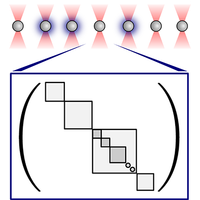
Hilbert space fragmentation provides a novel route to ergodicity breaking in isolated quantum many-body systems. The authors present here a feasible scheme to systematically explore Hilbert space fragmentation in a Rydberg atom array. They show that asymmetric quasiparticle transport can be used to tune Krylov-subspace ergodicity, and that atomic position disorder can selectively induce a many-body localization transition. The proposed scheme is expected to be realized on state-of-the-art Rydberg quantum simulators.

Exact spectral form factors of noninteracting fermions with Dyson statistics

Tatsuhiko N. Ikeda, Lev Vidmar, and Michael O. Flynn

Phys. Rev. B 111, 144312 (2025) - Published 23 April, 2025

Random matrix theory (RMT) is a cornerstone of quantum dynamics that predicts universal features of interacting many-body systems. Here, the authors establish exact methods to compute the spectral form factor (SFF) of noninteracting models whose single-particle states exhibit random matrix statistics. This regime is characterized by exponential growth of the SFF, in sharp contrast to the linear growth of typical interacting systems. These exact results provide a rigorous foundation for future studies of the crossover to many-body RMT and the onset of thermalization.

Slow measurement-only dynamics of entanglement in Pauli subsystem codes

Benedikt Placke and S. A. Parameswaran

Phys. Rev. B 111, 144308 (2025) - Published 15 April, 2025

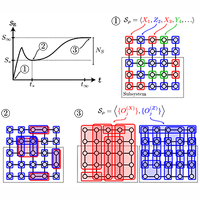
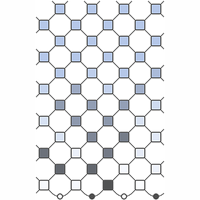
The authors explore here the measurement-only dynamics of a class of models built from subsystem error correcting codes and uncover a wide range of features in entanglement dynamics, with a surprising connection to Hilbert-space fragmentation.

Translation symmetry restoration under random unitary dynamics

Katja Klobas, Colin Rylands, and Bruno Bertini

Phys. Rev. B 111, L140304 (2025) - Published 8 April, 2025

The authors study here how a system initialized in a non translationally symmetric initial state eventually becomes translationally invariant. They consider the average distance between the time-evolved state, and its translationally symmetric counterpart under the dynamics given by a brickwork circuit with randomly chosen local unitary gates. They find that the timescale for the restoration of translational symmetry coincides with the thermalization time, suggesting that the memory of initial state is not immediately lost, but rather persists until times comparable with the system size.

Temporal chirp, temporal lensing, and temporal routing via space-time interfaces

Victor Pacheco-Peña, Mathias Fink, and Nader Engheta

Phys. Rev. B 111, L100306 (2025) - Published 31 March, 2025

Here, the authors propose photonic time interfaces (rapid modulations of the permittivity of the medium where the wave travels) to induce/create spatial interfaces, that is, space-time interfaces. They explore perpendicular, parallel, and oblique spatial interfaces created in time. In so doing, they show how such space-time metamaterials can be seen as the generalization of Snell’s law in four dimensions (x,y,z,t). Applications such as temporal chirp, lensing, and routing are then proposed as examples.

Mode-coupling formulation of heat transport in anharmonic materials

Aloïs Castellano, J. P. Alvarinhas Batista, Olle Hellman, and Matthieu J. Verstraete

Phys. Rev. B 111, 094306 (2025) - Published 17 March, 2025

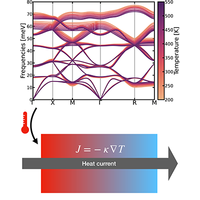
The authors apply here the recently introduced mode-coupling framework for anharmonic lattice dynamics to derive a general theory of phonon heat transport, which does not depend on the harmonic approximation or perturbation theory. They account for diagonal and off-diagonal contributions to the heat current, with and without collective effects, and describe an efficient implementation of the theory, including Monte Carlo integration of the scattering, which reduces the computational cost by an order of magnitude.

Formation of generalized Wannier-Stark ladders: Theorem and applications

H. P. Zhang and Z. Song

Phys. Rev. B 111, 014313 (2025) - Published 23 January, 2025

For noninteracting systems, Wannier-Stark ladders (WSLs) describe electronic state quantization in crystals under constant electric fields, related to Bloch oscillations. The authors develop here a theory for interacting Hamiltonians with translational symmetry and linear potentials, possessing WSLs. They illustrate this using 1D extended Bose-Hubbard models with real and imaginary hopping strengths.

Entanglement enhancement induced by noise in inhomogeneously monitored systems

Cristiano Muzzi, Mikheil Tsitsishvili, and Giuliano Chiriacò

Phys. Rev. B 111, 014312 (2025) - Published 22 January, 2025

Noise is usually seen as an obstacle to quantum coherence, but the authors uncover here a surprising phenomenon: under certain conditions, noise can enhance entanglement in quantum systems. By examining two coupled fermionic chains—one system and one ancilla—they demonstrate that fast ancilla dynamics, combined with strong noise, alters the interplay between coherence and decoherence, boosting entanglement within the system. This counterintuitive discovery opens up new pathways to exploit noise for processes in quantum information technologies.

Observation of non-Hermitian pseudo-mobility-edge in a coupled electric circuit ladder

Xuewei Zhang, Chaohua Wu, Mou Yan, and Gang Chen

Phys. Rev. B 111, 014304 (2025) - Published 6 January, 2025

The authors report here the experimental observation of the non-Hermitian pseudo-mobility-edge in a hybridized non-Hermitian circuit ladder. Through measuring the admittance spectrum and eigenstates, they show the transition from pseudo-mobility-edge phase to the skin-localized phase for open boundary condition and to the extended phase for mixed boundary condition. The results are in good agreement with theoretical predictions.

Nonlinear finite-difference time-domain method for exciton-polaritons: Application to saltatory conduction in polariton neurons

K. Dini, H. Sigurðsson, N. W. E. Seet, P. M. Walker, and T. C. H. Liew

Phys. Rev. B 110, 214303 (2024) - Published 4 December, 2024

Polariton neurons allow exciton-polaritons to transport information using a successive local switching in analogy to action potentials in biological neurons. The authors show here an analogue of saltatory conduction for enhancing signal speeds: by connecting bistable nodes with waveguides, polariton signal speeds can be increased tenfold. The modeling of this system requires a new theoretical tool: nonlinear finite-difference time-domain simulation, which accounts for the propagation of light in the full three-dimensional nanostructure together with nonlinear exciton-exciton scattering using Maxwell-Bloch equations.

Quasinormal mode expansion in thin elastic plates

Benjamin Vial, Marc Martí Sabaté, Richard Wiltshaw, Sébastien Guenneau, and Richard V. Craster

Phys. Rev. B 110, 174305 (2024) - Published 15 November, 2024

The authors present here a quasinormal mode (QNM) framework to optimize wave control in thin elastic plates. This model simplifies complex wave interactions, enabling efficient simulations and precise manipulation of resonant modes. By integrating gradient-based optimization, the authors demonstrate control over resonator parameters, achieving quasibound states and tailored eigenfrequency placements. This approach offers a powerful tool for designing elastic metamaterials and sources with customized responses, advancing applications in wave manipulation and control.

Room-temperature optomechanics with light-matter condensates

Vladislav Yu. Shishkov, Evgeny S. Andrianov, and Anton V. Zasedatelev

Phys. Rev. B 110, 134321 (2024) - Published 29 October, 2024

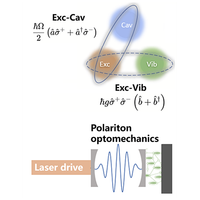
The authors develop here an optomechanical framework for macroscopic quantum states operational at room temperature — light-matter Bose-Einstein condensates with simultaneous strong exciton-photon and exciton-phonon interactions. Under resonant laser drive, they explore different polariton optomechanical scenarios that enable changing dissipative and dispersive properties of the system, assign vibrational states an effective mass, and open up new avenues to control polariton states by vibrations and vice versa.

Versatile braiding of non-Hermitian topological edge states

Bofeng Zhu, Qiang Wang, You Wang, Qi Jie Wang, and Y. D. Chong

Phys. Rev. B 110, 134317 (2024) - Published 22 October, 2024

The mathematical concept of braiding describes how string-like objects can be interwoven, including topologically distinct “links” and “knots”. A physical setting for realizing braids is the complex energy levels of non-Hermitian systems. The authors introduce here a route to generating energy braids, using topological edge states of non-Hermitian lattices. The model hosts braids like Solomon links and [n]-catenanes, which have not yet been observed physically. The model is experimentally feasible, requiring only a lattice with local gain and loss, without nonreciprocal coupling.

Measurement-induced phase transitions in systems with diffusive dynamics

Hyunsoo Ha, Akshat Pandey, Sarang Gopalakrishnan, and David A. Huse

Phys. Rev. B 110, L140301 (2024) - Published 2 October, 2024

The universality class of the measurement-induced phase transition changes significantly when a diffusing conserved density is present. The authors analytically show here the impact of diffusive correlations, supported by numerical results from a new model that couples conserved densities into Clifford circuits through projective measurements. Rare-region effects away from the critical point are also explored. This result extends to monitored circuits with U(1) symmetry.

Longitudinal optical phonons in photonic time crystals containing a stationary charge

Sihao Zhang, Junhua Dong, Huanan Li, Jingjun Xu, and Boris Shapiro

Phys. Rev. B 110, L100306 (2024) - Published 23 September, 2024

Photonic time crystals (PTCs) enable exotic light-matter interactions but typically require significant modulation strength to open a wide momentum band gap, limiting their practical realization. Here, the authors demonstrate that a Lorentzian medium-based PTC with a stationary charge cannot only excite but also amplify longitudinal optical phonons, with a band gap spanning the entire momentum space. This infinite momentum band gap can be achieved with a minimal modulation depth, enriching time-varying photonics by incorporating the distinct wave characteristics of longitudinal excitations.

Quantum walks of correlated photons in non-Hermitian photonic lattices

Mingyuan Gao, Chong Sheng, Yule Zhao, Runqiu He, Liangliang Lu, Wei Chen, Kun Ding, Shining Zhu, and Hui Liu

Phys. Rev. B 110, 094308 (2024) - Published 9 September, 2024

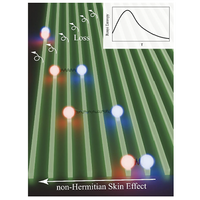
Quantum walks have demonstrated capabilities that surpass classical approaches across a range of applications, including quantum computing, quantum simulation, quantum information processing, etc. Recently, quantum walks in non-Hermitian systems have garnered significant attention. The authors experimentally realize here a non-Hermitian photonic lattice on a silicon chip, observing asymmetric quantum walks of single photons induced by the non-Hermitian skin effect. Notably, they investigate the entanglement dynamics of correlated photons, revealing a suppression of entanglement in these non-Hermitian systems.

Charge separation and directed migration of photoelectrons in LiNbO3:Fe crystals after excitation by nanosecond laser pulses

F. S. Pilyak, E. I. Mareev, A. G. Kulikov, N. M. Asharchuk, N. N. Obydennov, Y. V. Pisarevsky, A. E. Blagov, F. V. Potemkin, and M. V. Kovalchuk

Phys. Rev. B 110, L100302 (2024) - Published 9 September, 2024

Under nanosecond laser excitation, time-delayed changes in the x-ray diffraction parameters of LiNbO3 and LiNbO3:Fe crystals are revealed. On-tip synchronization of 4-ns optical laser pulses with electron bunches in a synchrotron provides a subnanosecond time resolution for diffraction rocking curve (DRC) dynamics. The crystals exhibit a reversible center-of-mass shift and a decrease in DRC integral intensity with recovery in approximately 35 ns. This behavior indicates the formation and decay of a charged layer due to photoelectron migration.

Phonon thermal Hall effect in nonmagnetic Y2Ti2O7

Rohit Sharma, Martin Valldor, and Thomas Lorenz

Phys. Rev. B 110, L100301 (2024) - Published 3 September, 2024

The authors report a field-linear thermal Hall effect in single-crystal samples of Y2Ti2O7, Dy2Ti2O7, and DyYTi2O7. The slopes κxy/B show temperature-dependent peaks that align with corresponding peaks in the respective longitudinal thermal conductivities κxx(T). This is consistent with a phononic thermal Hall effect, observed in a growing number of insulating materials. While the presence of magnetic Dy3+ ions significantly influences the longitudinal thermal conductivities, the thermal Hall ratios vary rather weakly between magnetic and nonmagnetic materials, suggesting a primarily nonmagnetic origin of the thermal Hall effect.

Spread complexity and localization in PT-symmetric systems

Aranya Bhattacharya, Rathindra Nath Das, Bidyut Dey, and Johanna Erdmenger

Phys. Rev. B 110, 064320 (2024) - Published 22 August, 2024

This study investigates the behavior of wave functions in parity-time (𝒫𝒯) symmetric quantum systems, focusing on their spread and localization. Using a tight-binding chain model, the authors explore the dynamics under 𝒫𝒯 symmetry and its breaking. By employing innovative quantum information measures, such as complexity, entropy, and inverse participation ratio in Krylov space, they quantify the wave function’s distribution. In the 𝒫𝒯-symmetric phase, the wave function spreads evenly, while 𝒫𝒯 symmetry breaking leads to localization, exemplifying the non-Hermitian skin effect and edge modes.

Sign In to Your Journals Account

Filter

Section

Filter

Article Lookup

Enter a citation