Highlights

Beyond trotterization: Variational product formulas for quantum simulation

Ibsal Assi, Michael Vogl, Meenu Kumari, and J. P. F. LeBlanc

Phys. Rev. B 113, 214314 (2026) - Published 15 June, 2026

The authors introduce here a variational splitting scheme for the time-evolution operator that surpasses standard Trotter-Suzuki decompositions. Unlike typical variational methods, this framework works directly in operator space, providing globally valid results irrespective of the targeted initial state. The method generalizes naturally to a wide range of applications in condensed matter physics and beyond. In particular, it enables quantum circuits with lower gate counts and higher accuracy than Trotter-based formulas, making it useful for near-term quantum computing.

Affine transformations for purely anisotropic cloaking in flexural elastic thin plates

Léo Pradier, Baptiste Chomette, Manuel Collet, Grégoire Pizon, Morvan Ouisse, Valentin Rapine, and Arnaud Hubert

Phys. Rev. B 113, 214307 (2026) - Published 8 June, 2026

The problem of bending wave cloaking in thin elastic plates is a longstanding theoretical and engineering challenge due to the dispersive nature of guided bending waves. The approach proposed here establishes a theoretical framework and a design methodology allowing manufacturability of a unidirectional cloaking proof of concept using composite materials. The authors present numerical and experimental evidence of the broadband performances associated with the proposed cloaking implementation.

Generation of volume-law entanglement by local-measurement-only quantum dynamics

Surajit Bera, Igor V. Gornyi, Sumilan Banerjee, and Yuval Gefen

Phys. Rev. B 113, 144309 (2026) - Published 15 April, 2026

Entanglement and measurements are perceived as antagonistic, since local measurements typically degrade entanglement within a quantum system by entangling the external observer with a part of the system. Addressing a many-body system, the authors show here that the observer can selectively generate genuine large multipartite entanglement (even volume-law entanglement entropy) through repeated quasilocal measurements, employing a set of spectators (ancillas). Intriguingly, the spectators only act as entanglement mediators while remaining unentangled or weakly entangled with the system throughout the entire dynamical process of entanglement generation.

Absence of thermalization after a local quench and strong violation of the eigenstate thermalization hypothesis

Peter Reimann and Christian Eidecker-Dunkel

Phys. Rev. B 113, 144304 (2026) - Published 6 April, 2026

Although thermalization is ubiquitous in nature, most theoretical studies rely on some unproven assumptions like the eigenstate thermalization hypothesis. Here, the authors rigorously show the absence of thermalization in a paradigmatic class of integrable spin chain models by solely employing the basic laws of quantum mechanics. Likewise, the occurrence of thermalization is provable after very minor, integrability preserving changes of some model parameters. In conclusion it seems unlikely that there exist simple general, and reliable thermalization criteria.

Quantifying electron-nuclear spin entanglement dynamics in central-spin systems using one-tangles

Isabela Gnasso, Khadija Sarguroh, Dorian Gangloff, Sophia E. Economou, and Edwin Barnes

Phys. Rev. B 113, 134301 (2026) - Published 2 April, 2026

Achieving a quantitative understanding of the many-body entanglement dynamics in central spin systems has been challenging. To overcome this challenge, the authors analytically calculate entanglement using a metric called the one-tangling power. They focus on the example of an InGaAs quantum dot to study electron-nuclear entanglement when spins are either freely evolving or subject to dynamical decoupling. They analytically and numerically pinpoint conditions that give rise to maximal entanglement between target subsets of spins that could potentially serve as quantum memories.

Chiral phonons in sixfold chiral CrSi2: Raman spectroscopy and first-principles calculations

Gakuto Kusuno, Shingo Kisanuki, Yusuke Kousaka, Yoshihiko Togawa, and Takuya Satoh

Phys. Rev. B 113, 104306 (2026) - Published 16 March, 2026

Chiral phonons, collective atomic rotations in crystals, have been experimentally identified mainly in trigonal chiral materials. Here, the authors demonstrate chiral phonons in the sixfold chiral semiconductor CrSi2 using circularly polarized Raman spectroscopy. Polarization-dependent frequency splittings of doubly degenerate phonon modes reveal the handedness of the crystal, and first-principles calculations confirm their rotational character. The work extends chiral phonon research to hexagonal systems and establish circularly polarized Raman scattering as a powerful probe of crystal chirality.

Information phases of partial projected ensembles generated from random quantum states and scrambling dynamics

Alan Sherry, Saptarshi Mandal, and Sthitadhi Roy

Phys. Rev. B 113, 104301 (2026) - Published 2 March, 2026

How is quantum information distributed in complex many-body systems? Here, using partially projected ensembles, the authors show that the Holevo information in such ensembles uncovers sharp “information phases” invisible to standard entanglement measures. For Haar random states and late-time scrambling dynamics, it exhibits a qualitative change in scaling—from exponential decay to linear growth—separated by nonanalytic transitions as subsystem sizes vary. The decaying regime establishes a measurement-invisible quantum correlated phase, providing a finer probe for understanding scrambling and information structure in chaotic quantum systems beyond conventional entanglement measures.

Opposite impact of thermal expansion and phonon anharmonicity on the phonon-limited resistivity of elemental metals from first principles

Ao Wang, Junwen Yin, Félix Antoine Goudreault, Michel Côté, Olle Hellman, and Samuel Poncé

Phys. Rev. B 113, L060302 (2026) - Published 25 February, 2026

The authors show here that thermal expansion and phonon anharmonicity act in opposite ways on electrical resistivity in metals. Thermal expansion enhances electron–phonon coupling, while anharmonicity suppresses it. Accounting for both effects yields a more complete picture of electron transport, demonstrated here for Pb, Nb, and Al.

Investigating anharmonicities in polarization-orientation Raman spectra of acene crystals with machine learning

Paolo Lazzaroni, Shubham Sharma, and Mariana Rossi

Phys. Rev. B 113, 054309 (2026) - Published 20 February, 2026

Polarization-orientation Raman experiments on acene crystals show temperature-dependent intensity changes that challenge conventional harmonic approaches. Here, by combining machine-learned interatomic potentials and polarizability models, the authors simulate polarization-orientation Raman spectra of anthracene and naphthalene with full anharmonic vibrational dynamics, revealing the measurable signatures of anharmonic coupling. While some key experimental trends are reproduced, the subtle predicted polarization changes highlight the need for theory-assisted analysis to disentangle real anharmonic deviations in temperature-dependent polarized Raman experiments.

Information dynamics in decohered quantum memory with repeated syndrome measurements

Jacob Hauser, Yimu Bao, Shengqi Sang, Ali Lavasani, Utkarsh Agrawal, and Matthew P. A. Fisher

Phys. Rev. B 113, 054303 (2026) - Published 9 February, 2026

Repeated measurements can help protect information in decohered quantum memories. Here, the authors intrinsically characterize the information dynamics in such systems. In particular, they develop a (d+1)-dimensional statistical mechanics model for information-theoretic quantities characterizing the dynamics of d-dimensional stabilizer codes subject to Pauli errors and noisy measurements. The resulting model is dual to the model previously obtained for the optimal decoding algorithm, with decoding transitions manifesting as thermal phase transitions in both cases.

Nonexponential relaxation in the rotating frame of a driven nanomechanical mode

Hyunjin Choi, Oriel Shoshani, Ryundon Kim, Younghun Ryu, Jinhoon Jeong, Junho Suh, Steven W. Shaw, M. I. Dykman, and Hyoungsoon Choi

Phys. Rev. B 113, L060301 (2026) - Published 2 February, 2026

The authors report here a direct observation of relaxation toward a stable vibrational state of a driven nanomechanical oscillator. They find that, in the rotating frame, the decay is profoundly nonexponential and is accompanied by characteristic nonsinusoidal oscillations. A minimalistic model successfully describes the observed behavior, which arises from the interplay of the nonlinearity and dissipation and is ultimately rooted in the broken time-translation and time-reversal symmetries.

Thermalization and hydrodynamic long-time tails in a Floquet system

Anne Matthies, Nicolas Dannenfeld, Silvia Pappalardi, and Achim Rosch

Phys. Rev. B 113, 024305 (2026) - Published 12 January, 2026

Here, the authors develop a comprehensive hydrodynamic description of late-time relaxation in interacting Floquet spin systems after a quantum quench. Exploiting symmetries in a clean Floquet setting, they analytically predict hydrodynamic long-time tails and verify them with extensive numerical simulations, filling a gap left by previous studies. While establishing a concrete quantum–classical correspondence at late times, an unexpectedly slow decay of spin-current fluctuations raises open questions about its origin.

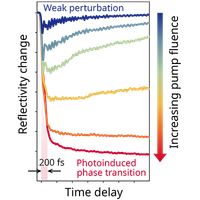
Ultrafast modification of coherent phonons during the photoinduced insulator-to-metal phase transition in neodymium nickelate

Oleg Dogadov, Grace A. Pan, Andrea Villa, Dan Ferenc Segedin, Premysl Marsik, Charles M. Brooks, Hanjong Paik, Qi Song, Valeria Russo, Carlo S. Casari, Julia A. Mundy, Giulio Cerullo, and Stefano Dal Conte

Phys. Rev. B 113, 014304 (2026) - Published 9 January, 2026

Due to the high interest in the insulator-metal transition (IMT) in rare-earth nickelates for potential applications, a deep understanding of the role of different degrees of freedom is required. Here, the authors perform transient reflectivity measurements to study the photoinduced IMT in NdNiO3. They show that the ultrafast reflectivity change is concomitant with the suppression of the coherent phonons of the insulating phase, revealing a strong connection between the electronic changes and rapid lattice modifications across the IMT.

Revisiting the mechanisms of thermal transport in vacancy-defective silicon

Xueyan Zhu, Jin Yang, Junichiro Shiomi, and Cheng Shao

Phys. Rev. B 112, 214313 (2025) - Published 15 December, 2025

Conventional understanding on thermal conduction mechanisms in defective crystals is based on the phonon gas picture, treating defects as scattering centers that reduce phonon lifetimes without altering frequencies and group velocities. However, this theory overlooks fundamental consequences of defects: they break crystal symmetry and disrupt the definition of unit cells, which may fundamentally alter the nature of heat transport. The authors go beyond the phonon gas picture here, and establish a computational framework combining the Wigner transport equation with normal-mode decomposition. They reveal that the emergence of wavelike effects and defect-induced modifications to velocity operators in vacancy-defective silicon are critical previously underappreciated mechanisms.

Nonadiabatic dynamics in non-Hermitian quantum systems from the quantum metric perspective

Xiang Zhang, Kangyi Hu, and Fuxiang Li

Phys. Rev. B 112, 224305 (2025) - Published 8 December, 2025

The authors generalize here the quantum metric framework to the 𝒫𝒯 broken region, and investigate the nonadiabatic dynamics in non-Hermitian quantum systems. The authors demonstrate that the long-time average of the rate function can be used to characterize the 𝒫𝒯 phase transitions. They also find that this framework can remove the accidental dynamical quantum phase transitions, and thus build a bridge between dynamical and equilibrium quantum phase transitions.

Quadrupole conserving dynamics in the noncommutative plane

Isabella Zane and Andrew Lucas

Phys. Rev. B 112, 224301 (2025) - Published 1 December, 2025

Quadrupole conserving dynamics in the noncommutative plane is shown to realize unconventional “fracton hydrodynamics”. Invariant Hamiltonians correspond to the areas of shapes, meaning that all interactions are at least three body. In fact, hydrodynamics breaks down due to relevant nonlinearities, as predicted analytically and confirmed numerically.

Experimentally probing non-Hermitian spectral transition and eigenstate skewness

Jia-Xin Zhong, Jeewoo Kim, Kai Chen, Jing Lu, Kun Ding, and Yun Jing

Phys. Rev. B 112, L220301 (2025) - Published 1 December, 2025

Probing complex-valued spectra and biorthogonal eigenstates in non-Hermitian systems remains experimentally challenging. The authors present here a Green’s function based method that directly measures these fundamental quantities in two-dimensional acoustic lattices. By capturing the full response matrix, they demonstrate eigenstate skewness and geometry-dependent spectral transitions. This universal method overcomes the limits of conventional pump‑probe or complex‑frequency techniques, providing a robust route for exploring exotic non‑Hermitian phenomena across wave‑based platforms.

Momentum-robust temporal scattering via PT-symmetry transition

Meng-Cheng Jin, Guang-Chen He, Ze-Guo Chen, Ming-Hui Lu, Peng Zhan, and Yan-Feng Chen

Phys. Rev. B 112, 184313 (2025) - Published 21 November, 2025

The authors show here that non-Hermitian terms can enforce a fixed geometric relationship between eigenstates of a two-level system on the Bloch sphere, governed by the system’s 𝒫𝒯 phase rather than by momentum. This geometric constraint yields a momentum-independent projection angle at temporal interfaces when the system undergoes a 𝒫𝒯-symmetry transition, enabling broadband control of temporal scattering. Measurements in an active acoustic lattice confirm the geometric prediction. This work identifies eigenstate-geometry restructuring as a key mechanism underlying temporal scattering phenomena.

Phonon spectrum in the spin-Peierls phase of CuGeO3

L. Spitz, A. Razpopov, S. Biswas, H. Lane, S. E. Nikitin, K. Iida, R. Kajimoto, M. Fujita, M. Arai, M. Mourigal, Ch. Rüegg, R. Valentí, and B. Normand

Phys. Rev. B 112, 184302 (2025) - Published 5 November, 2025

The spin-Peierls transition in CuGeO3 is a demonstration of the profound effect of spin-phonon coupling, which makes the compound a promising candidate for studying spin-phonon hybridization effects and magnetophononic phenomena. The authors provide here a systematic characterization of the phonon excitations and spin-phonon coupling in the dimerized phase of CuGeO3 using neutron time-of-flight spectroscopy and density functional theory calculations, setting the stage for the study of magnetoelastic effects both in and out of equilibrium.

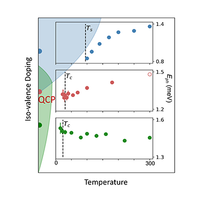
Weak phonon coupling to nematic quantum critical mode in BaFe2(As1−xPx)2

S. Wu, D. Ishikawa, A. Q. R. Baron, A. Alatas, A. H. Said, Jiayu Guo, Y. He, X. Chen, Y. Song, J. G. Analytis, Dung-Hai Lee, and R. J. Birgeneau

Phys. Rev. B 112, 174302 (2025) - Published 3 November, 2025

Despite intense focus on quantum critical behavior, microscopic information on the evolution of spin and nematic correlations remains scarce. Using high-resolution inelastic scattering, the authors investigate here in-plane transverse acoustic phonons in BaFe2(As1−xPx)2 near its nematic quantum critical point. The authors observe a weak coupling between the critical nematic fluctuations and the lattice near the critical regime. Together with theory, this result suggests the nature of nematicity evolves from spin-driven with strong lattice coupling in the underdoped regime to orbital-driven with weak coupling near the critical point.

Sign In to Your Journals Account

Filter

Section

Filter

Article Lookup

Enter a citation