Highlights

Coupled valence carrier and core-exciton dynamics in WS2 probed by few-femtosecond extreme ultraviolet transient absorption spectroscopy

Hung-Tzu Chang, Alexander Guggenmos, Christopher T. Chen, Juwon Oh, Romain Géneaux, Yi-De Chuang, Adam M. Schwartzberg, Shaul Aloni, Daniel M. Neumark, and Stephen R. Leone

Phys. Rev. B 104, 064309 (2021) - Published 23 August, 2021

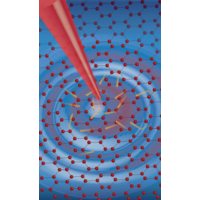
Understanding the interaction between photoexcited carriers and valence excitons is crucial to the development of optoelectronics. However, the influence of carriers on core excitons, the strongly bound core-level excitations due to electron–core-hole interactions, is not fully explored. By conducting optical–extreme-ultraviolet transient absorption spectroscopy at two different core-level absorption edges in WS2 simultaneously, the authors here not only measure the picosecond relaxation of optically excited carriers, but also observe carrier-induced modifications to core-exciton transitions and their few-femtosecond free induction decay.

Anomaly-induced sound absorption in Weyl semimetals

Ohad Antebi, D. A. Pesin, A. V. Andreev, and Roni Ilan

Phys. Rev. B 103, 214309 (2021) - Published 25 June, 2021

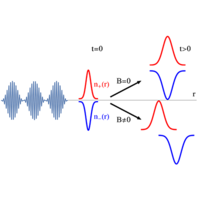
Topology of Weyl semimetals affects sound attenuation in these materials. Most notably, the existence of Berry monopoles associated with linear band crossings leads to the existence of acoustic magnetochiral dichroism: sound attenuation is different for opposite directions of sound propagation. The effect is within reach of current experimental techniques, and, importantly, is of quantum mechanical origin. This should help its detection in available compounds.

Anomalous sound attenuation in Weyl semimetals in magnetic and pseudomagnetic fields

P. O. Sukhachov and L. I. Glazman

Phys. Rev. B 103, 214310 (2021) - Published 25 June, 2021

A sound wave propagating through a semimetal causes a redistribution of electrons between different valleys of the electron spectrum. This dynamic redistribution leads to sound attenuation. Such an attenuation mechanism is effective as long as the redistribution between the valleys is not accompanied by local charge perturbations. In the presence of magnetic field, the chiral anomaly in Weyl semimetals couples the intervalley redistribution with the charge perturbations. Thus, the magnetic field weakens the sound attenuation and, in certain cases, induces its dichroism.

Probing strong coupling between a microwave cavity and a spin ensemble with Raman heterodyne spectroscopy

Gavin G. G. King, Peter S. Barnett, John G. Bartholomew, Andrei Faraon, and Jevon J. Longdell

Phys. Rev. B 103, 214305 (2021) - Published 14 June, 2021

Rare-earth ions in solids are under active investigation for quantum microwave-optical signal converters. Here, light passed through an Er:YSO crystal sitting in a driven microwave resonator develops modulation due to three-wave mixing in the erbium dopants. Strong coupling between the microwave cavity and the spins causes modulation when the microwaves are resonant with the spin-cavity polaritons rather than the spins. This work extends the rare-earth microwave-optical conversion to both millikelvin temperatures and isotopically pure dopants.

Self-organized error correction in random unitary circuits with measurement

Ruihua Fan, Sagar Vijay, Ashvin Vishwanath, and Yi-Zhuang You

Phys. Rev. B 103, 174309 (2021) - Published 27 May, 2021

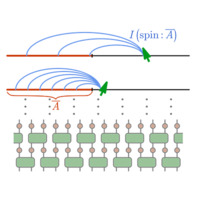
Quantum systems evolving under unitary dynamics with a low rate of projective measurements can realize a highly entangled steady state. However, the stability of this phase against the disentangling action of measurements has not been fully understood. Here, the authors quantify the ability of this highly entangled phase to hide local quantum information, thereby relating its stability to its behavior as an emergent quantum error-correcting code. The authors estimate the tolerable measurement rate, above which this quantum code becomes unstable.

Quantum criticality in the nonunitary dynamics of (2+1)-dimensional free fermions

Qicheng Tang, Xiao Chen, and W. Zhu

Phys. Rev. B 103, 174303 (2021) - Published 12 May, 2021

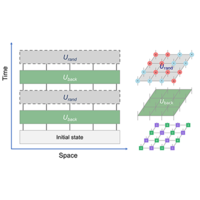
Quantum criticality, which exhibits universal features such as nontrivial collective fluctuations, is one of the central topics in statistical and condensed matter physics. Here, the authors design a class of nonunitary random dynamics of free fermions that robustly produces novel critical steady states. The emergent quantum criticality is numerically confirmed for the 2+1 dimensional case, and the proposed analytical interpretation can be easily extended to any dimensions. Their discoveries are potentially helpful to understand quantum critical phenomenon in nonequilibrium dynamics.

Statistical mechanics of quantum error correcting codes

Yaodong Li and Matthew P. A. Fisher

Phys. Rev. B 103, 104306 (2021) - Published 24 March, 2021

Random quantum dynamics generates quantum error correcting codes that are robust against observers and errors. Here, the authors describe a simple physical picture of such codes, mapping characteristic code properties to the statistical mechanics of fluctuating “entanglement domain walls”. The error correcting criterion is understood as a decoupling condition of domain walls, which leads to a universal scaling law of the “code distance”.

Time-dependent self-consistent harmonic approximation: Anharmonic nuclear quantum dynamics and time correlation functions

Lorenzo Monacelli and Francesco Mauri

Phys. Rev. B 103, 104305 (2021) - Published 23 March, 2021

Simulating nuclear quantum dynamics in strongly anharmonic materials is an open challenge where state-of-the-art techniques fail. This is relevant in ferroelectrics, charge density waves, and crystals encapsulating light atoms, such as superconductive high-pressure hydrides. Here, the authors develop a theory to compute dynamical properties and predict experimental Raman and IR spectroscopy, neutron scattering, and x-ray scattering of any material, accounting for the nuclear quantum and anharmonic dynamics.The method is efficient and can be applied to systems with hundreds of atoms even when treating electrons ab initio within density functional theory.

Emergent fracton dynamics in a nonplanar dimer model

Johannes Feldmeier, Frank Pollmann, and Michael Knap

Phys. Rev. B 103, 094303 (2021) - Published 18 March, 2021

Lattice gauge theories describe strongly interacting quantum many-body systems whose nonequilibrium properties in more than one dimension provide a challenge to current numerical methods. Here, the authors study a dimer model as an example of a U(1) gauge theory whose universal transport properties can be extracted using classically simulable methods. This is achieved by exploiting a surprising connection to topological solitons, enabling a venue of analysis that demonstrates how gauge constraints induce fractonic mobility, slow subdiffusive transport, and nonergodic dynamics.

Hydrodynamics of nonintegrable systems from a relaxation-time approximation

Javier Lopez-Piqueres, Brayden Ware, Sarang Gopalakrishnan, and Romain Vasseur

Phys. Rev. B 103, L060302 (2021) - Published 24 February, 2021

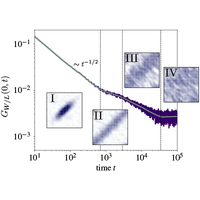
Many strongly interacting systems of experimental relevance are nearly integrable. A paradigm for studying such weakly nonintegrable systems has been lacking. Here, the authors extend a generalized hydrodynamics framework, which has been successfully used to study transport in integrable systems, in order to tackle the dynamics away from integrability. In doing so, the authors propose a simple ansatz in the form of a relaxation-time approximation for the collision integral, finding excellent agreement with first-principle numerical simulations.

Electron thermalization and relaxation in laser-heated nickel by few-femtosecond core-level transient absorption spectroscopy

Hung-Tzu Chang, Alexander Guggenmos, Scott K. Cushing, Yang Cui, Naseem Ud Din, Shree Ram Acharya, Ilana J. P. Molesky, Ulf Kleineberg, Volodymyr Turkowski, Talat S. Rahman, Daniel M. Neumark, and Stephen R. Leone

Phys. Rev. B 103, 064305 (2021) - Published 10 February, 2021

Thermalization and relaxation of photoexcited carriers play an important role in ultrafast demagnetization and photoinduced phase transitions. However, direct observation of carrier thermalization in metals is highly challenging due to its fast timescale. Here, the authors track the thermalization and relaxation of photoexcited electrons in nickel in real time with few-femtosecond core-level transient absorption spectroscopy. In addition, a method to extract carrier temperature from the core-level absorption spectrum is proposed and verified by the experimental results. This enables further applications of core-level spectroscopy to explore element- and, hence, domain-specific carrier dynamics in metallic alloys and multilayers.

Floquet engineering of topological transitions in a twisted transition metal dichalcogenide homobilayer

Michael Vogl, Martin Rodriguez-Vega, Benedetta Flebus, Allan H. MacDonald, and Gregory A. Fiete

Phys. Rev. B 103, 014310 (2021) - Published 28 January, 2021

Motivated by the recent experimental realization of twisted transition metal dichalcogenide bilayers, the authors study the influence of different forms of monochromatic light on such materials. They consider irradiation with circularly polarized light in free space and longitudinal light, such as the one coming from the waveguide’s TM mode. Unlike irradiated twisted bilayer graphene, they find that the longitudinal light has a more interesting effect on the material and induces topological transitions.

Long-time relaxation dynamics of a spin coupled to a Chern insulator

Michael Elbracht and Michael Potthoff

Phys. Rev. B 103, 024301 (2021) - Published 20 January, 2021

The authors compute the dynamical phase diagram for the relaxation of a classical spin, exchange coupled to the local magnetic moment at an edge site of the one-dimensional spinful Su-Schrieffer-Heeger model. The role of the topological edge state and its internal Zeeman splitting for the spin-relaxation process, as well as incomplete spin relaxation on long time scales, can be explained within the framework of a renormalized linear response approach, when explicitly taking retardation effects and nonequilibrium spin-exchange processes into account.

Spreading of correlations in Markovian open quantum systems

Vincenzo Alba and Federico Carollo

Phys. Rev. B 103, L020302 (2021) - Published 20 January, 2021

The spreading of information forms the basis of several quantum nonequilibrium phenomena, such as seen in the emergence of thermodynamics and statistical physics. Recently, much progress has been made in understanding the dynamics of information in isolated integrable systems after a quantum quench, by using a quasiparticle picture predicting ballistic spreading of quantum correlations. This paper shows how to apply these ideas to describe the dissipative dynamics of correlations and of entanglement in open quantum many-body systems.

Quantum metamorphism

V. M. Bastidas, M. P. Estarellas, T. Osada, Kae Nemoto, and W. J. Munro

Phys. Rev. B 102, 224307 (2020) - Published 21 December, 2020

Crystals are widely present in our daily life in the form of solid materials whose atoms self-organize in regular patterns, such as salt, diamonds, and ice. While these arrangements tend to be periodic in space, such regularities can also arise in time. By using common tools in condensed matter theory, the authors show here that time crystals can indeed metamorphose as normal crystals do, with the difference that now the structural transformation happens in the temporal and not spatial dimension.

Disorder-free localization and many-body quantum scars from magnetic frustration

Paul A. McClarty, Masudul Haque, Arnab Sen, and Johannes Richter

Phys. Rev. B 102, 224303 (2020) - Published 8 December, 2020

Magnetic frustration has been a source of inspiration to condensed matter physicists for many years, usually as a means to obtain exotic low-energy physics. Here, magnetic frustration is shown to lead to various classes of models with anomalous eigenstates embedded in the high-energy spectrum. These include states called many-body quantum scars that live in a sea of typical eigenstates. The work also shows that the entire spectrum can be scarred through a fragmentation of Hilbert space generated by frustration.

Establishing nonthermal regimes in pump-probe electron relaxation dynamics

M. X. Na, F. Boschini, A. K. Mills, M. Michiardi, R. P. Day, B. Zwartsenberg, G. Levy, S. Zhdanovich, A. F. Kemper, D. J. Jones, and A. Damascelli

Phys. Rev. B 102, 184307 (2020) - Published 30 November, 2020

How do electrons relax after optical excitation? When does temperature become a well-defined quantity to describe the system, and what can nonthermal electrons tell us about microscopic interactions? Using state-of-the-art time- and angle-resolved photoemission, the authors track the evolution of nonthermal electrons dynamics in graphite over hundreds of femtoseconds. The Boltzmann formalism is used to model the dynamics beyond the use of effective temperature. Based on a quantitative analysis, distinct nonthermal phases in electron relaxation are identified.

Information scrambling at finite temperature in local quantum systems

Subhayan Sahu and Brian Swingle

Phys. Rev. B 102, 184303 (2020) - Published 5 November, 2020

Quantum information scrambling provides diagnostics about how information spreads when an isolated quantum system evolves in time. Here, the authors study the temperature dependence of scrambling in locally gapped systems. Using tensor networks, they numerically evaluate out-of-time-ordered commutators in a large, strongly interacting spin chain as a function of temperature. They find that scrambling crucially depends on the ordering of operators around the thermal circle, exposing subtleties in information propagation at finite temperature. For a regulated operator ordering, the butterfly velocity decreases with lowering the temperature, as seen in the figure. The low temperature behavior is derived from a field-theoretical analysis.

Space-time dependent thermal conductivity in nonlocal thermal transport

Chengyun Hua and Lucas Lindsay

Phys. Rev. B 102, 104310 (2020) - Published 30 September, 2020

Here, a direct solution is provided of a time-space-dependent Peierls-Boltzmann equation with a linearized collision matrix. This will expand the state-of-the-art of thermal transport prediction and provide an avenue for understanding novel nonlocal transport measurements. Application ofmethodology developed here will illuminate physical insights into length and time scale dependent transport behavior in ultrahigh thermal conductivity materials, thus guiding interpretation of measurements and enabling critical understanding of materials for design of novel thermal management applications.

Experimental observation of the acoustic Z2 Weyl semimetallic phase in synthetic dimensions

Farzad Zangeneh-Nejad and Romain Fleury

Phys. Rev. B 102, 064309 (2020) - Published 27 August, 2020

Scalar waves, such as airborne sound, lack an intrinsic spin degree of freedom, making the realization of sonic Z2 topological phases based on spin degeneracy challenging. In this article, the authors demonstrate the relevance of synthetic dimensions and higher-dimensional topological physics for exploring topological phases based on acoustic pseudospin.

Sign In to Your Journals Account

Filter

Section

Filter

Article Lookup

Enter a citation