Highlights

Measurement-driven entanglement transition in hybrid quantum circuits

Yaodong Li, Xiao Chen, and Matthew P. A. Fisher

Phys. Rev. B 100, 134306 (2019) - Published 15 October, 2019

Quantum information tends to spread out in interacting systems, leading to thermalization as characterized by the volume-law entropy of entanglement, while local measurements that extract classical information of the state tend to interrupt the propagation of information and reduce the entanglement entropy. Can entanglement sustain repeated measurements? The authors address this question in a toy hybrid-circuit model, where qubits undergo both unitary time evolution and sporadic local measurements. The phase diagram features a stable volume-law phase of entanglement for weak measurements and an area-law phase for strong measurements. The two domains in the diagram are separated by a single second-order phase transition. Characterization of both phases as well as of the critical point are presented.

Prethermal quantum many-body Kapitza phases of periodically driven spin systems

Alessio Lerose, Jamir Marino, Andrea Gambassi, and Alessandro Silva

Phys. Rev. B 100, 104306 (2019) - Published 30 September, 2019

The action of external drive on a physical system can cause novel dynamical behavior with no counterpart in equilibrium. A paradigmatic example is provided by the so-called Kapitza pendulum, where the upside-down configuration of the rigid rod of the pendulum is made stable by modulating its suspension point periodically in time. The present work demonstrates that driving periodically a quantum many-body system with long-range interactions may generate a multiparticle analog of the Kapitza pendulum, which is stabilized against all possible microscopic quantum fluctuations.

Observation of dynamical phase transitions in a topological nanomechanical system

Tian Tian, Yongguan Ke, Liang Zhang, Shaochun Lin, Zhifu Shi, Pu Huang, Chaohong Lee, and Jiangfeng Du

Phys. Rev. B 100, 024310 (2019) - Published 25 July, 2019

Here, the authors present a novel scheme to study dynamical phase transitions (DPTs) from topological edge states in the Su-Schrieffer-Heeger model. They utilize eight coupled nanomechanical oscillators to simulate the quantum quenches and observe DPTs via directly measuring the Pancharatnam geometric phase in the experiment. The robustness of the DPT and its relation to equilibrium phases are explored. This nanomechanical lattice with its multiple modes, high quality factor, and temporal configurability offers unique advantages for research into nonequilibrium phenomena via an artificial solid-state platform.

Group theoretical approach to computing phonons and their interactions

Lyuwen Fu, Mordechai Kornbluth, Zhengqian Cheng, and Chris A. Marianetti

Phys. Rev. B 100, 014303 (2019) - Published 18 July, 2019

The authors introduce a formalism for computing phonons and their interactions based upon space group irreducible derivatives, yielding an approach that satisfies all symmetries by construction. The formalism provides the most efficient finite-displacement algorithm allowed by group theory, resulting in speedups of more than an order of magnitude compared to competing approaches. These gains will make possible the study of vibrations in far more complex materials by means of DFT in addition to allowing expensive methods beyond DFT to be employed.

Constructing neural stationary states for open quantum many-body systems

Nobuyuki Yoshioka and Ryusuke Hamazaki

Phys. Rev. B 99, 214306 (2019) - Published 28 June, 2019

A theoretical exploration of exotic properties in open quantum many-body systems requires an efficient search of the nonequillibrum stationary states. Aiming to accelerate the process, the authors develop here a variational method, in which the ansatz for the mixed states is based on the restricted Boltzmann machine, motivated by its high expressive power shown in various recent works. It is demonstrated that the ansatz successfully simulates dissipative spin systems both in one and two dimensions.

Creating anomalous Floquet Chern insulators with magnetic quantum walks

Muhammad Sajid, János K. Asbóth, Dieter Meschede, Reinhard F. Werner, and Andrea Alberti

Phys. Rev. B 99, 214303 (2019) - Published 17 June, 2019

Charged particles in a two-dimensional lattice behave like a Chern topological insulator when subject to a perpendicular magnetic field. Here, the authors propose a realistic scheme to use neutral atoms in optical lattices to simulate the effect of the magnetic field and to study transport in the strong field regime, which is not accessible when working with conventional materials. Importantly, the topological behavior of these so-called magnetic quantum walks extends even beyond the Chern insulator model because they are periodically driven in time,. Magnetic quantum walks may open a new route to studying topological properties of charged particles in strong magnetic fields.

Discrete time quasicrystals

Krzysztof Giergiel, Arkadiusz Kuroś, and Krzysztof Sacha

Phys. Rev. B 99, 220303(R) (2019) - Published 11 June, 2019

Periodically driven quantum many-body systems can spontaneously reorganize their motion and start moving with a period different than the driving period. These are “discrete time crystals” and they have been realized already in the laboratory. It turns out that systems from the same class can spontaneously reveal quasicrystalline structures in time. The interaction between the particles forces them into a quasicrystal pattern in the time domain, in spite of the fact that the driving is periodic.

Ultrafast quantum-path interferometry revealing the generation process of coherent phonons

Kazutaka G. Nakamura, Kensuke Yokota, Yuki Okuda, Rintaro Kase, Takashi Kitashima, Yu Mishima, Yutaka Shikano, and Yosuke Kayanuma

Phys. Rev. B 99, 180301(R) (2019) - Published 20 May, 2019

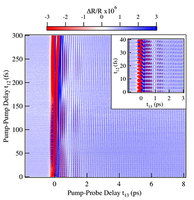
Ultrafast quantum-path interferometry by using a pair of relative-phase-locked femtosecond pulses is proposed to evaluate the contribution of each quantum path in an optical transition. The observed characteristic interference fringes (collapse and revival) reveal that the impulsive stimulated Raman scattering is dominant in the coherent-phonon generation in n-type GaAs even in an opaque condition. It is demonstrated that the optical dual-pulse pumping actively creates quantum mechanical superposition of the electronic and phononic states in a bulk solid.

High-harmonic generation in quantum spin systems

Shintaro Takayoshi, Yuta Murakami, and Philipp Werner

Phys. Rev. B 99, 184303 (2019) - Published 20 May, 2019

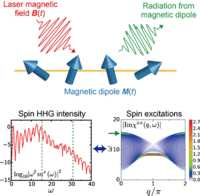
High-harmonic generation (HHG), a nonlinear response to strong laser driving, has been studied extensively for electron systems excited by the laser electric field. Here, the authors extend this concept to quantum spin systems driven by the laser magnetic field and propose a novel probe for the magnetic structure. The radiation emitted by time-dependent magnetic dipoles exhibits HHG spectra with plateau structures, whose cutoff energies correspond to the energy scale of the magnetic excitations. This maps out an exciting route for the implementation of HHG in solids. In addition, the similarities and the differences between HHG in electron and spin systems are also discussed.

Phonon dispersion in MoS2

Hans Tornatzky, Roland Gillen, Hiroshi Uchiyama, and Janina Maultzsch

Phys. Rev. B 99, 144309 (2019) - Published 24 April, 2019

The phonon dispersion is one of the most fundamental properties of a crystalline material. It determines virtually all of its physical properties, including optical, electronic, mechanical, and thermal behavior. Despite its importance, the phonon dispersion of MoS2 – one of the most investigated two-dimensional semiconductors – has not been determined experimentally in relevant parts of the Brillouin zone. In a combined experimental and theoretical approach, the authors present comprehensively the entire phonon dispersion of a MoS2 crystal and determine displacement patterns, symmetries, and scattering intensities.

Low-temperature infrared dielectric function of hyperbolic α-quartz

Christopher J. Winta, Martin Wolf, and Alexander Paarmann

Phys. Rev. B 99, 144308 (2019) - Published 22 April, 2019

Hyperbolic materials are attracting considerable interest in the nanophotonics community due to their ability to support highly directional, large-momentum states that can be utilized for, e.g., subdiffractional imaging or nanolithography. Here, the authors explore the infrared dielectric properties of α-quartz at low temperatures by performing infrared reflectivity measurements. The results imply remarkably high quality factors for polaritons in the pronounced hyperbolic spectral region of α-quartz as well as additional design opportunities for nanophotonic applications.

Instability of many-body localized systems as a phase transition in a nonstandard thermodynamic limit

Sarang Gopalakrishnan and David A. Huse

Phys. Rev. B 99, 134305 (2019) - Published 16 April, 2019

At the many-body localization transition, the dynamics of an isolated quantum system freezes out. In systems with long-range interactions (and possibly short-range systems in many spatial dimensions) this transition does not happen in the conventional thermodynamic limit: arbitrarily weak interactions prevent many-body localization. Here, the authors argue that even in these cases a sharp phase transition exists if one scales down the interaction strength with increasing system size in a specific nonstandard way.

Operator spreading in quantum maps

Sanjay Moudgalya, Trithep Devakul, C. W. von Keyserlingk, and S. L. Sondhi

Phys. Rev. B 99, 094312 (2019) - Published 27 March, 2019

The authors initiate the study of “operator spreading” in quantum maps on a torus, systems which do not have a tensor product Hilbert space or a notion of spatial locality. The evolution of functions on classical phase space and quantum operator evolutions are compared and contrasted using the perturbed Arnold cat map as an example. Dynamics of operators in quantum chaotic maps are characterized by distinct time scales that can be related to the quasienergy spectrum of the unitary via the spectral form factor.

Theory for time-resolved resonant inelastic x-ray scattering

Yuan Chen, Yao Wang, Chunjing Jia, Brian Moritz, Andrij M. Shvaika, James K. Freericks, and Thomas P. Devereaux

Phys. Rev. B 99, 104306 (2019) - Published 22 March, 2019

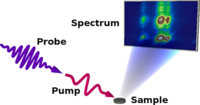
How do we map collective excitations with time, momentum, and energy resolution? Development of time-resolved resonant inelastic x-ray scattering (tr-RIXS) shows promise. Here, the authors present a theory for the tr-RIXS cross section, and as a proof of principle, they apply the theory to single-band models to elucidate the dynamics of particle-hole excitations. This work provides a crucial bridge for understanding how excitations from complicated phases manifest in time-resolved resonant scattering experiments.

General method for atomistic spin-lattice dynamics with first-principles accuracy

Johan Hellsvik, Danny Thonig, Klas Modin, Diana Iuşan, Anders Bergman, Olle Eriksson, Lars Bergqvist, and Anna Delin

Phys. Rev. B 99, 104302 (2019) - Published 15 March, 2019

Conservation of angular momentum implies that when a material changes its magnetic state, the resulting change in angular momentum must appear in some other form. In materials, the atomic magnetic moment and lattice degrees of freedom are coupled through the electronic subsystem. Here, the authors present a computationally efficient and general first-principles based method for spin-lattice simulations, opening the door for quantitative description and understanding of the microscopic origin of ultrafast demagnetization, magnetocalorics, and spincaloritronics.

Acoustic flat lensing using an indefinite medium

M. Dubois, J. Perchoux, A. L. Vanel, C. Tronche, Y. Achaoui, G. Dupont, K. Bertling, A. D. Rakić, T. Antonakakis, S. Enoch, R. Abdeddaim, R. V. Craster, and S. Guenneau

Phys. Rev. B 99, 100301(R) (2019) - Published 13 March, 2019

Acoustic flat lensing is experimentally confirmed, using optical feedback interferometry, for a phononic array of rigid spheres placed in air. The array behaves as an indefinite medium characterized by tensors whose principal elements have different signs, allowing for effects such as negative refraction and high impedance surface reflection. Here, this behavior is achieved in a narrow frequency region around 10.6 kHz, where the acoustic band displays a hidden singularity unveiled by an unusual path in the irreducible Brillouin zone.

Steady states of interacting Floquet insulators

Karthik I. Seetharam, Charles-Edouard Bardyn, Netanel H. Lindner, Mark S. Rudner, and Gil Refael

Phys. Rev. B 99, 014307 (2019) - Published 30 January, 2019

Floquet engineering offers exhilarating opportunities for controlling the dynamics of quantum many body systems and realizing new nonequilibrium phases of matter. However, generic interacting Floquet systems tend to heat up due to energy absorption from the drive, washing away the desired behavior. In this work, the authors characterize the steady states of an interacting electronic system, coupled to a phonon heat bath. They determine the regimes where the system-bath coupling stabilizes Floquet-insulator-like states, an important prerequisite for realizing topological states through Floquet engineering.

Observation of quadrupole transitions and edge mode topology in an LC circuit network

Marc Serra-Garcia, Roman Süsstrunk, and Sebastian D. Huber

Phys. Rev. B 99, 020304(R) (2019) - Published 15 January, 2019

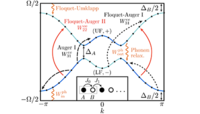
Higher-order topological insulators belong to a recently discovered class of materials where nontrivial topology results in boundary states with a dimensionality two or more below that of the bulk. This work realizes a higher-order topological insulator in a circuit model. By using nonlinear elements, the authors demonstrate dynamical switching between topological and trivial phases as well as controllable interactions between topologically protected states. The topological nature of the model is exhibited by direct extraction of the invariants from the measured boundary Green’s functions.

Probing the Berry curvature and Fermi arcs of a Weyl circuit

Yuehui Lu, Ningyuan Jia, Lin Su, Clai Owens, Gediminas Juzeliūnas, David I. Schuster, and Jonathan Simon

Phys. Rev. B 99, 020302(R) (2019) - Published 4 January, 2019

Topology has recently emerged as a powerful tool in condensed matter physics to engineer materials whose macroscopic properties are robust to imperfections. Indeed, rather than measuring the “topological invariants” associated with the band structure of a material, the existence of such invariants is often inferred from observations of disorder robustness. Here, the authors directly measure such a topological invariant by building a “topological circuit” that exhibits Weyl points, one of the paradigmatic topological features of 3d band structures. The exaggerated size of the unit cell in the circuit allows for measurement of the complete band structure and Berry curvature of the circuit’s bands, and thus a direct measurement of the chiral charge of Weyl points.

Irreversible dynamics in quantum many-body systems

Markus Schmitt and Stefan Kehrein

Phys. Rev. B 98, 180301(R) (2018) - Published 9 November, 2018

The concept of irreversibility is necessary to justify the statistical description of many-body systems. Here, the authors study the dynamics of observable echoes in quantum many-body systems occurring when the time-evolution is effectively inverted. For nonintegrable systems they find that small imperfections in the time-reversal procedure that alter the state of the system lead to exponentially decaying echoes. As the corresponding decay rate is largely independent of the strength of the perturbation, an intrinsic sensitivity to the perturbation is revealed. This implies irreversibility of the dynamics for all practical purposes, similar to the situation in chaotic classical systems.

Sign In to Your Journals Account

Filter

Section

Filter

Article Lookup

Enter a citation